
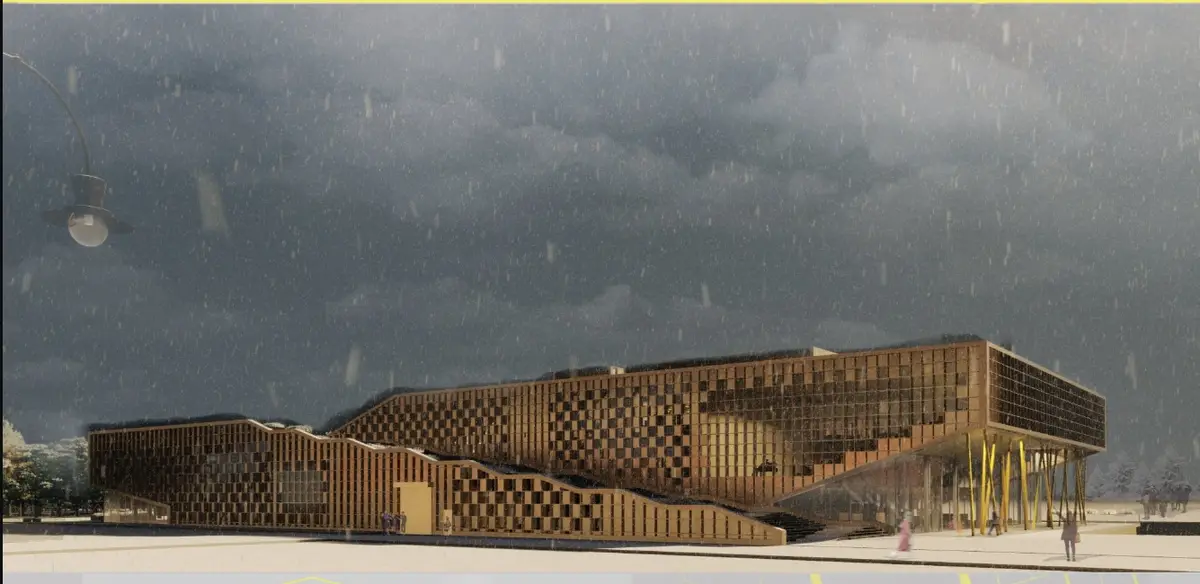
Re-Imagine: A School Without Classrooms, Organised Around a Transparent Workshop Core
Shortlisted in School Of Thought 2020, Re-Imagine replaces classrooms with stepped floors, open stairs and a transparent maker hub at its centre.


Remove the classroom and a school has to answer a harder question: where does learning actually happen? Re-Imagine answers it spatially. Learning happens on the stairs, in the workshop, on the stage and across the open floor plate, wherever students can see one another working. The project treats the classroom less as a room to redesign and more as an assumption to retire. In its place is a building where visibility, movement and making carry the teaching.
Designed by Elaheh Teimouri and Shahrzad Soltanieh, Re-Imagine was shortlisted in School Of Thought 2020. The designers push back against what they call the single-point information source, the model in which the teacher is the only channel of knowledge. Their alternative favours peer learning, collaborative workshops and hands-on experience. Fabrication labs, theatres, art studios and open gathering zones take over the floor area that enclosed classrooms would normally claim.
A Stepped Massing That Pulls Levels Into Conversation

The presentation board sets out the strategy in sequence. The massing diagrams show the volume being carved and terraced, the level one plan holds a football field and a courtyard within the school's territory, and an autumn render reveals the checkered facade wrapping the building. The key move is the setback of floors from Level 1 to Level 3. Each upper storey recedes from the one below, so the building opens towards its own interior rather than stacking sealed layers on top of each other.
This is where the collaborative ambition becomes architecture rather than a slogan. A student on the third level can look down onto activity below, and someone at ground level can read what is happening above. The design deliberately avoids hierarchy between floors. The terracing turns the section into a shared field of view, which matters for a school that relies on students learning from what their peers are doing.
Circulation as the School's Social Infrastructure


The lobby render shows the design's most legible gesture: stepped yellow seating rising from the floor, slanted yellow columns cutting across the space, and low sun pouring through the glazing as people pass through. The stair is also a place to sit. That double role recurs across the scheme, where large interior staircases, exterior ramps and open seating areas act as informal social zones for gathering and unplanned discussion. In a school without classrooms, these in-between spaces carry real programmatic weight, and the designers give them the colour and scale to match.
The sectional perspective explains how that works over the full height of the building. Stepped seating threads through the levels, a green roof caps the volume, and an accompanying programme diagram maps how activities are distributed. The section makes clear that movement is part of the curriculum here. Interior and exterior stairs knit the building together vertically and horizontally, so moving between activities also means passing through other people's work.
A Glass Workshop Core and a Stage at the Centre
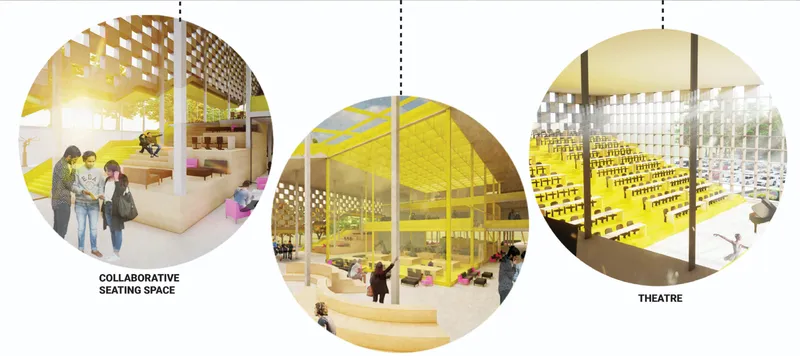

The three circular renders move through the building's spatial range: a collaborative seating area, a tall central atrium and a tiered theatre with a dancer beside a piano. Anchoring all of this is a large central glass box that houses the main workshops and maker spaces. As the visual and functional nucleus of the school, it keeps the act of making visible from several levels. Placing fabrication at the transparent heart of the plan, rather than in a back-of-house wing, is a clear statement about what the designers think education should prioritise.
The final view, looking down from the second floor onto a dance rehearsal on a yellow stage in warm backlight, captures the scheme's spirit. Performance takes place in the open, watched from the levels above, and the boundary between audience and participant stays loose. The image suggests that creative production, not passive information consumption, is meant to set the rhythm of the school day.
Why This Project Matters
Many proposals for future schools stop at flexible furniture or movable partitions. Re-Imagine is more structural in its thinking. The stepped section, the glass workshop core and the seating stairs all work toward a single goal: making learning visible and shared. Each element is simple, yet together they turn the building into an active participant in how students meet, watch and work alongside one another.
The proposal still leaves open questions, such as how acoustically demanding activities coexist in such an open plan and how quieter forms of study find refuge. Those are the right questions for a competition entry to raise. By committing fully to a school without classrooms, Teimouri and Soltanieh give educators and architects a clear spatial model to test, critique and build on.
View the Full Project
About the Designers
Designers: Elaheh Teimouri, Shahrzad Soltanieh
Enter a Design Competition on uni.xyz
uni.xyz runs architecture and design competitions year-round that reward proposals with spatial conviction and real site intelligence.
Project credits: Re-Imagine by Elaheh Teimouri, Shahrzad Soltanieh School Of Thought 2020 (uni.xyz).


Popular Articles
Popular articles from the community


LT2A and OPEN Architectes Thread a Brick and Glass High School Through a Wooded Belgian Campus
In Braine-l'Alleud, a 3,000 m² wing for Collège Cardinal Mercier pairs pale brick with a glazed colonnade, deferring to a small chapel and a dense wood.

U.GA Architects Wraps an Oval Rooftop Pool in Curved Board-Formed Concrete on Busan's Jeollidan-gil
In Busan's Jeonpo-dong, a 454 m² mixed-use block stacks a neighborhood facility, guest rooms and an oval rooftop pool inside spiraling concrete walls.

GROUP A Strips a 1969 Rotterdam Harbor Headquarters to Its Frame and Wraps It in Timber Louvers
In Rotterdam's M4H harbor district, Ferro Offices reuses a 1969 frame, adds one timber storey and reaches BREEAM-NL Outstanding.

longwave studio Reorganizes a 112 m² Tainan Apartment Around the Daily Routines of a Family and Two Cats
In Tainan, Taiwan, birch plywood, rust-red furniture and a freestanding plaster wall link arrival, storage, work and family life in one apartment.

Similar Reads
You might also enjoy these articles
Healing Façade: A Modular Chapel System That Restores Ethiopia's Sacred Forests
Winner of the Eco-Chapel competition, this circular timber façade collects water from air to rebuild soil and reforest degraded Ethiopian landscapes.
Kaffeebühnen: Where Coffee Shop Architecture Becomes a Civic Stage in Vienna
A linear sequence of timber boxes, transparent shells, and open yards turns the Viennese café tradition into a public performance space.
Eco Chapel: A Modular Forest Pavilion That Grows Like the Landscape It Protects
Hexagonal timber modules weave through existing trees, turning a chapel into a living system for prayer, education, and reforestation.


Urban Forest: A Vertical Ecosystem for 5,000 Workers in Singapore's Changi Business Park
Radially stacked pods and layered green decks turn a 7-acre plot into 47 acres of ecological workspace projected for 2040.

Explore Reimagining Competitions
Discover active competitions in this discipline

Challenge to design public laboratory

Challenge to reimagine the Iron Throne

Photograph architecture without architects

Illustrate the lost glory of Angkor Wat - Render Challenge
Comments (0)
Please login or sign up to add comments
No comments yet. Be the first to comment!