
Re-Utility journal
A look into our group's process

REPURPOSING STEEL GRAIN BINS
CITYZEN AGENCY AT OSAGE CITY, KANSAS - USA

All infrastructure has a useful life and you will be surprise with the reinvention
and repurposing story. It is the beauty and the authenticity of being “perfection
in the imperfection”
Site:
The United States is a major exporter of food and the agriculture sector contributes
heavily to the economy of the country. There are vast stretches of farmlands in every state and assistance from technology has enabled urban farming as well. Kansas is a
well-established state in regards to the agriculture and manufacturing industry.
The site is located in Osage City, Kansas. It consists of huge farming lands and agricultural
practice is widespread. The majority of the city's farmlands have been using steel
grain bins for storage. The reputation of the agricultural state of Kansas extends to the city as it is benefitted by subtropical climate and plain, flatlands that are ideal for farming.
The site is just outside the dense settlement area of the city. It can be accessed by Lakin street surrounded by vast green stretches of land. This site will be suitable for this typology due to its connection to farming and holding a prime location in Kansas.
Site area = 658 sq.m
Height restriction = 9 metres
Maximum Built-up Area = 329 sq.m
Ground coverage = 20%
Setbacks (as per CAD plan)
Coordinates = 38°38'12.1"N 95°49'26.4"W
Our journey here as Cityzen Agency- we are team of four from the studio of The Ethical Activist Environment focusing on ADAPTIVE RE-USE of steel grain bins. We have spent a number of weeks collaborating on this project.

Above: Olivia and Jade

Above: Olivia, Emmanuel and Oran

Above: meeting in progress
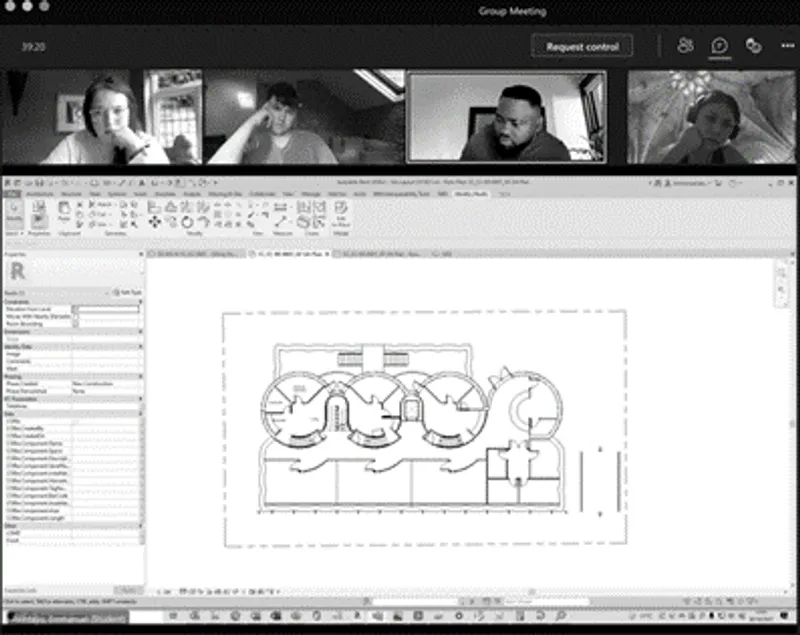
Above: collaborative design progress
Using the grain bins to find a new purpose - We would like to give these large pieces of equipment a new life. Each grain bin is 21 feet in diameter, 5.59/7.6 OHT(weight: 160 Metric tonnes without air floor)
We are using 12 grain bins – (each 21feet diameter) to create space that can be used by the members of a farming community to lodge their trainees, visiting the farm for training. Taking into consideration its various limitations, grain bins are huge entities built crudely.
Our strategy in urban architecture is also taking full consideration of the sociocultural, economic and environmental settings of context. The compact space will be serviced with modular elements. It is safe and accommodating to all users designing with great ventilation, and eco-friendly materials such as rammed earth as external wall; and recycled wood as interior millwork. The reuse project is designed with minimal resources and waste to achieve functional output.
Our Method:
We are expressing methods of investigation by gathering bins and site information.
In the meantime, we have also been communicating with local people in
Kansas City. While engaging with people, we developed thoughts and understanding
of the possibilities of adaptive re-use architecture in Kansas.
Methodology:
In the preliminary conceptual development, our team brainstormed our ideas by studying
time, space and movement of urbanism architecture by sketches. Reacting to material
selection and technological solution by understanding the impact of context and material flow strategy.
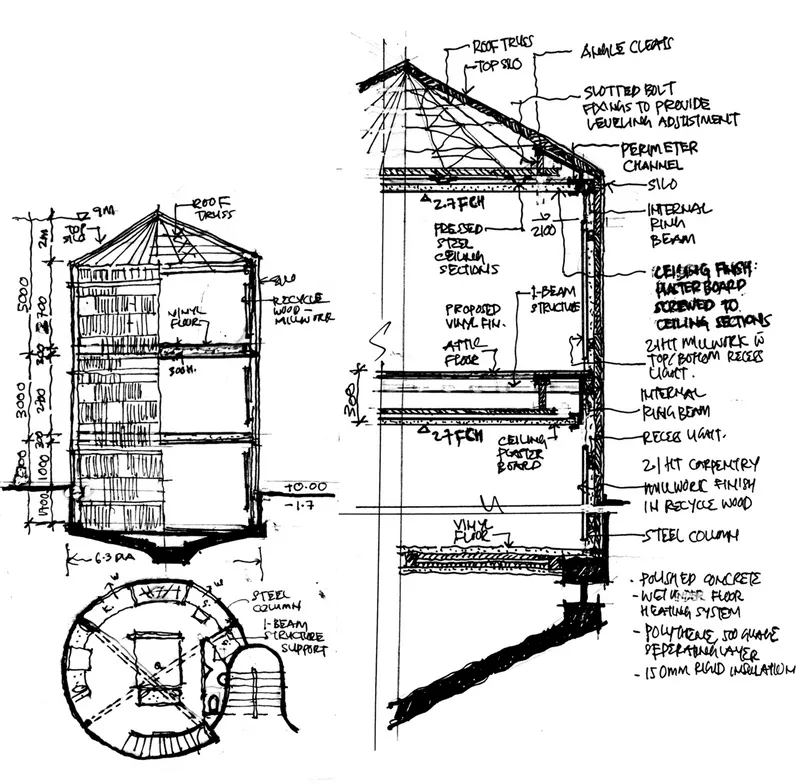
BIN SECTION JOURNAL SKETCH:
This sketch denotes our initial ideas of how the grain bins would work as accommodation with floors added in to create accommodation.
SITE JOURNAL PROGRESS SKETCH:
We then documented the processes involved in creating the building. As we are using this site as an opportunity for teaching, we wanted to ensure that the processes were as simple as possible so those without much construction experience could still get involved.

CONCEPTUAL JOURNAL PROGRESS SKETCH:
The following sketchbook entries also show our progress through different designs.


Popular Articles
Popular articles from the community


The Amber Palace Opera: A Geological Fiction Surfaces on Tallinn's Baltic Waterfront
Pierre Brillard reimagines a Baltic legend as a public landscape, opera house, and waterfront promenade rooted in Tallinn's coastal identity.

Manzana Morphosis: Stretching Barcelona's Grid into a Living Landscape for 2050
A radical reworking of the Eixample manzana turns density into a tool for generous public space, vertical ecology, and environmental performance.

Cloaked Colonization: A Mobile Underwater Habitat That Moves Like a Fish
Micah Abaya's shortlisted EHC Pacific entry reimagines ocean settlement as a dispersed network of self-sustaining architectural organisms.

Singing Woman: An Opera House That Performs Before the Curtain Rises
Ovidiu Cristian Pavel's conceptual opera house translates Estonia's choral identity into a sculpted waterfront landmark facing the Baltic Sea.

Similar Reads
You might also enjoy these articles

Shakur's House: Exposed Brick as an Interior Organiser in a 168 m² Mashhad Residence
Brick moves indoors in this Mashhad residence, where masonry walls, glass partitions and teal planes sequence a compact home without closing it off.

Day and Night Park: A Time-Based Urban Newsstand in Beijing
A temporary urban newsstand in Beijing blending travel, light, and reading through poetic colors, compact form, and community-focused design.

Modernist Patio Renovation in El Masnou, Barcelona by Oliver Segura Arquitectura + Cebrià Arquitectura
Modernist patio renovation blending tradition and innovation with a movable pool, leveled floors, and Catalan materials in El Masnou.

Alto Residencial Coop: Cooperative Housing Development in Santiago de Compostela by Carbajo Barrios Arquitectos
A linear cooperative housing complex blending white volumes and perforated metal façades, enhancing community living, natural light, privacy, and urban integration.


Comments (0)
Please login or sign up to add comments
No comments yet. Be the first to comment!