

Compact Houseive: Turning a Kuala Lumpur Shoplot into a Multi-Generational Vertical Home
An abandoned shoplot on Jalan Tuanku Abdul Rahman becomes a split-level family dwelling that stacks private retreats, shared living, and a ground-floor bus


Kuala Lumpur has no shortage of abandoned shoplots. What it lacks is a convincing model for turning them into housing that serves real families, not just investors. Compact Houseive offers exactly that: a six-person, multi-generational vertical home carved into a disused commercial shell on Jalan Tuanku Abdul Rahman, one of the city's most connected corridors. The proposal keeps the ground floor active with a small business outlet, stacks domestic life across split-levels above, and uses perforated facades, open stairwells, and a rooftop garden to make a narrow tropical footprint feel generous.
Designed by Gary Yeow and Vikkie Lee, the project is rooted in adaptive reuse: conserve the embedded energy of an existing structure, minimize construction waste, and prove that compact urban housing can accommodate wildly different daily routines under one roof. The family it serves ranges from a quiet coffee-shop-owner grandfather and an active, sporty father to digitally inclined teenagers and a nurturing mother. The architecture treats that diversity as a design driver, not a constraint.
A Strategic Site at the Intersection of Commerce, Culture, and Transit
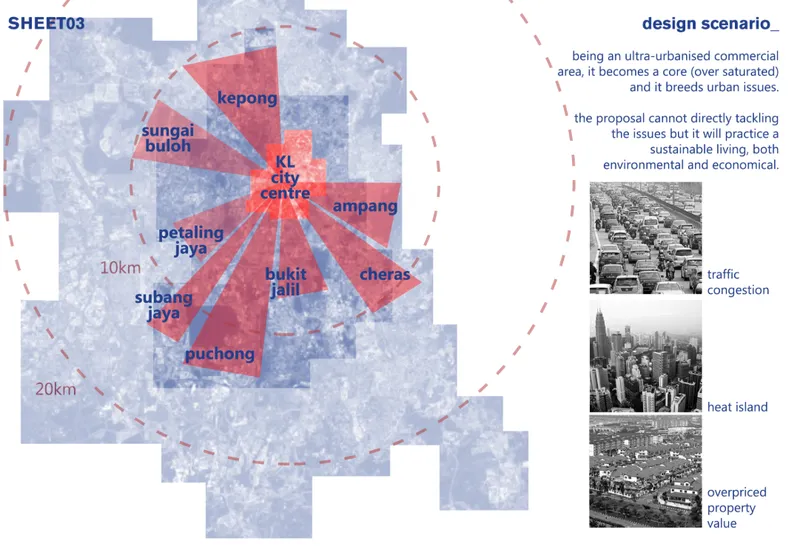
The urban plan diagram radiates outward from the site on Jalan Tuanku Abdul Rahman, mapping tourism hubs, commerce districts, and cultural landmarks in layered red and blue zones. The location is not accidental. Situating a family home here means daily life overlaps with the city's economic and cultural pulse, reducing commute dependence and keeping money circulating locally. The ground-floor business outlet reinforces that logic: mixed-use zoning that integrates housing with micro-economies, so the building contributes to the street rather than turning its back on it.
Street-Level Activation and Vertical Programme Stacking
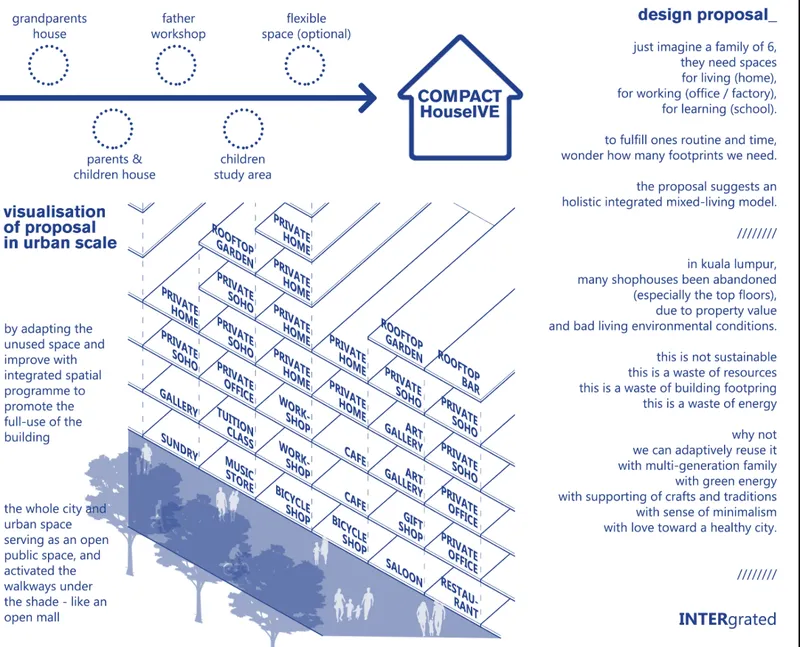
The axonometric diagram breaks down the multi-story block into labeled programme zones along a public walkway. Commercial activity occupies the ground plane, drawing foot traffic and maintaining the shopfront character of the original building. Above, domestic spaces are vertically stacked in a sequence calibrated to privacy gradients: communal living closer to the ground, private bedrooms and retreats further up. Compact vertical circulation, primarily open stairwells, connects the levels without consuming precious floor area.
Inspired by Le Corbusier's advocacy for new urban typologies, Yeow and Lee push the idea that city residents should live, work, and play within the core rather than escaping to suburban sprawl. The hybrid live-work model embedded in this shoplot is their response: a building that is simultaneously a home, a place of business, and a small piece of urban infrastructure.
Split-Levels That Breathe: Cross Ventilation and Visual Connection
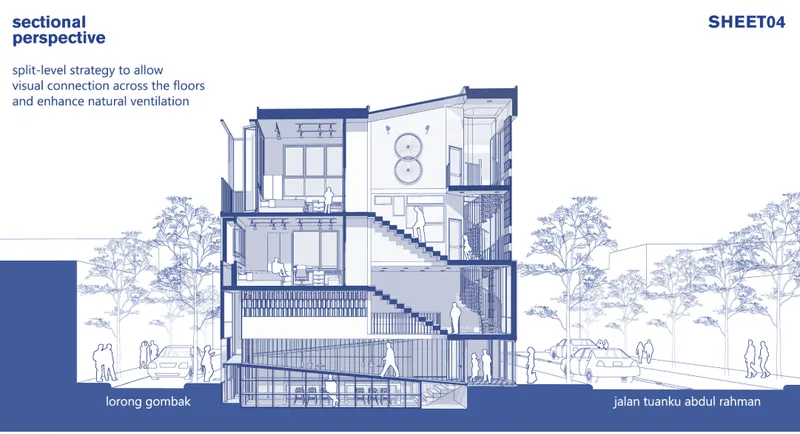
The sectional perspective is where the design's intelligence becomes most legible. Split-levels create half-floor offsets that allow sightlines between areas, so a parent cooking on one level can see children studying on another. These visual connections reinforce family unity without collapsing everyone into a single open plan. Malaysia's tropical climate demands serious attention to airflow, and the section reveals the strategy: perforated facades pull cross ventilation through the building's narrow depth, while skylights draw hot air upward and out.
Materials are regionally sourced and thermally appropriate. Timber shutters modulate light and privacy on the facade. Steel rod screens filter glare without blocking breeze. Blockwork provides thermal mass to stabilize interior temperatures. At the top, a rooftop garden extends the livable envelope and gives the family a communal outdoor retreat, a luxury in a dense urban setting where ground-level open space is nonexistent.
Anatomy of a Narrow Plot: Floor Plans and Exploded Assembly
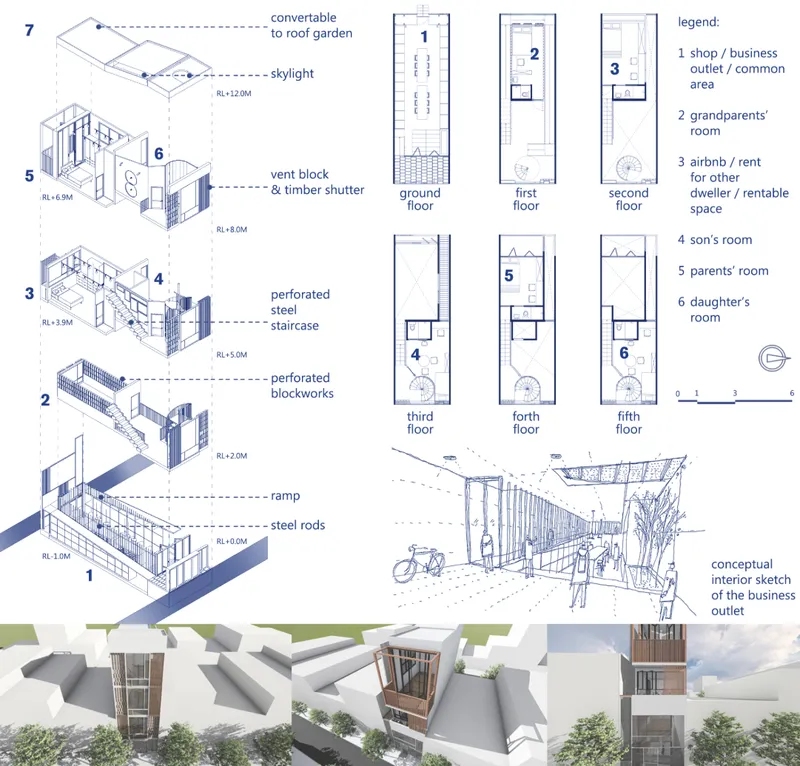
The exploded axonometric and floor plan drawings dissect the building layer by layer, revealing how much programme fits into a genuinely narrow footprint. Each floor is tailored to a specific overlap of function and user. The modular layout is designed to adapt as the family structure changes over time: a teenager's room can become a study, a grandparent's suite can absorb adjacent space. Cost-effective building techniques, including recycled and local materials, keep the project within reach of families who actually need it, not just those who can afford bespoke architecture.
What stands out is the discipline of the plan. Every square meter is accounted for, yet the drawings never feel claustrophobic. Stairwells double as light wells. Walls stop short of ceilings to let air pass. Storage is embedded into structure. The result is a compact vertical home that reads as spatially richer than its dimensions suggest.
Why This Project Matters
Compact Houseive confronts a question that most Southeast Asian cities are avoiding: what happens to all the abandoned commercial stock in historic corridors when retail patterns shift? Demolition wastes embodied energy and erases streetscape character. Leaving them empty drains neighborhood vitality. Adaptive reuse into multi-generational housing is a third path, and Yeow and Lee's proposal makes a strong case that it works spatially, socially, and economically.
The broader value lies in the typological argument. By proving that a single narrow shoplot can house six people across three generations, support a small business, achieve passive comfort through regionally sourced materials, and adapt to future change, the project offers a replicable model. It does not require extraordinary budgets or imported technology. It requires careful sectional thinking, honest material choices, and the conviction that dense city living can be humane. That is a proposition worth taking seriously.
View the Full Project
About the Designers
Designers: Gary Yeow, Vikkie Lee
Enter a Design Competition on uni.xyz
uni.xyz runs architecture and design competitions year-round that reward proposals with spatial conviction and real site intelligence.
Project credits: Compact Houseive by Gary Yeow, Vikkie Lee.


Popular Articles
Popular articles from the community


Juan García Correa, John González and Claudia Rueda Sink a Circular Amphitheater into a Manizales Engineering Building
On the La Nubia campus in Manizales, Colombia, the S1 Building folds labs and offices into a hillside of ramped lawns that double as a campus route.

longwave studio Reorganizes a 112 m² Tainan Apartment Around the Daily Routines of a Family and Two Cats
In Tainan, Taiwan, birch plywood, rust-red furniture and a freestanding plaster wall link arrival, storage, work and family life in one apartment.

David Macias Steps a Doorless Stone and Plaster House Down a Tropical Colombian Hillside
In the humid hills of Colombia, Threshold House replaces the front door with an open void and terraces its 850 m² down the slope instead of fighting it.

LT2A and OPEN Architectes Thread a Brick and Glass High School Through a Wooded Belgian Campus
In Braine-l'Alleud, a 3,000 m² wing for Collège Cardinal Mercier pairs pale brick with a glazed colonnade, deferring to a small chapel and a dense wood.

Similar Reads
You might also enjoy these articles


Vereda Arquitetos Renovates a 40-Square-Meter Apartment Inside Niemeyer's Copan Building
A compact unit in São Paulo's most iconic residential tower gets a material overhaul that pairs exposed concrete with bold blue Formica.

Shakur's House: Exposed Brick as an Interior Organiser in a 168 m² Mashhad Residence
Brick moves indoors in this Mashhad residence, where masonry walls, glass partitions and teal planes sequence a compact home without closing it off.

Day and Night Park: A Time-Based Urban Newsstand in Beijing
A temporary urban newsstand in Beijing blending travel, light, and reading through poetic colors, compact form, and community-focused design.

Modernist Patio Renovation in El Masnou, Barcelona by Oliver Segura Arquitectura + Cebrià Arquitectura
Modernist patio renovation blending tradition and innovation with a movable pool, leveled floors, and Catalan materials in El Masnou.

Explore Urban Dweller Competitions
Discover active competitions in this discipline

Challenge to design a portable theatre

Challenge to design a portable music platform

Challenge to design an open learning module for the elderly

Render competition to represent the city as a machine
Comments (0)
Please login or sign up to add comments
No comments yet. Be the first to comment!