
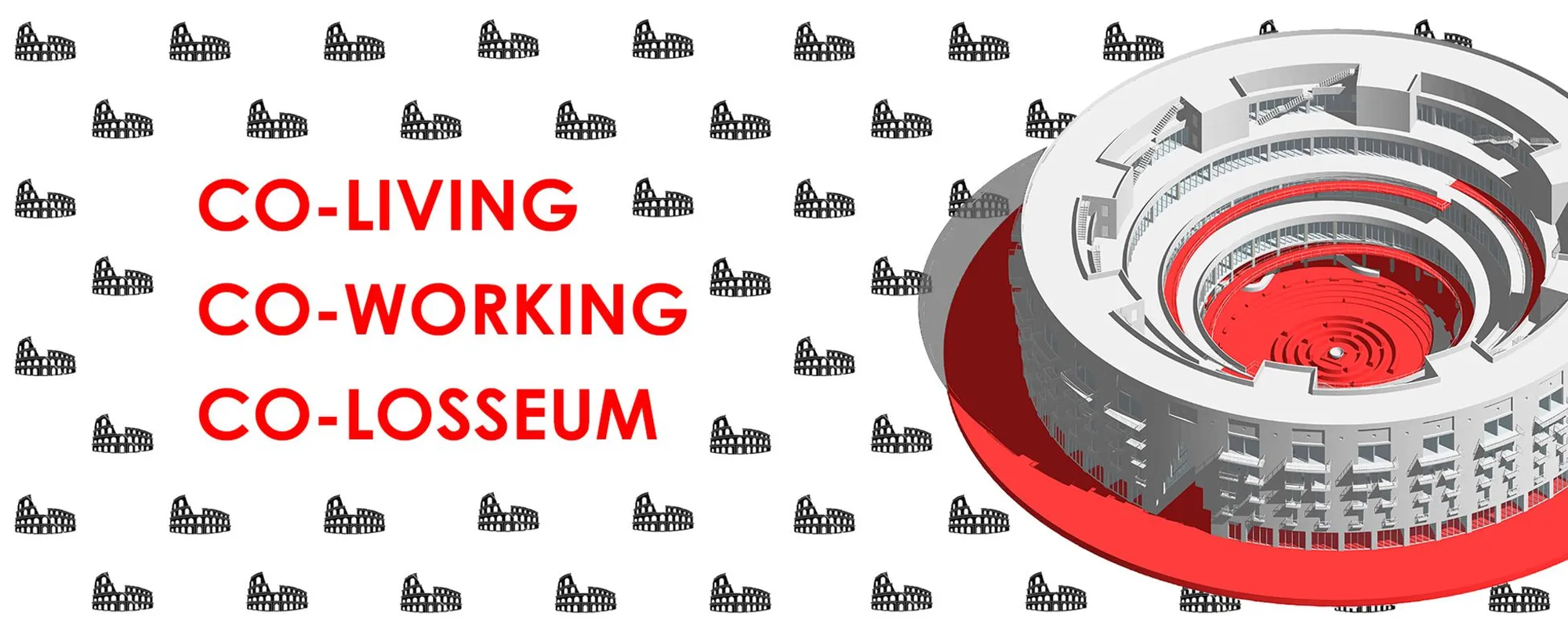
Co-losseum: A Circular Arena You Live In
A circular co-living building in Moscow with an open-air arena at its centre, where the geometry enforces equality and daily life is the spectacle.


The Colosseum was not a house. It was a public spectacle: an arena where the entire city gathered to watch, cheer, and be together. Co-losseum, a co-living project by Anna Krylova, Denis Nemukhin, and Aleksei Ustinov, borrows the form and inverts the function. It is a circular residential building with an open-air arena at its centre, where the spectacle is not performance but daily life.
Shortlisted in the Hustle Hub '19 competition on uni.xyz, the project is sited near the Moscow Central Circle (MCC) on an underutilised industrial zone. The circular plan, the red arena, and the superposition of residential levels make it one of the most formally memorable entries in the series.
The Arena: Community at the Centre
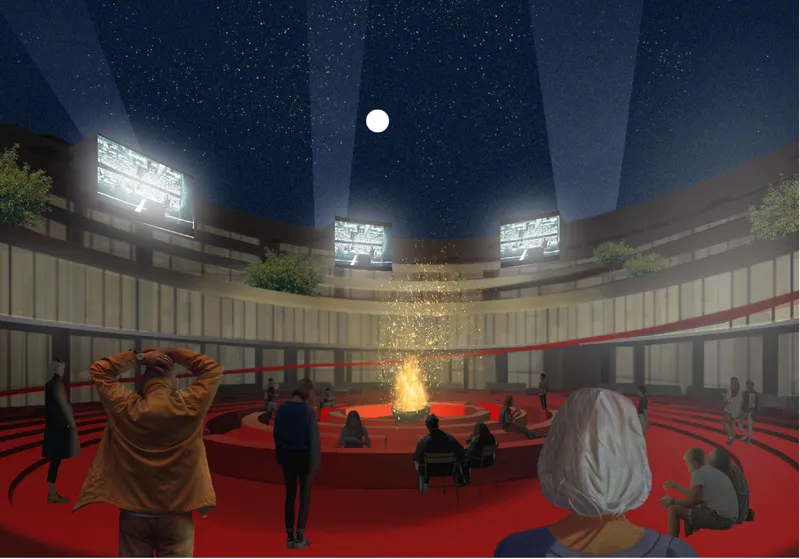
The night render is the project's most powerful image. Concentric red seating tiers descend toward a central fire or light installation. Projection screens hover above. The moon is visible through the open roof. Residents gather, sit, watch. The arena is the building's living room, shared by everyone, open to the sky.
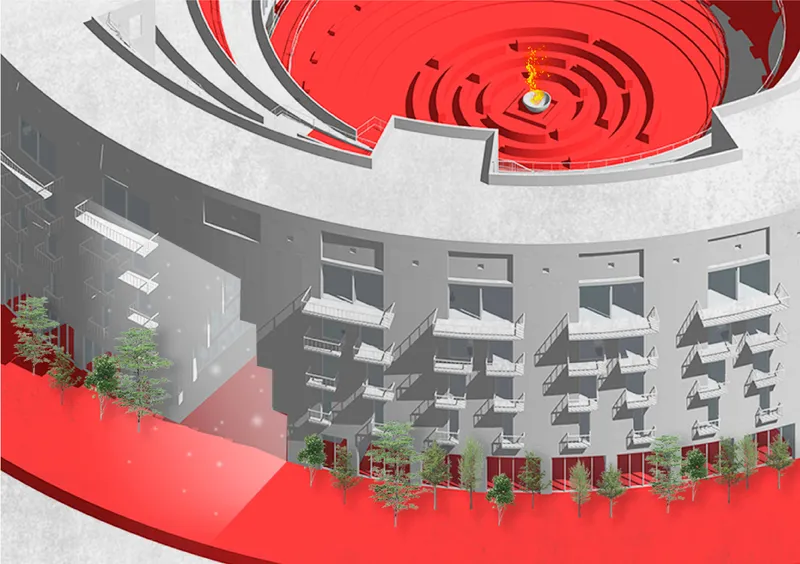
The cutaway confirms how this works architecturally. The circular building wraps around the arena. A red spiral ramp connects all levels. Apartments face inward, their balconies overlooking the central void. Trees grow at the base. The building is an amphitheatre that you live in. The arena is not an event space added to a housing block. It is the reason the housing block exists.
The Shared Spaces: Library and Lounge
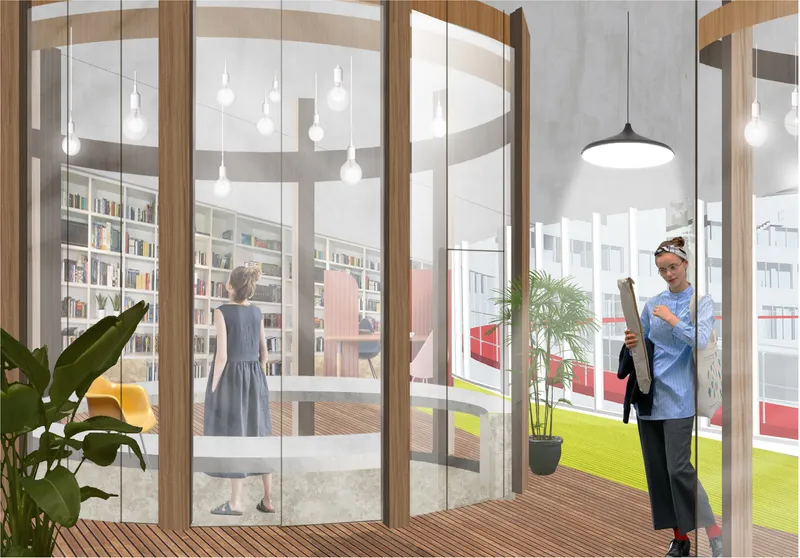
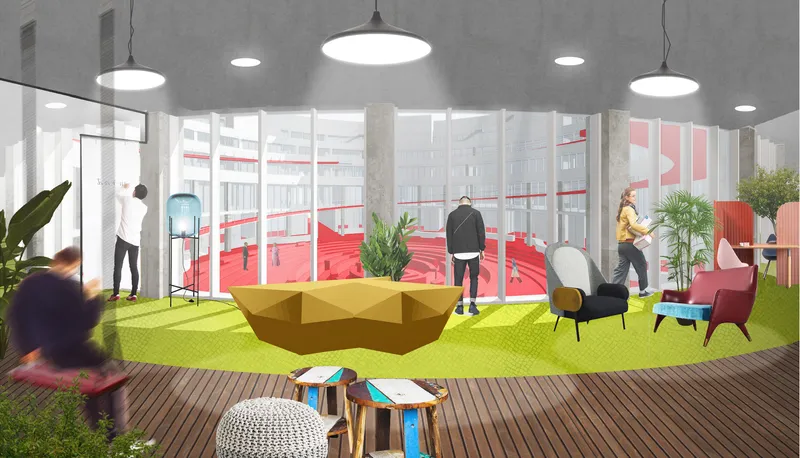
The interior renders show the communal programme that wraps the arena. A curved glass library pod contains floor-to-ceiling bookshelves, timber columns, and pendant lights. A resident carries a portfolio tube, signalling that this is a working library, not a decorative one. Next to it, a communal lounge with green carpet, colourful furniture, and a faceted gold coffee table overlooks the red arena through a curved glass wall.
These shared spaces are positioned where every resident passes them: along the circular corridor that rings the arena. You cannot go home without seeing the library. You cannot leave without passing the lounge. The circulation is the social programme. This is the same logic as the Social Core project from the same competition, but applied to a circular plan where the path is infinite.
The Units: Capsule to Apartment
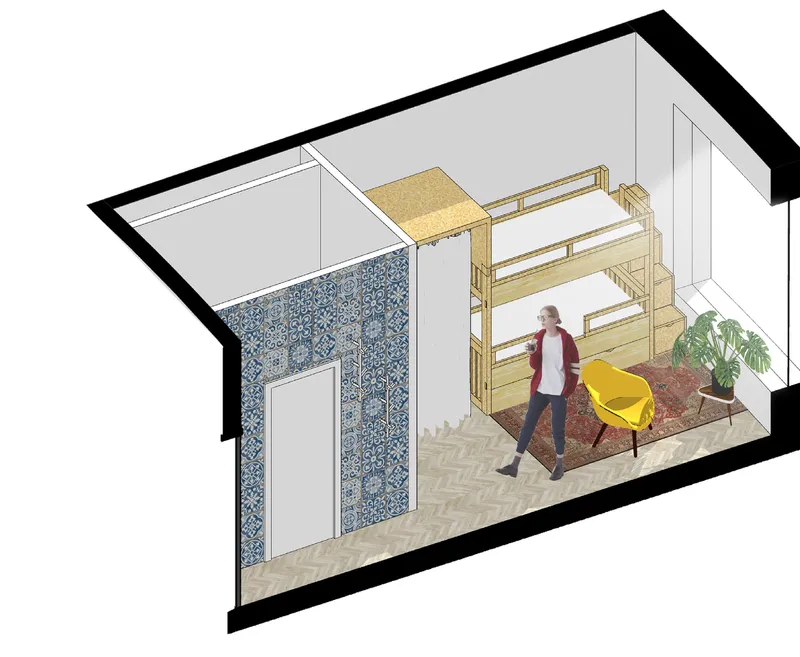
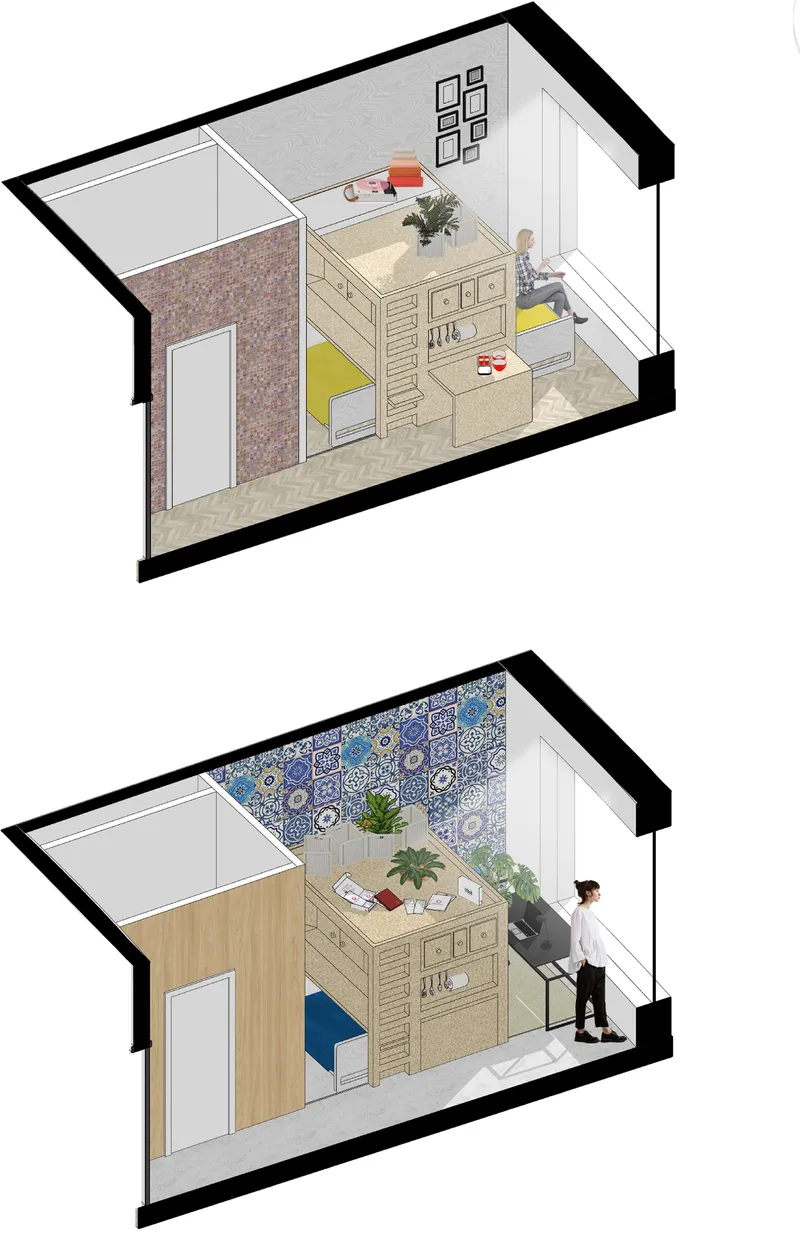
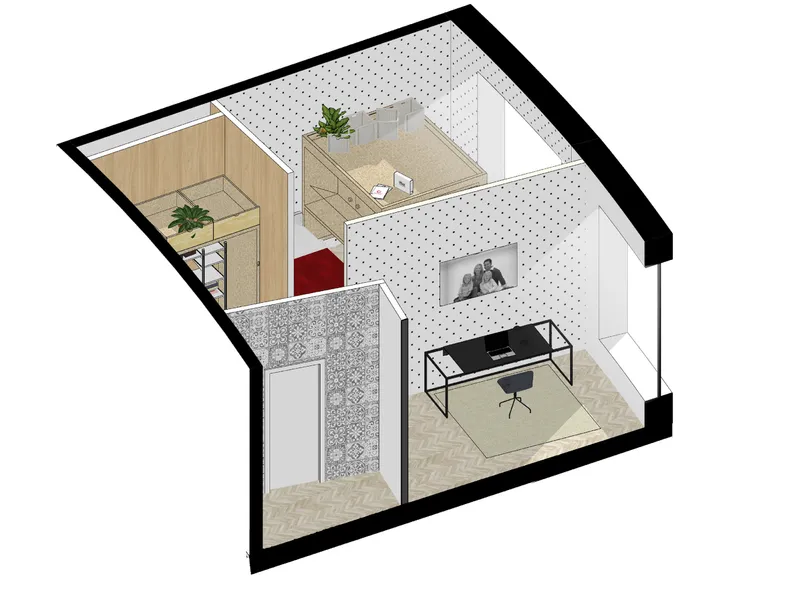
The unit axonometrics show three scales of living. The capsule is the smallest: a loft bed, a blue tiled bathroom, a yellow armchair, and a herringbone floor in a room no larger than a hotel cabin. The studio adds a built-in desk and shelving. The co-working unit has a standing desk and a blue tile accent wall. The apartment is the largest: a separate bedroom, a living/work area, a patterned tile bathroom, and clerestory windows.
The variety is the point. Capsule residents pay the least and use the shared spaces the most. Apartment residents pay more and have everything they need inside. The building serves both without forcing either to compromise. This gradient from minimal private space (maximum shared use) to generous private space (occasional shared use) is the economic engine that makes co-living viable.
Why This Project Matters
The Hustle Hub competition produced co-living entries that were rectangular, terraced, organic, and digital. Co-losseum is the only one that is circular, and the circle changes everything. The circulation is continuous. Every unit faces the centre. The arena is equidistant from every front door. No resident is closer to the shared space than any other. The geometry enforces equality.
For anyone studying co-living typologies, the lesson is that plan geometry is not neutral. A rectangle produces corridors and hierarchy. A circle produces a loop and equality. The Co-losseum demonstrates that choosing the right geometry can solve the social problem before the programme even starts.
View the Full Project
About the Designers
Designers: Anna Krylova, Denis Nemukhin, Aleksei Ustinov
Enter a Design Competition on uni.xyz
If circular typologies, arena-centred housing, or the relationship between geometry and community is the kind of thinking you want to explore, uni.xyz runs competitions year-round that reward formally inventive co-living proposals.
Project credits: Co-losseum by Anna Krylova, Denis Nemukhin, Aleksei Ustinov. Shortlisted, Hustle Hub '19 (uni.xyz).



Popular Articles
Popular articles from the community


Conexión: Biophilic Design Reimagines High-Rise Living in Hong Kong
Conexión reimagines high-rise living in Hong Kong through biophilic design, green facades, shared spaces, daylight, water and nature within.

The Ocean Hive: Sustainable Architecture for a Self-Sufficient Civilization at Sea
The Ocean Hive imagines sustainable architecture at sea, where modular habitats, algae, wave power and ocean waste sustain a growing colony.

The Earth Pod: 3D Printed Homes for Resilient Refugee Communities
The Earth Pod reimagines refugee housing through 3D printed homes made from clay, combining resilience, self-sufficiency, and rapid shelter.

The Musturak Paradise: Senior Living Architecture for a Connected Future in Temara, Morocco
The Musturak Paradise reimagines senior living architecture in Temara via private homes, social spaces, culture, community, and shared care.

Similar Reads
You might also enjoy these articles

Day and Night Park: A Time-Based Urban Newsstand in Beijing
A temporary urban newsstand in Beijing blending travel, light, and reading through poetic colors, compact form, and community-focused design.

Modernist Patio Renovation in El Masnou, Barcelona by Oliver Segura Arquitectura + Cebrià Arquitectura
Modernist patio renovation blending tradition and innovation with a movable pool, leveled floors, and Catalan materials in El Masnou.

Alto Residencial Coop: Cooperative Housing Development in Santiago de Compostela by Carbajo Barrios Arquitectos
A linear cooperative housing complex blending white volumes and perforated metal façades, enhancing community living, natural light, privacy, and urban integration.

Vil Genis School by BPA ARCHITECTURE – Massy, France
Vil Genis School in Massy, France, features sustainable design, south-facing classrooms, community integration, accessible spaces, and modern educational architecture.




Comments (0)
Please login or sign up to add comments
No comments yet. Be the first to comment!