
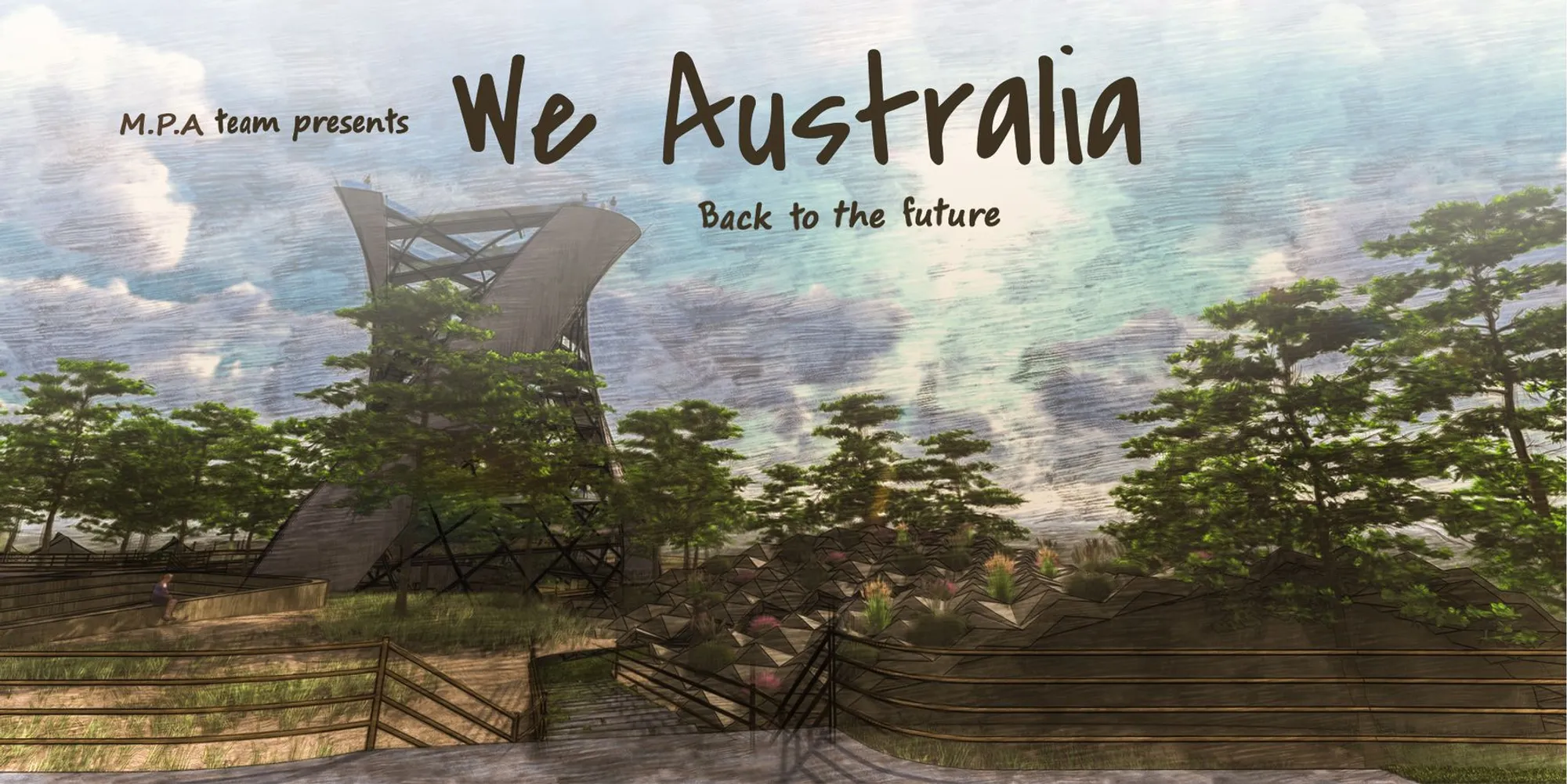
Back to the Future: Boomerang Geometries and Indigenous Narratives in Kakadu
A shortlisted proposal for Kakadu National Park weaves numbered wayfinding paths through pavilions inspired by hunting boomerangs and ancient triangular sy


What happens when architecture refuses to define a national identity and instead offers a lens through which visitors discover it for themselves? In the forests and waterways of Kakadu National Park, a constellation of timber pavilions, amphitheaters, and observation towers emerges from the landscape rather than landing on it. The design draws its formal vocabulary from three Indigenous Australian archetypes: the native shelter, the hunting boomerang, and ancient triangular symbols. These are not decorative references. They generate the plan geometries, the roof profiles, and the numbered wayfinding system that turns a walk through the site into a layered act of storytelling.
Titled "We Australia, back to the future," the project is a shortlisted entry in the We Australia competition. It was developed by Shamim Dabiri, Mounes Sherafati, Saba Saboori, and Amir Hossein Rezaei. Their central provocation is pointed: how can architecture preserve Kakadu's ecological and spiritual sanctity while still enabling meaningful human interaction? The answer lies in a programme that scatters workshops, performance venues, quiet zones, and cultural courtyards across the riverside terrain, threaded together by site-specific narratives visitors physically walk through.
Pavilions Scattered Like Seeds Along the Waterfront
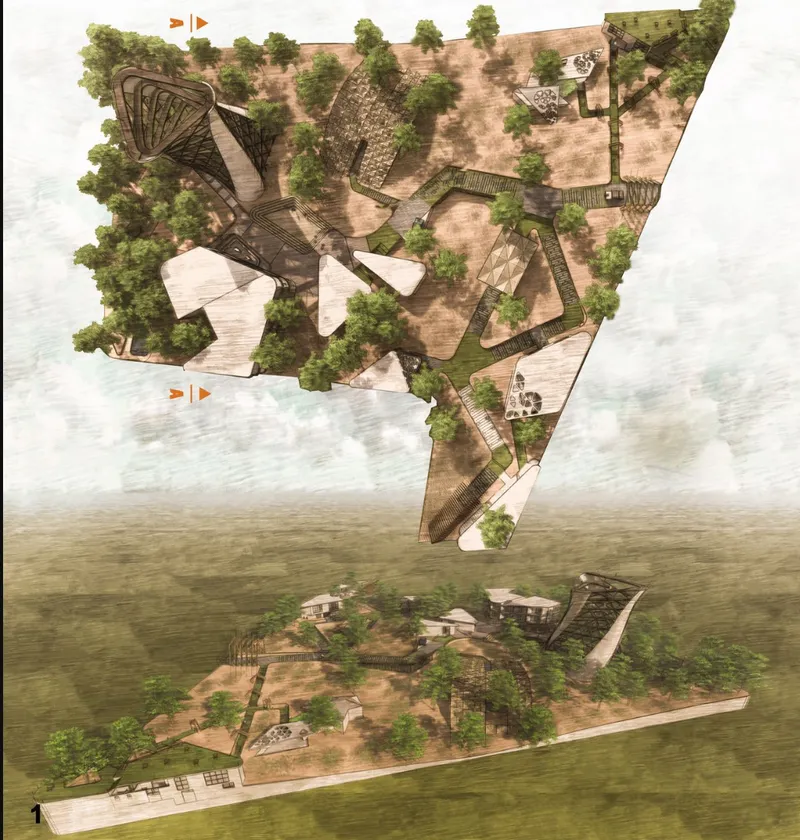
The axonometric drawing reveals the project's most important move: nothing is monolithic. Pavilions, planted areas, and timber decks are dispersed among existing trees along a waterfront edge, reading less like a building complex and more like a cultivated clearing. Each structure sits lightly on the ground, its triangular or curvilinear footprint echoing the boomerang and shelter forms that anchor the design language. The spaces between buildings matter as much as the buildings themselves, with gaps calibrated to frame views of the river and the forest canopy beyond.
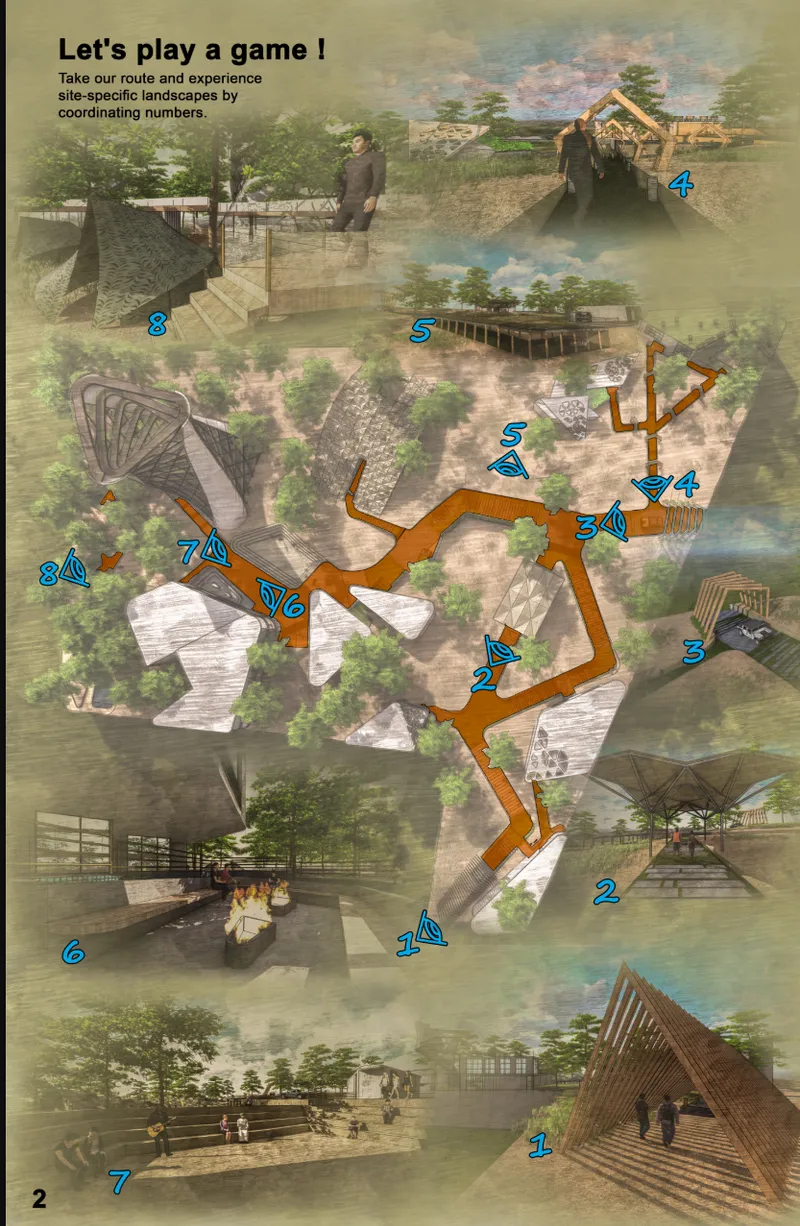
The illustrated site plan adds a critical layer: a numbered wayfinding route, labeled "Let's Play a Game," overlaid on aerial views of the pavilions and landscaping. Visitors follow numbered paths that coordinate spatial experiences into a sequential narrative. Rather than wandering aimlessly, they are guided from a theater embedded in the forest to a canopy overlook to a quiet resting node in a cultural courtyard. Exploration becomes storytelling, and the site itself becomes what the designers call a teaching tool.
A Timber Deck Plaza Under a Broken Canopy
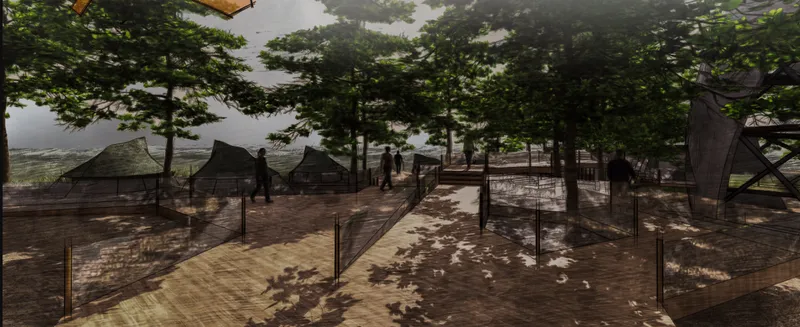
At ground level, the panoramic render makes the tectonic strategy legible. Timber deck surfaces extend horizontally beneath pavilion roofs, with glass railings defining edges without blocking sightlines. Scattered trees puncture the plaza, reinforcing the principle that the built form defers to the existing ecology. Gentle curves in the deck geometry and the textured surfaces of the roof structures produce shadowplay that shifts through the day, mimicking the organic forms of the surrounding landscape. The effect is less like arriving at a destination and more like passing through a clearing that happens to have a programme.
A Latticed Tower Rising Above the River Forest
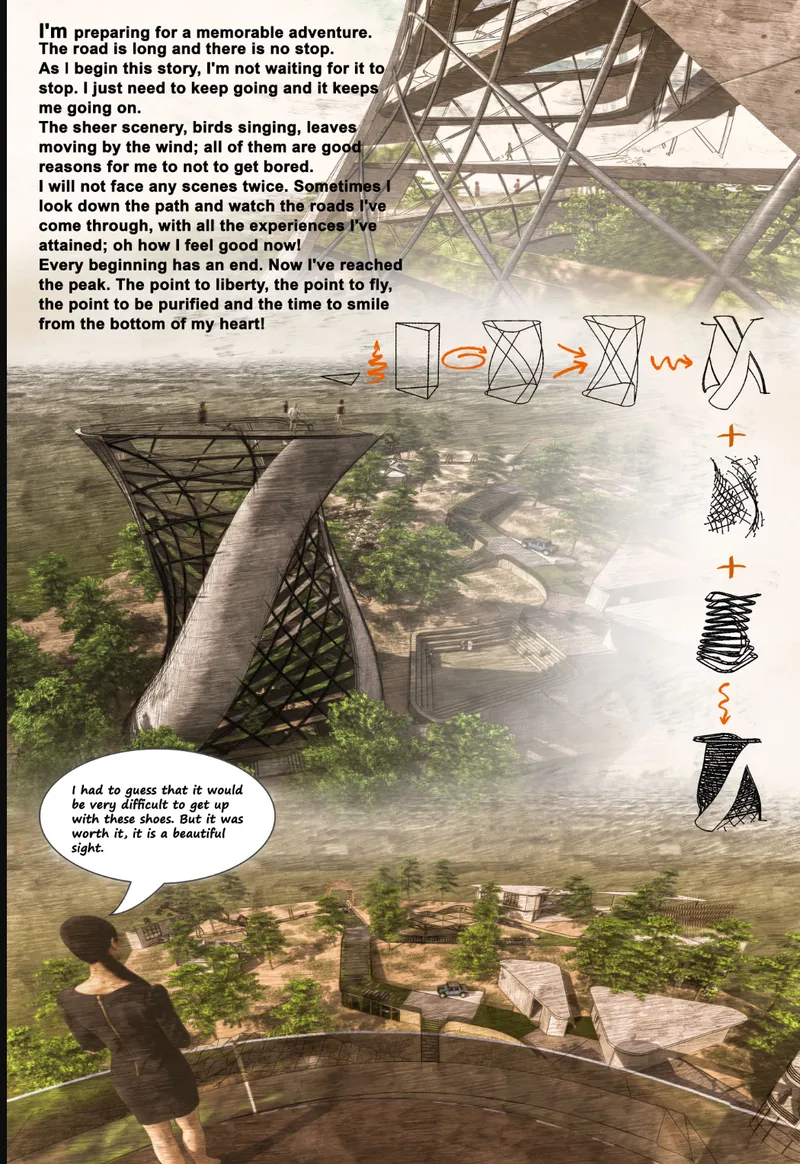
The most vertical element in the scheme is a latticed observation tower that rises above the forest canopy along the riverside. Seen in aerial perspective, its open structural framework allows wind and light to pass through, avoiding the visual weight of a solid mass against the tree line. The tower serves a dual purpose: it is a practical lookout offering panoramic views of Kakadu's terrain, and it is a symbolic marker, signaling the presence of the cultural precinct without dominating the horizon. The lattice pattern itself appears to reference the triangular geometries found elsewhere in the project, maintaining formal coherence across scales.
Pyramidal Steps and Reflecting Pools as Gathering Space
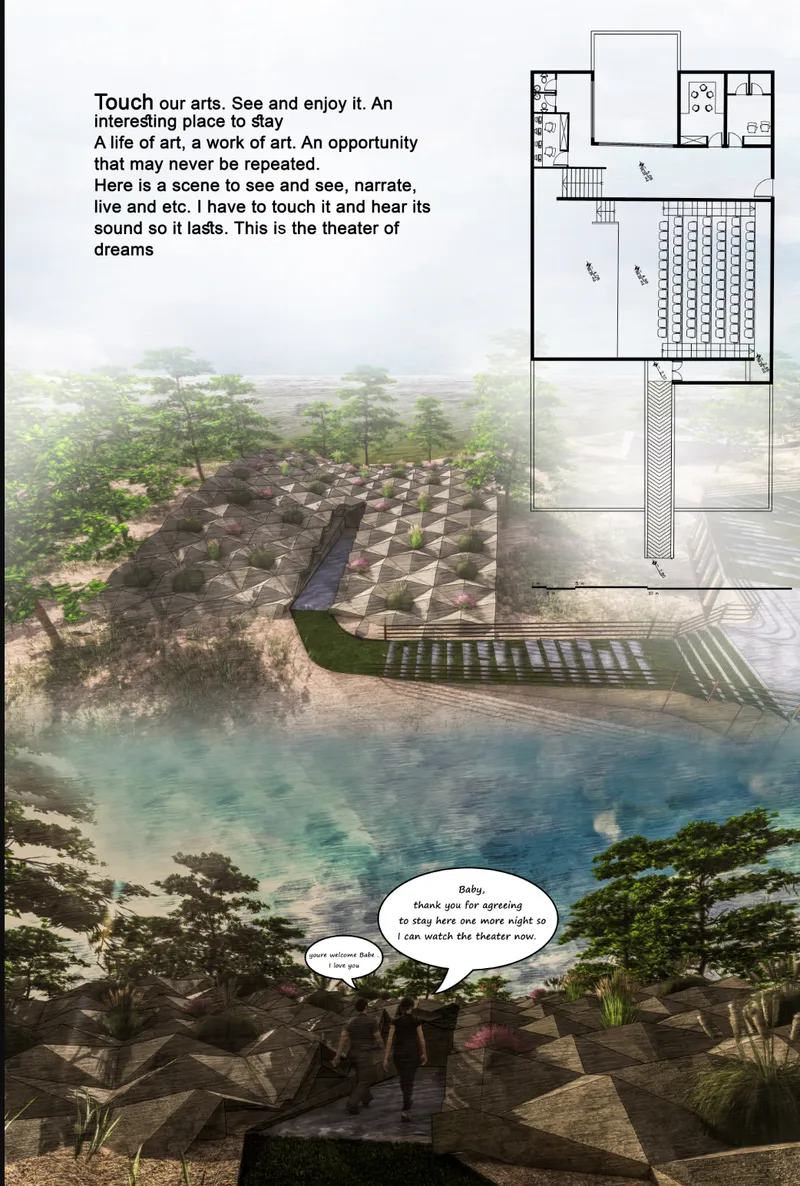
The section drawing and rendered view of the amphitheater expose one of the project's most spatially compelling moments. Pyramidal seating steps descend toward a stage area beside a reflecting pool, creating a performance venue that is simultaneously landscape and architecture. The stepped geometry recalls ancient triangular symbols from the project's conceptual framework, while the water surface at the base of the section doubles as a cooling element and an acoustic reflector. It is a space designed for coexistence: large enough for communal performance, intimate enough for quiet contemplation when the seats are empty.
Triangular Pavilions Resolved in Plan and Elevation
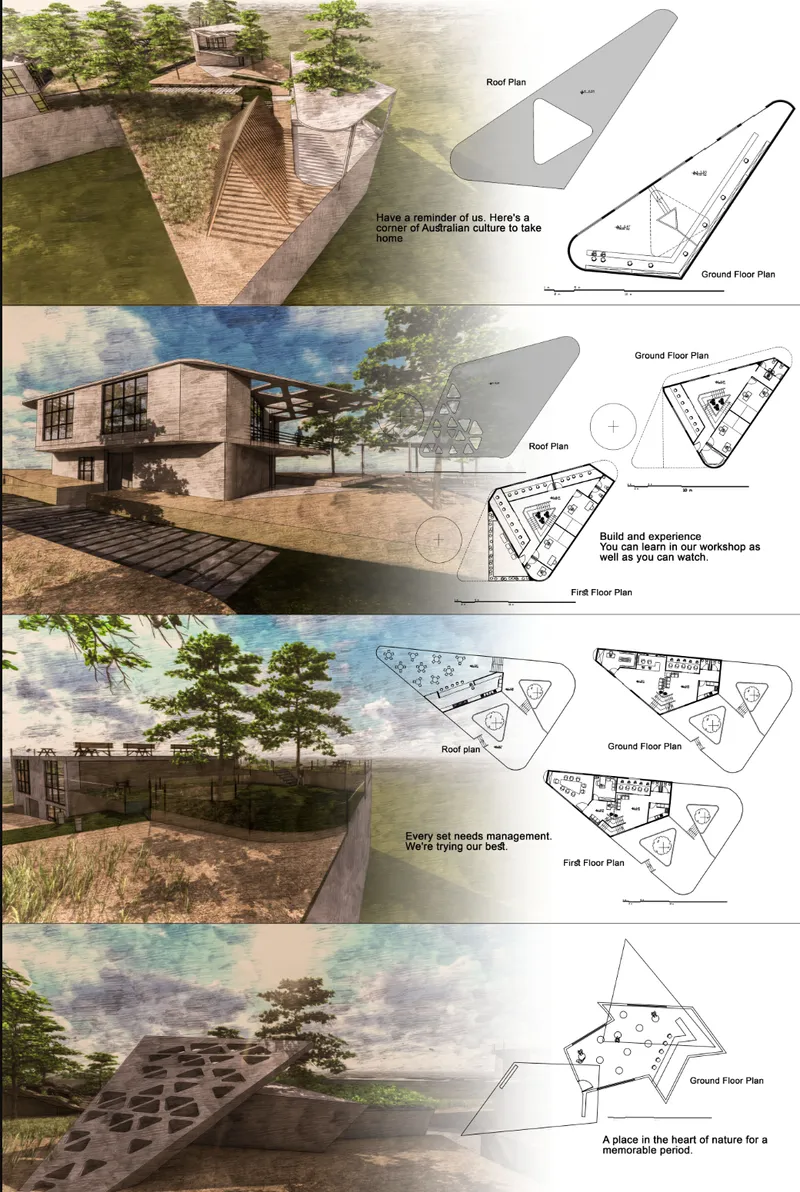
The final presentation board assembles floor plans and rendered views of the triangular pavilions on the waterfront site, making the full programmatic range visible. Workshops, shelters, and cultural spaces share a common geometric discipline rooted in the triangle, yet each pavilion varies in scale and orientation to respond to its specific position within the landscape. The plans show how interior spaces open outward to the trees and water, with thresholds designed to blur the line between inside and outside. The project's ambition to function as a living archive of interaction, education, and leisure comes into focus here, where every plan move has a corresponding experiential consequence.
Why This Project Matters
The strength of this proposal lies in its refusal to monumentalize. In a competition asking designers to articulate what "We Australia" means, Dabiri, Sherafati, Saboori, and Rezaei chose not to build a symbol. They built a system of encounters. The numbered wayfinding paths, the dispersed pavilions, and the amphitheater embedded in the topography all work together to frame Australia's identity as something visitors experience rather than something they are told. That is a sophisticated architectural position, and it is one that takes Indigenous spatial wisdom seriously rather than treating it as ornament.
The project also demonstrates that sustainable cultural architecture in ecologically sensitive contexts does not require invisibility. The latticed tower, the timber plazas, and the reflecting pool amphitheater are all legible interventions with real presence. What keeps them from becoming intrusions is the disciplined relationship between structure and site: buildings emerge from the land's contours, respect its tree cover, and use its water edges as design partners rather than backdrop. As a model for responsible tourism infrastructure in World Heritage landscapes, this proposal deserves the attention its shortlisted status has earned.
View the Full Project
About the Designers
Designers: Shamim Dabiri, Mounes Sherafati, Saba Saboori, Amir Hossein Rezaei
Enter a Design Competition on uni.xyz
uni.xyz runs architecture and design competitions year-round that reward proposals with spatial conviction and real site intelligence.
Project credits: We Australia, back to the future by Shamim Dabiri, Mounes Sherafati, Saba Saboori, Amir Hossein Rezaei We Australia (uni.xyz).



Popular Articles
Popular articles from the community


Co-life: Sustainable Architecture for Age-Friendly Community Living
Co-life reimagines sustainable architecture for seniors through courtyards, rammed earth, shared gardens, and spaces designed for belonging.

Co-Life: Senior Housing Design That Reconnects Older Adults With the City
Co-Life reimagines senior housing design through healing gardens, shared streets, workshops, and a sustainable community across generations.

Conexión: Biophilic Design Reimagines High-Rise Living in Hong Kong
Conexión reimagines high-rise living in Hong Kong through biophilic design, green facades, shared spaces, daylight, water and nature within.

Lunar Spiral: Space Architecture Shaped by the Mathematics of the Universe
Lunar Spiral reimagines space architecture through Fibonacci geometry, lunar regolith, levitating habitats, and self-sustaining Moon living.

Similar Reads
You might also enjoy these articles

Bao Huynh Watercolor Atelier: A Serene Art Retreat in Hội An
Bao Huynh Watercolor Atelier in Hội An blends multifunctional art spaces, sustainable design, local materials, and family-friendly living in a serene environment.

Atelier Macri Concept Store Interior Design by CASE-REAL
Atelier Macri store features a "ko" counter, walnut wood details, cork displays, blending retail, gallery, and seamless customer experiences.

Manuel Vargas Izquierdo Stadium and High-Performance Sports Center: Architectural Excellence in Jalpa de Méndez
The Manuel Vargas Izquierdo Stadium blends sustainable design, inclusive sports facilities, and cultural-inspired architecture, revitalizing Jalpa de Méndez’s public spaces.

KAKR Buluh Awar Hall: Revitalizing Community and Ecology Through Bamboo Architecture
Community built bamboo hall revitalizes Buluh Awar village, empowering youth, restoring ecology, celebrating vernacular craftsmanship through sustainable architecture and culture.


Comments (0)
Please login or sign up to add comments
No comments yet. Be the first to comment!