

Reimagining Urban Spaces: Sustainable and Innovative Shopping Mall Design
Revitalizing communities with sustainable architecture, combining tradition and innovation for a better urban future."


Nilkhet Book Market is one of Dhaka's most beloved places. It is chaotic, crowded, informal, and full of secondhand books stacked on wooden carts. Any proposal to replace it with a shopping mall has to answer one question first: does the new building still feel like Nilkhet? Design of a Large-Scale Shopping Mall, by Akib Sikder, answers yes, by keeping the book carts, keeping the street, and building the mall around both of them.
Published on uni.xyz, the project proposes a mall that is not a box. It is an open brick framework carved with courtyards, ramps, and a continuous interior street. The vendors stay. The circulation stays. The experience of walking past stacks of books stays. What changes is that the whole thing now has a roof, daylight, and a structure that can survive Dhaka's monsoon.
The Plaza: A Market That Is Also a Doorway
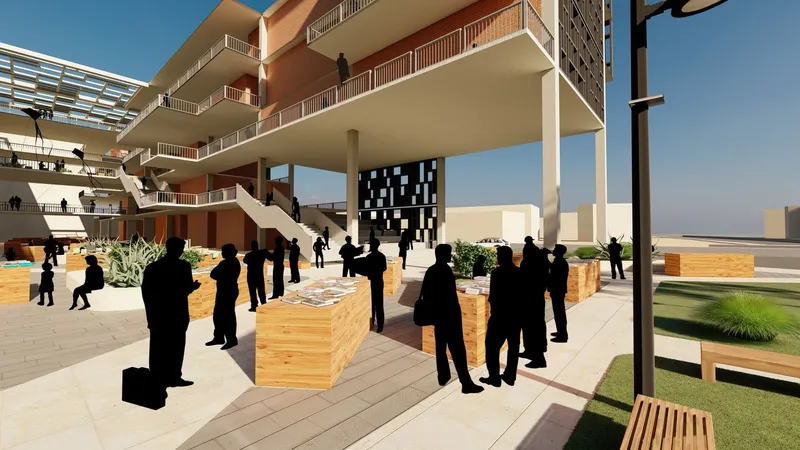
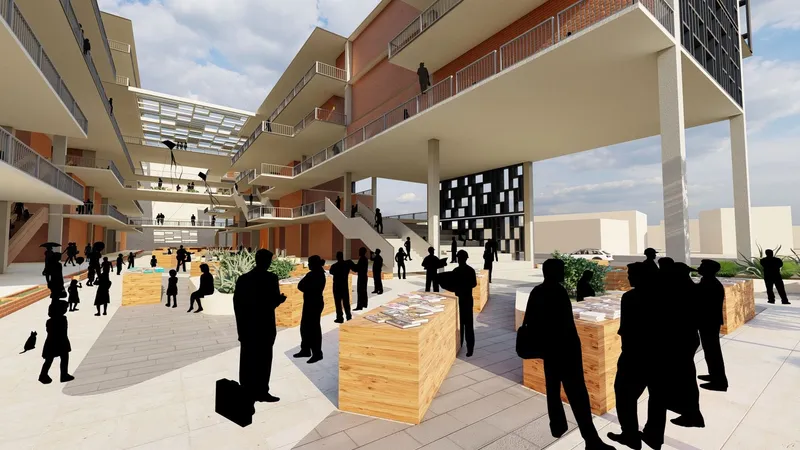
The two plaza renders establish the project's first move. Deep cantilevered brick floors overhang an open ground plane where wooden book carts sit in neat rows. Residents and shoppers circulate between them. A broad stair leads up to the first level. Bamboo screens and planted edges soften the threshold. The mall does not begin at a door. It begins at a cart in the shade.
This is where the project separates itself from every other large-scale shopping proposal. The book cart is not demolished. It is promoted. The vendors who currently sell under tarpaulins are now selling under a proper cantilever, protected from sun and rain, with storage in the volume above. The informal economy is not displaced. It is absorbed, housed, and continued.
The Interior: An Atrium as a Bazaar
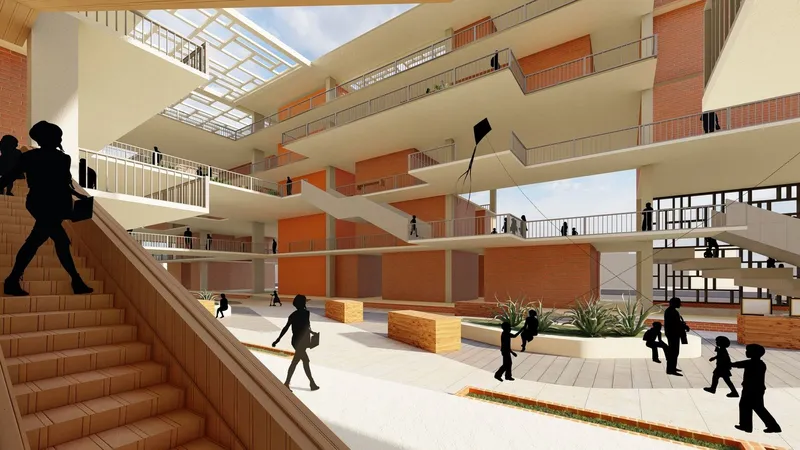
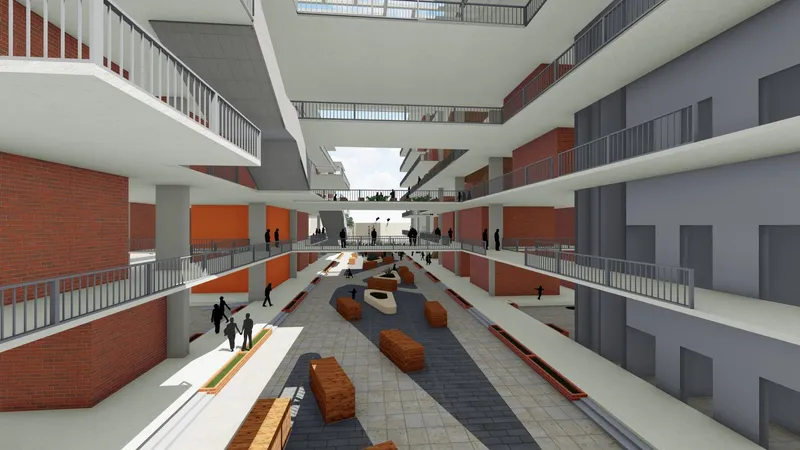
The interior renders show what the upper floors look like. A central atrium runs the full length of the building. Brick walls, exposed concrete slabs, and open stairs form the structure. Multi-level balconies face inward, with continuous shopfronts on every level. Residents and students walk the length of the atrium at the ground floor while others pass overhead on the balconies. The space reads as a covered bazaar more than a mall.
The difference is deliberate. A conventional mall is organised around a closed food court, a central fountain, and sealed anchor tenants at each end. This atrium is organised around circulation: the path through the building is the experience, the shops are arranged along the path, and there is no single anchor. The model is the covered souk, not the American mall, and it is a much better match for how Dhaka already shops.
The Light: A Skylit Street
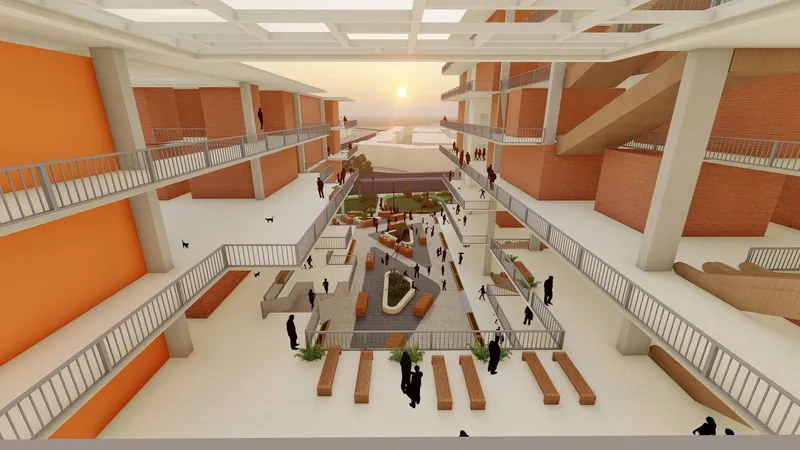
The double-height atrium render shows the roof's one confident move. A glazed skylight runs the full length of the central street, dropping a warm sunset beam onto the crowds below. The roof is not a decorative gesture. It is a climate strategy. Dhaka gets intense sun and heavy monsoons, and a covered but daylit street is the only way to keep a tropical bazaar open year-round without collapsing into air conditioning.
The light matters because it turns the interior from a corridor into a public room. When daylight reaches the ground floor through a glazed roof rather than through fluorescent fittings, the building feels like an extension of the outdoor plaza. The distinction between inside and outside softens. Shopping becomes walking, and walking becomes the programme.
The Model: Courtyards Carved from a Block
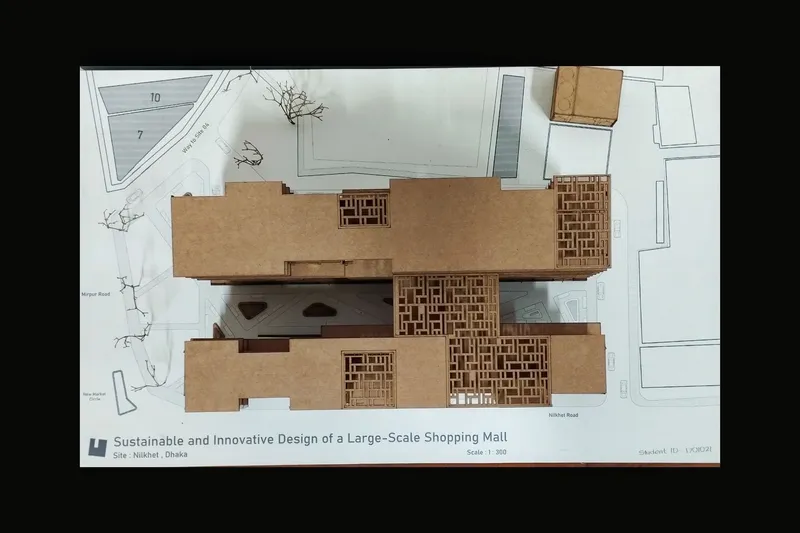
The physical cardboard study model is the project's most informative drawing. A rectangular massing sits on the Nilkhet site plan, and courtyards are carved out of it. The carving is the design. Every public space in the project, the entry plaza, the central atrium, the upper terraces, is a negative volume removed from a solid block. The model makes it obvious that the plan was developed by subtraction, not addition.
This is an old-fashioned way to work, and it suits the project. Tropical commercial architecture has always been about carving shade out of mass: courtyards, arcades, recessed balconies, deep cantilevers. The cardboard model shows that the designer is thinking in those terms rather than in mall-of-America terms. Cut the voids first, build the solid around them.
Why This Project Matters
Large-scale shopping mall projects in South Asian cities almost always fail the same way: they push out informal vendors, eat ground-floor public life, and trap shoppers inside a sealed envelope. This project refuses all three. The book carts stay on the ground. The interior street is open to the plaza. The skylit atrium replaces the sealed HVAC box. Every choice pulls in the opposite direction to the default mall.
For anyone studying the adaptive reuse of informal markets, tropical mall typologies, or shopping architecture as public infrastructure, this Nilkhet proposal is a useful reference. It treats the book market as a cultural asset to be protected, not a nuisance to be replaced. And it proves that a large-scale shopping mall does not have to read as a mall at all. It can read as a covered Dhaka street.
View the Full Project
About the Designer
Designer: Akib Sikder
Enter a Design Competition on uni.xyz
If tropical commercial architecture, informal market reuse, or the redesign of shopping mall typologies is the kind of work you want to explore, uni.xyz runs competitions year-round that reward proposals grounded in real place and real people.
Project credits: Design of a Large-Scale Shopping Mall by Akib Sikder. Published on uni.xyz.


Popular Articles
Popular articles from the community


FCC Arquitectura Expands a Portuguese Granite House with a Board-Marked Concrete Wing
In Portugal, JV House pairs a cleaned-up whitewashed and granite dwelling with a timber-shuttered concrete extension, courtyards and a garden pool.

ETEH Reworks the Shared Spaces of São Domingos School in Brazil Around Timber, Color and Hanging Plants
At São Domingos School in Brazil, 436 m² of hall, refectory and library are recast with timber joinery, a yellow and blue code and trailing greenery.


The Amber Palace Opera: A Geological Fiction Surfaces on Tallinn's Baltic Waterfront
Pierre Brillard reimagines a Baltic legend as a public landscape, opera house, and waterfront promenade rooted in Tallinn's coastal identity.

Aquadapt: An Underwater Habitat That Rewrites Its Rooms by the Hour
Curved modules ring the seabed while one shell shifts from breakfast room to cinema, farm and football pitch as residents' needs change.

Similar Reads
You might also enjoy these articles

Vereda Arquitetos Renovates a 40-Square-Meter Apartment Inside Niemeyer's Copan Building
A compact unit in São Paulo's most iconic residential tower gets a material overhaul that pairs exposed concrete with bold blue Formica.

Shakur's House: Exposed Brick as an Interior Organiser in a 168 m² Mashhad Residence
Brick moves indoors in this Mashhad residence, where masonry walls, glass partitions and teal planes sequence a compact home without closing it off.

Day and Night Park: A Time-Based Urban Newsstand in Beijing
A temporary urban newsstand in Beijing blending travel, light, and reading through poetic colors, compact form, and community-focused design.

Modernist Patio Renovation in El Masnou, Barcelona by Oliver Segura Arquitectura + Cebrià Arquitectura
Modernist patio renovation blending tradition and innovation with a movable pool, leveled floors, and Catalan materials in El Masnou.

Explore Contemporary Mall Competitions
Discover active competitions in this discipline

Challenge to design locus for the upliftment of human rights

Design challenge to reuse E-waste
Comments (0)
Please login or sign up to add comments
No comments yet. Be the first to comment!