
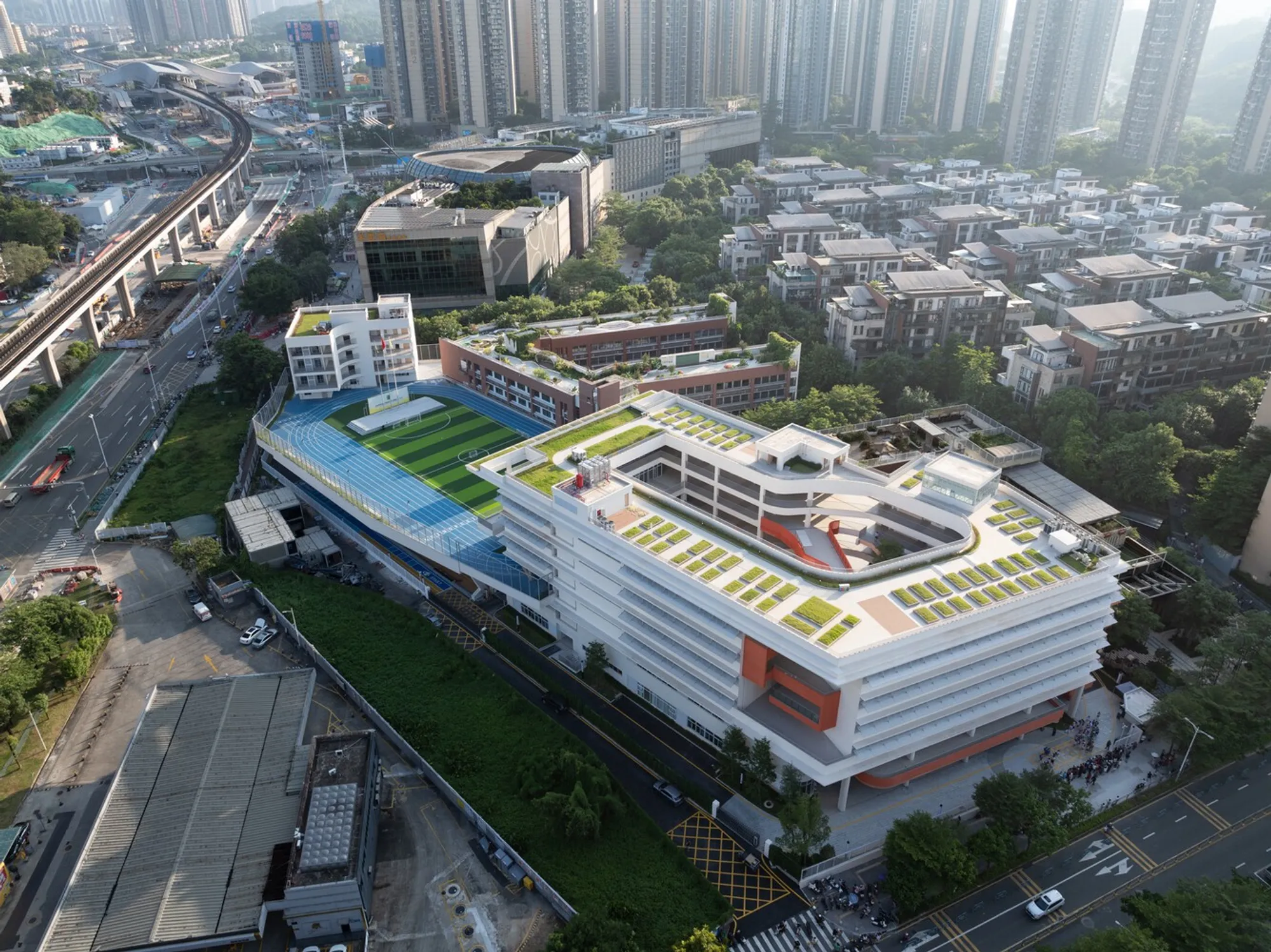
Renovation and Expansion of Shenzhen Longgang District Xinghe School by A.C.R.E. Atelier
High-density Shenzhen school reimagined with walled-house layout, terraced learning spaces, aerial walkways, community integration, and climate-responsive shading for healthy, connected education.


Transforming a High-Density Urban School Campus into a Future-Ready Learning Environment
The Renovation and Expansion of Shenzhen Longgang District Xinghe School byA.C.R.E. Atelier represents a pioneering approach to educational architecture in China’s rapidly urbanizing cities. Completed in 2024 in Shenzhen’s Longgang District, this 29,960 m² campus reimagines spatial density, student wellbeing, and climate-responsive design.
Through a combination of adaptive reuse, vertical layering, informal learning landscapes, and passive environmental strategies, the project advances a new model for future schools in high-density urban settings.
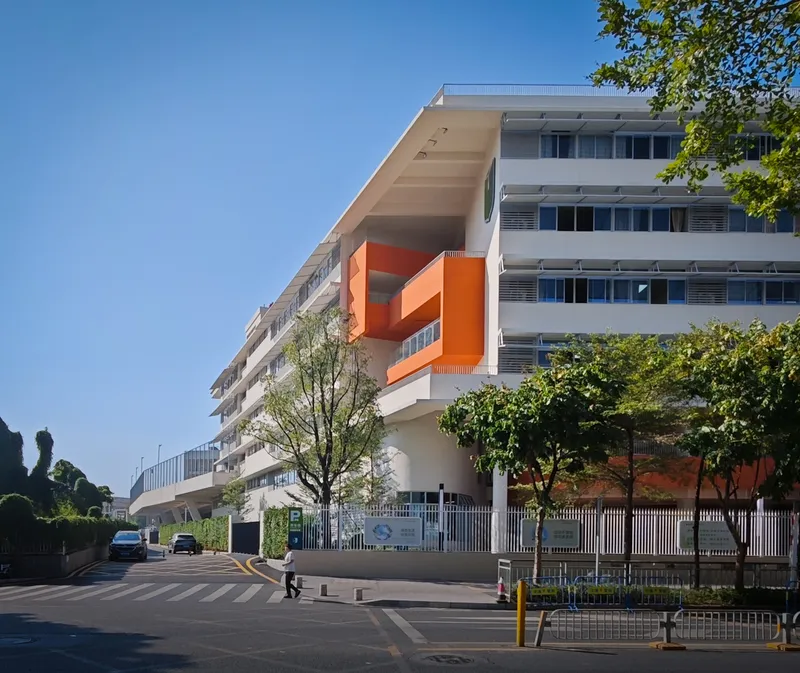
A Modern Interpretation of the “Walled House” for Collective Learning
Cultural Identity, Density Strategy, and Human-Scale Courtyards
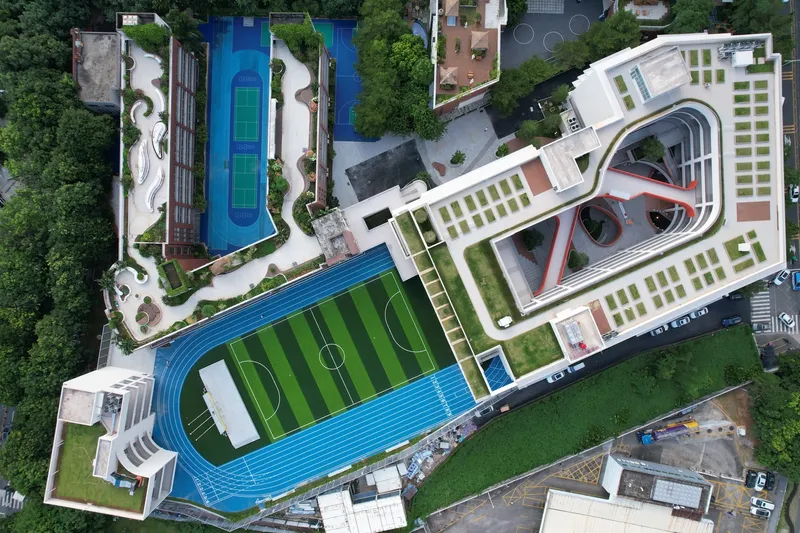
At the heart of the design is a contemporary reinterpretation of Longgang’s traditional “walled house” typology, adapted to strict urban planning limits including a 3.4 FAR and a 200m circular track requirement.
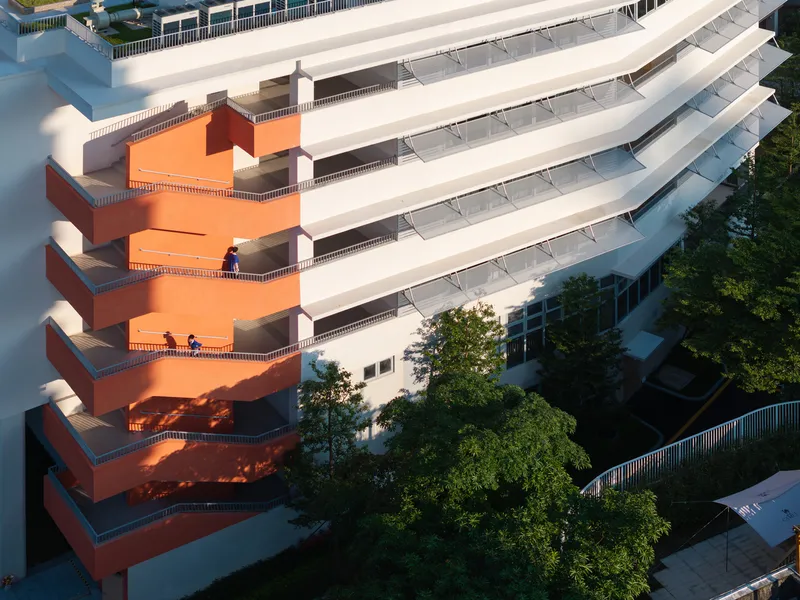
A six-story perimeter structure densifies the northern edge while opening toward the south, creating a gradient spatial strategy that balances privacy, daylight, and human scale. Carefully calibrated setbacks and façade proportions generate intimate courtyards that double as informal learning zones, encouraging collaboration and interaction beyond classrooms.
This integrated approach transforms the school into a living campus — one where architecture becomes a teaching tool and spatial boundaries nurture curiosity.

Embedded Topography and Floating Learning Clusters
Layered Terrain for Play, Exploration, and Community Engagement
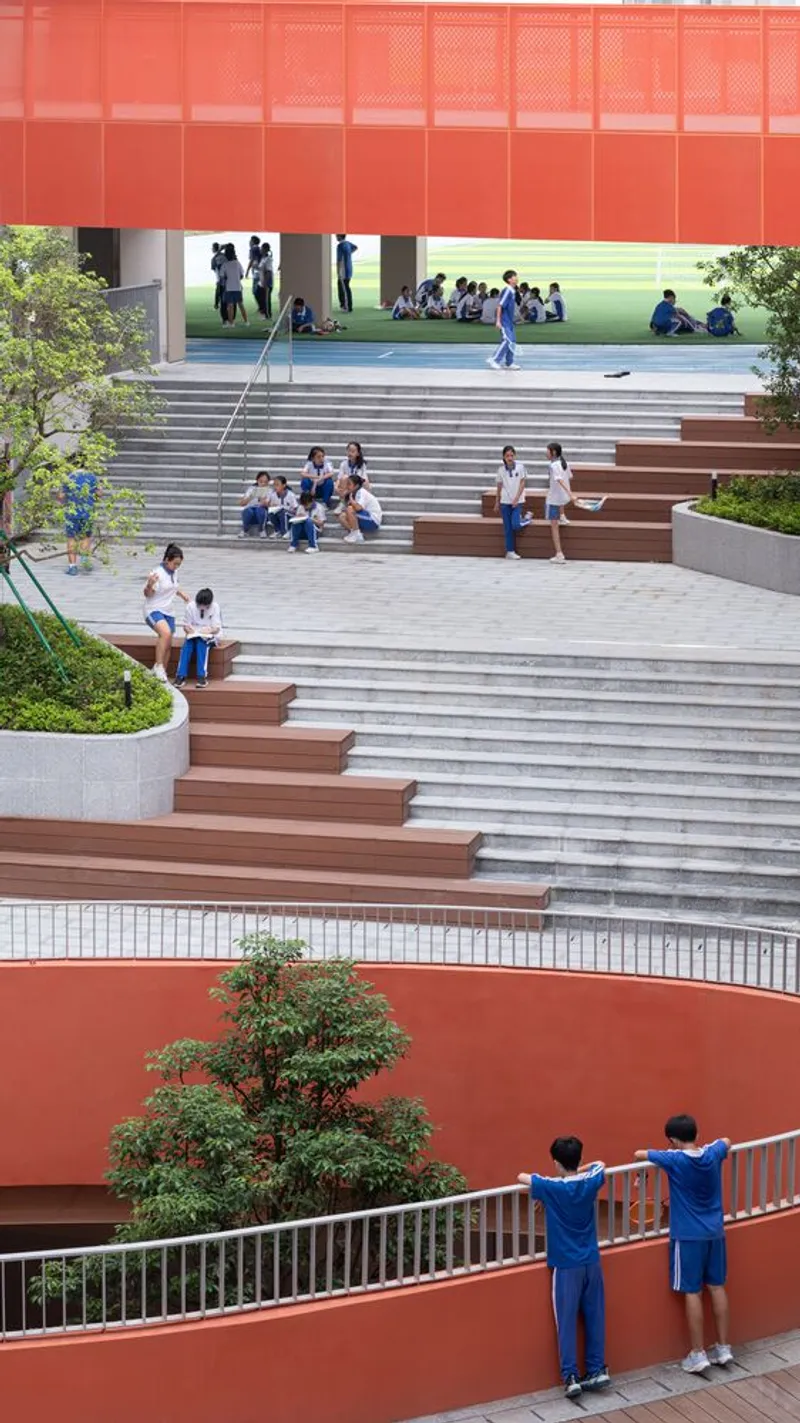
Responding to spatial constraints and student circulation needs, the architects embedded key public facilities — gymnasium, auditorium, and shared programs — within a terraced plinth. Above this base, teaching clusters float dynamically, linked through cascading platforms and roof terraces.
These multi-level landscapes create a “learning valley” filled with playful social spaces, shaded circulation paths, and greenery. It encourages free movement, peer interaction, and student-driven discovery across the campus.
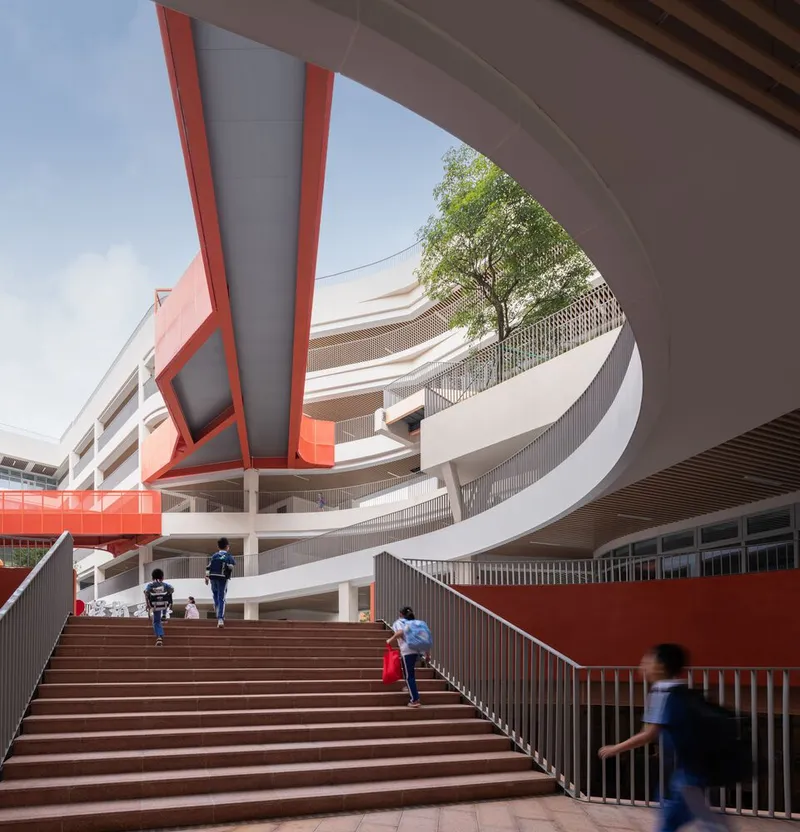
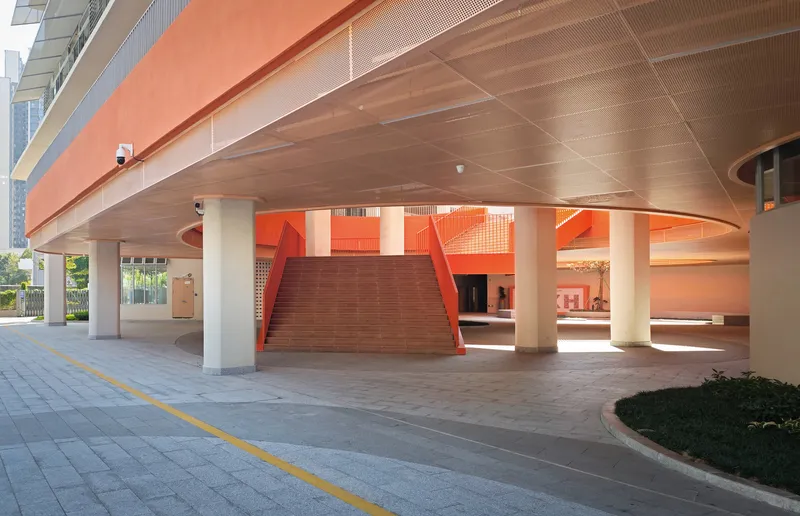
Three-Dimensional Connectivity and Nature-Driven Wellbeing
Colorful Bridges, Elevated Gardens, and Climatic Comfort
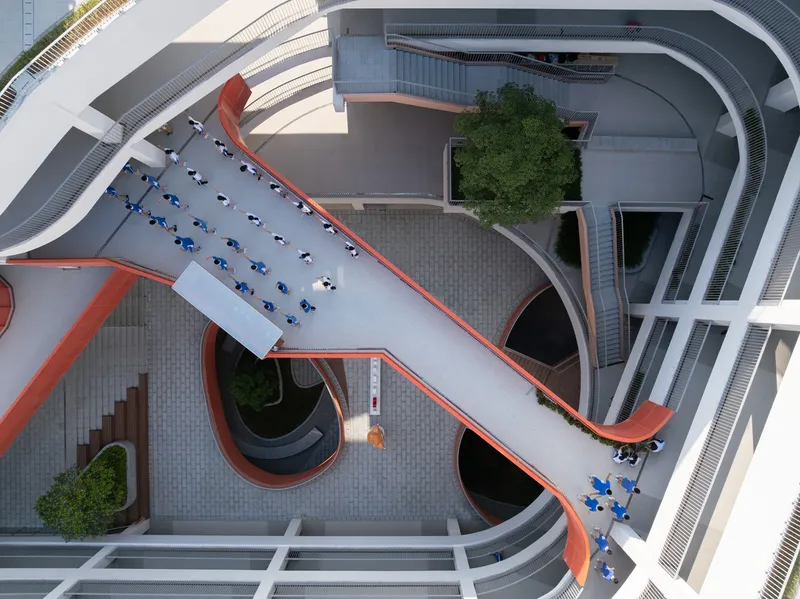
A network of aerial bridges and suspended walkways forms fluid 3D mobility across the school. Children are never confined — instead, they move through bridges lined with tree plantings, breezeways, and open views of the city.
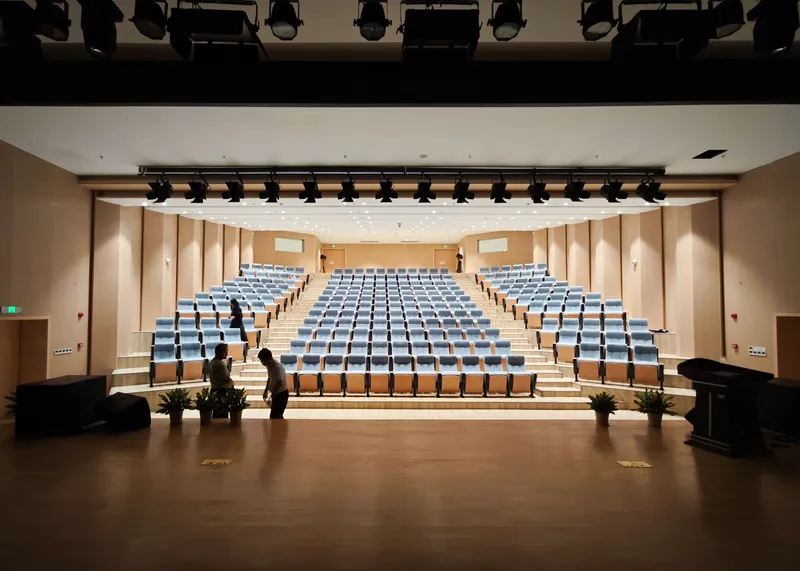
Strategic voids cut into the massing allow natural ventilation, sunlight, and visual permeability, anchoring the design’s mission to create a healthier microclimate in a dense urban environment. The school becomes a vertical garden campus, where students reconnect with nature within their daily routines.
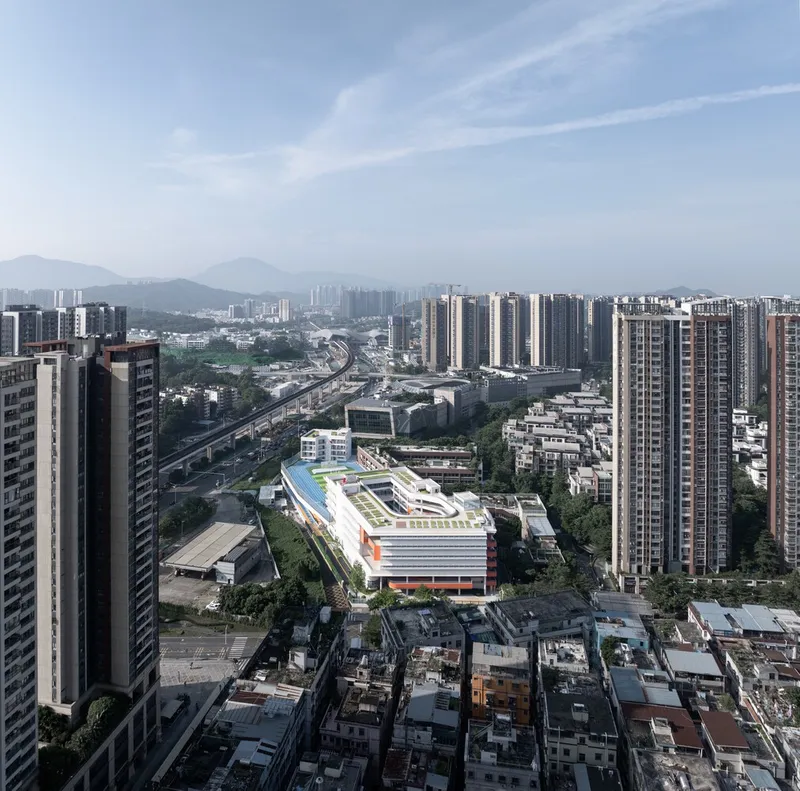
Open Boundaries and Shared Urban Interface
A School Without Walls — Connecting Education and Community
To manage student and parent circulation while promoting community integration, the design introduces a dual-ground-floor system and time-shared plaza.
During school hours, it functions as a controlled drop-off zone. After hours, it transitions into a public space shared with the neighborhood. Removal of traditional perimeter walls opens views to the sports field and student activities, fostering transparency, inclusivity, and civic vitality.
This gesture turns the school into a cultural and social energy hub, strengthening bridges between academic life and the city.

Climate-Responsive Innovation: Translucent Grid Shading System
Balancing Daylight, Comfort, and Energy Efficiency in Subtropical Shenzhen
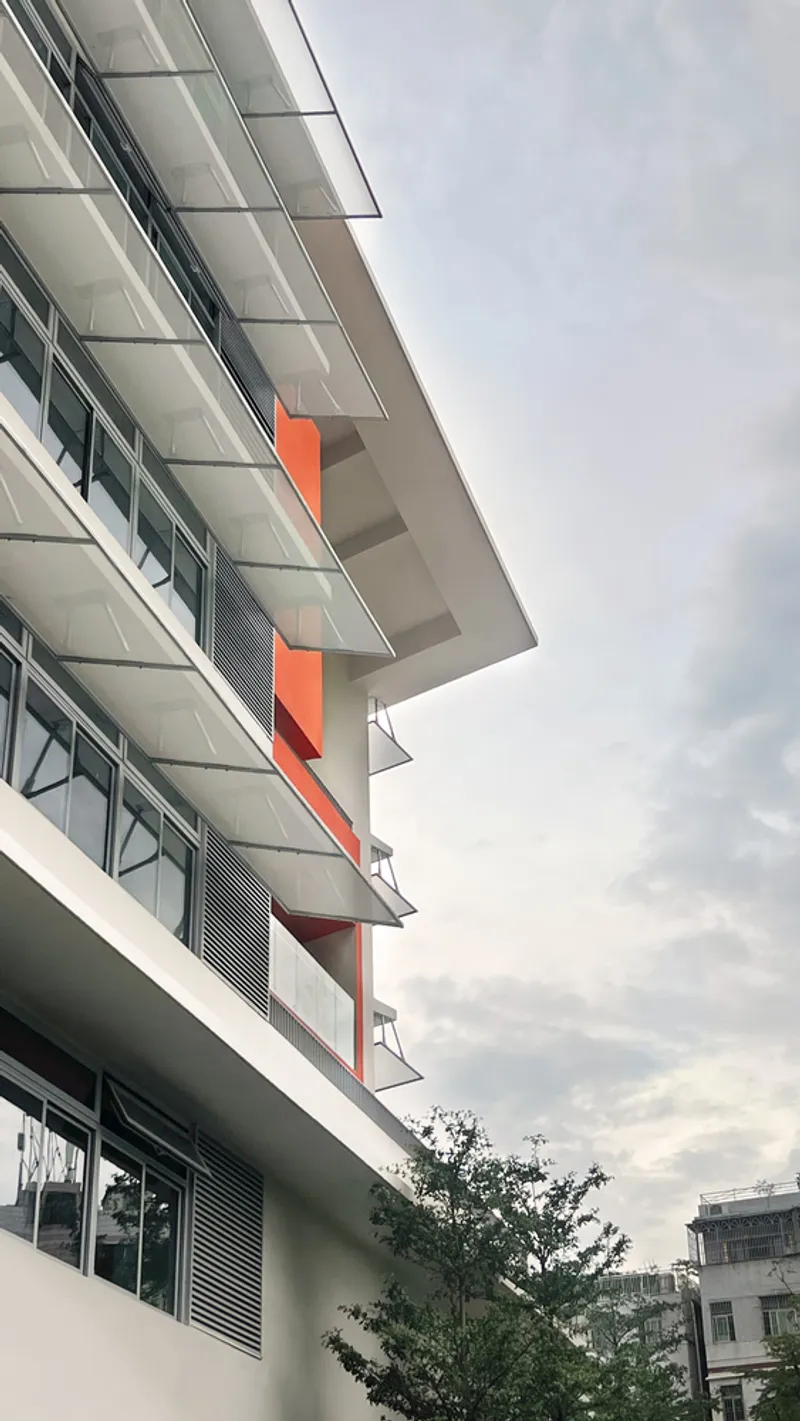
Designed for the challenges of heat, solar exposure, and heavy rainfall, the architects developed a custom translucent grid shading film system.
Through rigorous simulation, the solution demonstrates ability to:
- Maintain ideal daylight autonomy (sDA)
- Improve Useful Daylight Illuminance (UDI)
- Reduce glare (sGA) and heat gain
The result is a healthier learning environment with optimized natural light, reduced energy consumption, and greater visual comfort.
A Prototype for Future Urban Schools in China
The Renovation and Expansion of Shenzhen Longgang District Xinghe School stands as a benchmark for educational transformation in dense Asian cities. By blending architectural innovation, cultural memory, environmental strategy, and social openness, A.C.R.E. Atelier delivers a bold vision for student-centered learning environments.
This project models how urban regeneration, vertical schools, and child-focused design can shape sustainable and inclusive educational futures.
All photographs are works of Right Angle Image, XIAO Xiao, Jinhui Li



Popular Articles
Popular articles from the community


The Ocean Hive: Sustainable Architecture for a Self-Sufficient Civilization at Sea
The Ocean Hive imagines sustainable architecture at sea, where modular habitats, algae, wave power and ocean waste sustain a growing colony.

Conexión: Biophilic Design Reimagines High-Rise Living in Hong Kong
Conexión reimagines high-rise living in Hong Kong through biophilic design, green facades, shared spaces, daylight, water and nature within.

Riyadh For All: Intergenerational Urban Design for Active Aging in Rabat
Riyadh For All reimagines urban design in Rabat with intergenerational co-living, adaptive courtyards, and Moroccan cultural exchange today.

The Musturak Paradise: Senior Living Architecture for a Connected Future in Temara, Morocco
The Musturak Paradise reimagines senior living architecture in Temara via private homes, social spaces, culture, community, and shared care.


Similar Reads
You might also enjoy these articles


Hodi-Mandai Geram
Project Function: Preservation and revitalization of the Intangible heritage and socio-spatial identity of the Hodi by Housing, Cultural Memory Center, Sacred Grove, landscape, local tourism economy


Olio Towers: A Mid-Rise for Performers That Fuses Housing, Rehearsal, and Stage
Located blocks from Houston's Theater District, this modular tower stacks living units around a central performance atrium.

Oasis: Modular Green Housing Carved into Dhaka's Urban Fabric
A shortlisted Plugin Housing entry reclaims unauthorized settlements in Dhaka with stepped concrete volumes, green roofs, and ventilation-driven design.

Black Hole: A Floating Megastructure for the Post-Physical Era
Emiliano Mazzarotto envisions a spherical, self-scaling arena where e-sports, digital hotels, and holographic stadiums replace traditional public space.


Explore Educational Building Competitions
Discover active competitions in this discipline



Challenge to design public laboratory


Challenge to reimagine the Iron Throne


Photograph architecture without architects


Illustrate the lost glory of Angkor Wat - Render Challenge
Comments (0)
Please login or sign up to add comments
No comments yet. Be the first to comment!