

Dubai Tower: A Vertical City Designed for Air Mobility and Green Living in 2050
A mixed-use skyscraper splits its mass with a central void to channel daylight, airflow, and a new model of urban coexistence in Dubai.


What if the defining gesture of a skyscraper wasn't its height but the space it deliberately left empty? The Dubai Tower carves a void between two interlocking masses, turning absence into the building's most active element. That gap channels northern daylight deep into the plan, drives natural cross-ventilation through dozens of floors, and visually connects residents, workers, and visitors across the full height of the structure. The designers call it the "upper eyelid," a metaphor that captures something essential: the building watches the sky as much as the sky watches it.
Conceived for the year 2050 and set in Dubai, the project was submitted to the Hybrid Futures competition under the IA category. Designers Bouzid Boudiaf, Azzam Abdulqawi Radma, and Mohammad Issam Al Hariri propose a multi-layered ecosystem where people work, live, commute, and relax across seamlessly integrated zones. The result is less a tower and more a prototype for the self-sustaining vertical city.
Splitting the Mass: Concept Diagrams and the Logic of the Void
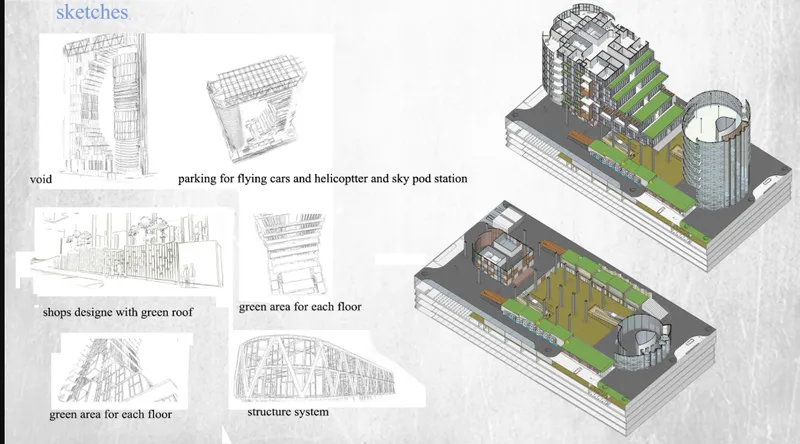
The concept diagrams lay out the tower's generative move clearly. Two volumes rise from a shared podium, separated by the central void that gives the building its distinctive silhouette. Axonometric views reveal planted terraces stacked at intervals up the facade and a cylindrical element that punctuates the composition, hinting at the vertical transit systems embedded within. The decision to break the mass rather than consolidate it is strategic: it increases the building's surface area for daylight and ventilation while reducing the visual bulk that plagues conventional supertall designs.
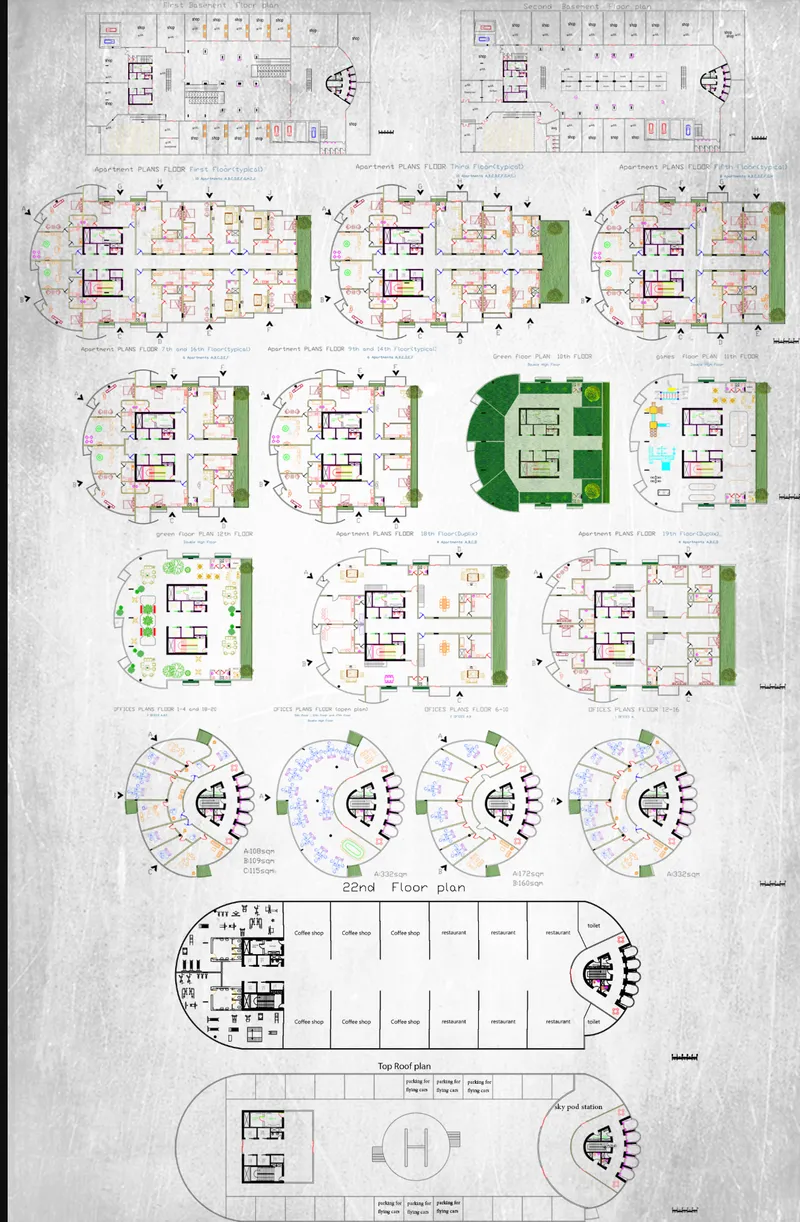
Floor plans at the residential levels show curved ends wrapping around central circulation cores. The geometry is not arbitrary. Those curves negotiate between maximizing usable area and ensuring that every unit receives adequate light and air, a persistent challenge in high-rise residential typologies. The central cores handle vertical transit, allowing the perimeter to remain free for living spaces that open outward toward views and planted balconies.
Dual Towers in Elevation: Diagonal Facades and Structural Trusses
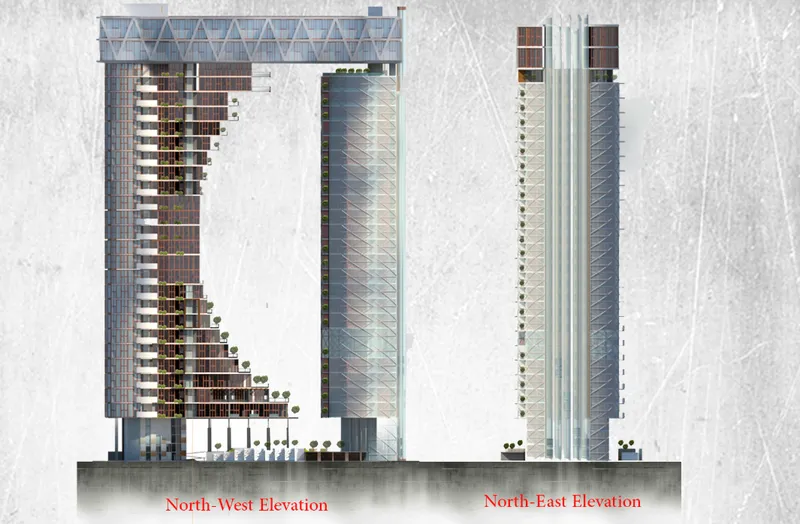

The elevation drawings present three interconnected high-rise volumes with diagonal facade patterning that does double duty: it expresses the structural diagrid beneath while giving the towers a kinetic, shifting appearance depending on viewing angle. At ground level, planted balconies soften the transition between the towers and the city, pulling greenery down to the street where pedestrians actually experience it. The section drawings are where the internal logic becomes legible. Glazed atriums span multiple floors, acting as communal lungs that bring daylight into the building's core. Sky gardens appear at regular intervals, positioned to serve as thermal buffers and social condensers between programmatic zones.
Structural trusses at the roof level tie the two towers together, forming the "sky bridge" that provides both lateral stability and a dramatic public space at altitude. The hybrid structural system blends steel cores in the office zones with column-supported concrete slabs in the residential levels, allowing each programmatic band to adopt the structural logic best suited to its span requirements and spatial ambitions. It is a pragmatic decision that enables genuine variety in floor plate size and ceiling height from zone to zone.
Ground-Level Urbanism: Cafes, Plazas, and the Invitation to Enter
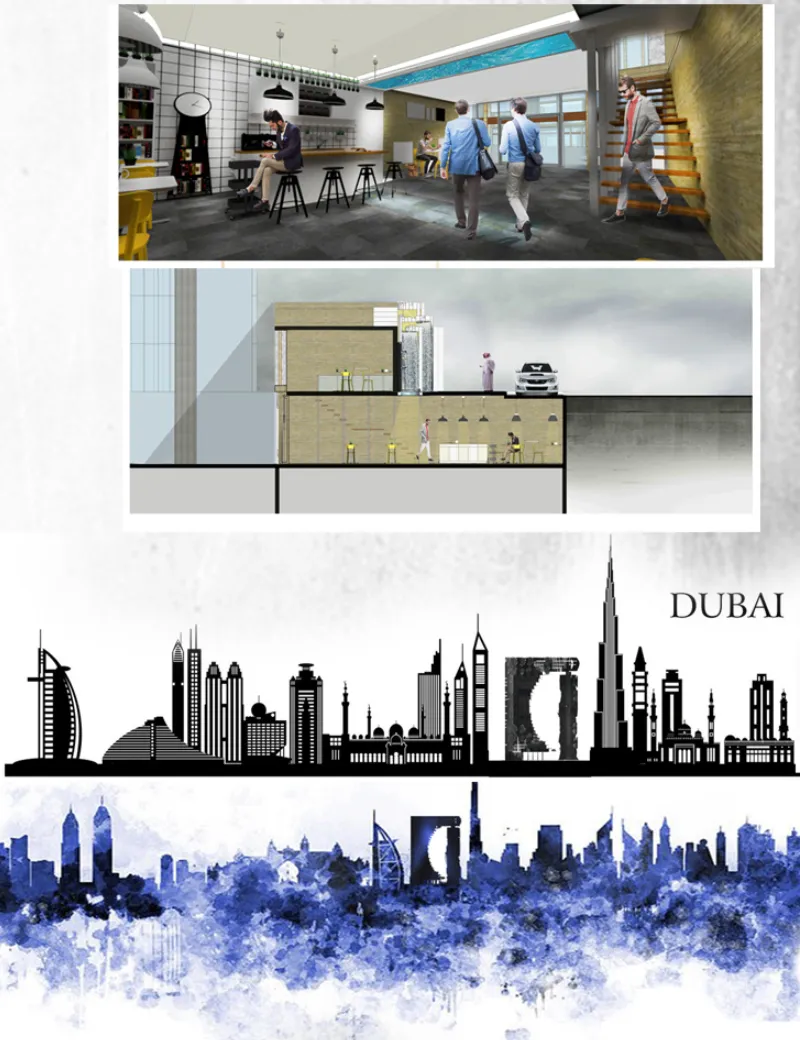
A vertical city fails if its ground floor repels the public. The rendering of the ground-level cafe reveals a space designed to feel loose and inhabited: exposed ceiling ducts, bar seating, and a flow of pedestrians passing through rather than past. The base floors host public programs including plazas, retail outlets, and lounges intended to draw people in from the surrounding city. This porosity at the base is critical. It establishes the tower not as a gated compound but as an extension of the urban fabric, a place where the non-resident has reason to be.
Sky Pods, Helipads, and the Vertical Commute of 2050

The most speculative layer of the project is also its most visually compelling. The axonometric view shows flying vehicles approaching a rooftop landing pad, a gesture that positions the tower squarely within a future of mainstream air mobility. Sky pod stations, helipads, and landing platforms for flying cars are integrated across the upper levels, connected by vertical transit systems that link every functional layer from shopping areas to the rooftop sky hubs. Whether or not flying cars arrive on schedule, the spatial provisions matter: they demonstrate how a building's circulation strategy must evolve if mobility itself transforms.
Sustainability is woven through the scheme rather than applied as an afterthought. Green terraces and rooftops act as carbon sinks and thermal regulators. A water recycling system supports irrigation and reduces environmental impact. Passive strategies, including the natural cross-ventilation enabled by the central void and deliberate daylighting, aim to minimize energy consumption. Recreation decks with gyms, pools, and cafes are distributed at upper levels to reduce the need for residents to travel to ground level for daily needs, compressing the commute to a vertical journey measured in seconds.
Why This Project Matters
The Dubai Tower takes the familiar provocation of the "vertical city" and pushes it past slogan into spatial specificity. By splitting the tower into two masses linked by sky bridges and organized around a central void, Boudiaf, Radma, and Al Hariri demonstrate that density does not require darkness, that height does not demand isolation, and that a building's most powerful move can be the space it chooses not to fill. The multi-zonal typology, where structure, program, and sustainability strategy shift floor by floor, suggests a more responsive approach to supertall design than the extruded floor plate repeated ad infinitum.
As a competition entry for Hybrid Futures, the project does what speculative work should: it tests ideas at the edge of feasibility without losing architectural discipline. The flying car pads may read as science fiction today, but the passive ventilation strategies, the community-scaled sky gardens, and the porous urban ground plane are lessons that apply now. If the vertical city is inevitable, its success depends on designers willing to break the monolith open and let air, light, and life pass through.
View the Full Project
About the Designers
Designers: Bouzid Boudiaf, Azzam Abdulqawi Radma, Mohammad Issam Al Hariri
Enter a Design Competition on uni.xyz
uni.xyz runs architecture and design competitions year-round that reward proposals with spatial conviction and real site intelligence.
Project credits: Dubai tower by Bouzid Boudiaf, Azzam Abdulqawi Radma, Mohammad Issam Al Hariri.


Popular Articles
Popular articles from the community


The Amber Palace Opera: A Geological Fiction Surfaces on Tallinn's Baltic Waterfront
Pierre Brillard reimagines a Baltic legend as a public landscape, opera house, and waterfront promenade rooted in Tallinn's coastal identity.

Manzana Morphosis: Stretching Barcelona's Grid into a Living Landscape for 2050
A radical reworking of the Eixample manzana turns density into a tool for generous public space, vertical ecology, and environmental performance.
Tsunami Convergenics: Turning Catastrophic Ocean Forces into Underwater Housing Infrastructure
A speculative underwater settlement off the coast of Onagawa, Japan, treats tsunamis and typhoons as energy sources rather than threats.

Cloaked Colonization: A Mobile Underwater Habitat That Moves Like a Fish
Micah Abaya's shortlisted EHC Pacific entry reimagines ocean settlement as a dispersed network of self-sustaining architectural organisms.

Similar Reads
You might also enjoy these articles

Day and Night Park: A Time-Based Urban Newsstand in Beijing
A temporary urban newsstand in Beijing blending travel, light, and reading through poetic colors, compact form, and community-focused design.

Modernist Patio Renovation in El Masnou, Barcelona by Oliver Segura Arquitectura + Cebrià Arquitectura
Modernist patio renovation blending tradition and innovation with a movable pool, leveled floors, and Catalan materials in El Masnou.

Alto Residencial Coop: Cooperative Housing Development in Santiago de Compostela by Carbajo Barrios Arquitectos
A linear cooperative housing complex blending white volumes and perforated metal façades, enhancing community living, natural light, privacy, and urban integration.

Vil Genis School by BPA ARCHITECTURE – Massy, France
Vil Genis School in Massy, France, features sustainable design, south-facing classrooms, community integration, accessible spaces, and modern educational architecture.

Explore Future City Competitions
Discover active competitions in this discipline

Challenge to design locus for the upliftment of human rights

Design challenge to reuse E-waste
Comments (0)
Please login or sign up to add comments
No comments yet. Be the first to comment!