
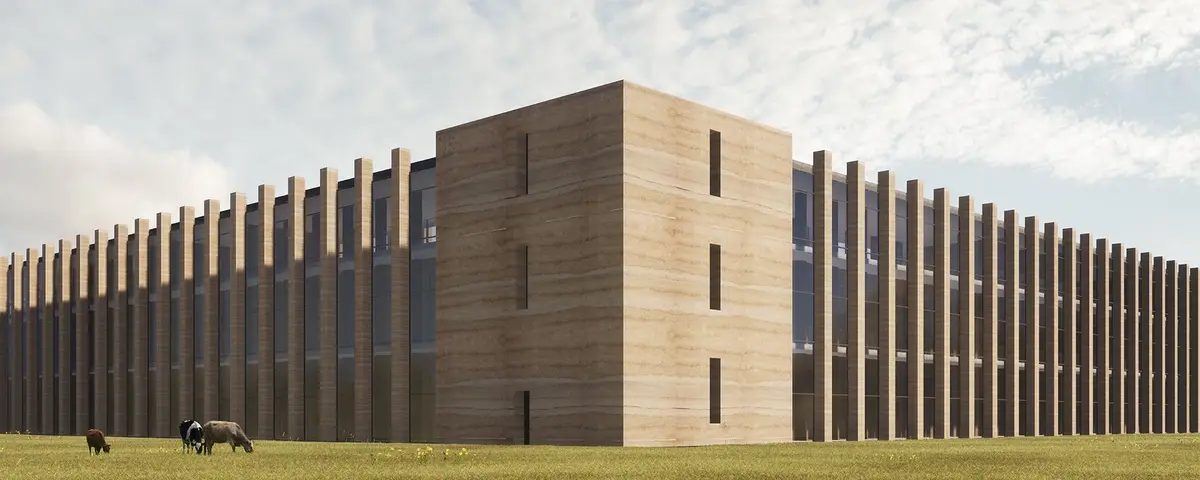
01 | Prison: Rethinking Incarceration Through Biophilic and Modular Architecture
A People's Choice Award entry reimagines the prison as a timber-lined rehabilitative landscape balancing security with human dignity.


Cybercrime thrives on anonymity, yet traditional prisons strip identity from the people inside them. That paradox sits at the center of 01 | Prison, a project that refuses to accept the inherited logic of punitive architecture. Instead of reinforcing isolation, the design deploys biophilic materials, modular spatial organization, and community-oriented programming to construct a facility where rehabilitation is not an afterthought but the organizing principle.
Designed by Fabian Gay and Thibaut Servier, this entry to the Switching Prisons competition won the People's Choice Award for its adaptive approach to prison architecture. The project asks a pointed question: as the nature of crime shifts toward the digital realm, how should the physical spaces of incarceration evolve? The answer here is a building that foregrounds timber construction, natural light, and shared social spaces over concrete walls and surveillance corridors.
Deep Recessed Openings and a Landscape That Participates
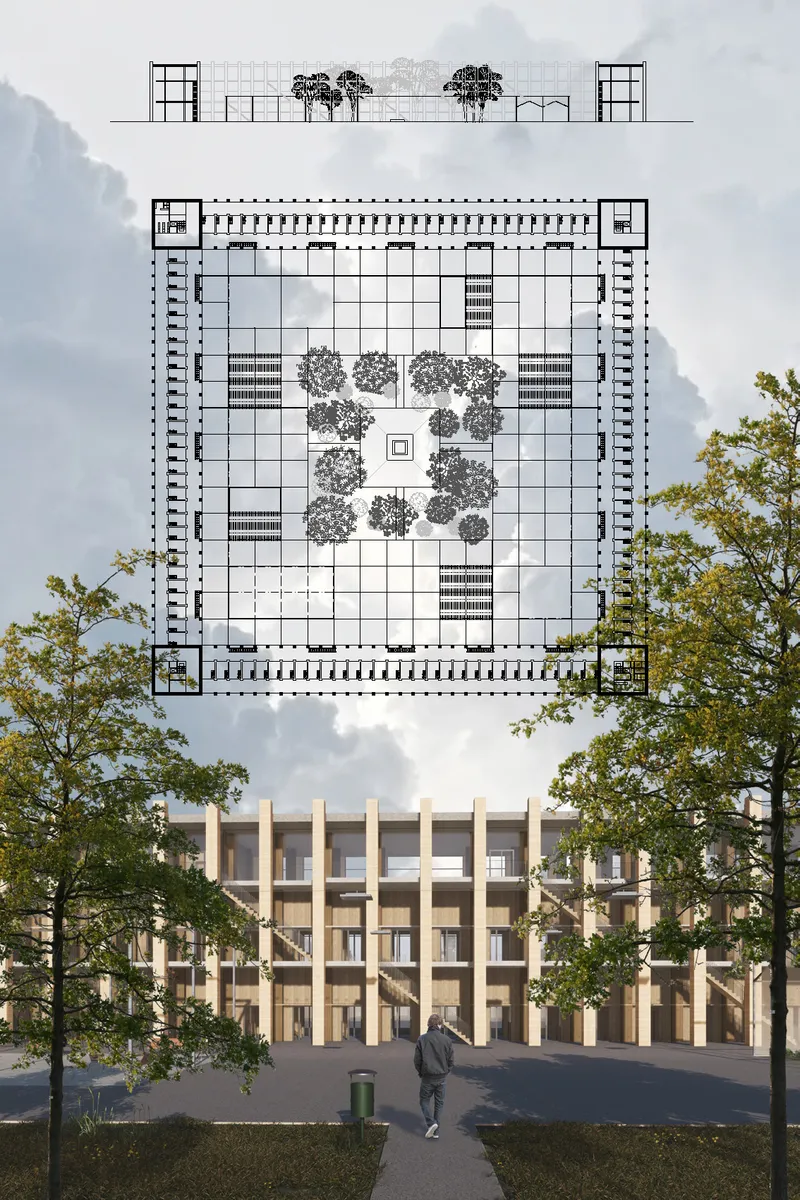
The composite of elevation, plan, and rendered facade reveals a building that mediates between enclosure and openness with striking precision. Deep recessed openings punctuate the facade, creating thresholds between interior life and the surrounding tree canopy. These are not token gestures toward nature; the trees are positioned to frame views, filter light, and psychologically soften the boundary condition of the institution. The plan layout suggests a modular logic, with repeatable units that could adapt to different population sizes or security classifications without requiring wholesale redesign.
Timber Corridors and a Multi-Story Atrium as Social Infrastructure
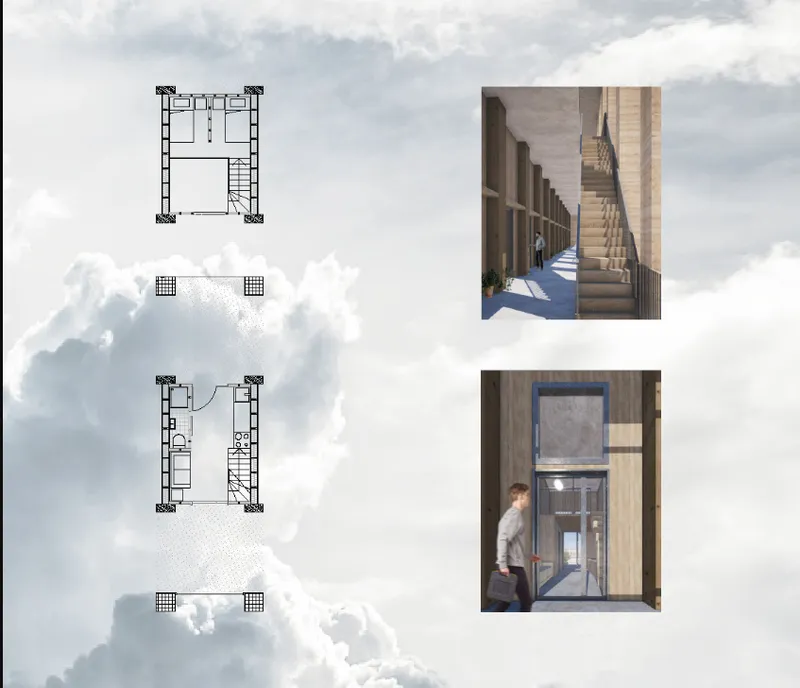
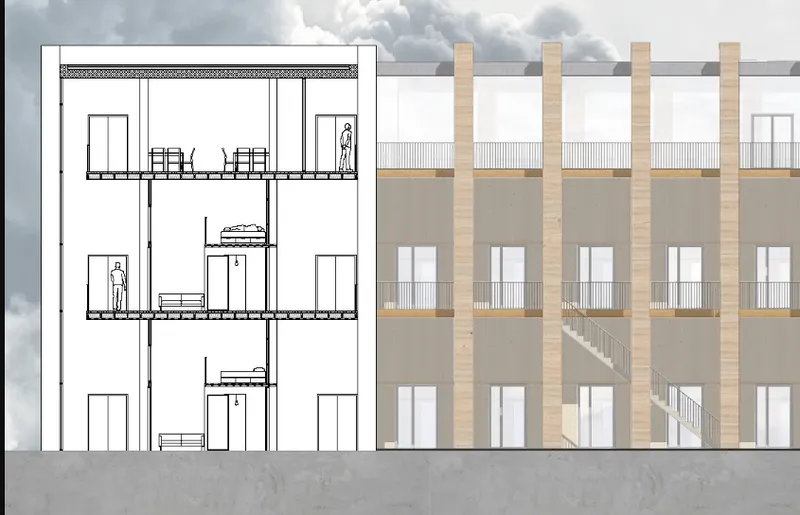
The sectional drawings and rendered views expose the project's interior ambition. A timber-lined corridor runs through the building, warm in tone and tactile in materiality, a deliberate contrast to the steel and concrete that define most carceral environments. The multi-story atrium, shown with a solitary figure for scale, functions as the social heart of the facility. Vertical circulation and visual connections across floors transform what would typically be dead space into an active commons where inmates encounter one another in structured, non-threatening ways.
The second set of section and elevation drawings reinforces the commitment to timber as both structure and surface. Vertical banding on the facade introduces rhythm and texture, while balcony railings suggest that outdoor access is distributed across multiple levels rather than confined to a single exercise yard. This is security architecture that does not look like security architecture, and that distinction matters. The psychological effect of material choice on behavior is well documented; wood reads as domestic, not institutional, and that reading can shift how people inhabit a space.
A Dining Hall Built Around Encounter, Not Control
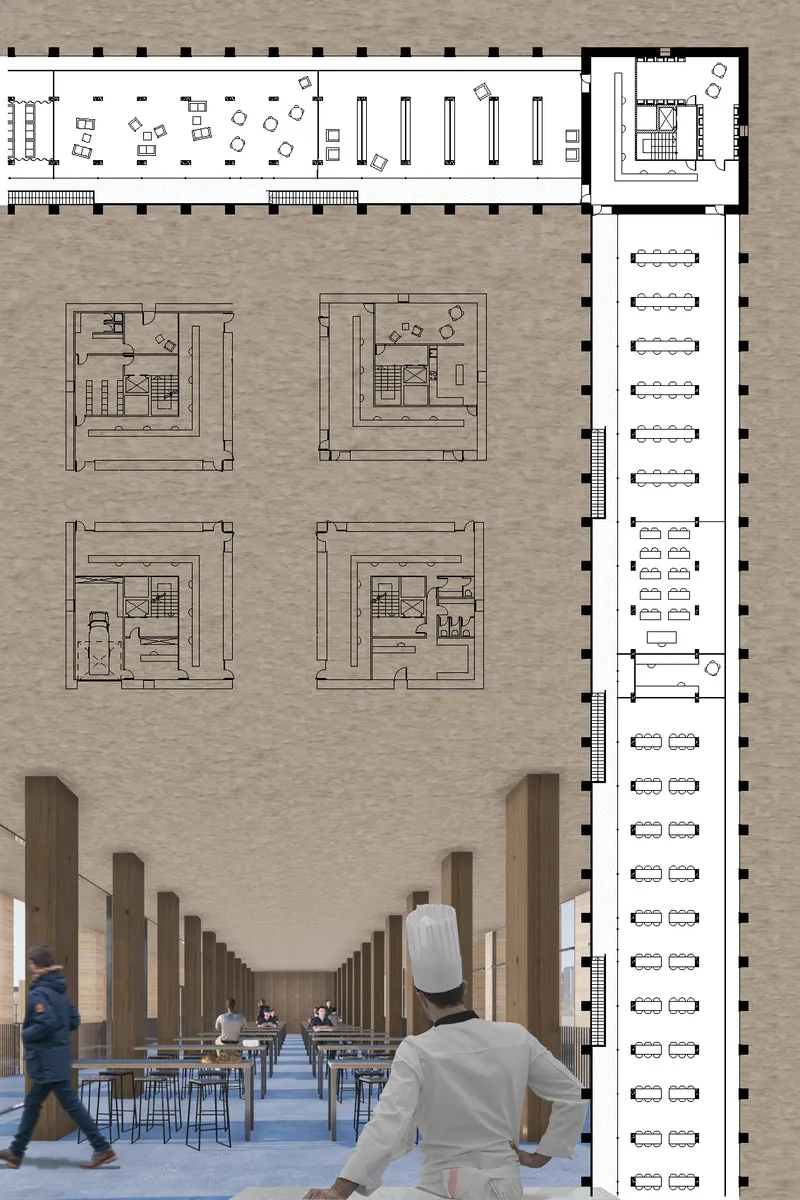
The floor plans above a perspective view of the dining hall complete the programmatic picture. Timber columns rise through the space, supporting a generous ceiling height that gives the room a civic quality rather than a cafeteria one. Scattered tables replace rigid rows, encouraging smaller group interactions and allowing individuals some agency over where and with whom they sit. Figures populate the space casually, and the rendering deliberately avoids the regimented geometry that typifies institutional dining. This is community-oriented space at its most legible: architecture that trusts its occupants enough to offer choice.
Why This Project Matters
01 | Prison does not propose a utopia. It proposes a recalibration. By addressing cybercrime, a category of offense that barely existed a generation ago, Gay and Servier force a broader conversation about whether inherited prison typologies serve anyone well. Their answer is grounded in specifics: timber structure for warmth and sustainability, modular planning for adaptability, biophilic design for psychological well-being, and communal programming for social reintegration. Each decision is legible in the drawings.
The People's Choice Award signals that this resonated beyond the jury. Voters recognized something in the project's refusal to accept that security and dignity are opposed values. As incarceration rates climb globally and recidivism remains stubbornly high, work like this argues that architecture is not a passive container for punishment but an active participant in rehabilitation. That argument, made this clearly and this specifically, is worth taking seriously.
View the Full Project
About the Designers
Designers: Fabian Gay, Thibaut Servier
Enter a Design Competition on uni.xyz
uni.xyz runs architecture and design competitions year-round that reward proposals with spatial conviction and real site intelligence.
Project credits: 01 | Prison by Fabian Gay, Thibaut Servier Switching Prisons (uni.xyz).


Popular Articles
Popular articles from the community


GROUP A Strips a 1969 Rotterdam Harbor Headquarters to Its Frame and Wraps It in Timber Louvers
In Rotterdam's M4H harbor district, Ferro Offices reuses a 1969 frame, adds one timber storey and reaches BREEAM-NL Outstanding.

LT2A and OPEN Architectes Thread a Brick and Glass High School Through a Wooded Belgian Campus
In Braine-l'Alleud, a 3,000 m² wing for Collège Cardinal Mercier pairs pale brick with a glazed colonnade, deferring to a small chapel and a dense wood.

David Ortega Stacks a Two-Story Mexico City Penthouse Around a Steel Stair and a Pergola-Shaded Roof Terrace
In Colonia Roma, a 300 m² penthouse uses oak joinery, a planted steel stair and a slatted roof pergola to make a new-build apartment feel like a house.

Cube Design Draws an Ecological Corridor Between Two Shenzhen Hills with the Nankai Building
Beside Shenzhen's container docks, the Nankai Building pairs stacked balconies with a climbing green screen to connect two hillsides across its height.

Similar Reads
You might also enjoy these articles


Vereda Arquitetos Renovates a 40-Square-Meter Apartment Inside Niemeyer's Copan Building
A compact unit in São Paulo's most iconic residential tower gets a material overhaul that pairs exposed concrete with bold blue Formica.

Shakur's House: Exposed Brick as an Interior Organiser in a 168 m² Mashhad Residence
Brick moves indoors in this Mashhad residence, where masonry walls, glass partitions and teal planes sequence a compact home without closing it off.

Day and Night Park: A Time-Based Urban Newsstand in Beijing
A temporary urban newsstand in Beijing blending travel, light, and reading through poetic colors, compact form, and community-focused design.

Modernist Patio Renovation in El Masnou, Barcelona by Oliver Segura Arquitectura + Cebrià Arquitectura
Modernist patio renovation blending tradition and innovation with a movable pool, leveled floors, and Catalan materials in El Masnou.

Comments (0)
Please login or sign up to add comments
No comments yet. Be the first to comment!