

SAHAARA: A Polar Daycare That Rewrites the Igloo for Early Childhood Learning
Dome-shaped volumes, recycled rubber play surfaces, and vernacular climate logic create a child-centric micro-community in extreme cold.


What happens when you take the structural logic of an igloo, strip away its impermanence, and rebuild it as a place where three-year-olds learn to paint on walls? SAHAARA (सहारा), meaning support, answers that question with a daycare facility sited in a polar region, where curved dome geometries deflect snow, absorb sunlight, and enclose spaces finished in pink recycled rubber flooring. The building refuses the obvious move of sealing children inside a thermal box. Instead, it distributes programme across clustered pavilions, outdoor play zones, and interconnected ramps, treating extreme climate as a design constraint to be negotiated rather than hidden from.
Designed by Smarth Sharma and published on uni.xyz, the project reinterprets vernacular polar architecture through a contemporary lens. The dome typology is not nostalgic set dressing; it performs. Curved envelopes reduce snow buildup and minimize heat loss, wide tinted glazing distributes daylight evenly across interiors, and earth-insulated lower levels retain warmth passively. Every formal decision circles back to a dual mandate: keep children warm and keep them curious.
Pink Rubber Against White Snow: A Courtyard That Invites Entry
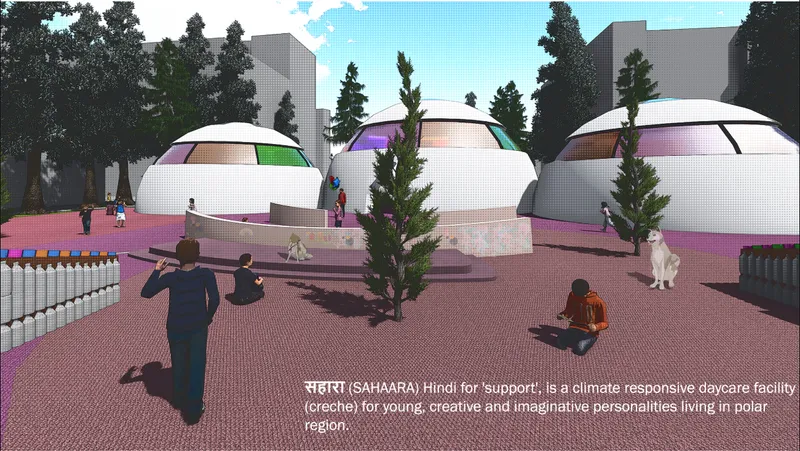
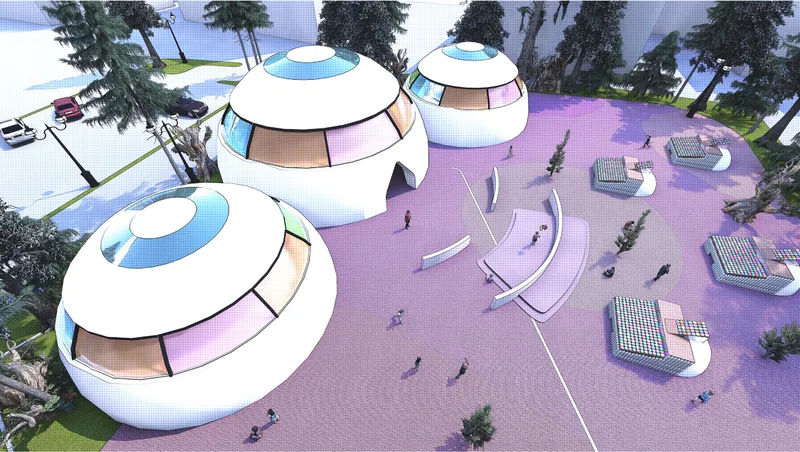
The first view of SAHAARA announces its intent immediately. A pink recycled rubber surface sprawls across the courtyard, offering warmth, slip resistance, and a deliberate visual contrast to the surrounding snowscape. Igloo-like prototypes built from wooden frames filled with recycled plastic bottles and cups punctuate the landscape, serving simultaneously as informal play zones, seating areas, and material experiments in reuse. Young evergreen trees line the paths, functioning as wind buffers while softening the geometry of the domes behind them.
From above, the clustering strategy becomes legible. Dome pavilions with colored clerestory panels gather around a central plaza, their orientation calibrated to maximize solar gain throughout the day. Outdoor play areas occupy the zones receiving the most sunlight, a planning decision that extends usable outdoor time even during long, cold winters. The arrangement reads less like a single building and more like a small settlement, a child-centric micro-community where architecture shapes social encounter rather than merely sheltering from weather.
Below Grade, Below Zero: Learning Spaces Warmed by Earth
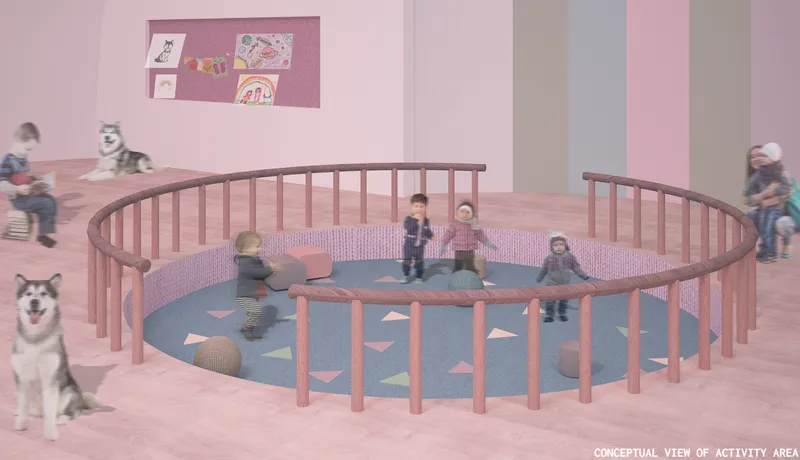
The lower level houses SAHAARA's primary learning spaces, library, and activity zones, all benefiting from the passive thermal advantage of earth insulation. A circular play pit with a timber railing and blue cushioned floor sits at the heart of this level, scaled to small bodies and designed for tactile engagement. Rubber and wood dominate the interior material palette, chosen for warmth, comfort, and sustainability. Centrally located hydration points on both floors reinforce the spatial idea of shared, communal resources rather than isolated programme rooms.
Connecting the ground floor and lower level is an S-shaped ramp that does more than solve vertical circulation. Its curving path creates moments of visual interaction between levels, letting children see activity happening above or below them as they move. Large white canvas walls appear throughout the play areas, inviting children to draw, paint, and personalize their environment. It is a small gesture with outsized effect: the architecture becomes a surface for self-expression, shifting ownership of the space toward its youngest users.
Curved Thresholds and Raised Planters: Climate Strategy at the Entrance
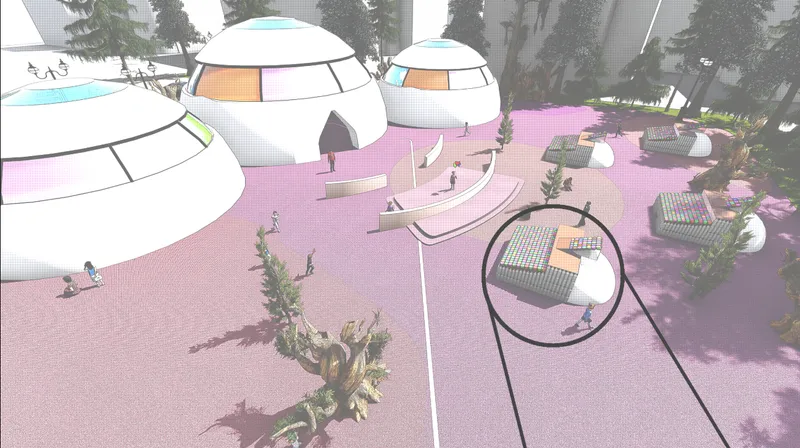
The entry sequence reveals how climate performance and spatial experience overlap. White dome entries emerge from misty daylight, their curved profiles shedding precipitation and reducing wind exposure at the threshold. Raised planters along curved paths introduce greenery at a scale children can interact with, while the elevated walkways keep foot traffic above potential snow accumulation. Wide glazed openings are positioned to capture daylight without compromising thermal comfort, a calibration that balances visibility with insulation.
What makes these thresholds effective is their refusal to treat arrival as a binary event, where you are either outside in the cold or inside in the warm. The transition is graduated. Landscaping buffers wind, covered paths moderate temperature, and the dome geometry funnels daylight into arrival zones before users reach the fully conditioned interiors. For young children being dropped off by parents, this spatial gradient reduces the shock of moving between environments, a consideration that is physiological as much as architectural.
Why This Project Matters
Designing for children in extreme climates usually produces two kinds of buildings: sealed thermal envelopes that prioritize survival, or whimsical forms that prioritize play but ignore performance. SAHAARA sidesteps this dichotomy. Its dome structures are not decorative references to igloos; they are functional envelopes whose curvature minimizes heat loss and deflects snow. Its pink rubber courtyards are not aesthetic indulgence; they provide slip resistance and warmth underfoot. Every playful element carries a performance justification, and every performance strategy enables play.
Smarth Sharma's project also demonstrates something architects working in polar contexts often overlook: the value of outdoor space. By orienting play zones toward maximum solar exposure, buffering wind with trees and raised planters, and using recycled materials to build interactive installations directly on the landscape, SAHAARA argues that children in cold climates deserve generous exterior environments, not just insulated rooms. The vernacular wisdom of the igloo is preserved, but its ambitions are expanded. Support, as the name promises, extends from structure to pedagogy.
View the Full Project
About the Designers
Designer: Smarth Sharma
Enter a Design Competition on uni.xyz
uni.xyz runs architecture and design competitions year-round that reward proposals with spatial conviction and real site intelligence.
Project credits: सहारा (SAHAARA) // DAYCARE FACILITY by Smarth Sharma.


Popular Articles
Popular articles from the community


longwave studio Reorganizes a 112 m² Tainan Apartment Around the Daily Routines of a Family and Two Cats
In Tainan, Taiwan, birch plywood, rust-red furniture and a freestanding plaster wall link arrival, storage, work and family life in one apartment.

Juan García Correa, John González and Claudia Rueda Sink a Circular Amphitheater into a Manizales Engineering Building
On the La Nubia campus in Manizales, Colombia, the S1 Building folds labs and offices into a hillside of ramped lawns that double as a campus route.

Cube Design Draws an Ecological Corridor Between Two Shenzhen Hills with the Nankai Building
Beside Shenzhen's container docks, the Nankai Building pairs stacked balconies with a climbing green screen to connect two hillsides across its height.

David Macias Steps a Doorless Stone and Plaster House Down a Tropical Colombian Hillside
In the humid hills of Colombia, Threshold House replaces the front door with an open void and terraces its 850 m² down the slope instead of fighting it.

Similar Reads
You might also enjoy these articles


Aquadapt: An Underwater Habitat That Rewrites Its Rooms by the Hour
Curved modules ring the seabed while one shell shifts from breakfast room to cinema, farm and football pitch as residents' needs change.

Play: Fragments of Their World: Remembered Architecture Rebuilt as a Modular Playground for Refugee Camps
Tom Gardner abstracts domes, arches and towers from the homelands of displaced families into a kit of child-scaled play parts for camp settlements.
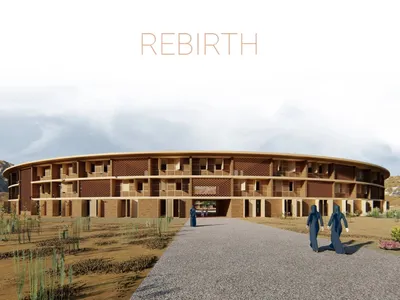
REBIRTH: A Circular Settlement Where Afghan Widows and Their Children Rebuild Life Together
A shortlisted Resile entry turns the circle into a protective ring of timber and brick, gathering homes, classrooms and gardens around a shared landscape.
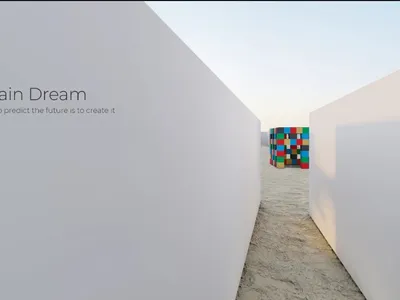
The Main Dream: A Recycled Plastic Kit That Lets Refugee Children Build Their Own Playground
Thirty-centimetre interlocking cubes that connect on three axes turn play into construction, letting children author the spaces they occupy.


Comments (0)
Please login or sign up to add comments
No comments yet. Be the first to comment!