
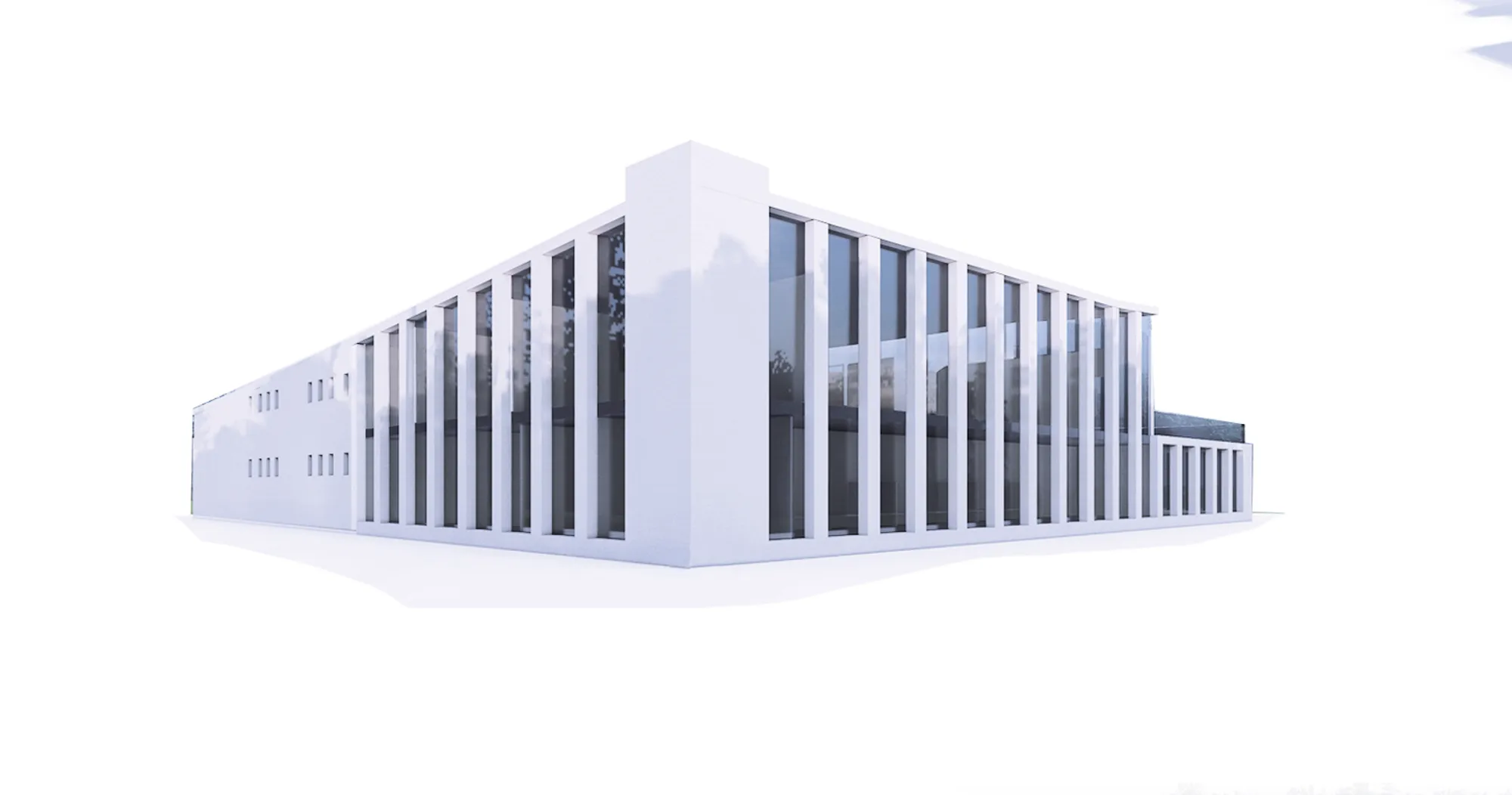
Salzburg Forum
A representation of hierarchy and enclosure
- Introduction
A townhall is a representative entity for the public, and it is the base for the council members and employees. The nature of its function dictates formality on the building, which tenet to be solid and rigid as a symbolic statement for authority. Incorporating cultural activities which make the community a part of the building use may change the way it is preserved and provide a new angle on how architecture can change the sense of place and shift the perspective into more of a people-oriented building rather than authority oriented.
The townhall is located in Salzburg, Austria, it is a city with rich history famous for being the birthplace of W. A. Mozart. It has a unique identity and is well known for its landscape, art, and culture which can be seen reflected in its architecture both historic and modern, Salzburg city center is known for its historical landmarks such as museums and public buildings.
- Project goal
The main goal was to make the people feel connected to the building, in order to excel in its original function as an administrative institute. The concept is to reflect the hierarchy and approachability, the idea was to create spaces that are accessible to the public, in a way to integrate the community and add value to the governmental building beyond its main function.
- Design process and conceptual massing
The design process started from the mass’s conceptualization into a functional analysis that fits the criteria of a public building and interprets the concept of public integration.
(1) The design started with a rigid cube as a representative of the nature of the administrative function of a townhall. (2) Another tilted cube deconstructed the rigidity; it was placed in the middle with 45 degrees rotation and will function as the atrium and distribution point and the entrance which was subtracted as a path leading to the central point which was the dominated element in separating the mass.
(3) The mass around the atrium is inclined reflecting hierarchy and enclosure, starting with an outdoor stair from the ground level until it reaches the highest point in the building.
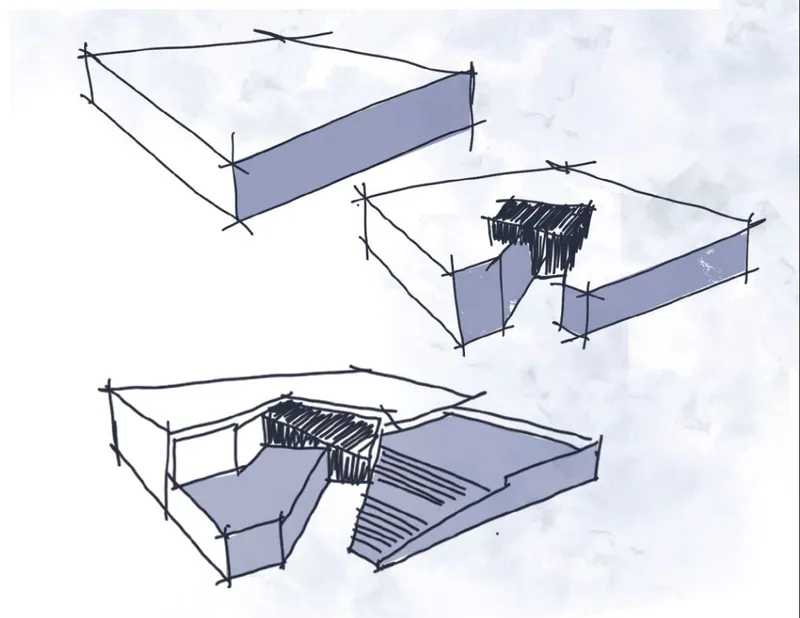 Conceptual diagrams
The separation of public and private use was taken into consideration while designing the functions, public functions as the library, exhibition were placed with separate entrances, the library was created underneath the outdoor stairs which created an interesting interior space under the stepped ceiling, this space will be a lounge and informal reading space in the library.
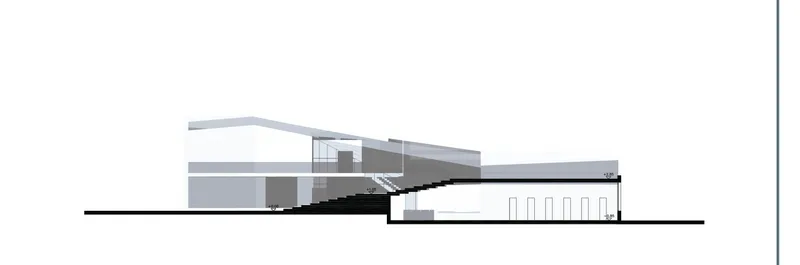 Library section
The exhibition takes place on the first floor, and it is accessed from the iconic outdoor stairs, with a spacious terrace in front of it which is also for public gatherings.
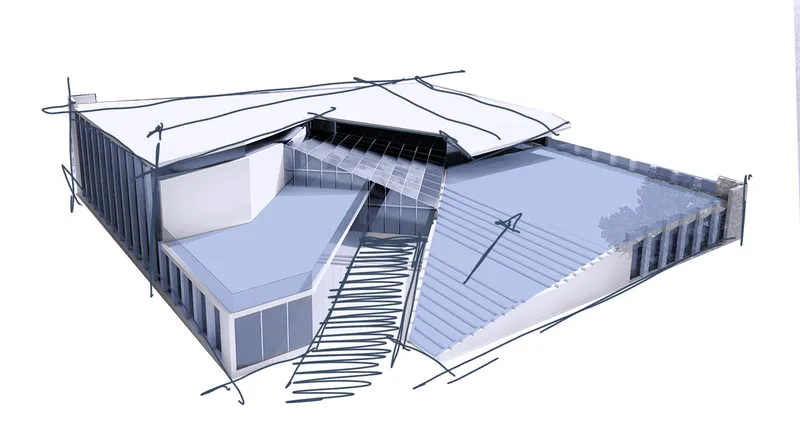 Spatial organization
The offices which are considered semi-public were divided into private administrative offices and public service windows for the users, a nearby café is also for the service of waiting it was placed on the main façade with curtain walls facing the outdoor. Two meeting rooms and one large conference hall are more semi-private areas on the ground floor with more private access, it is leveled 1.5 down from the main entrance. At last, the main function which is the council chamber is placed on the first floor, in the highest point of the mass representing the hierarchy of functions.
- The Building Image
The image of the building is inspired by the classical colonnade of townhalls and forums, this image of the colonnade was abstracted and interpreted in a contemporary style, concrete columns spanning from the ground floor to the first was the dominant element in the design of the facade gives the sense of stability and formality of the building, in paradox the inclination of the mass, the rotation of the atrium and the outdoor stairs breaks this image slightly to ensure the sense of accessibility for the public.
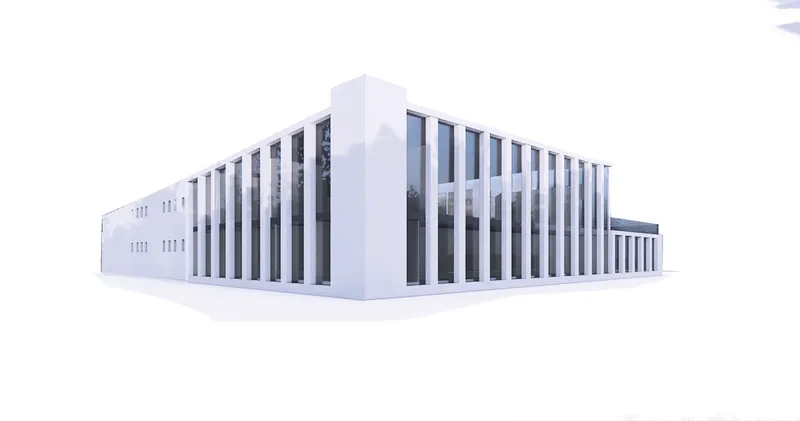 Building Image
The material used are white concrete, dark glass, and steel, the choice of these materials was to reflect transparency and clarity of the democratic nature of the building function. Since Salzburg have a cold climate in winter the placement of the atrium and glassed facades is meant to increase the sunlight into the building and provide a warmer ambient. The building provides future expansion through the reuse and utilization of its public spaces and exhibition hall, which can be transomed to host different events throughout the year.
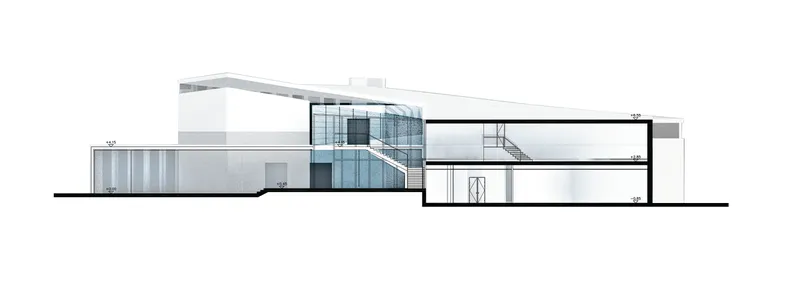 The Atrium

Popular Articles
Popular articles from the community


Hill & Cross Opera: Sculptural Opera House Architecture Shaped by Tallinn’s Landscape and Identity
Hill & Cross Opera reimagines opera house architecture in Tallinn through its sculptural hill, civic plaza, glass wave and a luminous cross.

The Earth Pod: 3D Printed Homes for Resilient Refugee Communities
The Earth Pod reimagines refugee housing through 3D printed homes made from clay, combining resilience, self-sufficiency, and rapid shelter.

Lunar Spiral: Space Architecture Shaped by the Mathematics of the Universe
Lunar Spiral reimagines space architecture through Fibonacci geometry, lunar regolith, levitating habitats, and self-sustaining Moon living.

Riyadh For All: Intergenerational Urban Design for Active Aging in Rabat
Riyadh For All reimagines urban design in Rabat with intergenerational co-living, adaptive courtyards, and Moroccan cultural exchange today.
Similar Reads
You might also enjoy these articles
The Rhythm of Seasons
A Farmers' Market Connecting Nature and the City

More Than a Building-Designing a Living System
More Than a Building-Designing a Living System
Base Beyond
DESERT COMPOUND ARID: TOURISM OF ABSENCE AND ABUNDANCE




Comments (0)
Please login or sign up to add comments
No comments yet. Be the first to comment!