
Sanjay Puri Architects Cascades a Laterite Community Center Down a Hillside Over the Arabian Sea
In Anjarle, India, parabolic volumes of local stone step across a steep coastal slope to form a 32,000-square-foot recreation hub.


Most hillside buildings fight the land. They flatten it, terrace it into submission, and plant a conventional floor plate on top. CREST NINE, a community center perched above the Arabian Sea in Anjarle, Maharashtra, does the opposite. Sanjay Puri Architects let the steep contour lines of the site become the building's organizing logic, stepping a cluster of parabolic volumes down the slope so that the architecture reads less as an object placed on the hill and more as something that grew out of it. The result, completed in January 2026 after four years of design and construction, is a 32,000-square-foot recreational hub for a gated villa enclave that treats topography as its primary material.
What makes the project genuinely interesting is its refusal to be one thing. The plan is not a single monolithic form but a constellation of curved volumes linked by a long circulation spine. That spine guides you from a restrained entrance wall, several meters below street level, through a sequence of increasingly expansive parabolic enclosures that open westward to the ocean. Seventy percent of the built area is naturally ventilated, the roofs dip toward interior courtyards to generate deep overhangs that handle both intense sun and monsoon rains, and the entire structure is clad in locally sourced laterite stone, a material with deep roots in Maharashtra's building traditions. The budget, at just over three million dollars, reinforces the point: this is not spectacle financed by excess but a disciplined response to climate, craft, and terrain.
Reading the Slope
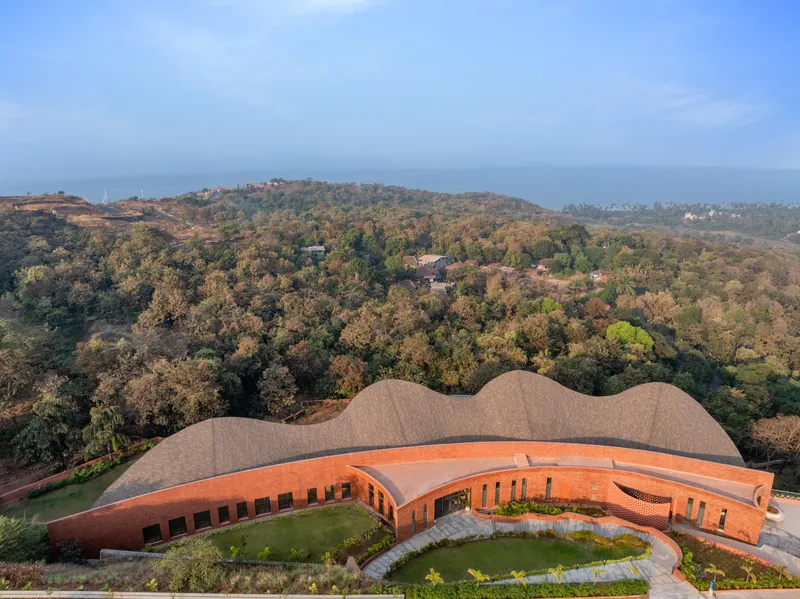
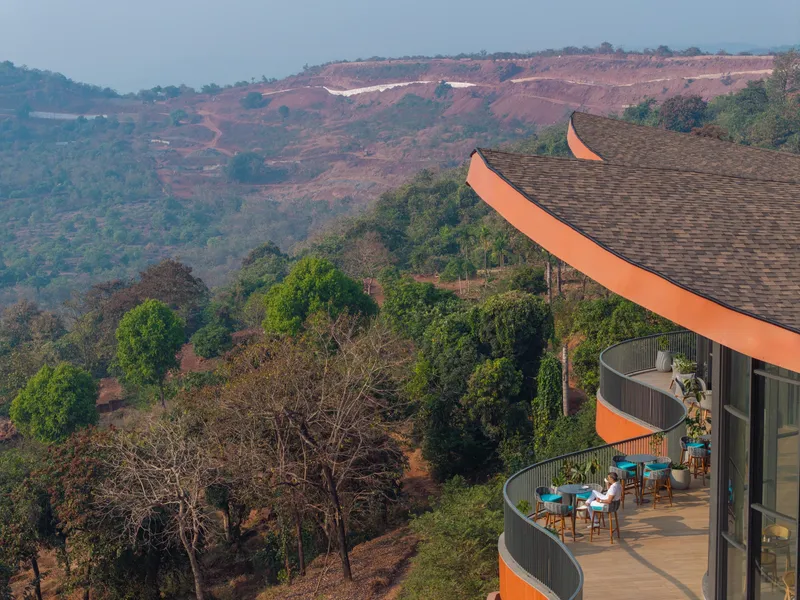
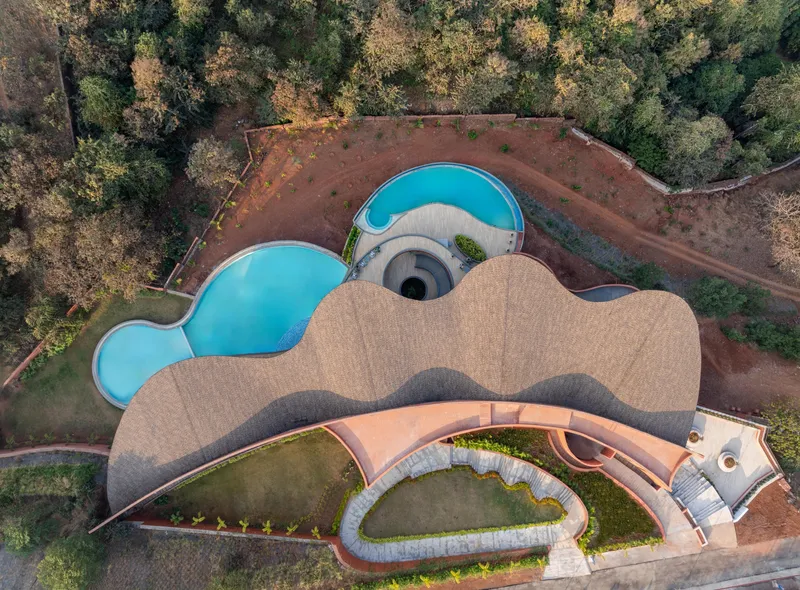
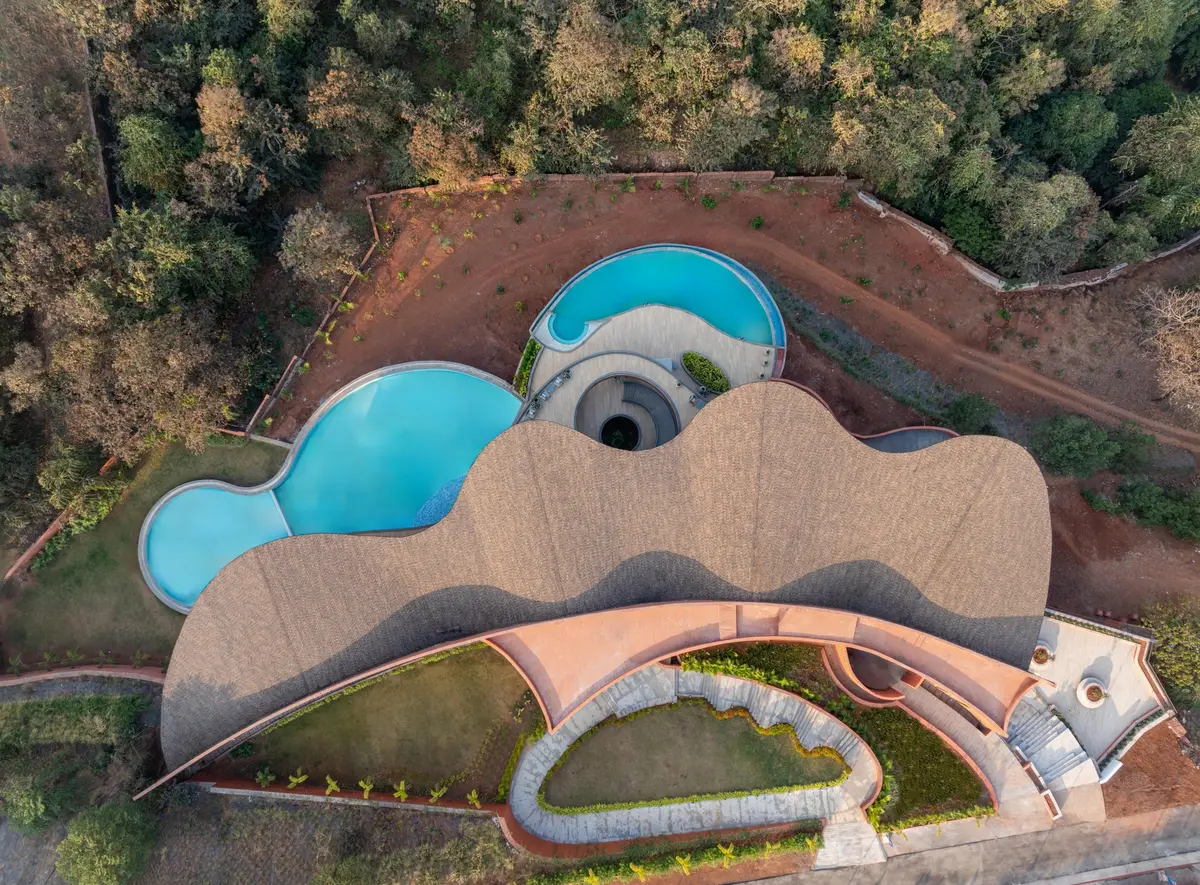
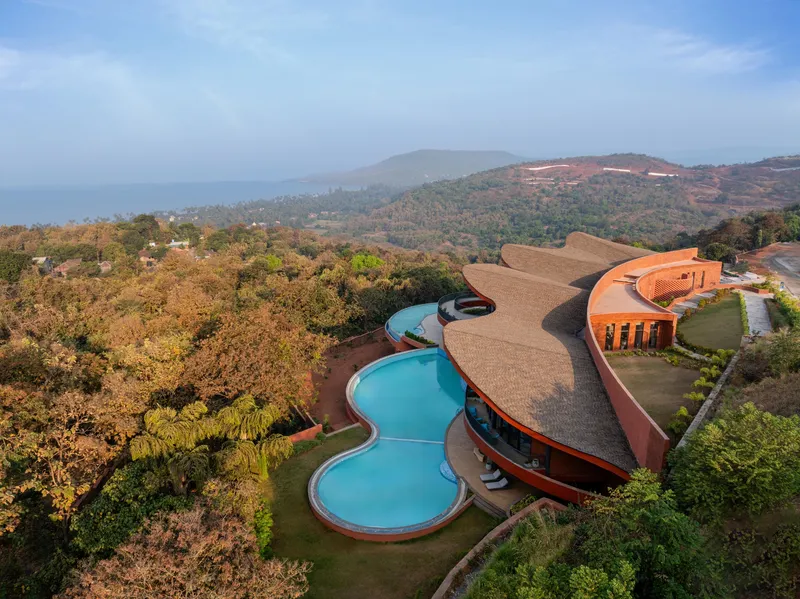
From the air, CREST NINE looks like a series of terracotta shells that have been pressed into the red earth of the hillside. The three-lobed roof form, visible in the aerial shots, echoes the rounded contours of the forested terrain rather than contradicting them. Each lobe houses a distinct programmatic zone, but the boundaries dissolve at the edges where curving balconies with upturned roof edges extend outward over the canopy of trees below.
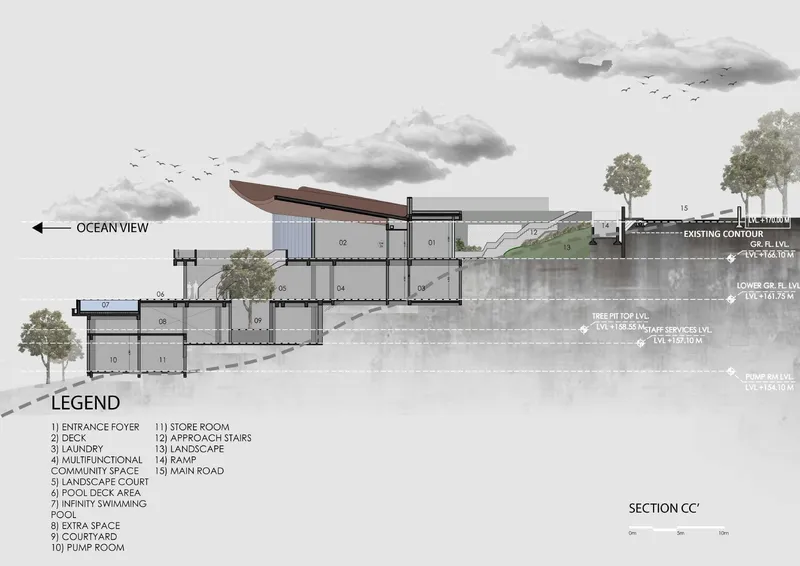
The decision to step down with the slope rather than cut into it to produce a flat surface is the project's most consequential move. It preserves the existing topography, reduces the volume of excavated material, and creates a varied skyline that mirrors the ridgeline behind it. You approach from above, and the building reveals itself gradually, unfolding downhill toward the water.
Entering from Above
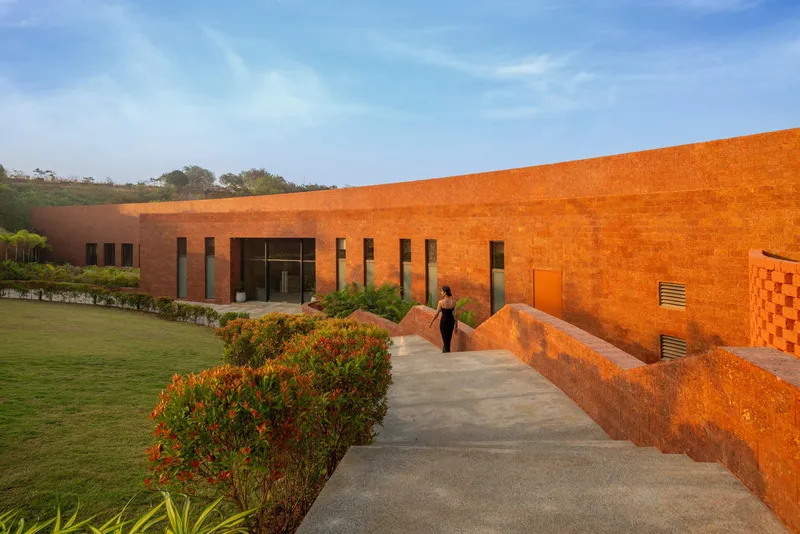
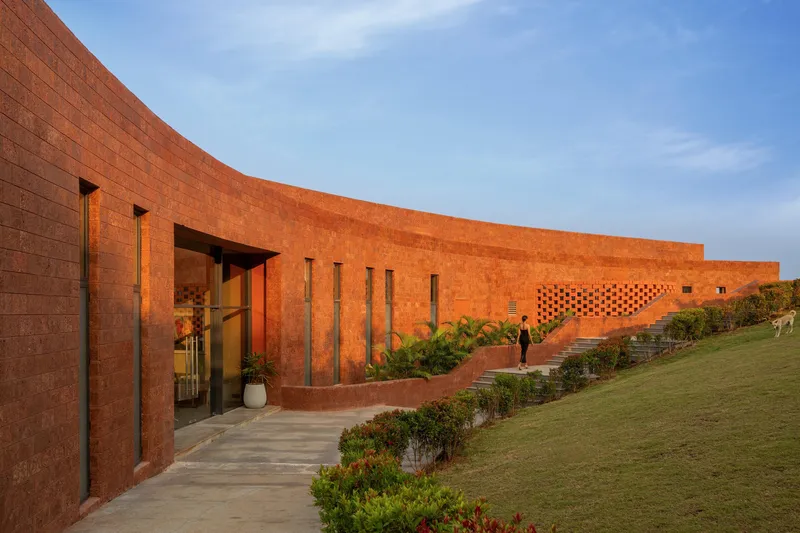
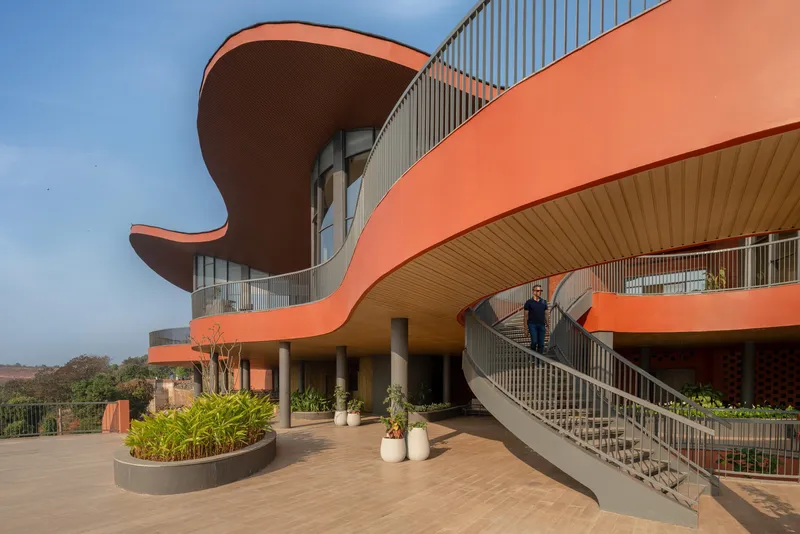
Because the access road sits above the project, the arrival sequence inverts the typical experience of approaching a building at grade. A broad staircase and a gently curving ramp trace the edge of a planted garden, drawing you downward along a restrained wall of laterite stone punctuated by narrow vertical slot windows. At dusk, these slots glow like lanterns, hinting at the interior life without exposing it.
The entrance wall is deliberately muted, almost fortress-like in its solidity. It withholds the ocean view and the expansiveness of the interior, banking on the architectural payoff that comes when you pass through and the building opens outward. A spiraling staircase with vertical metal louvres appears at the threshold, signaling the shift from compression to release.
The Spiral Core
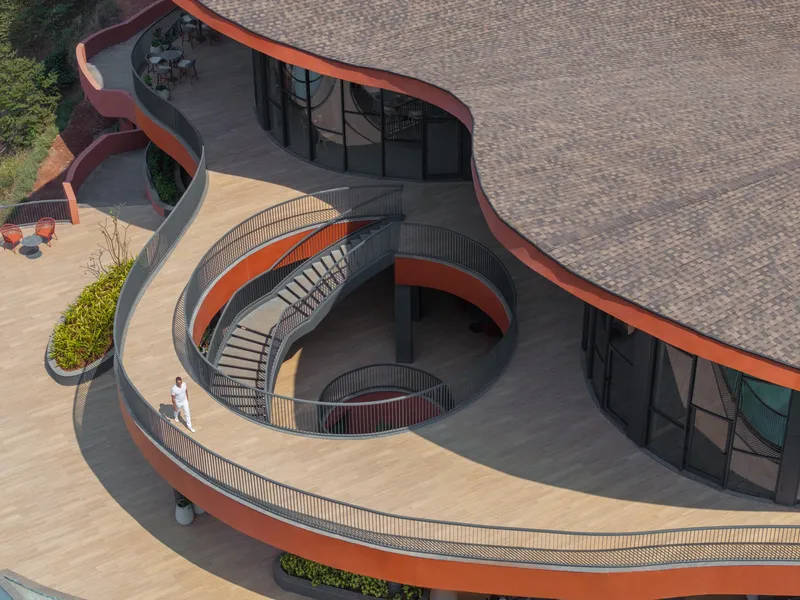
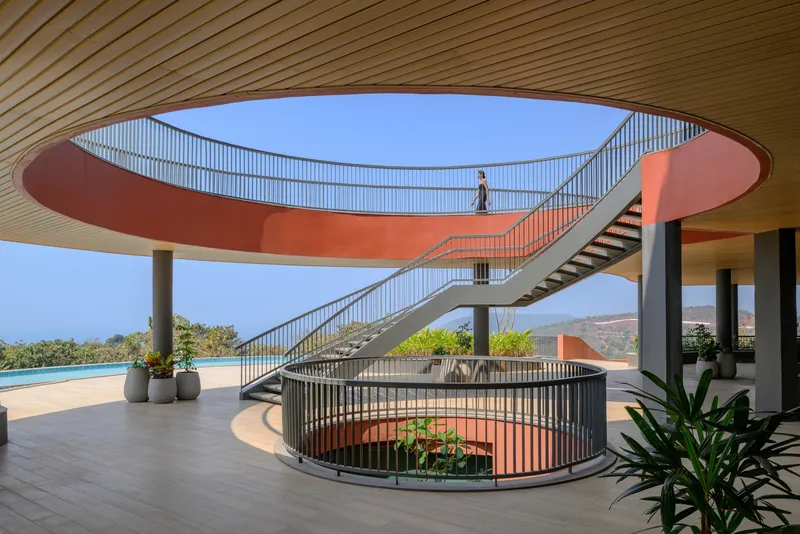
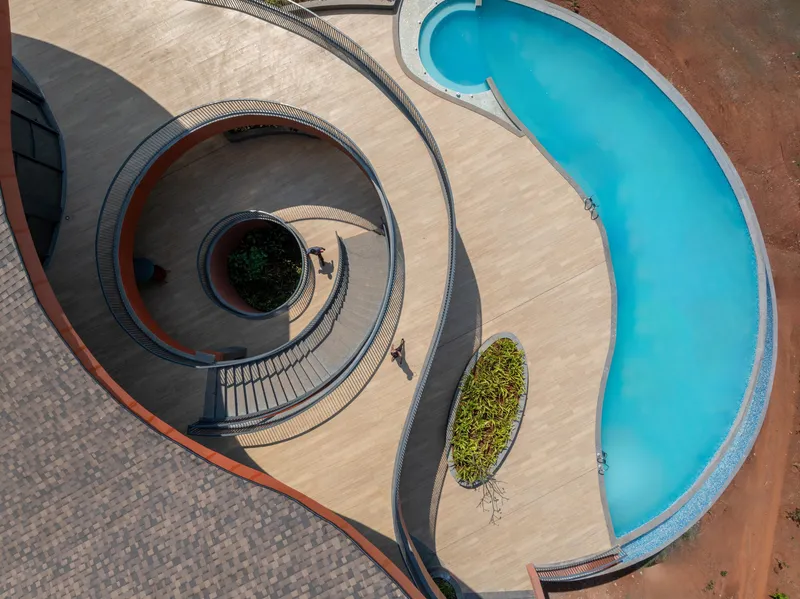
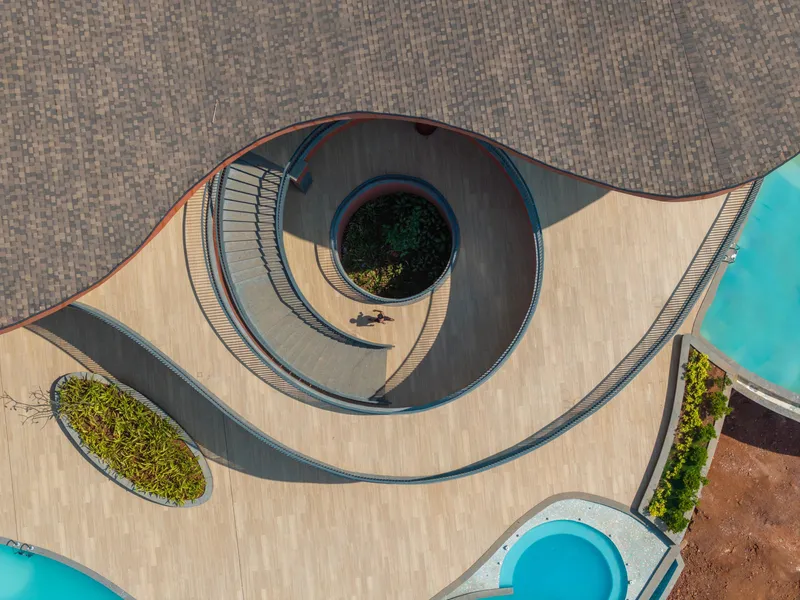
At the heart of the plan sits a circular courtyard around which an open stairway spirals down from the upper program to the pool level. It is the project's vertical spine, the hinge between the indoor sports room, gymnasium, restaurant, and guest bedrooms above, and the three pools, health club, and open cafeteria below. Seen from directly overhead, the spiral reads as a nautilus shell, its geometry reinforcing the building's commitment to organic, non-orthogonal form.
Functionally, the spiral does more than connect two floors. It introduces a moment of pause and orientation. Standing on the curved terrace, you can see the pool deck below and the planted courtyard at the center simultaneously. The orange-trimmed soffit of a curved bridge links the two levels overhead, framing the descent in a warm, saturated light that contrasts with the cooler laterite walls.
Upper Level: Light and Outlook
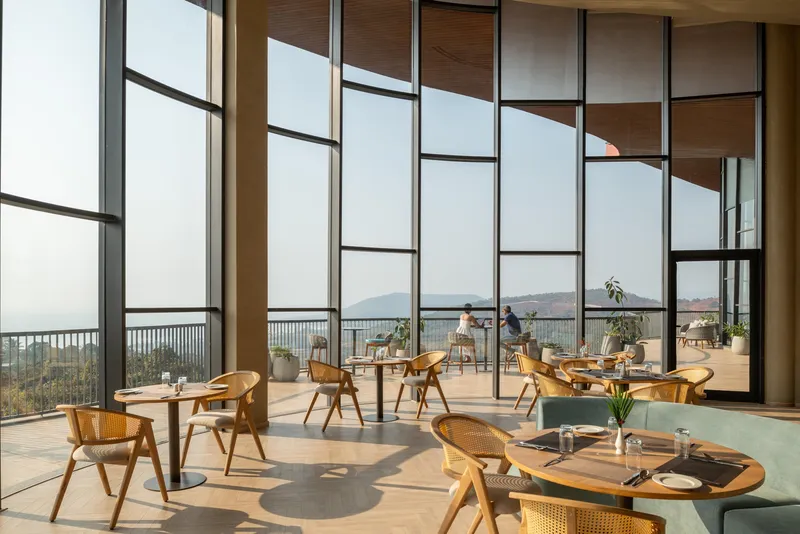
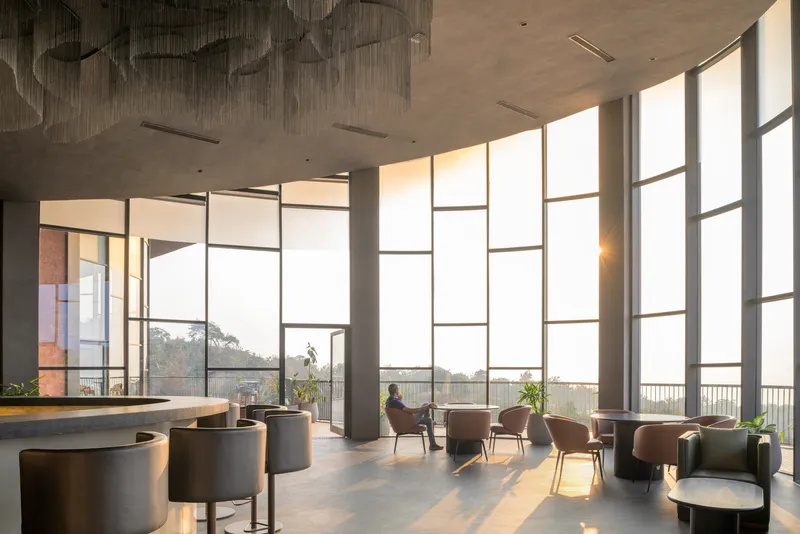
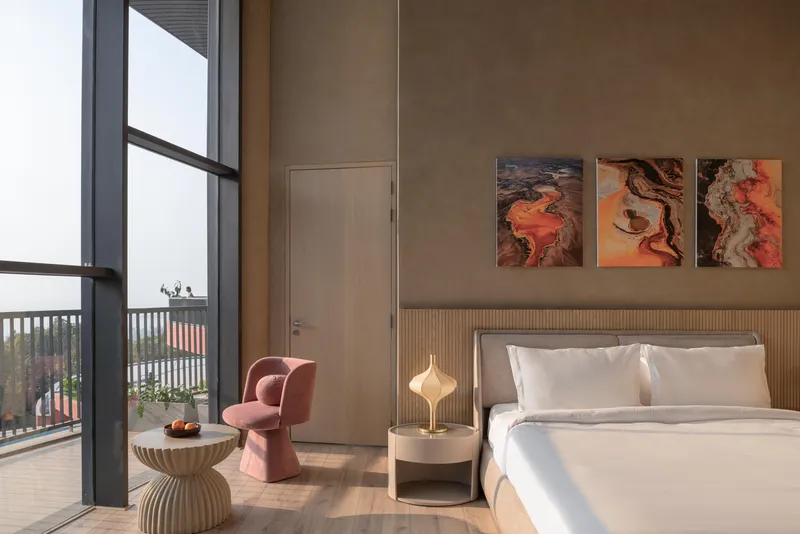
The upper level is where the building's passive strategy is most legible. Tall gridded windows, floor to ceiling, pull afternoon sunlight deep into double-height lounge spaces and dining areas. The glazing frames distant hills on one side and the open ocean on the other, turning every internal room into a viewfinder. Timber furniture and warm-toned finishes absorb the light rather than bounce it, keeping the interiors calm despite the scale of the openings.
Guest bedrooms occupy the quieter end of this level, each with its own terrace oriented west. The curving glazed wall in the fitness room wraps the exercise space in panoramic morning light, a small but telling detail: even the gym is designed with solar orientation in mind, not just tacked onto a leftover corner of the plan.
Interior Atmospheres
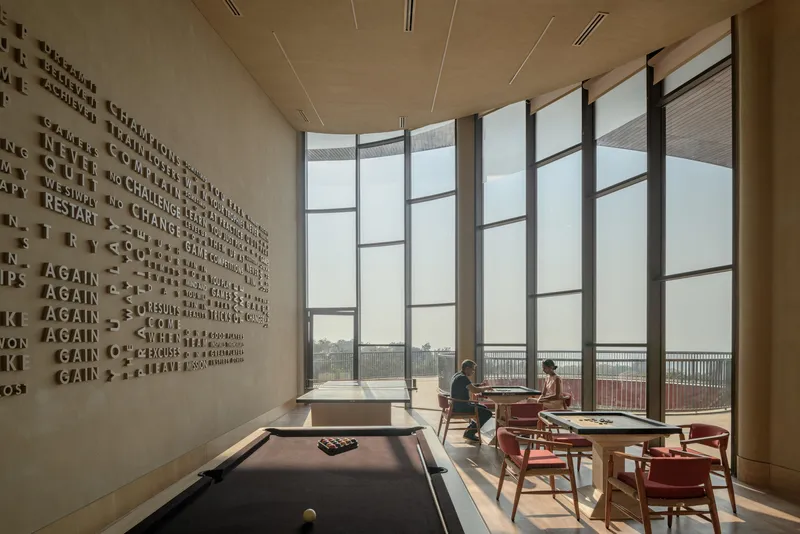
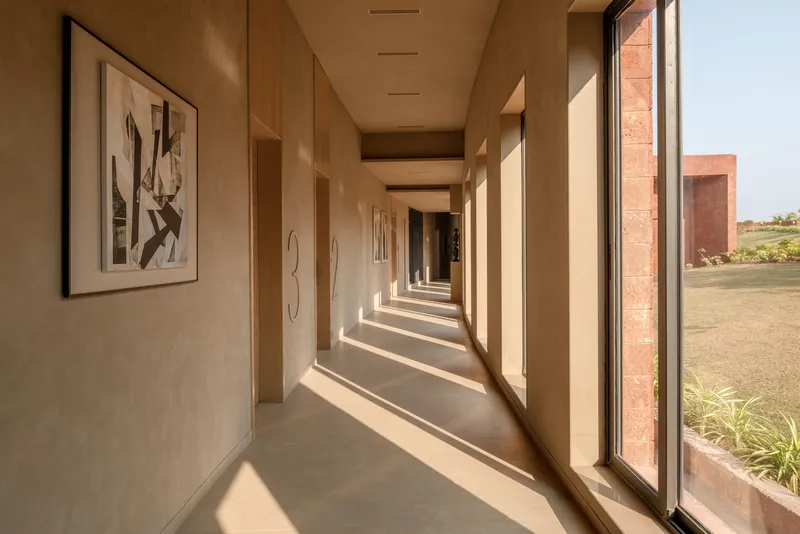
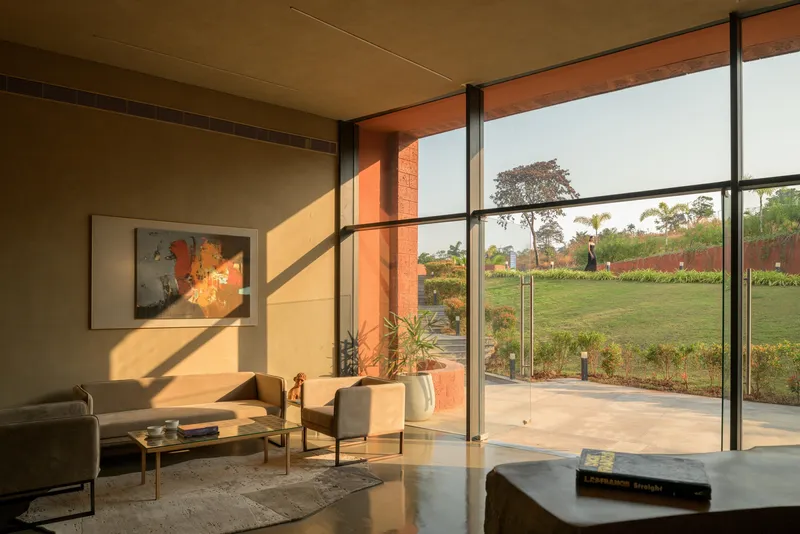
Inside, the corridors become galleries. A long passage lined with framed artworks catches rhythmic sunlight through deep window openings, projecting sharp geometric patterns across the floor. It is one of those moments where the architecture does the decorating. The recreation room takes a different approach, using a raised-lettering feature wall and expansive glazing to create a space that feels both playful and grounded.
Throughout the interior, the curving plan eliminates dead-end corridors and right-angled intersections. Movement feels continuous, even looping. Floor-to-ceiling glass doors in the living areas slide open to planted lawns, erasing the boundary between inside and out. Every internal space receives natural light, a claim many architects make but few deliver across an entire 32,000-square-foot program.
Water and Landscape
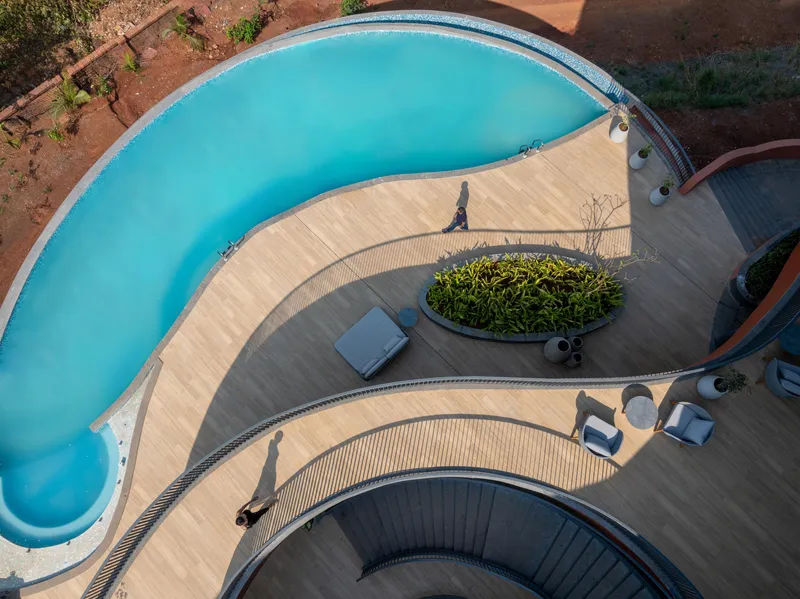
The pool deck is not an afterthought but a primary architectural element. A curving pool extends from the terracotta facade into the landscape like an arm reaching toward the sea. Planted islands and circular water features punctuate the deck, breaking up what could have been a monotonous expanse of concrete into a series of smaller garden rooms. A second, more intimate pool sits at a lower terrace, flanked by reflecting pools that catch the light and bounce it upward against the underside of the canopy.
Landscaped open areas, designed by Studio Roots, weave between the built forms, introducing pockets of vegetation that soften the transition from building to hillside. The planting strategy is simple: work with what grows here, use the courtyards to capture rainwater, and let the monsoon do the irrigation. It is low-tech landscape architecture that serves a high-impact purpose.
Terraces and Overhangs
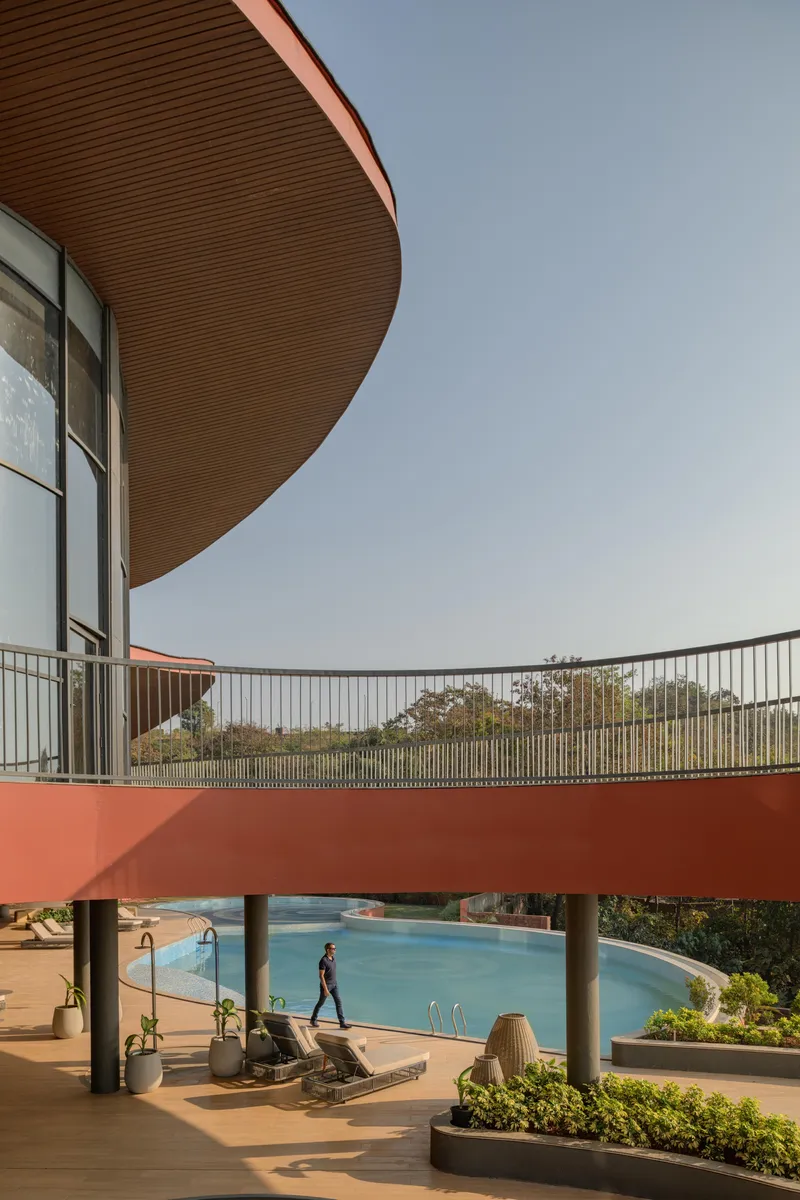
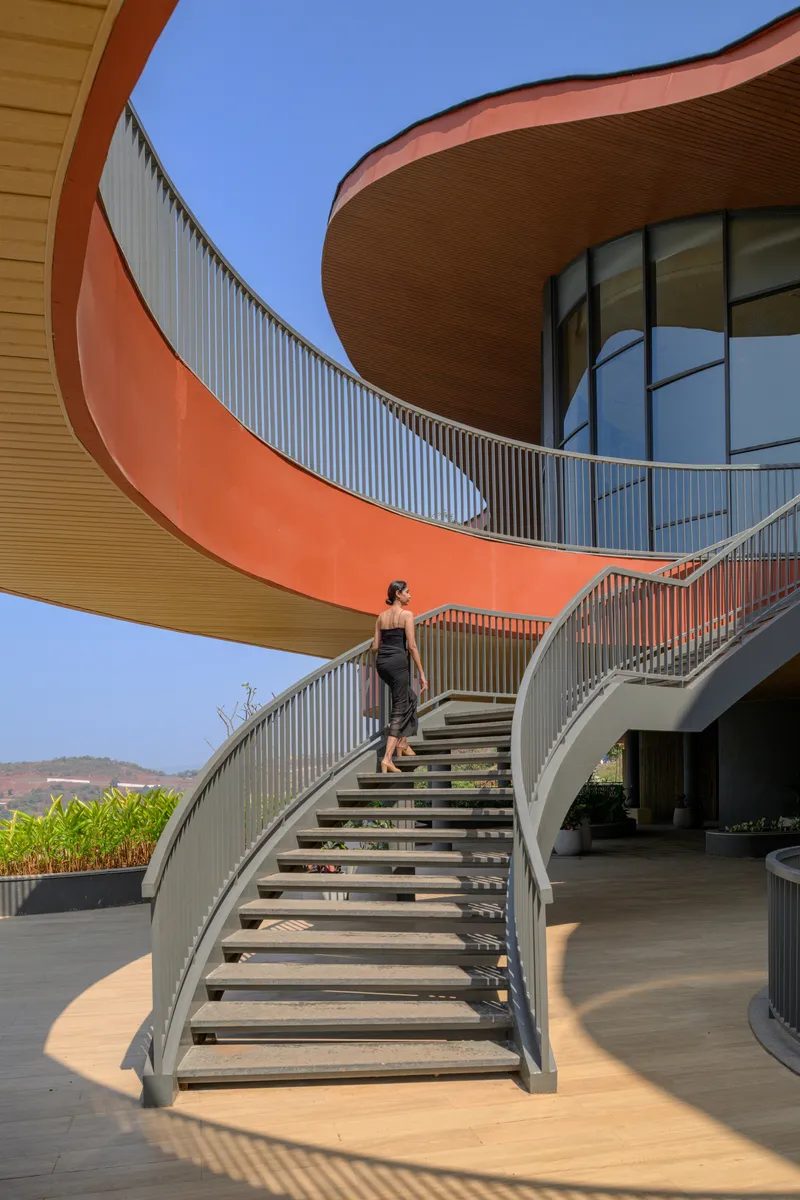
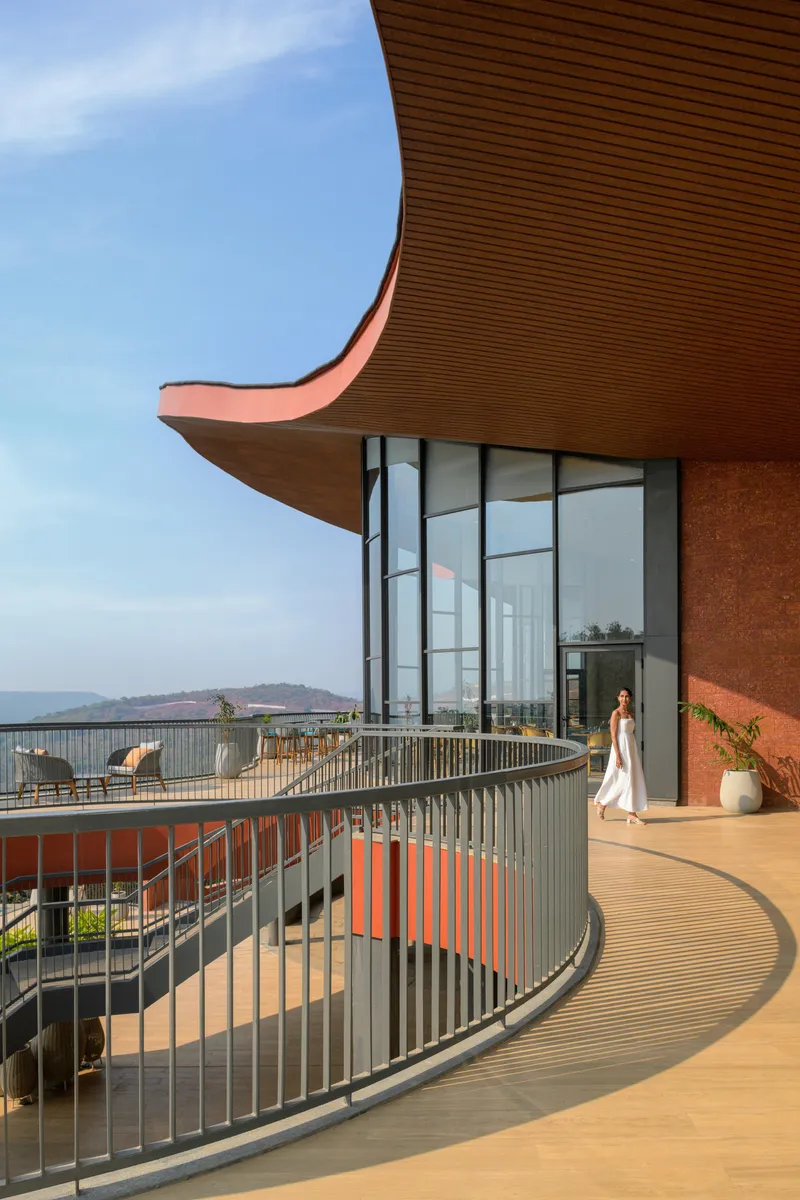
The curvilinear decks that wrap the upper level are shaded by deep roof overhangs that dip toward the courtyards. These are not decorative gestures. In a climate where the monsoon season delivers torrential rain and the pre-monsoon months bring relentless sun, a properly dimensioned overhang is the most consequential detail an architect can draw. Here, the roof's parabolic profile generates overhangs that vary in depth as the form curves, providing more shade where the orientation demands it and opening up where the view rewards it.
Exterior staircases with open risers connect the terraces to the lower decks, their curved geometry following the building's organic language. The metal railings are simple, circular in profile, and painted to match the terracotta palette. There is a consistency of material intention from roof to railing that holds the whole composition together.
Plans and Drawings
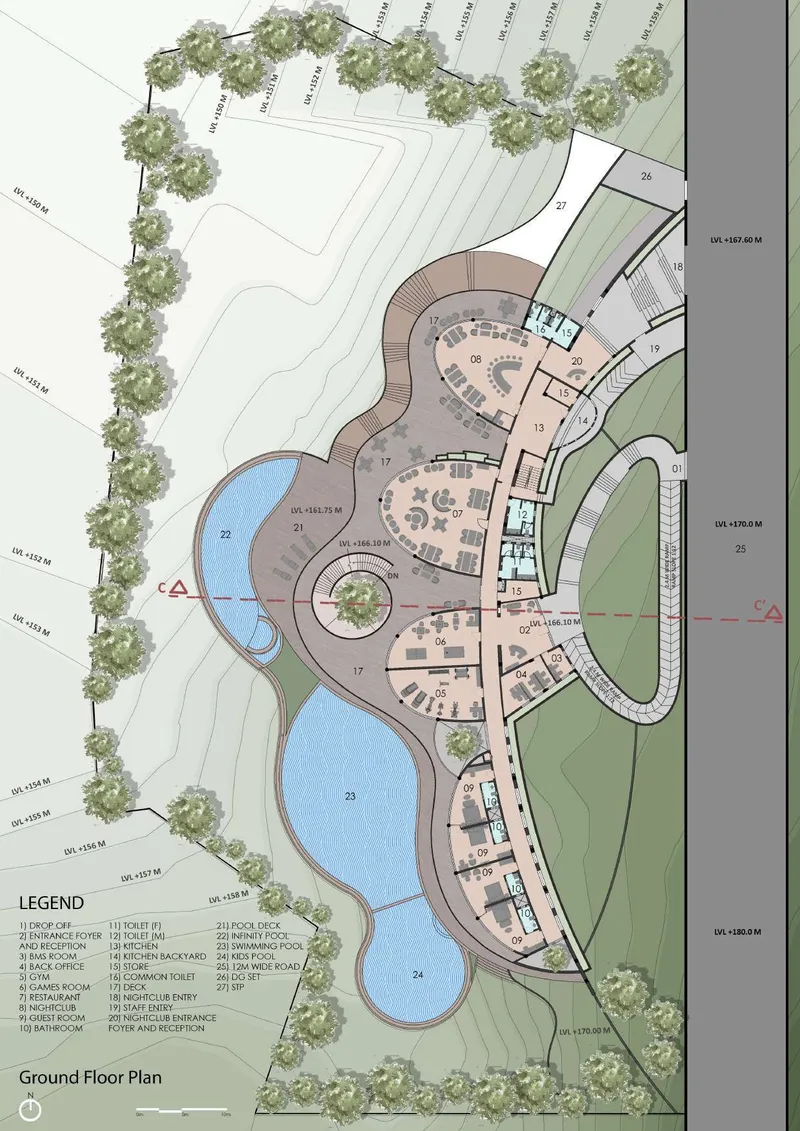
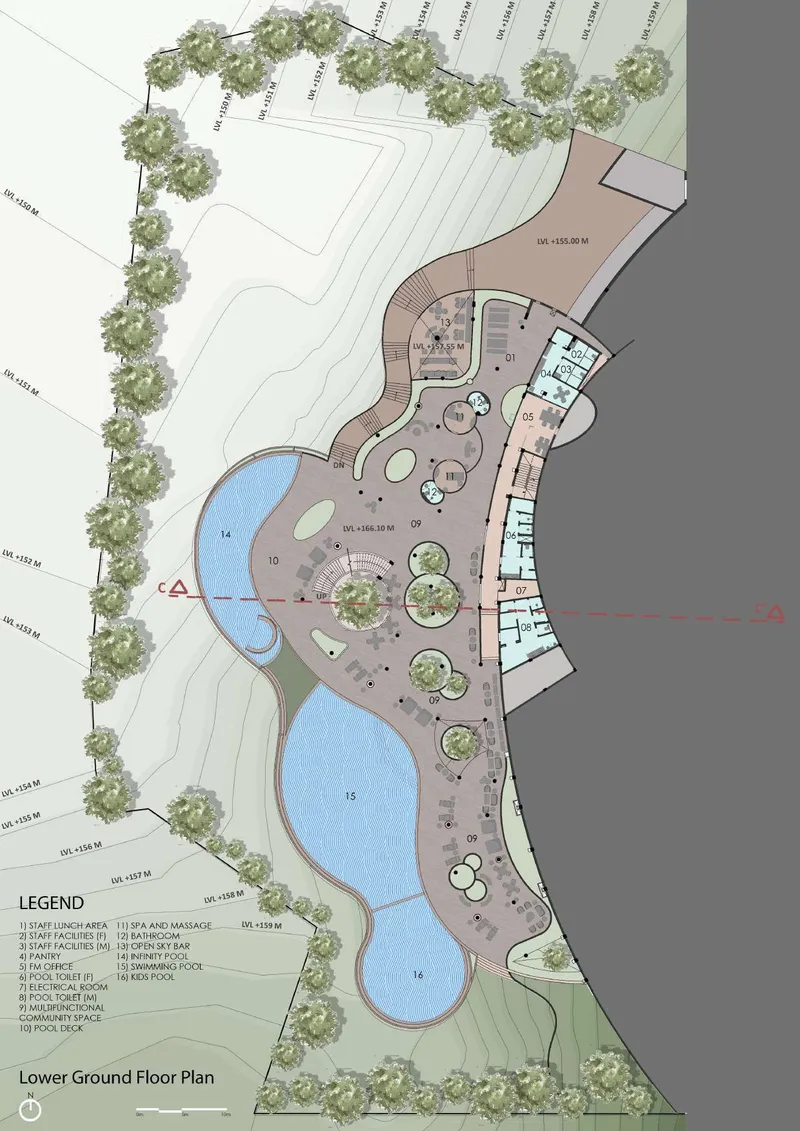
The ground floor plan reveals just how organic the layout truly is. Rooms wrap around the central courtyard in fluid arcs, with no two walls running parallel. The adjacent pools are carved into the plan like negative space, their curving edges continuous with the building's footprint. The lower ground floor plan shows the spa facilities flanked by reflecting pools and circular planted areas, confirming that the landscape is not applied to the building but woven into its structure.
The section drawing is the most revealing. It traces the curved roof canopy as it steps down the hillside in a series of terraced levels, each one dropping closer to the ocean. The relationship between the parabolic roof profiles and the slope's natural gradient is precise: the building neither floats above the terrain nor buries itself in it but occupies a middle condition, nestled into the contours like a hand cupping water.
Why This Project Matters
CREST NINE matters because it demonstrates that a community recreation center, a building type often reduced to generic boxes with pools attached, can be a serious work of architecture rooted in site, climate, and local material culture. By using laterite stone quarried nearby and relying on local contract labor, Sanjay Puri Architects achieved a construction cost of just over three million dollars for a building of considerable spatial ambition. That number represents not austerity but efficiency: money spent on craft and material rather than imported finishes and energy-hungry mechanical systems.
The broader lesson is about how buildings meet the ground. In a global market where hillside development typically means bulldozing a plateau and pretending the slope never existed, CREST NINE follows the terrain, lets it shape the plan, and uses gravity, orientation, and natural ventilation to do the work that mechanical systems would otherwise handle. Seventy percent naturally ventilated, entirely daylit, built from regional stone: these are not aspirational targets listed in a sustainability report. They are the building.
CREST NINE Community Center by Sanjay Puri Architects, Anjarle, Maharashtra, India. 32,000 sq ft (approximately 2,970 sq m). Completed January 2026. Structural consultant: Epicon Consultants Pvt. Ltd. MEP consultants: Epsilon Design Consultancy Pvt. Ltd. Landscape consultant: Studio Roots. Client: House of Abhinandan Lodha (HOABL). Photography by Vinay Panjwani.
About the Studio
Share Your Own Work on uni.xyz
If projects like this are the kind of work you want to make, uni.xyz is a place to publish your own, find collaborators, and enter design competitions.


Popular Articles
Popular articles from the community


Opera by the Sea Estonia: Three Shells Dissolving Architecture into Tallinn's Coastline
A winning opera house proposal replaces monumental form with interconnected shells that blur the boundary between building, park and Baltic Sea.

Faces of the Soviet Avant-Garde: Turning Moscow's Street Names into an Open-Air Museum
A network of sculptural installations across a Moscow residential district transforms forgotten architect names into spatial encounters with cultural memor

Extended Shell: Retrofitting Kolkata's Balconies as Living Urban Thresholds
A modular retrofit system recovers the social and environmental intelligence of Kolkata's historic verandas for contemporary Park Street residents.

The Amber Palace Opera: A Geological Fiction Surfaces on Tallinn's Baltic Waterfront
Pierre Brillard reimagines a Baltic legend as a public landscape, opera house, and waterfront promenade rooted in Tallinn's coastal identity.

Similar Reads
You might also enjoy these articles

Pixel Gardens: One Repeated Module Stacked Into a Terraced Social Housing Tower for Famagusta
Salem Bader's shortlisted housing tower builds a vertical neighbourhood from one repeated module, offsetting units to carve terraces, light and air.

Bao Huynh Watercolor Atelier: A Serene Art Retreat in Hội An
Bao Huynh Watercolor Atelier in Hội An blends multifunctional art spaces, sustainable design, local materials, and family-friendly living in a serene environment.

Atelier Macri Concept Store Interior Design by CASE-REAL
Atelier Macri store features a "ko" counter, walnut wood details, cork displays, blending retail, gallery, and seamless customer experiences.

Manuel Vargas Izquierdo Stadium and High-Performance Sports Center: Architectural Excellence in Jalpa de Méndez
The Manuel Vargas Izquierdo Stadium blends sustainable design, inclusive sports facilities, and cultural-inspired architecture, revitalizing Jalpa de Méndez’s public spaces.

Explore Community Center Competitions
Discover active competitions in this discipline

Challenge to design locus for the upliftment of human rights

Challenge to design mud housing for contemporary communities

Design challenge to reuse E-waste
Comments (0)
Please login or sign up to add comments
No comments yet. Be the first to comment!