

Santa Maria Educational, Sports and Cultural Complex: Adaptive Reuse and Pedagogical Renewal in São Caetano do Sul
Adaptive reuse transforms historic school into light-filled educational, sports, and cultural campus, blending heritage, sustainability, transparency, and community-focused learning spaces.


Located in São Caetano do Sul, the Santa Maria Educational, Sports and Cultural Complex is a thoughtful renovation and expansion project by Carolina Penna Arquitetos that transforms a historic educational building into a contemporary, multifunctional public school campus. Completed in 2022, the 107,639-square-foot complex reinterprets architectural heritage through sustainability, spatial integration, and progressive educational design.


Reconstructing Memory Through Architecture
Originally built in 1968 to house the Ginásio Vocacional da Vila de Santa Maria, the existing structure is part of a broader legacy of the Ginásios Vocacionais, experimental public schools developed in the State of São Paulo between 1961 and 1970. These institutions championed student-centered education, interdisciplinary learning, and critical engagement with social realities. Although the program was discontinued with the onset of the military dictatorship, its pedagogical values continue to resonate today.
The renovation positions architectural preservation as both a cultural and political act. By conserving and requalifying the original building, the project affirms the importance of collective memory while embracing sustainable construction practices. Adaptive reuse reduces material waste, minimizes demolition debris, and maximizes the value of existing infrastructure, an approach aligned with contemporary environmental responsibility.


Balancing Heritage and Contemporary Design
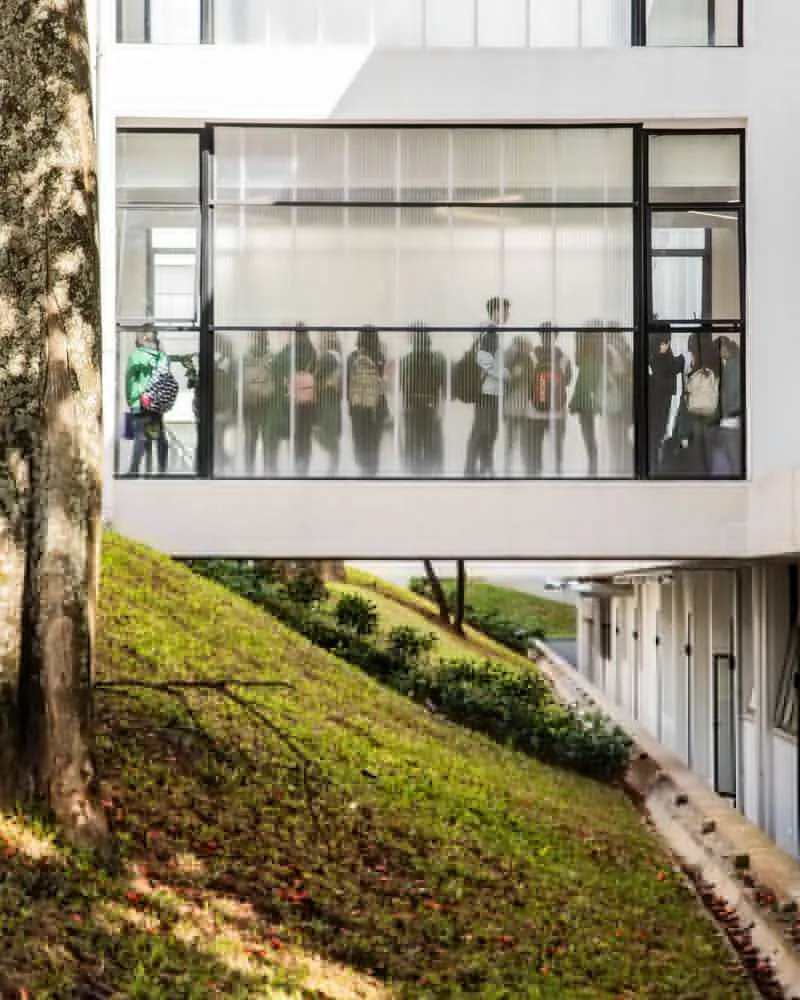
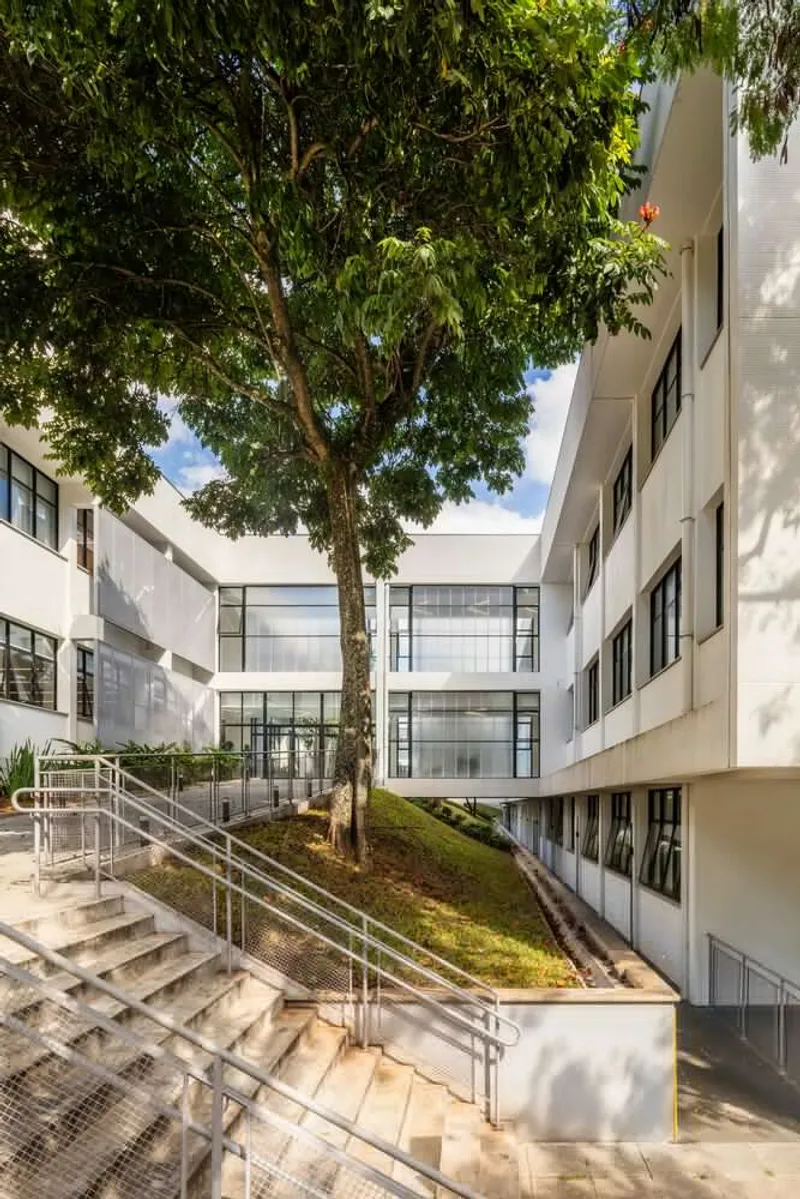
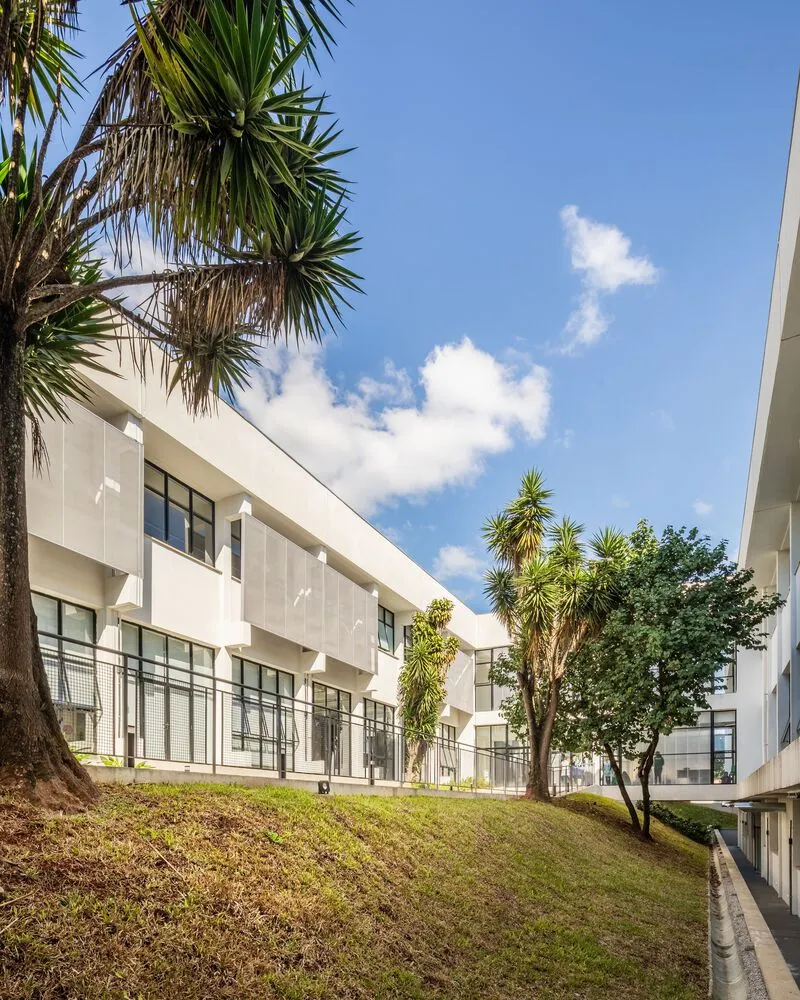
The core design concept honors the historical solidity of the original concrete structure while clearly distinguishing new architectural interventions. Contemporary additions introduce lighter materials such as metal structures, polycarbonate panels, and glass, creating a deliberate contrast between past and present. This material dialogue allows the building’s history to remain legible while accommodating modern pedagogical and technological requirements.

Transparency plays a central role in this transformation. New floor-to-ceiling glass façades, expanded courtyards, and elevated walkways foster visual continuity and spatial openness. Zenithal openings along classroom corridors bring natural light deep into the interior, improving comfort, reducing energy demand, and reinforcing a sense of connection between learning spaces.


A Dual-School Campus with Shared Social Infrastructure
The reconfigured complex accommodates two public schools, early childhood education and elementary education, each with independent administration yet dynamically connected through shared spaces. This spatial strategy encourages interaction among different age groups, supporting social development, empathy, cooperation, and inclusive learning.
The building’s zoning was carefully reorganized to balance autonomy and integration. The ground floor acts as the social heart of the campus, hosting communal and cultural programs such as the courtyard, auditorium, library, and dance and music studios. The upper level is dedicated to elementary education, including classrooms, multipurpose studios, coordination areas, and educational support rooms. Early childhood education occupies the lower floor, ensuring direct and safe access to outdoor green areas and sports facilities.


Outdoor Learning, Sports, and Community Engagement
External spaces are integral to the educational experience. The landscape design includes playgrounds, gardens, a vegetable patch, and three sports courts, one converted into a covered gymnasium. These outdoor environments extend learning beyond the classroom, promoting physical activity, environmental awareness, and informal social interaction.
The integration of educational, sports, and cultural functions transforms the complex into a civic anchor for the neighborhood, reinforcing the role of public architecture as a catalyst for community life.

A Sustainable and Inspiring Educational Environment
By merging heritage preservation with contemporary architectural strategies, the Santa Maria Educational, Sports and Cultural Complex demonstrates how adaptive reuse can generate meaningful, future-oriented learning environments. The project celebrates history while embracing transparency, flexibility, and sustainability, offering a powerful model for educational architecture in Brazil and beyond.
All photographs are works of
Guilherme Pucci



Popular Articles
Popular articles from the community


Co-life: Sustainable Architecture for Age-Friendly Community Living
Co-life reimagines sustainable architecture for seniors through courtyards, rammed earth, shared gardens, and spaces designed for belonging.

AL-JANNAH: Sustainable Architecture and Permaculture for Afghan Widows
AL-JANNAH uses sustainable architecture and permaculture to create resilient oasis of housing, learning, work and renewal for Afghan widows.

Riyadh For All: Intergenerational Urban Design for Active Aging in Rabat
Riyadh For All reimagines urban design in Rabat with intergenerational co-living, adaptive courtyards, and Moroccan cultural exchange today.

The Earth Pod: 3D Printed Homes for Resilient Refugee Communities
The Earth Pod reimagines refugee housing through 3D printed homes made from clay, combining resilience, self-sufficiency, and rapid shelter.

Similar Reads
You might also enjoy these articles

FAMM Arquitectura Organizes Ten Villas Around Courtyards and Jungle in Nosara, Costa Rica
El Molino pairs two elongated volumes with deep overhangs and timber louvers to build a compact coastal community five minutes from the beach.
Oscar Niemeyer's Ibirapuera Park Pavilions Define São Paulo's Cultural Identity in Concrete and Curve
A constellation of modernist volumes set within São Paulo's most important urban park, conceived for the city's 400th anniversary in 1954.
How Henri Picq's 1889 Paris Pavilion Traveled 11,000 Kilometers to Become Santiago's Artequín Museum
A prefabricated iron and glass pavilion built for the Paris Universal Exposition found a second life as a children's art museum in Chile.
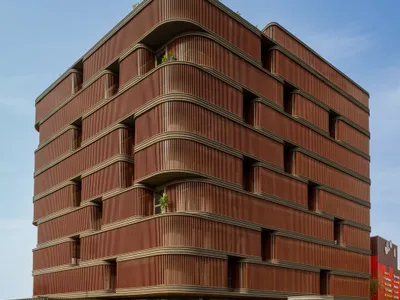
Sanjay Puri Architects Wraps a Jaipur Office Tower in Capsule-Shaped Green Buffers
A nine-level climate-responsive workplace near Jaipur Airport uses stacked planter terraces and aluminium screens to fight 40°C heat.


Explore Architecture Competitions
Discover active competitions in this discipline



Challenge to design public laboratory


Challenge to reimagine the Iron Throne


Photograph architecture without architects


Illustrate the lost glory of Angkor Wat - Render Challenge
Comments (0)
Please login or sign up to add comments
No comments yet. Be the first to comment!