
Schønherr Threads a 600-Meter Yellow Tile Riverbed Through Copenhagen's Most Vulnerable Neighborhood
Karens Minde Aksen transforms a flood-prone Sydhavn park into a 37,000 square meter climate sponge that captures 15,000 cubic meters of rain.

Sydhavn is not the Copenhagen you see on postcards. It is a workers' housing district defined by yellow brick apartment blocks from the early 1900s, some of the city's first social housing. The neighborhood sits low, both topographically and in the city's income rankings, and that low ground made its central greenway chronically vulnerable to flooding. Schønherr was tasked with turning a 600-meter long strip of parkland into something that could absorb 15,000 cubic meters of rainwater while also becoming a genuine public gathering space for a community that had long been underserved.
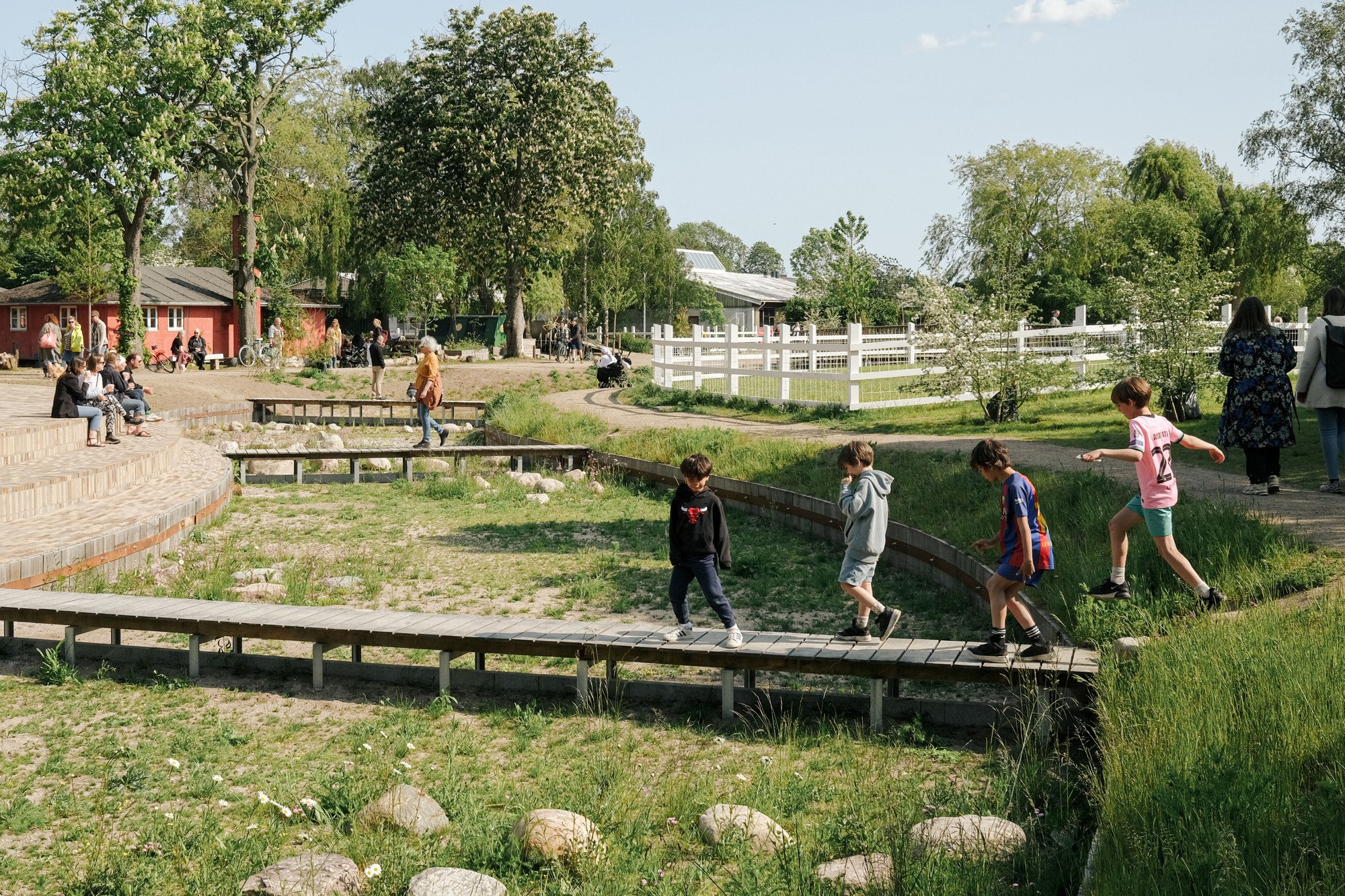
What makes Karens Minde Aksen worth studying is not the scale of its climate engineering, which is substantial, but the discipline of its design philosophy. The studio's self-imposed motto was to "add as much and take away as little as possible." Nearly every mature tree on the 37,000 square meter site was preserved. The existing playground, dog park, and children's farm with horses, sheep, and alpacas stayed put. What was added, a sinuous yellow tile channel that doubles as pathway and stormwater collector, 70 new trees, reed bed filtration, and a circular timber bridge, was calibrated to slot into a landscape that already belonged to its residents. The 70 million Danish Kroner project, built between August 2021 and December 2022, won Copenhagen's Best Urban Space award the following year.
The Yellow Riverbed as Civic Thread
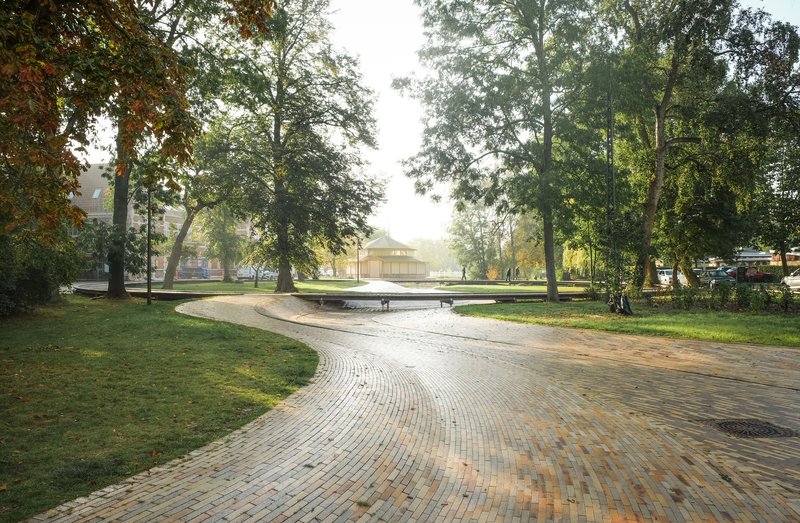
The defining gesture is the yellow tile riverbed that meanders the full 600-meter length of the park, threading between existing trees from the northern edge down to a new water reservoir in the south. The tiles are not a decorative flourish. They are a direct material reference to the yellow brick buildings that line Sydhavn's streets, a color rooted in the district's former brickworks. When dry, the channel reads as a generous pedestrian promenade with a distinct, slightly eccentric warmth. When it rains, it becomes a functioning watercourse, collecting and directing runoff before it reaches the surrounding facades.
The patterning of the brickwork visible in the plaza areas reinforces a sense of deliberate craft. Rather than defaulting to standard grey pavers or gravel, the design team, with citizen input, chose a material that collapses the distance between infrastructure and identity. Walking this path, you are both using a drainage system and traversing a visual history of the neighborhood.
A Circular Bridge and the Logic of Gentle Topography
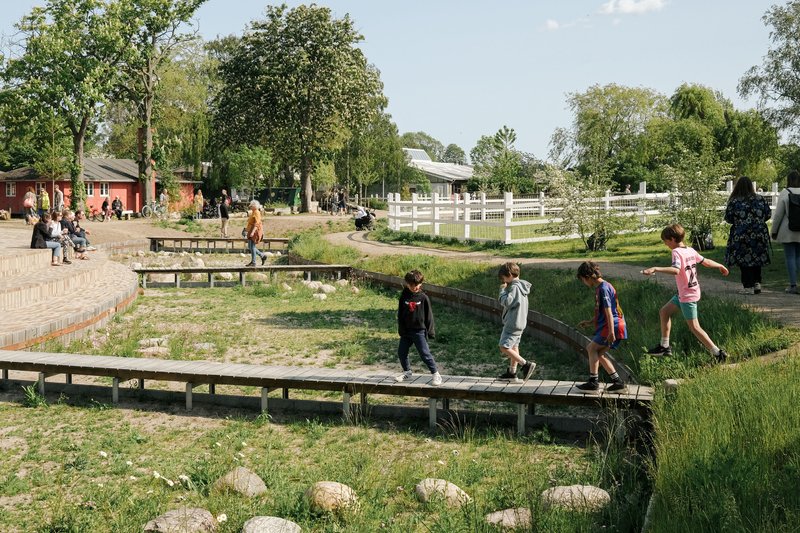
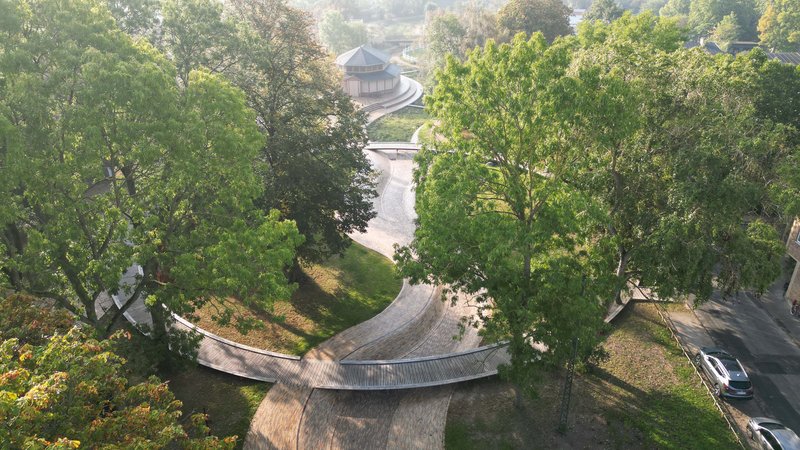
The circular timber bridge is one of the project's most photogenic elements, but it earns its place functionally. Spanning a planted bioswale, it creates a crossing point that is accessible, low-slung, and wide enough for groups of children to use without feeling funneled. The timber benches flanking the bioswale encourage people to linger at the water's edge, watching the reed beds do their quiet work of filtering runoff before it reaches the main basin.
Schønherr handled the site's gentle slopes with precision. Water is permitted to rise only 10 centimeters against surrounding building facades, a strict constraint that demanded careful grading across the entire corridor. The result is a landscape that appears effortlessly soft but is, beneath its surface, an engineered gradient.
The Pavilion as a Quiet Anchor
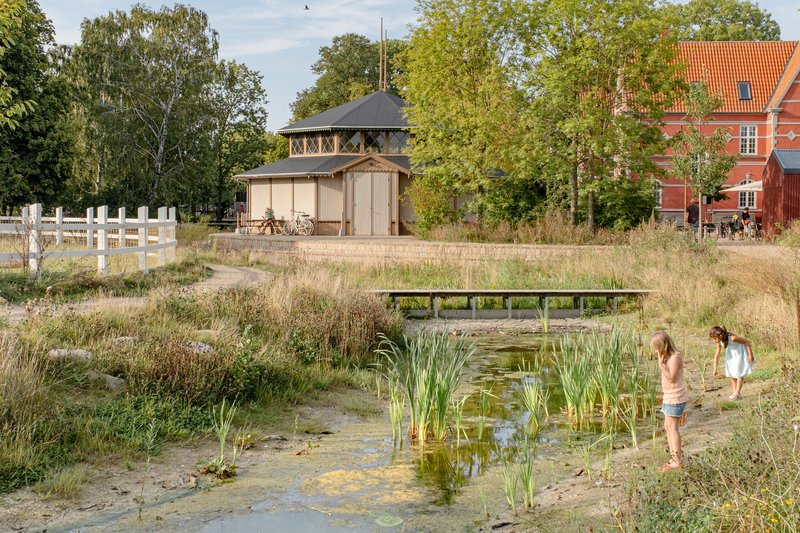
An octagonal pavilion with latticed timber walls and a dark pyramidal roof sits in the park's southern reaches, surrounded by shallow water pools. It reads almost as a folly, a deliberate counterpoint to the linear logic of the tile riverbed. The lattice walls filter light and air, making the interior a sheltered micro-climate even in an open landscape. Its positioning within the water pools ties it physically to the park's stormwater management narrative, but from a distance it simply looks like a well-made gathering point.
This southern end of the park operates under a distinct set of rules. There are no benches, and no artificial lighting, a conscious decision to minimize disruption to wildlife. Felled tree trunks were left as deadwood to create habitats for insects and small animals. Large rocks scattered through the planting serve the same purpose. The design makes a clear statement: the park's southern zone belongs as much to its non-human inhabitants as to the people walking through it.
Add Much, Take Little
Schønherr's approach to the existing landscape was unusually restrained for a project of this budget. Most mature trees were kept in place. Wild herbs replaced former lawns, eliminating the need for intensive mowing and increasing habitat diversity. Seventy new trees were planted to fill gaps in the canopy, but the aerial views make clear that the park's essential character, a dense corridor of deciduous trees casting long shadows over open ground, was already there. The design amplified it rather than replacing it.
This is a harder line to hold than it sounds. When 70 million kroner of public money is on the table, there is always pressure to show transformation. What the studio did instead was distribute interventions across the full 600 meters so that every meter feels considered without any single point feeling overworked. The canopy walkways, the brick channel, the bridge, the pavilion, and the reed beds form a sequence of events rather than a single spectacle.
Plans and Drawings
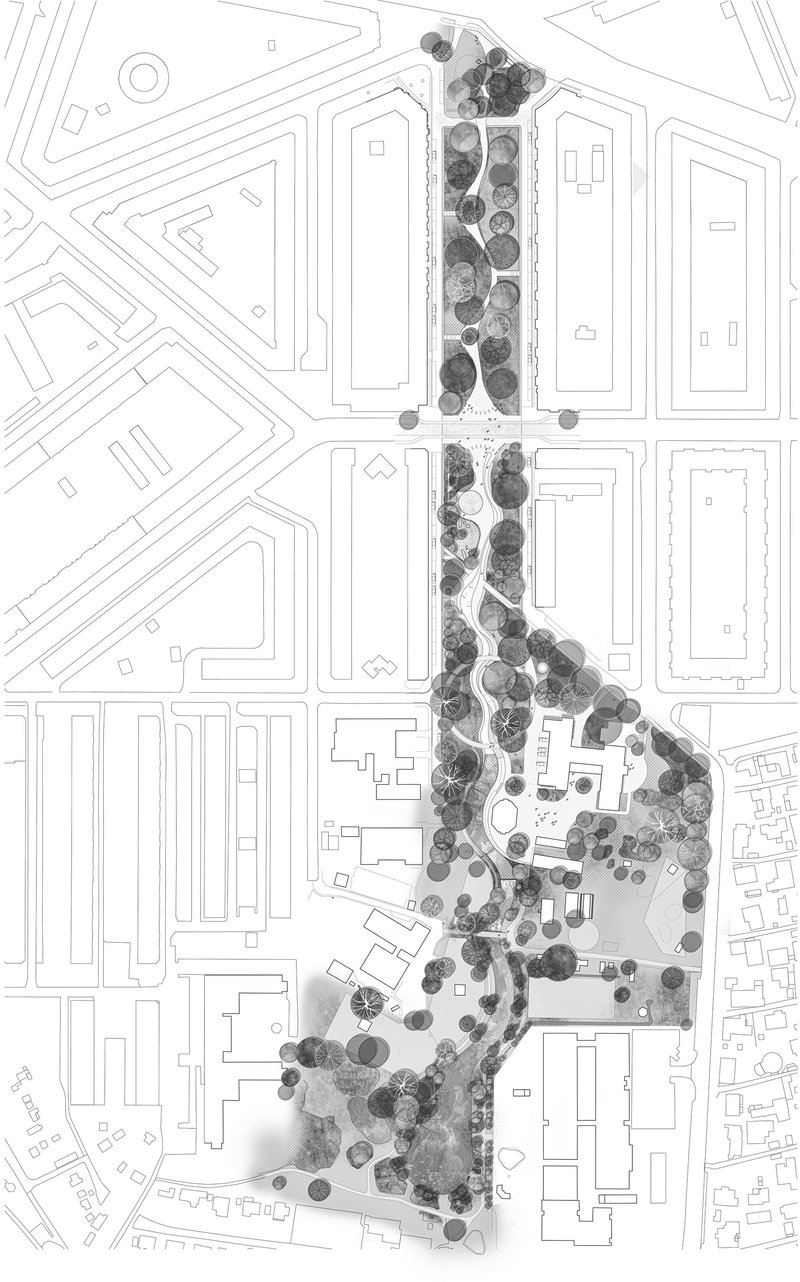
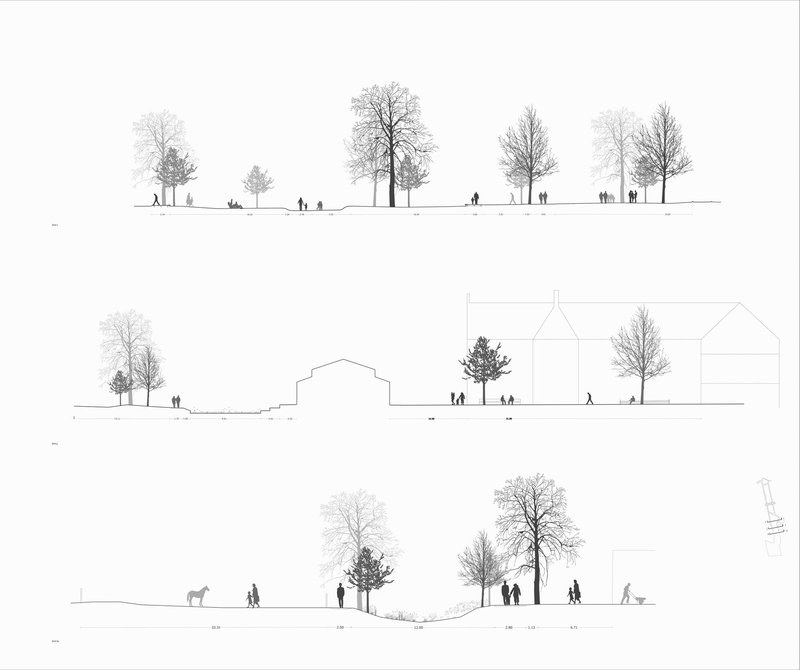
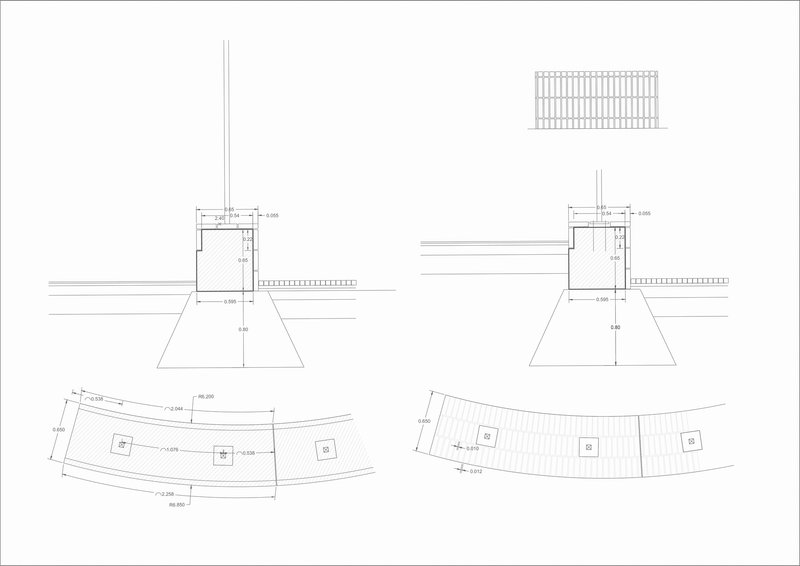
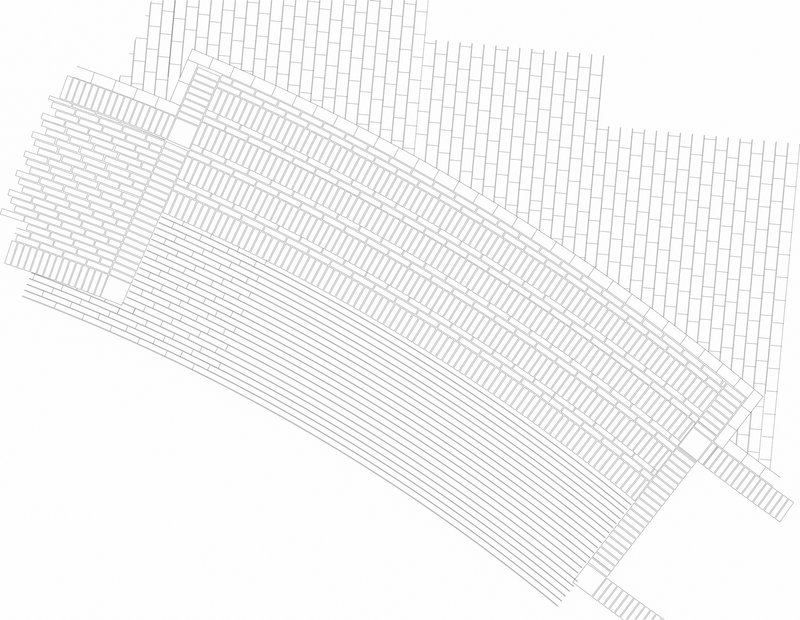
The site plan reveals the project's essential challenge: a narrow linear corridor hemmed in by urban blocks on both sides, with tree canopies already filling much of the available footprint. The pathways snake between trunks rather than cutting through them, and the plan makes visible the logic of preserving root zones while still introducing new grading for water management. Section drawings show how the gently sloping terrain was shaped to direct flow, with pedestrians, trees, and pavilion volumes all drawn in relation to water levels.
The axonometric and detailed section of the curved roof structure offer a closer look at the pavilion's construction. The segmented timber framing and layered assembly are legible in the drawing, with foundation footings and dimensional annotations confirming the care taken even in what might appear to be a secondary structure. These drawings remind us that landscape architecture at this level involves as much structural engineering as planting strategy.
Why This Project Matters
Climate adaptation projects in cities tend to fall into two camps: massive grey infrastructure hidden underground, or highly visible green interventions that read more as marketing than engineering. Karens Minde Aksen occupies a productive middle ground. Its stormwater capacity is real, 15,000 cubic meters is not a token gesture, and its public space ambitions are equally tangible. The park is used daily by residents of a historically underinvested neighborhood, and the design's refusal to remove existing features meant that the community's sense of ownership was never disrupted.
What Schønherr achieved here should recalibrate how we evaluate landscape architecture. The yellow tile riverbed is a formal invention that will likely be widely imitated, but the deeper lesson is about process: citizen engagement that influenced material choices, ecological zoning that gives wildlife genuine priority in parts of the site, and a design philosophy that treats restraint as a creative act rather than a limitation. For Copenhagen, a city that markets itself on livability, Karens Minde Aksen is proof that the most meaningful urban interventions happen not in the city center but at the edges where they are needed most.
Karens Minde Aksen by Schønherr. Located in København, Denmark. 37,000 m². Completed in 2022. Photography by Thomas Hjort Vesterbæk and Jens Juel Thiis Knudsen, Carsten Ingemann, Juan José Palma-Alvarez, and Jørgen Becker-Christensen.
About the Studio
Share Your Own Work on uni.xyz
If projects like this are the kind of work you want to make, uni.xyz is a place to publish your own, find collaborators, and enter design competitions.




Popular Articles
Popular articles from the community

Milan Crossover: Sustainable Architecture for a New Fashion Culture in Milan
Milan Crossover transforms fashion culture through sustainable architecture, linking material libraries, remake studios, and public runways.

Stanton Architects Sculpts a Curving Family Home into Sydney's Inner West Fabric
Five Dock House uses cantilevers, curved concrete, and layered courtyards to carve out privacy on a tight suburban lot in Sydney.
IKC de Geluksvogel: Sustainable School Architecture Designed for Free Movement and Digital Learning
IKC de Geluksvogel turns sustainable school architecture into a flexible Maastricht campus for digital learning, nature, and free movement.
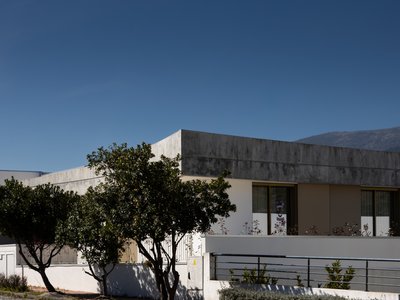
PLATAFORMArq Folds a Concrete Roof Over the Portuguese Mountains in House #474
A 220-square-meter residence in Teixoso, Portugal, wraps board-formed concrete into an angular canopy that frames the Serra da Estrela foothills.

Similar Reads
You might also enjoy these articles
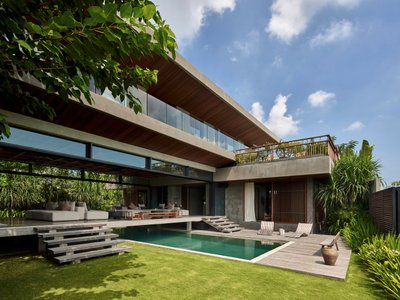
Freebird Residence by Alexis Dornier: A Tropical Modernist Sanctuary in Bali
Floating living pavilion above pool anchors H-shaped tropical villa, blending Japanese minimalism, sustainable strategies, lush landscape, and sculptural interiors.
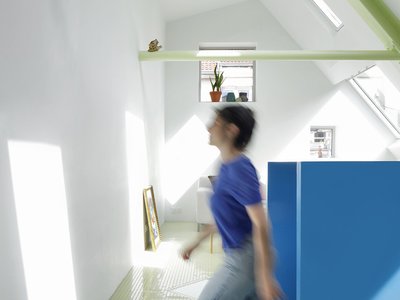
127af Flips a Tiny Bagnolet Rowhouse Upside Down with a Handcrafted Roof Extension
A 55-square-meter terraced house on the edge of Paris gains a luminous upper living floor through lightweight timber and steel.
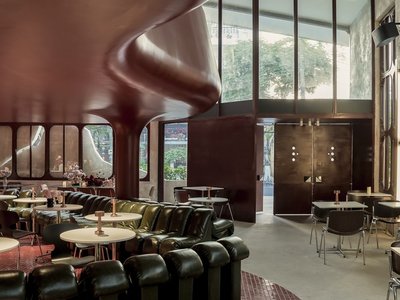
1.61 Design Workshop Wraps a 600-Square-Meter Café in Vietnam in Sculptural Burgundy Drama
Reden Café & Bistro pairs a helical staircase, mosaic floors, and deep red interiors to rethink Vietnamese hospitality space.

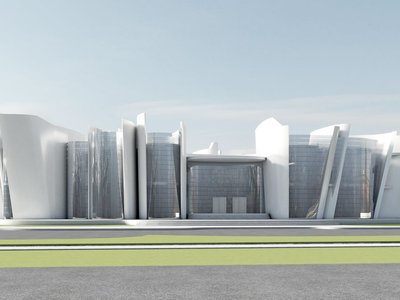
The Unbound Brain: A School Shaped by Cognitive Architecture
Cylindrical learning pods radiate like neurons from a central cortex, turning the floor plan into a spatial model of human thought.


Explore Landscape Design Competitions
Discover active competitions in this discipline




The Global Benchmark for Architecture Dissertation Awards


Challenge to design locus for the upliftment of human rights


Challenge to re-imagine a department store in present times


Design challenge fostering public involvement in wildlife research
Comments (0)
Please login or sign up to add comments
No comments yet. Be the first to comment!