

School of Innovative Ideas: A Bauhaus-Inspired Campus Where Landscape and Pedagogy Merge
A shortlisted Bauhaus Neue entry reimagines architectural education through timber, courtyards, and curving green pathways.


What would a school of architecture look like if it took its own lessons seriously? If it taught biomimicry and digital fabrication, shouldn't its campus embody the same ecological intelligence it preaches? The School of Innovative Ideas answers that question by weaving its buildings into a landscape of forest corridors, tiered courtyards, and curving pedestrian pathways, treating the campus itself as a teaching instrument for sustainable design.
Designed by Antoine Hurez and Lestang Lucile, the project was shortlisted in the Bauhaus Neue competition. Drawing directly from the Bauhaus movement's holistic ethos, the scheme fuses ecological consciousness, computational design, and material experimentation into a single campus plan. Rather than isolating these concerns into separate studios, the architecture collapses the boundary between theory and practice: students move through spaces that are themselves demonstrations of the interdisciplinary, sustainability-driven pedagogy the school champions.
A Timber Boardwalk Through a Forest Campus
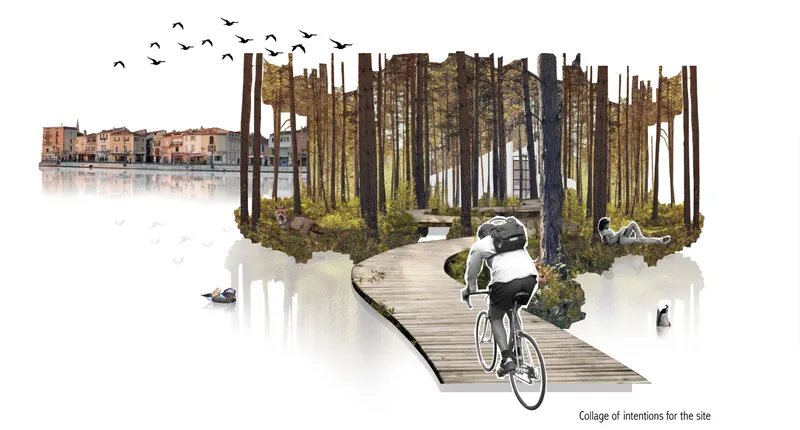
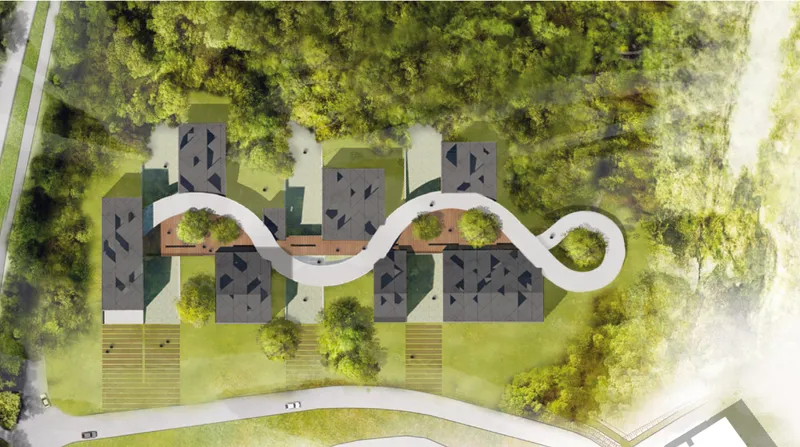
The collage drawing of a timber boardwalk threading through a dense forest island sets the tone immediately: this is a campus that privileges landscape over asphalt. A cyclist navigates the elevated path beneath a canopy of trees while birds circle overhead, suggesting an architecture subordinate to its ecology. The aerial plan view reinforces this reading, showing white curving pathways that link residential blocks across generous expanses of green lawn and mature tree cover. The circulation system avoids the rigid axial geometry typical of institutional campuses, instead following organic curves that prioritize pedestrian and cyclist movement through a continuous park.
Angular Volumes with Diagonal Timber Bracing
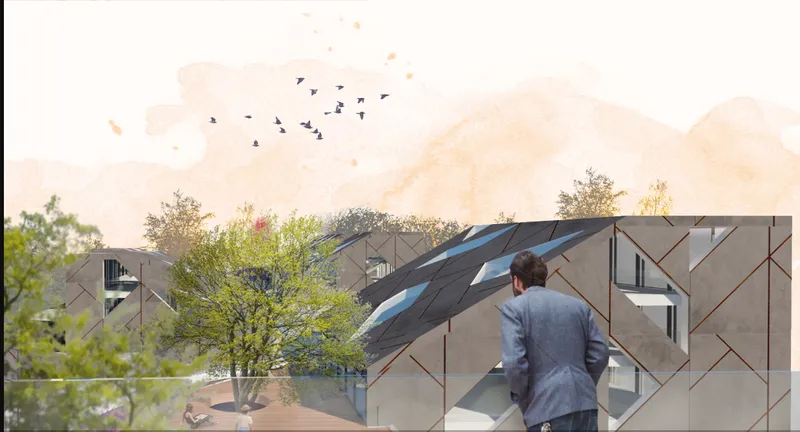
The building language shifts from the softness of the landscape plan to something far more assertive at the scale of individual structures. Angular concrete facades are stabilized by diagonal timber bracing, creating a visual tension between the rawness of exposed concrete and the warmth of wood. A figure standing on an upper terrace gives a sense of the generous proportions: these are not compressed studio floors but open, elevated platforms that engage with the surrounding tree canopy.
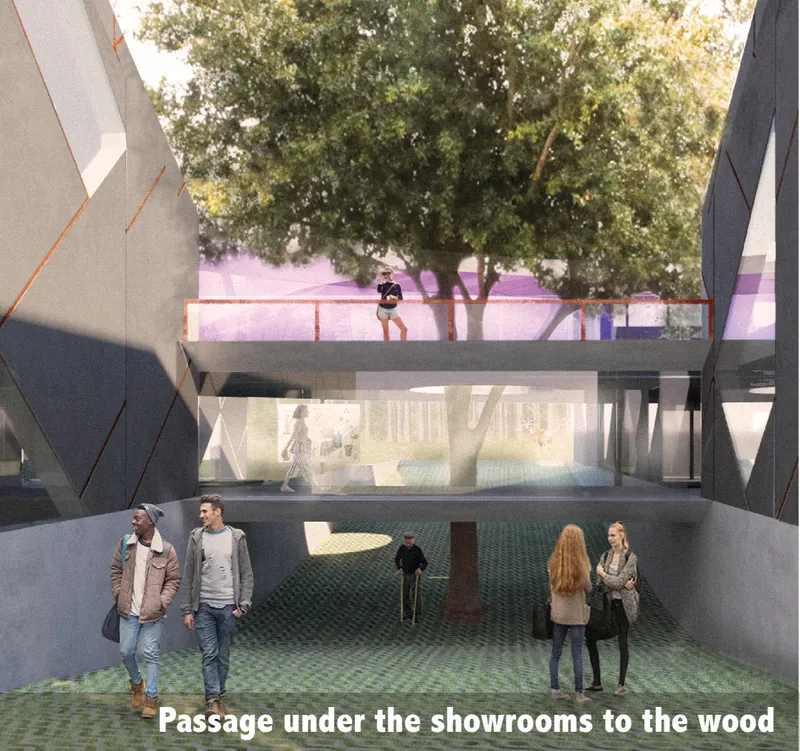
The section rendering of a tiered courtyard reveals how these volumes lift off the ground to shelter a communal space below, floored in green tile and shaded by an existing tree. The decision to elevate program above a landscaped ground plane is consistent throughout: buildings hover, and ground-level space belongs to gardens, courtyards, and informal gathering. It is a clear structural argument for porosity between built form and ecology.
A Triple-Height Atrium as the School's Social Core
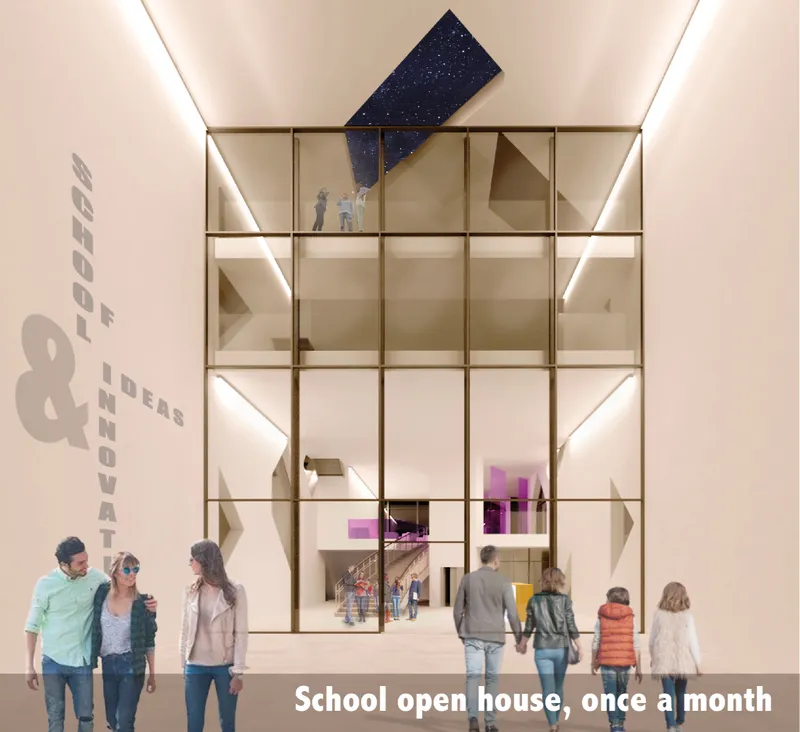
The interior section model exposes a triple-height atrium framed in metal and glass, with figures populating each level. This is the school's vertical commons, a space designed for the "iterative process of ideation, prototyping, and evaluation" described in the project brief. The open sightlines between floors encourage the kind of cross-pollination between disciplines that isolated corridors would suppress. Light floods through the metal-framed glazing, making the atrium legible from every adjacent workspace.
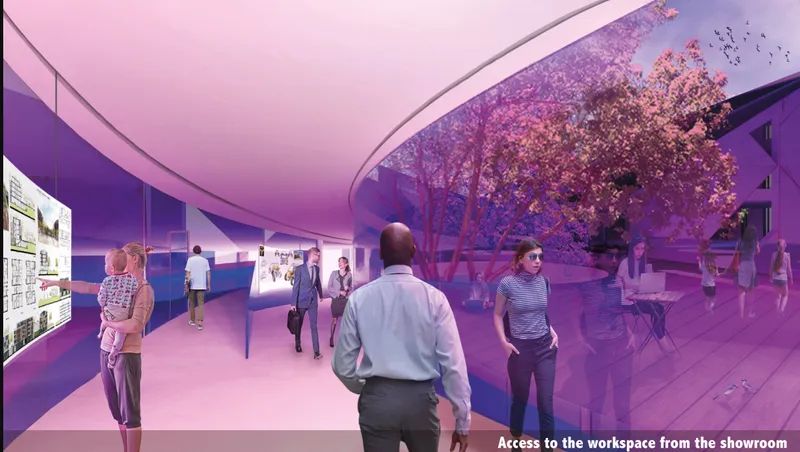
A curved interior corridor, bathed in purple-tinted light from tinted glazing panels, opens onto a cherry tree courtyard at dusk. The atmospheric quality here is deliberately different from the bright rationalism of the atrium. It suggests that the designers were thinking carefully about temporal and emotional variety within the campus, offering students spaces that shift in mood from analytical to contemplative as they move from studio to corridor to courtyard.
Display Corridors and Moonlit Courtyards
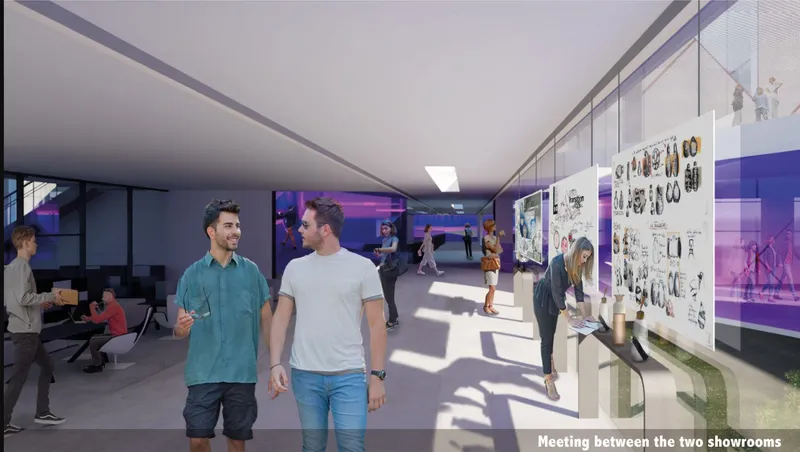
The interior corridor lined with display boards on glass partitions turns everyday circulation into an exhibition. Students walking past pinned-up work are constantly confronted with ongoing research and critique, an architectural strategy that makes the school's intellectual output visible at all times. The glass partitions maintain transparency between display and workspace, reinforcing the collaborative ecosystem the designers envisioned.
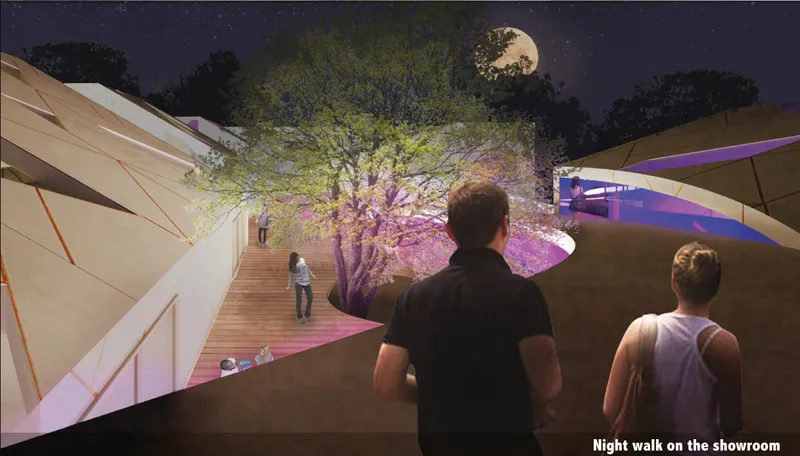
The final image is perhaps the most evocative: a timber staircase descending into an outdoor courtyard where a single illuminated tree glows beneath a full moon. It is a scene designed as much for the imagination as for the body, a place where prototyping gives way to reflection. The warmth of timber, the drama of uplighting against darkness, and the open sky above suggest a campus that does not shut down at the end of a studio session but continues to offer its occupants spatial experiences well into the night.
Why This Project Matters
The School of Innovative Ideas does not simply propose a new curriculum. It proposes a new kind of campus, one where the physical environment models the values it teaches. Sustainability here is not a module to be completed but a spatial condition: timber structures, forest boardwalks, green courtyards, and porous ground planes are not decorative choices but pedagogical ones. Students learn about ecological design by living inside it.
Hurez and Lucile have managed to translate the Bauhaus ethos of collapsing boundaries between art, craft, and technology into a contemporary proposition about landscape, structure, and atmosphere. The project earns its shortlisted place in the Bauhaus Neue competition by refusing to treat architecture education as something that happens only inside a lecture hall. Here, every corridor, courtyard, and canopy is part of the lesson.
View the Full Project
About the Designers
Designers: Antoine Hurez, Lestang Lucile
Enter a Design Competition on uni.xyz
uni.xyz runs architecture and design competitions year-round that reward proposals with spatial conviction and real site intelligence.
Project credits: School of innovative ideas by Antoine Hurez, Lestang Lucile Bauhaus Neue (uni.xyz).


Popular Articles
Popular articles from the community


Opera on the Sea: Driftwood Logic Shapes a Timber Opera House on Estonia's Coast
Trevor Orgill's opera house translates the entangled drift of floating timber into a civic building where wood, water, and music converge.

Temporary Home for Dogs: A Reversed Zoo Rethinks Animal Shelter Architecture
In Bucharest, a sinuous corridor and freed landscape flip the logic of containment, designing a shelter that works to make itself unnecessary.

Tsunami Convergenics: Turning Catastrophic Ocean Forces into Underwater Housing Infrastructure
A speculative underwater settlement off the coast of Onagawa, Japan, treats tsunamis and typhoons as energy sources rather than threats.

Opera by the Sea Estonia: Three Shells Dissolving Architecture into Tallinn's Coastline
A winning opera house proposal replaces monumental form with interconnected shells that blur the boundary between building, park and Baltic Sea.

Similar Reads
You might also enjoy these articles

Shakur's House: Exposed Brick as an Interior Organiser in a 168 m² Mashhad Residence
Brick moves indoors in this Mashhad residence, where masonry walls, glass partitions and teal planes sequence a compact home without closing it off.

Day and Night Park: A Time-Based Urban Newsstand in Beijing
A temporary urban newsstand in Beijing blending travel, light, and reading through poetic colors, compact form, and community-focused design.

Modernist Patio Renovation in El Masnou, Barcelona by Oliver Segura Arquitectura + Cebrià Arquitectura
Modernist patio renovation blending tradition and innovation with a movable pool, leveled floors, and Catalan materials in El Masnou.

Alto Residencial Coop: Cooperative Housing Development in Santiago de Compostela by Carbajo Barrios Arquitectos
A linear cooperative housing complex blending white volumes and perforated metal façades, enhancing community living, natural light, privacy, and urban integration.

Comments (0)
Please login or sign up to add comments
No comments yet. Be the first to comment!