

Sea of Tranquility: A Circular Void that Frames the Night Sky
A shortlisted Moontrip 2019 entry uses absence, silence, and minimal form to transform celestial observation into spatial ritual.


What happens when architecture removes itself from the center and places the sky there instead? Sea of Tranquility answers by organizing an entire building around a circular courtyard, an open-air Skyspace that frames the cosmos overhead and turns stargazing into an architectural event. The void is the project's core, not a leftover between walls but the primary spatial experience, a deliberate absence that connects visitors to something far larger than any built form.
Designed by Vlad Ducar and Marius Voica, the project was shortlisted in the Moontrip 2019 competition. Named after the lunar mare where Apollo 11 touched down, Sea of Tranquility takes the poetic associations of that barren plain and translates them into an earthbound architecture of silence, minimalism, and contemplation. The design questions how we perceive the universe and proposes that built form can be felt as much as seen.
Concentric Geometry Carved into Topography
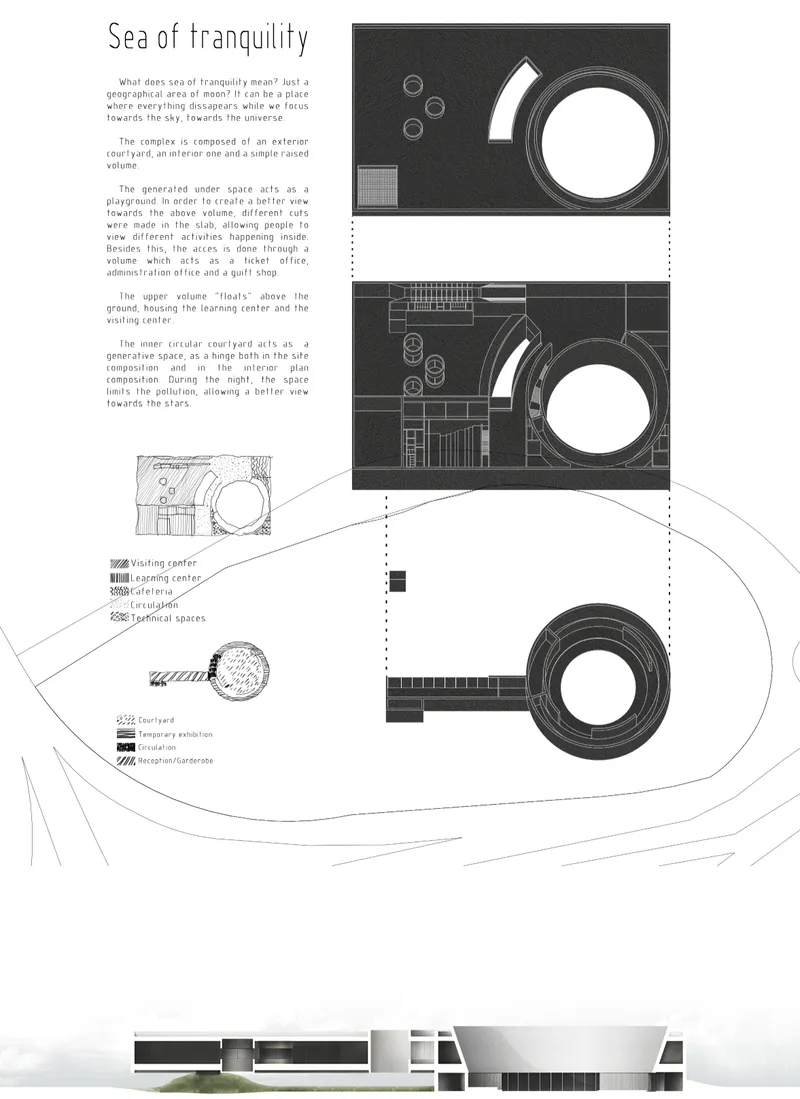
The plan drawings reveal the project's organizational logic: circular volumes nested within concentric topographic contours, as if the building were a crater pressed into the landscape. The central courtyard reads clearly as the gravitational center, with programmatic spaces arranged around its perimeter. A raised volume hovers above the courtyard to house a learning center and visiting space, visually floating to suggest celestial detachment while physically grounding the functional program. The site plan shows how access paths lead visitors through a ticket office and gift shop before entering the courtyard, turning the approach into part of the spatial ritual.
The section drawing later in the set confirms the vertical relationship: a circular atrium beneath the roof plane, with the courtyard walls rising tall enough to cut peripheral light and frame only sky. The circular form echoes astronomical instruments and cosmic cycles, a deliberate formal decision that reinforces the project's conceptual ambitions.
Curved Concrete and the Weight of Stillness


The exterior perspective shows a curved concrete wall with vertical fluting that catches raking light, standing beside a stone-paved plaza where two visitors sit in quiet observation. There is no signage, no spectacle. The architecture communicates through material presence alone: the mass of concrete, the texture of fluting, the generous emptiness of the plaza. The composition is elegantly minimal, and the scale of the wall relative to the human figures creates a threshold condition, a boundary between the everyday world and the contemplative interior beyond.
Inside, a corridor lined with perforated walls casts dappled light patterns across pink flooring, creating a transitional atmosphere between the solid exterior and the open courtyard. Two visitors walk through what feels less like a hallway and more like a light instrument. Strategically placed slab cuts allow sightlines across programs, offering glimpses of activity while preserving the meditative quality. The perforations serve a dual purpose: they animate the interior with filtered daylight while signaling the project's commitment to controlling light, particularly at night, when minimizing light pollution is essential for clear views of the stars.
The Courtyard as Interface Between Ground and Sky
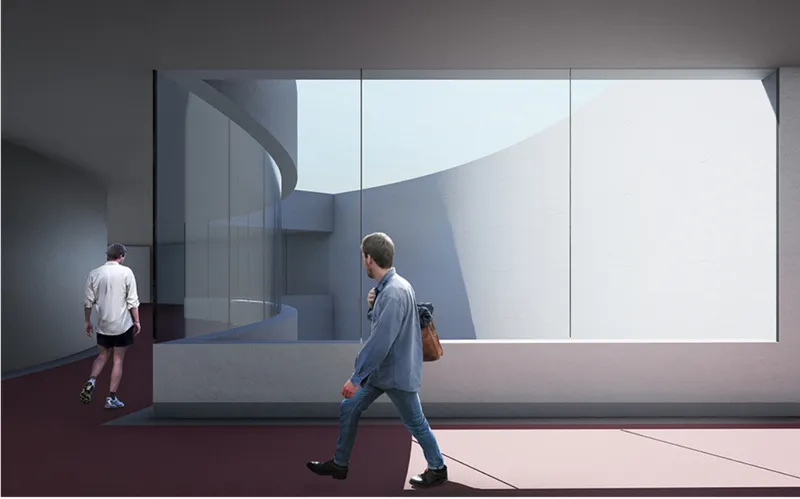
The interior courtyard photograph captures the heart of the project. Tall white walls rise on all sides, enclosing a space that is simultaneously intimate and infinite; the sky above is the only ceiling. A glass partition reflects the curved architectural forms back onto themselves, doubling the geometry and creating a disorienting sense of depth. Visitors pass through the space casually, but the proportions demand pause. The courtyard functions as a hinge, connecting sky and ground, inner silence and cosmic vastness.
At night, this space transforms. With light pollution minimized by design, the courtyard becomes a literal and metaphorical place of clarity, a viewing chamber for the stars. The architecture recedes, and the void takes over. It is a space to dream, learn, and gaze, three deeply human activities housed within a minimal architectural shell.
Reading the Section: Atrium Beneath the Cosmos

The section drawing completes the spatial narrative. It shows the circular atrium space beneath a roof plan inscribed with concentric topographic lines, reinforcing the reading of the building as a geological formation. The raised volume above the courtyard is legible here as a hovering slab, its structural lightness contrasting with the solidity of the courtyard walls below. The under-slab zone creates a dynamic play area that activates what could have been dead space, adding programmatic diversity beneath the floating element.
Juror Mark Kerr acknowledged the strength of the concept while noting that its intellectual rigor could shine through more clearly. Kevin Scholtes praised the internally consistent aesthetic but questioned whether the layout and public engagement strategy were sufficiently articulated for a space intended to inspire youth and educate the public about space. These are fair critiques, and they point to the tension at the project's core: between the purity of contemplative architecture and the messy, vital demands of public programming.
Why This Project Matters
Sea of Tranquility succeeds where many competition entries falter: it commits fully to a single spatial idea and executes it with clarity and discipline. The circular courtyard as Skyspace is not a gimmick; it is a genuine architectural proposition about how form can mediate our relationship to the cosmos. The material palette of concrete, stone, and controlled light reinforces the atmosphere without resorting to spectacle. In a competition field that likely included more programmatically complex entries, this project stands out for its restraint.
The jurors' critiques are instructive rather than damning. They suggest that the project's next evolution would involve demonstrating how this contemplative framework accommodates active public engagement, how the silence invites rather than excludes. But as a conceptual statement, Sea of Tranquility offers something increasingly rare in architectural discourse: an argument for emptiness as a medium, for the radical idea that the most powerful thing architecture can do is step aside and let the universe in.
View the Full Project
About the Designers
Designers: Vlad Ducar, Marius Voica
Enter a Design Competition on uni.xyz
uni.xyz runs architecture and design competitions year-round that reward proposals with spatial conviction and real site intelligence.
Project credits: Sea of Tranquility by Vlad Ducar, Marius Voica Moontrip 2019 (uni.xyz).


Popular Articles
Popular articles from the community


Opera on the Sea: Driftwood Logic Shapes a Timber Opera House on Estonia's Coast
Trevor Orgill's opera house translates the entangled drift of floating timber into a civic building where wood, water, and music converge.

Cloaked Colonization: A Mobile Underwater Habitat That Moves Like a Fish
Micah Abaya's shortlisted EHC Pacific entry reimagines ocean settlement as a dispersed network of self-sustaining architectural organisms.
Faces of the Soviet Avant-Garde: Turning Moscow's Street Names into an Open-Air Museum
A network of sculptural installations across a Moscow residential district transforms forgotten architect names into spatial encounters with cultural memor

Singing Woman: An Opera House That Performs Before the Curtain Rises
Ovidiu Cristian Pavel's conceptual opera house translates Estonia's choral identity into a sculpted waterfront landmark facing the Baltic Sea.

Similar Reads
You might also enjoy these articles

Shakur's House: Exposed Brick as an Interior Organiser in a 168 m² Mashhad Residence
Brick moves indoors in this Mashhad residence, where masonry walls, glass partitions and teal planes sequence a compact home without closing it off.

Day and Night Park: A Time-Based Urban Newsstand in Beijing
A temporary urban newsstand in Beijing blending travel, light, and reading through poetic colors, compact form, and community-focused design.

Modernist Patio Renovation in El Masnou, Barcelona by Oliver Segura Arquitectura + Cebrià Arquitectura
Modernist patio renovation blending tradition and innovation with a movable pool, leveled floors, and Catalan materials in El Masnou.

Alto Residencial Coop: Cooperative Housing Development in Santiago de Compostela by Carbajo Barrios Arquitectos
A linear cooperative housing complex blending white volumes and perforated metal façades, enhancing community living, natural light, privacy, and urban integration.

Explore Cosmic Architecture Competitions
Discover active competitions in this discipline

Challenge to design locus for the upliftment of human rights

Challenge to design public laboratory

Design challenge to reuse E-waste
Comments (0)
Please login or sign up to add comments
No comments yet. Be the first to comment!