
Sergio Sampaio and Tectônica Float a Timber Country House Over a Stone Plinth in Rural Brazil
Casa Themis in Itu leverages a curved stone platform and a five-meter cantilever to merge weekend domesticity with the landscape.

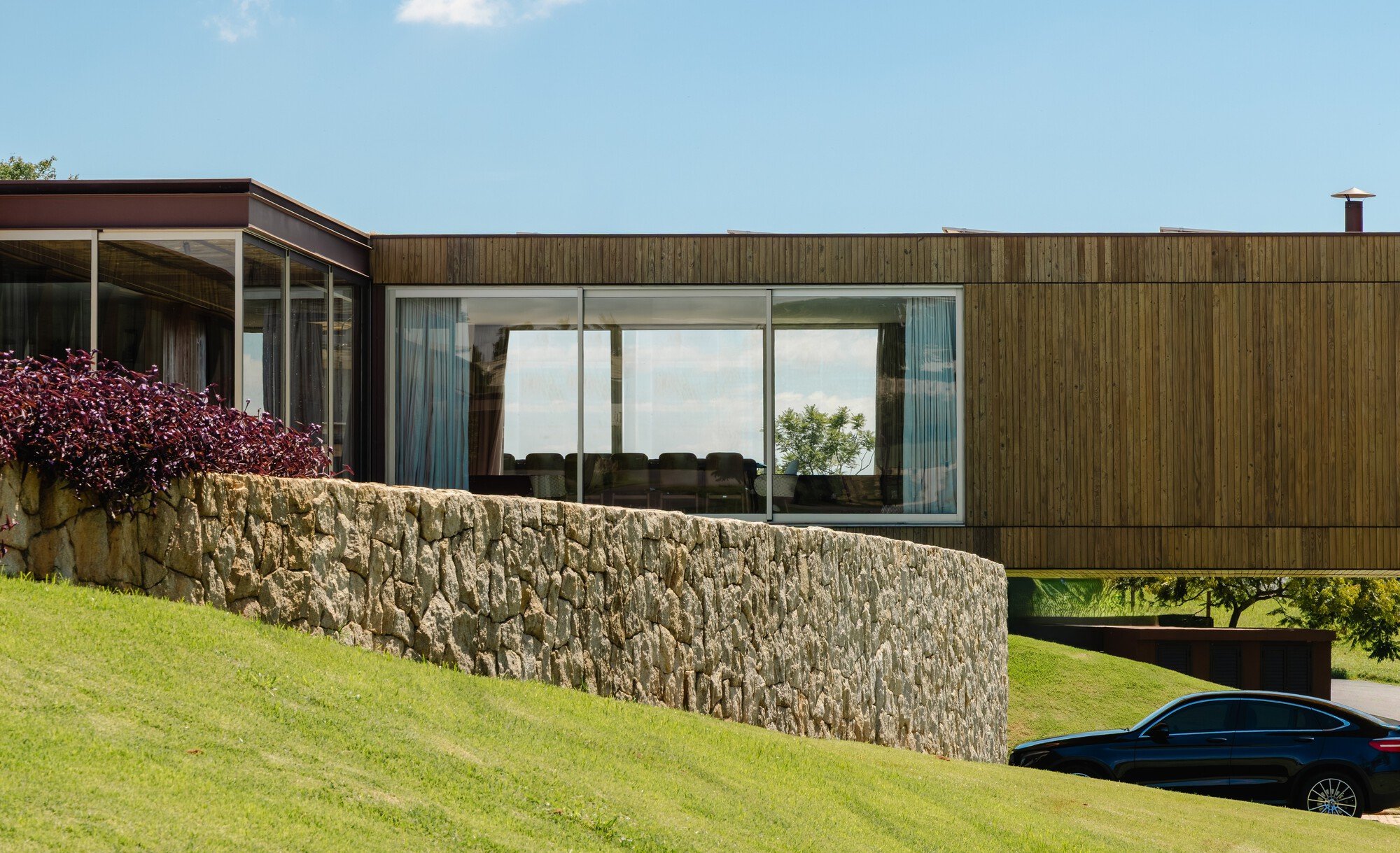
Weekend houses in the Brazilian countryside tend to fall into two camps: either they hunker into the terrain and try to vanish, or they sit on a flattened pad and ignore the slope entirely. Casa Themis, a 430 m² collaboration between Sergio Sampaio Archi and Tectônica, does neither. Completed in 2025 on a gently sloping, triangular plot in Itu, the house lifts itself on a curved fieldstone platform that rises with the grade of the land, simultaneously creating a podium for outdoor living and a sheltered carport underneath a five-meter cantilever. The result is a building that accepts its topography as a given rather than a problem to solve.
What makes the project worth studying is the layered relationship between its stone base and timber-clad steel frame. The stone is heavy, local, and irregular. The steel and timber above are precise, light, and linear. That contrast is not decorative; it solves a real programmatic split. The stone platform carries the pool, the sun deck, and the fire pit, all the communal outdoor rituals a weekend house exists for, while the L-shaped frame above organizes sleeping, cooking, and living into two intersecting wings that frame views of the surrounding hills.
A Stone Platform That Does Three Jobs
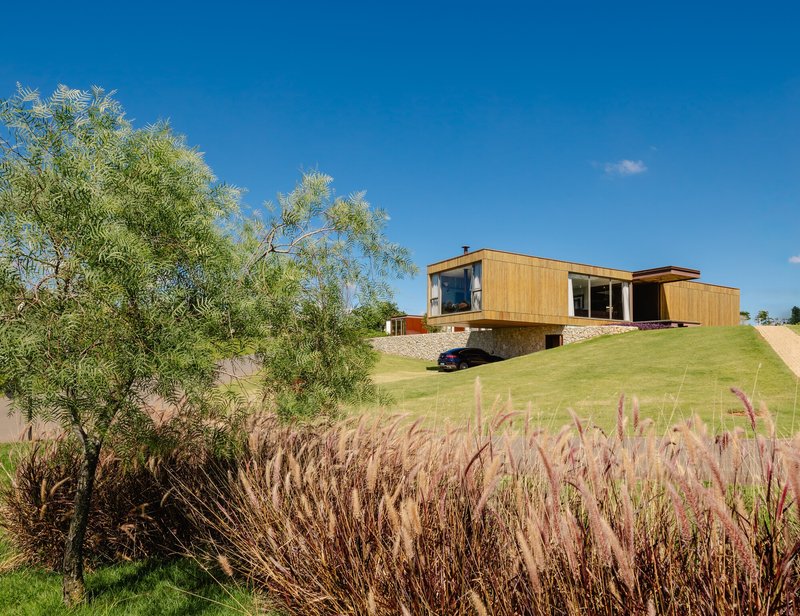
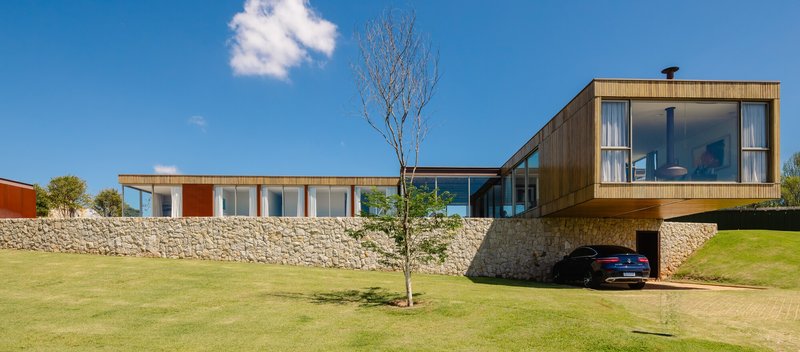
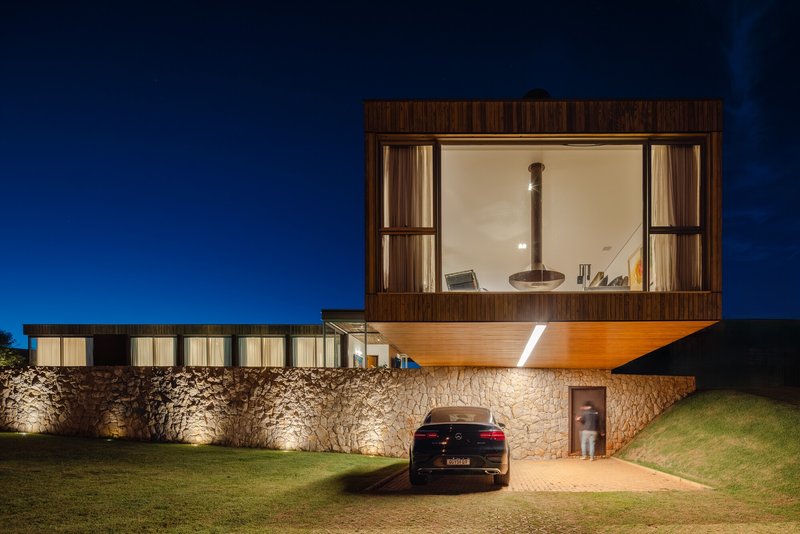
The curved stone retaining wall is the project's primary architectural move. It follows the arc of the access road, rising gradually from grade to create a continuous plinth that absorbs the site's slope. From the street side, the wall reads as a fortress: opaque, textured, and private. From inside the compound, it becomes a pedestal for the pool terrace and outdoor gathering zones. Underneath the cantilevered living room, the plinth shelters a vehicle entrance with its own staircase up to the house, turning the building's structural logic into a practical amenity.
The decision to work with the terrain rather than cut into it means the stone platform never appears imposed on the landscape. It looks geological, like an outcrop that the architects simply colonized. That reading is reinforced by the native grasses and shrubs planted around its base, which soften the transition between built and unbuilt ground.
The Cantilever and Its Consequences
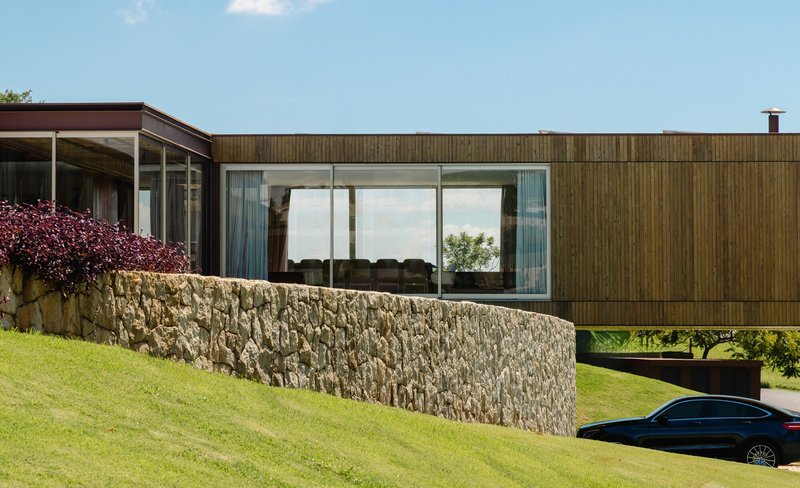
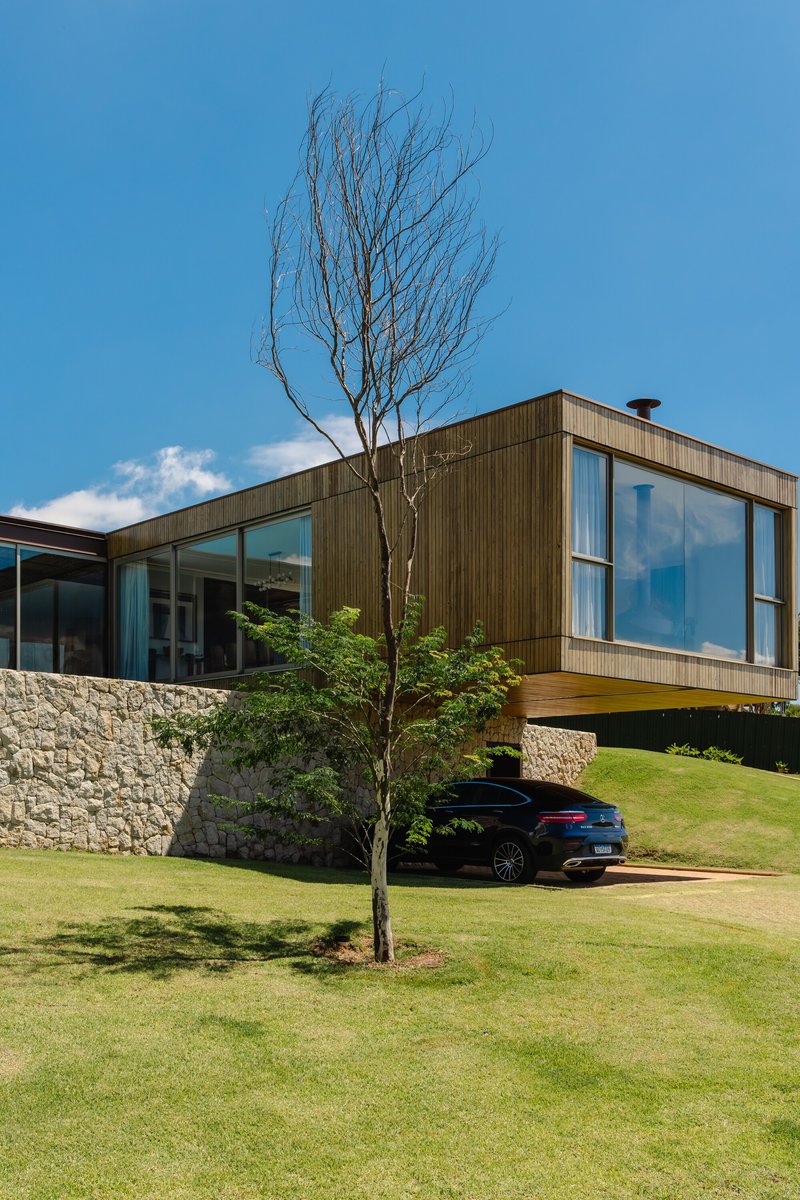
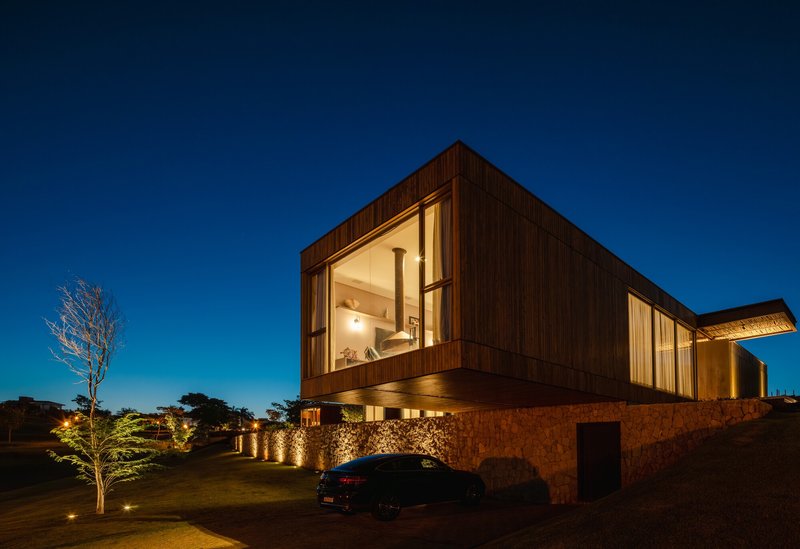
A five-meter cantilever is not modest. At Casa Themis, the living room projects beyond the stone wall and hovers above the planted beds and carport below, its corner glazing turning the room into a glass belvedere. The lightweight steel structure makes this possible without any visible drama: no massive exposed trusses, no heroic columns. The cantilever simply extends the domestic envelope into the air, offering the family a suspended vantage point over the rolling countryside.
At night, the effect intensifies. The timber-clad box glows against the stone base, and the gap between the two materials becomes a luminous seam. The architects clearly understood that the cantilever would be photographed from below, and they detailed the underside accordingly: clean lines, recessed lighting, and a careful junction between the steel frame and the rough fieldstone.
Timber, Corten, and Material Honesty
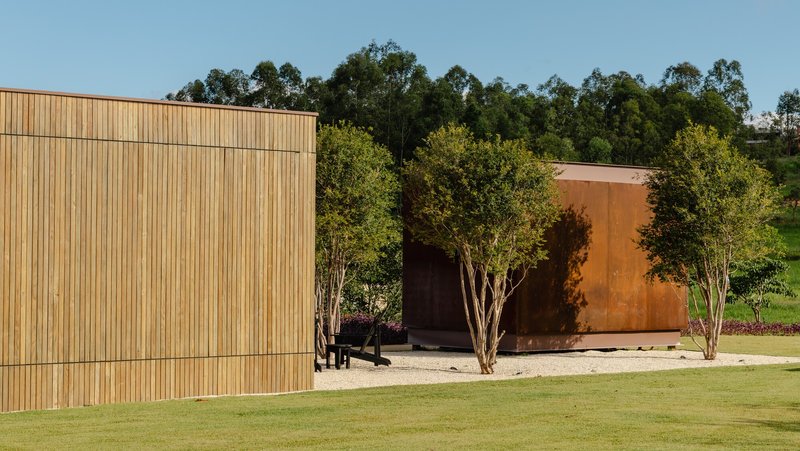
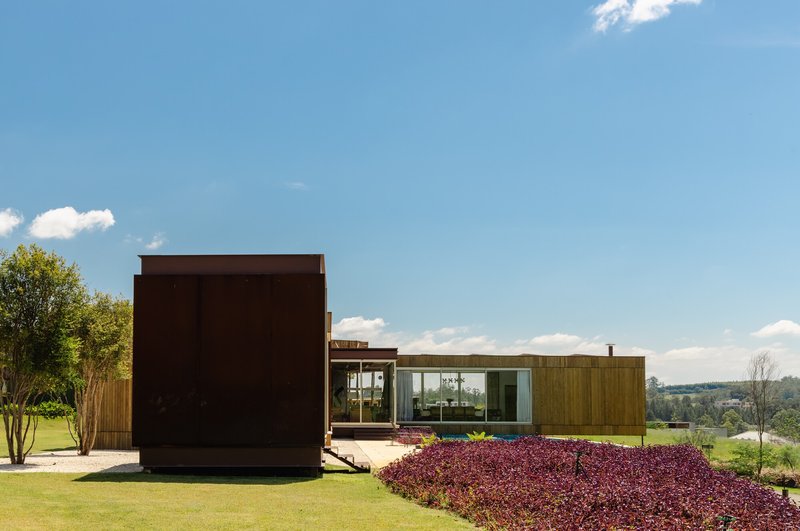
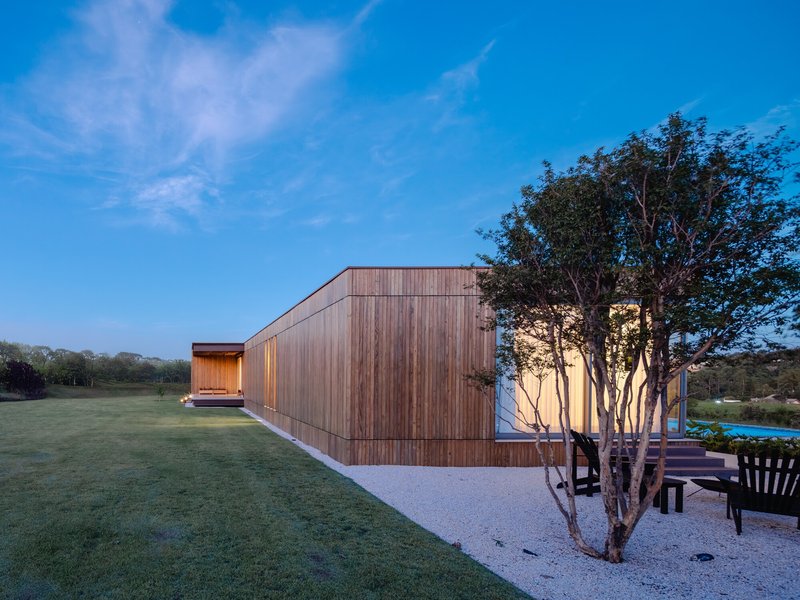
The exterior palette is deliberately restrained: horizontal timber cladding wraps the main volumes, weathered corten steel marks secondary surfaces and the entrance threshold, and the stone base provides the third texture. Each material ages differently. The timber will silver, the corten will deepen, and the stone will moss over. In a decade, Casa Themis will look more embedded in its site than it does today, which is a quality that synthetic finishes never achieve.
The entrance sequence plays these materials against each other with precision. A metal canopy overhead, corten walls flanking a gravel courtyard, and a sliding timber door behind it: three materials in three planes, each doing distinct work. The gravel courtyard with its folding chairs and young trees suggests a deliberate informality, a threshold zone between the driveway and the interior that slows you down before you enter.
Living Spaces Opened to the Horizon
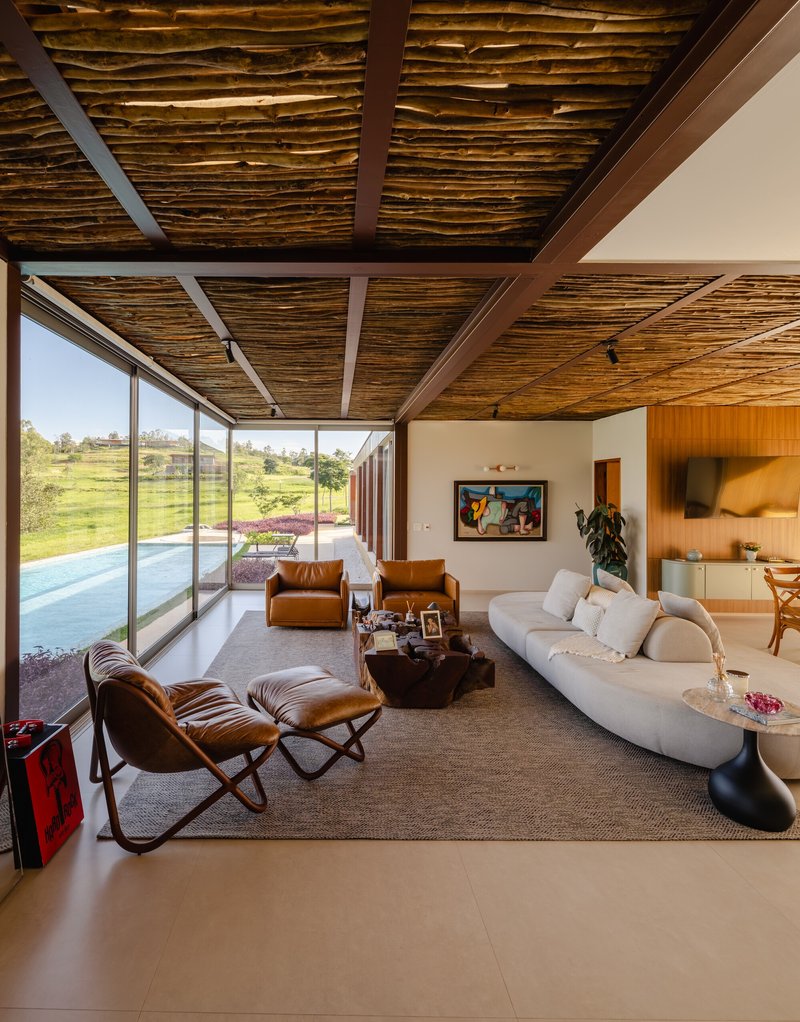
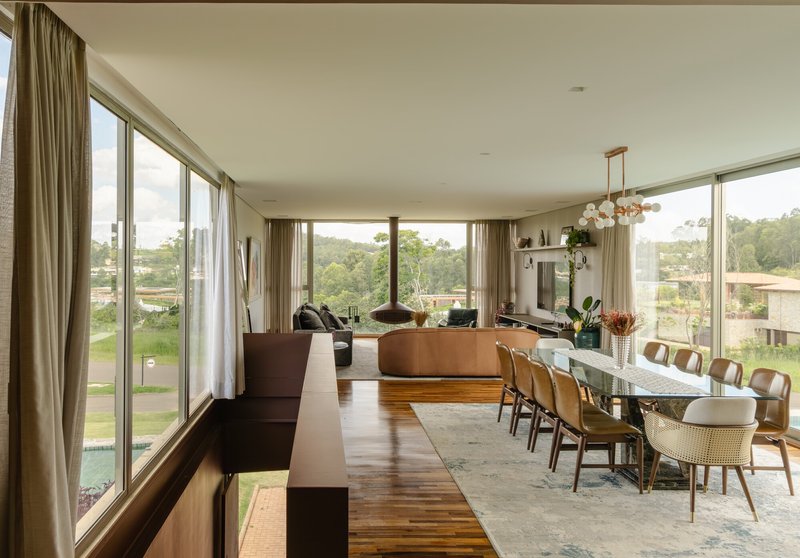
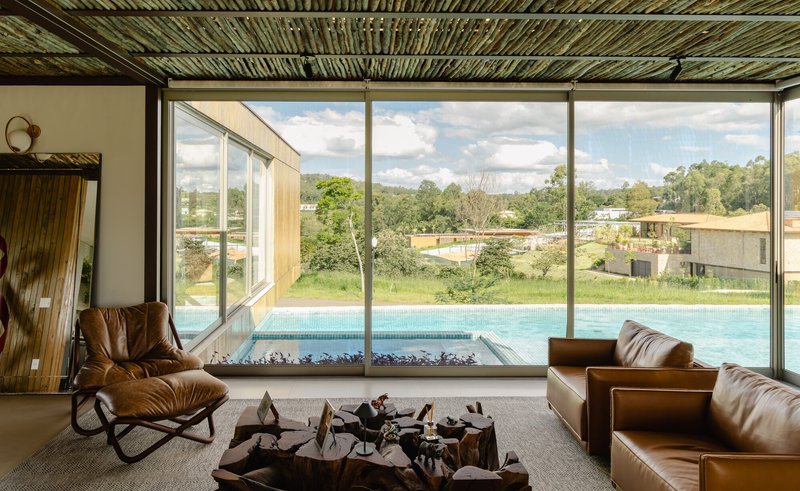
Inside, the exposed timber-strip ceiling runs continuously across the living and dining areas, binding them into a single horizontal field. Full-height glazing on three sides dissolves the boundary between the interior and the pool terrace, the hills, and the sky. The slatted ceiling keeps the rooms from feeling exposed; it compresses the vertical dimension just enough to create a sense of shelter without sacrificing the panoramic views.
The open-plan social zone is calibrated for flexibility. A secondary lounge and dining area, set slightly apart, gives the family the option of intimacy when twenty guests are not filling the main space. That programmatic generosity, providing both a grand gathering room and a quiet retreat within the same wing, reflects the architects' understanding that a weekend house oscillates between large-scale entertaining and small-scale recovery.
Bedrooms, Gardens, and the L-Shaped Logic
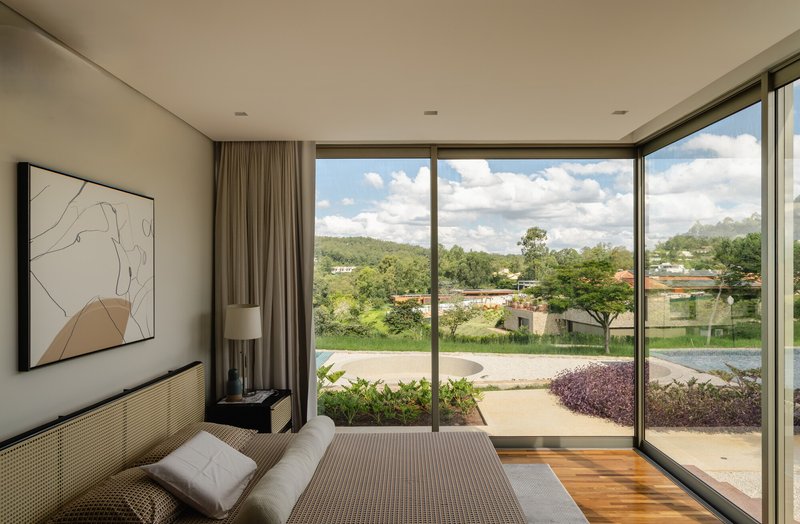
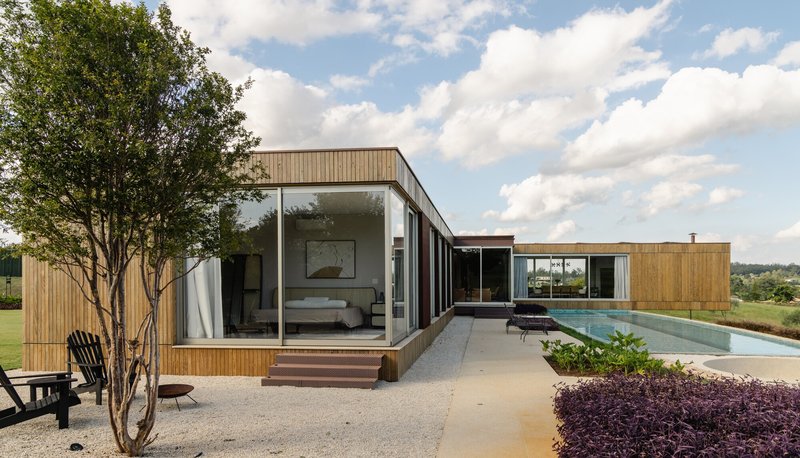
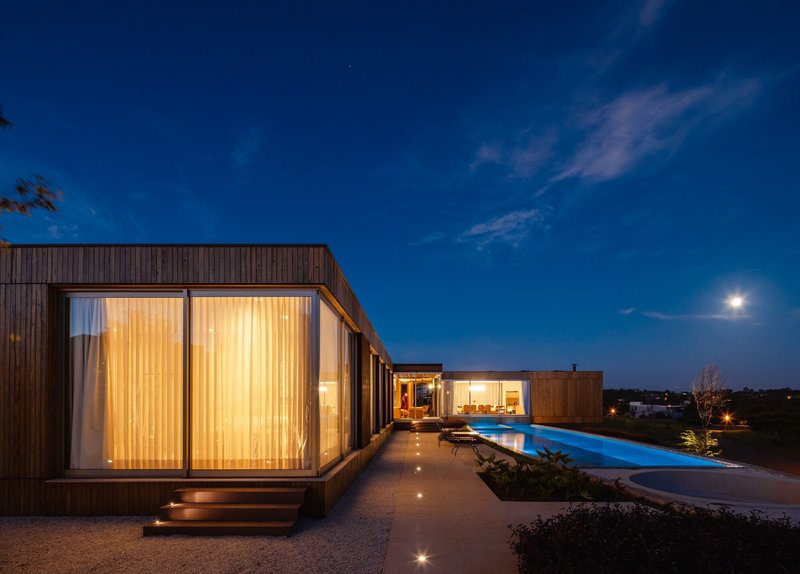
The bedrooms occupy the second arm of the L, a linear wing positioned to overlook both the pool terrace and the broader landscape. Floor-to-ceiling glass doors in each room open directly onto garden beds planted with purple foliage, creating individual outdoor thresholds that give privacy without walls. The planted beds act as buffers between adjacent rooms, and their color provides a counterpoint to the dominant greens and browns of the site.
At dusk, the glazed bedroom volumes glow beside the pool, their curtains softening the interior light into lantern-like rectangles. The paved terrace linking the bedroom wing to the pool wing serves as a secondary gathering space, quieter and more intimate than the main deck. The L-shaped plan allows these two outdoor moods, the expansive poolside and the sheltered courtyard, to coexist without competing.
Pool Terrace and Outdoor Ritual
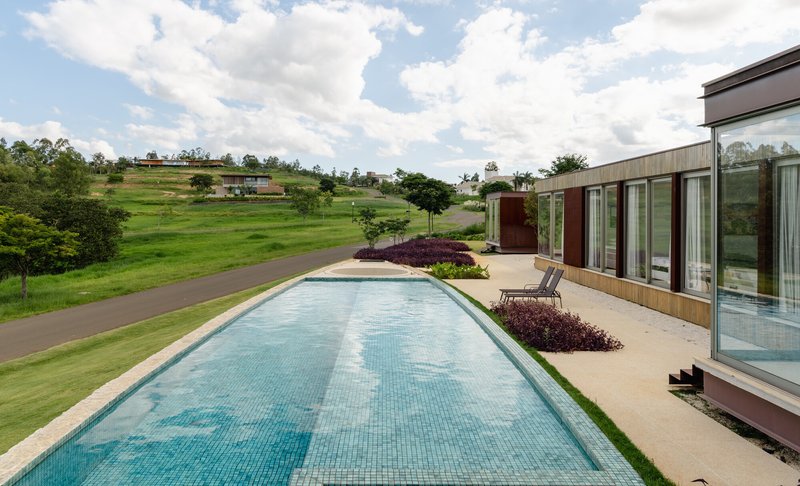
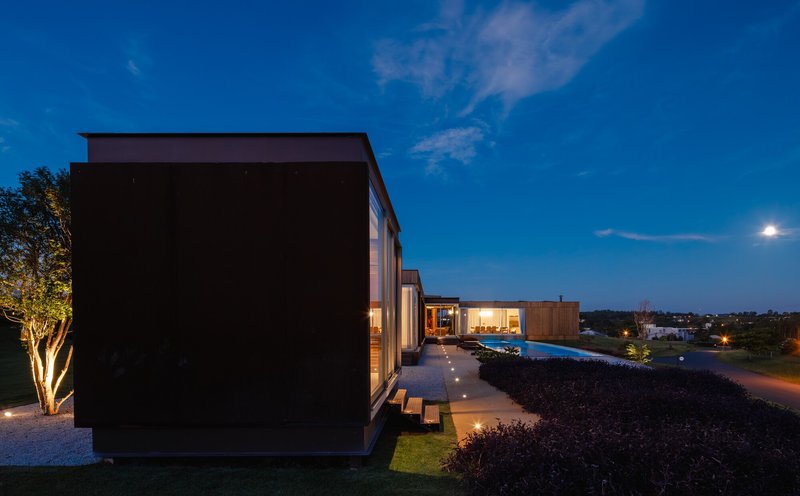
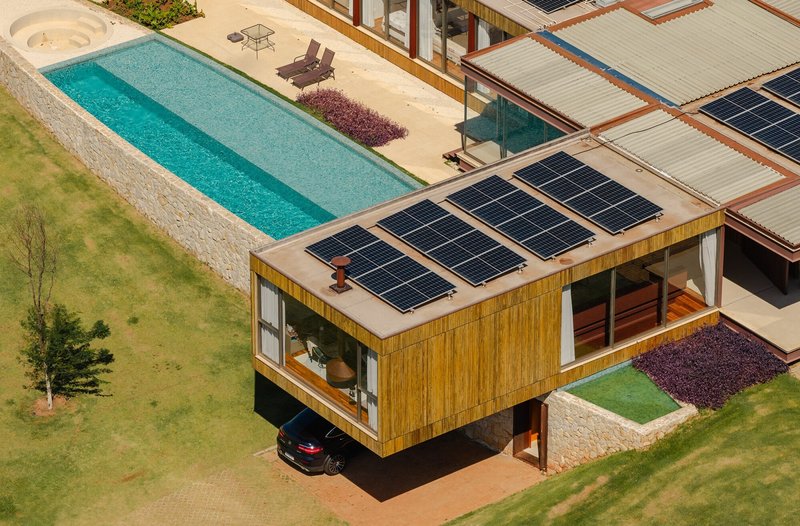
The long rectangular lap pool extends from the timber-clad volume toward the sloping green landscape, its mosaic tile catching light and drawing the eye outward. It is the spine of the outdoor program, connecting the sun deck, the fire pit zone, and the cantilevered living room into a single sequence of leisure. The stone platform beneath it all provides a stable, elevated ground plane that keeps the pool and its surrounds elevated above the road, reinforcing the sense of privacy.
The aerial views reveal how deliberately the pool and terrace are oriented. Solar panels line the corrugated metal roofs, and the curved pool edge echoes the arc of the stone platform below. At twilight, the dark geometric volumes arranged around the pool terrace form a composition that reads as sculptural from above, each wing casting its own shadow across the stone.
Facade Detail and Screening
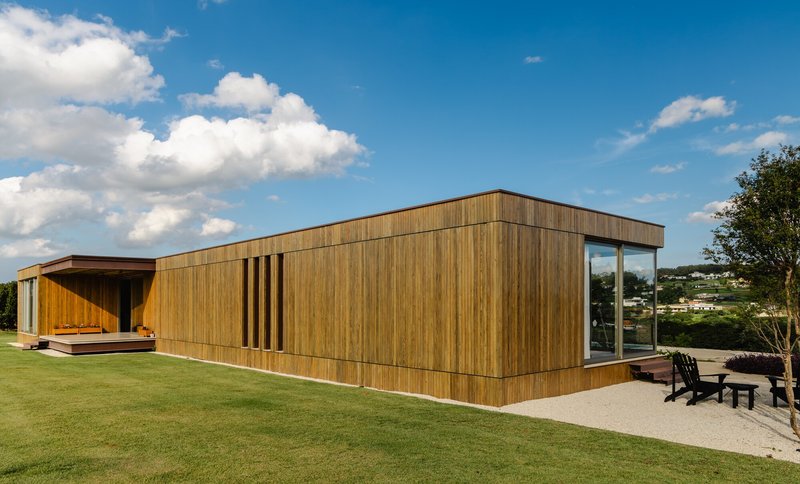
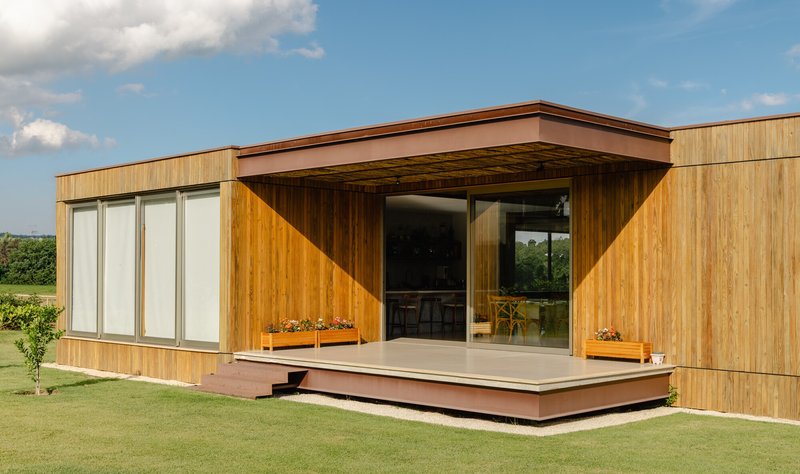
The vertical timber slat screens along the side elevation do more than modulate light. They introduce a second rhythm to a facade otherwise dominated by horizontal cladding. Where the horizontal boards emphasize the building's length and groundedness, the vertical slats break the surface and create depth, turning a flat plane into something tactile and responsive to the angle of the sun.
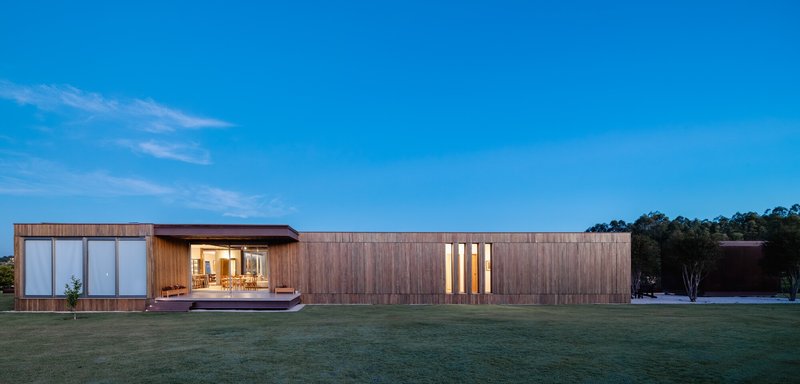
At the covered terrace entrance, exposed wood rafters run beneath a copper-wrapped canopy, a moment of overt craft in a house that generally prefers understatement. The narrow window slits punched into the timber volume facing the lawn at dusk suggest the bedrooms behind, offering just enough light to animate the facade without exposing the interior. It is a controlled performance: the house reveals only what it chooses to.
Plans and Drawings
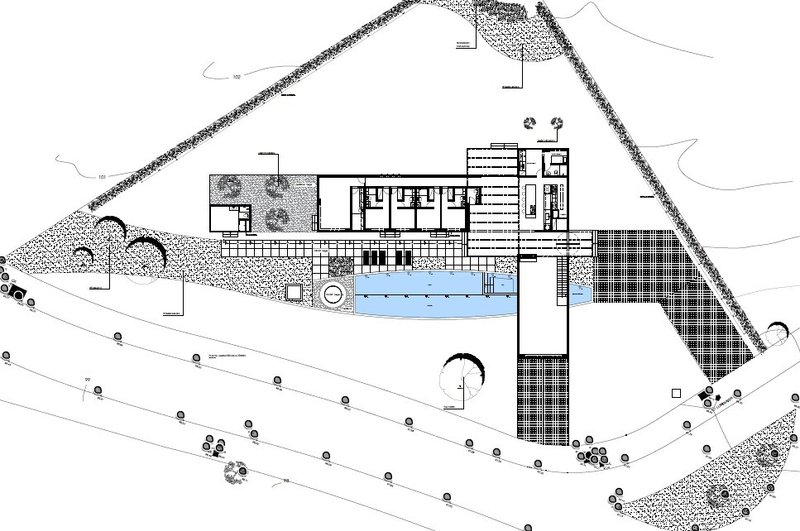
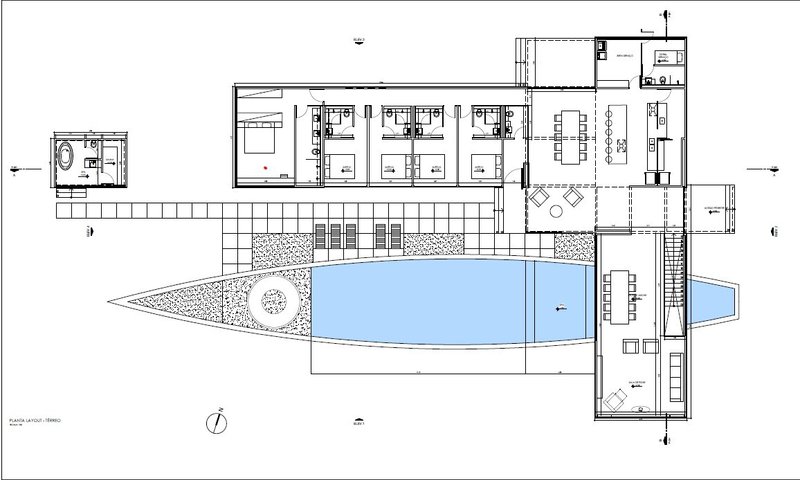
The site plan confirms the L-shaped footprint on its triangular plot, with the swimming pool occupying the hinge between the two wings. The landscape strategy is legible here: a large open lawn to the north, the curved access road and stone wall to the south, and native planting zones softening the perimeter. The floor plan reveals the programmatic clarity of the layout. Bedrooms line the linear wing in a file, each with its own garden threshold, while the living, dining, and kitchen spaces cluster around the pool terrace at the intersection of the L. Service areas and circulation are compactly organized along the interior spine, keeping the perimeter free for views.
Why This Project Matters
Casa Themis is not trying to reinvent the Brazilian country house. What it does, quietly and with conviction, is resolve a series of competing demands: privacy from the road, openness to the landscape, communal scale for entertaining, intimate scale for retreat, and structural ambition without exhibitionism. The stone platform is the key. By investing the earthwork with as much design intelligence as the house above it, Sergio Sampaio and Tectônica created a project whose base and superstructure are equally considered.
The five-meter cantilever, the L-shaped plan, the layered material palette: none of these moves are novel in isolation. What sets this house apart is the discipline with which they are combined. Every element earns its place. The architects resisted the temptation to flatten the site, and they resisted the temptation to let the cantilever become the whole story. The result is a weekend house that feels grounded and light at the same time, a place built for gathering that also knows how to be still.
Casa Themis by Sergio Sampaio Archi and Tectônica. Itu, Brazil. 430 m². 2025. Photography by Manuel Sá.
About the Studio
Share Your Own Work on uni.xyz
If projects like this are the kind of work you want to make, uni.xyz is a place to publish your own, find collaborators, and enter design competitions.




Popular Articles
Popular articles from the community

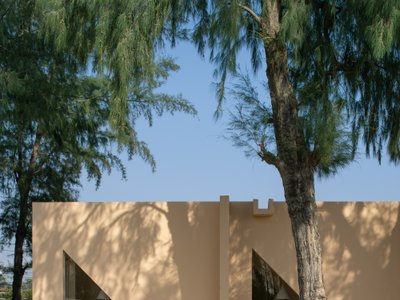
Pinto Builds a Faceless Pavilion Beneath Casuarina Trees on Thailand's Rayong Coast
SON Restaurant refuses a front door or a back wall, treating all four facades equally in a 260-square-meter brick and stucco grid.
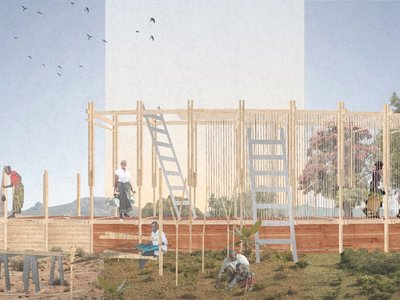
Healing Façade: Sustainable Architecture for Reforestation, Community, and Sacred Ecology in Ethiopia
Healing Façade reimagines sustainable architecture as a living wall that restores soil, catches water and renews Ethiopia's forest churches.
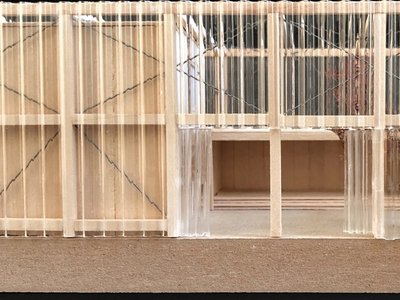
Kaffeebühnen: Coffee Shop Architecture Designed as a Civic Stage Between Vienna’s City and Park
Kaffeebühnen turns coffee shop architecture into a civic stage, linking Vienna’s park edge, urban life, warm timber yards, and coffee craft.
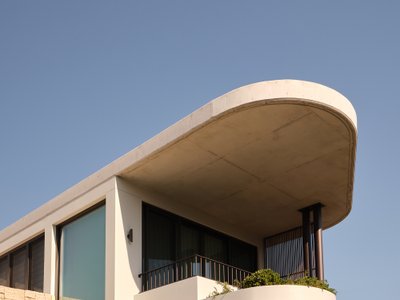
Stanton Architects Sculpts a Curving Family Home into Sydney's Inner West Fabric
Five Dock House uses cantilevers, curved concrete, and layered courtyards to carve out privacy on a tight suburban lot in Sydney.

Similar Reads
You might also enjoy these articles

Freebird Residence by Alexis Dornier: A Tropical Modernist Sanctuary in Bali
Floating living pavilion above pool anchors H-shaped tropical villa, blending Japanese minimalism, sustainable strategies, lush landscape, and sculptural interiors.
127af Flips a Tiny Bagnolet Rowhouse Upside Down with a Handcrafted Roof Extension
A 55-square-meter terraced house on the edge of Paris gains a luminous upper living floor through lightweight timber and steel.
1.61 Design Workshop Wraps a 600-Square-Meter Café in Vietnam in Sculptural Burgundy Drama
Reden Café & Bistro pairs a helical staircase, mosaic floors, and deep red interiors to rethink Vietnamese hospitality space.

The Unbound Brain: A School Shaped by Cognitive Architecture
Cylindrical learning pods radiate like neurons from a central cortex, turning the floor plan into a spatial model of human thought.


Explore Landscape Design Competitions
Discover active competitions in this discipline




The International Standard for Design Portfolios


The Global Benchmark for Architecture Dissertation Awards


The Global Benchmark for Graduation Excellence


Challenge to reimagine the Iron Throne
Comments (0)
Please login or sign up to add comments
No comments yet. Be the first to comment!