
Sitti Architects Wraps a Cloud-Chasing Café in Curved White Geometry in Southern Thailand
On cloud9 hdy brings circles, triangles, and squares together around water and sky in Hat Yai's dense residential fabric.


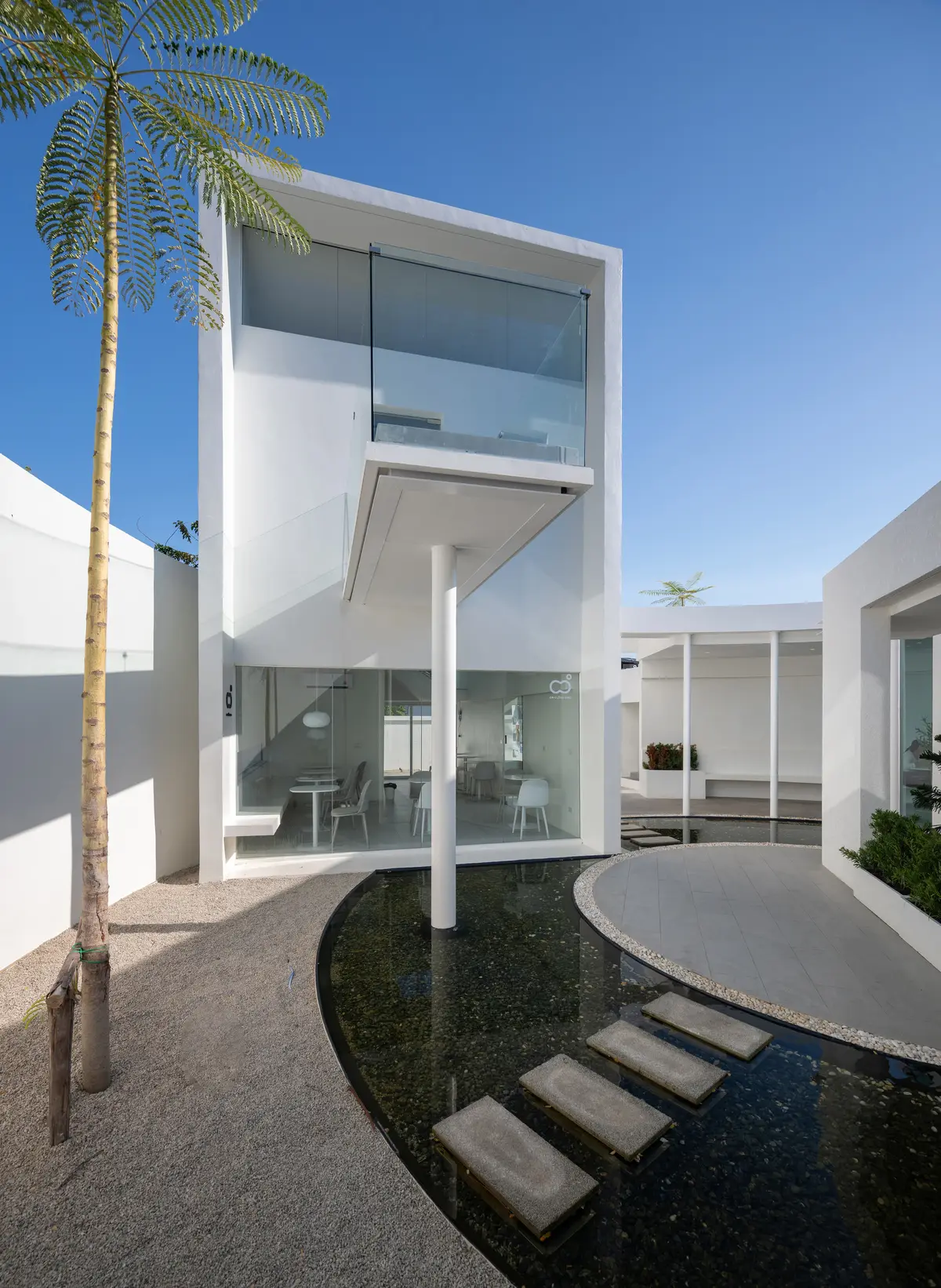
Hat Yai is not a city you associate with ethereal architecture. It is a dense, commercial hub in Thailand's deep south, where buildings crowd one another and green space is scarce. That context makes On cloud9 hdy, a 200 square meter healthy café and restaurant by Sitti Architects and Design, feel almost hallucinatory. Planted on Phetkasem Road, Soi 10, the project is a compact arrangement of white stucco volumes organized around courtyards, water, and sky, carved out of a tight residential lot as though someone scooped a cloud from above and set it down between neighbors.
Lead architect Sittikorn Suwannarat took the owner's brief for something "simple yet truly outstanding" and turned it into a design thesis about elementary geometry. Circles, triangles, and squares are not merely decorative motifs here; they are the organizational logic of the plan. A curved perimeter wall wraps around a circular void, an angled wing shoots off at a contrasting axis, and rectilinear openings punch through surfaces to frame views of palm canopies and open sky. The result is a café that feels far larger and more atmospheric than its modest footprint suggests.
A White Signal in a Dense Neighborhood
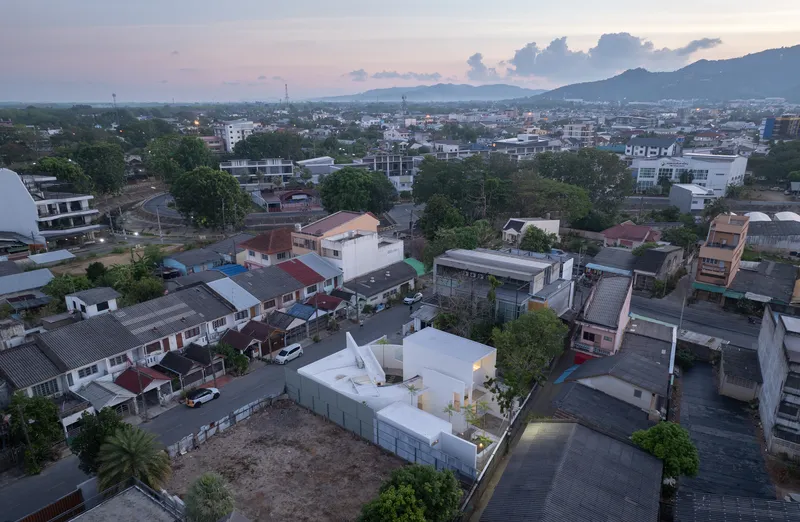


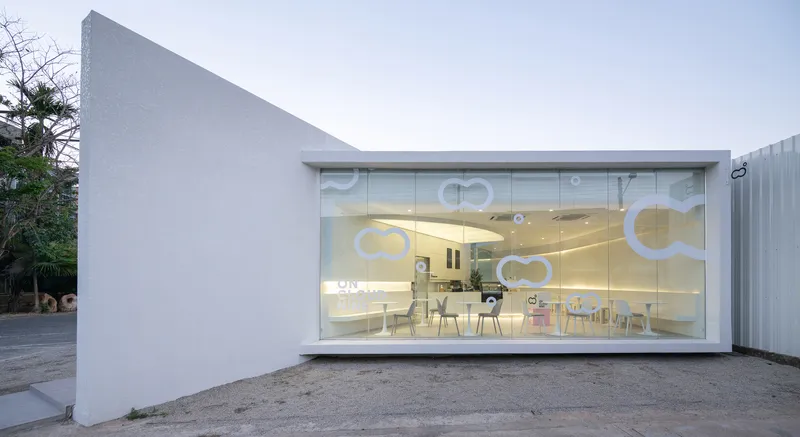
From the air, the project reads as a bright white anomaly in a sea of corrugated roofs and weathered concrete. That contrast is not accidental. The building's monochromatic palette, reinforced concrete and steel clad in smooth white stucco, distinguishes it from its surroundings without resorting to scale or height. Curved walls at the street edge soften the façade and pull visitors toward a recessed entry, while a sliding metal gate and large corner glazing manage the threshold between public sidewalk and interior sanctuary.
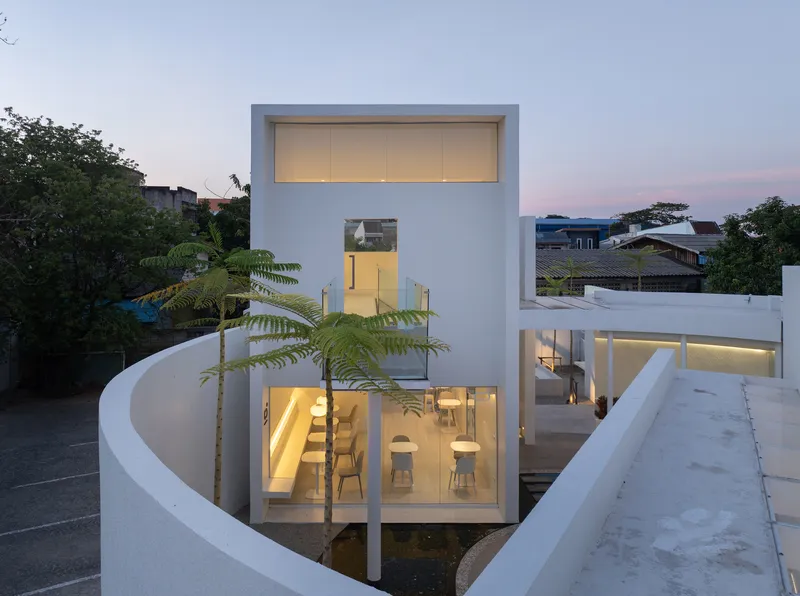
The street-facing volume stacks glass openings at multiple levels, creating a lantern effect at twilight that advertises the café's presence without signage. It is a restrained move, one that lets the architecture do the marketing.
Geometry as Spatial Engine

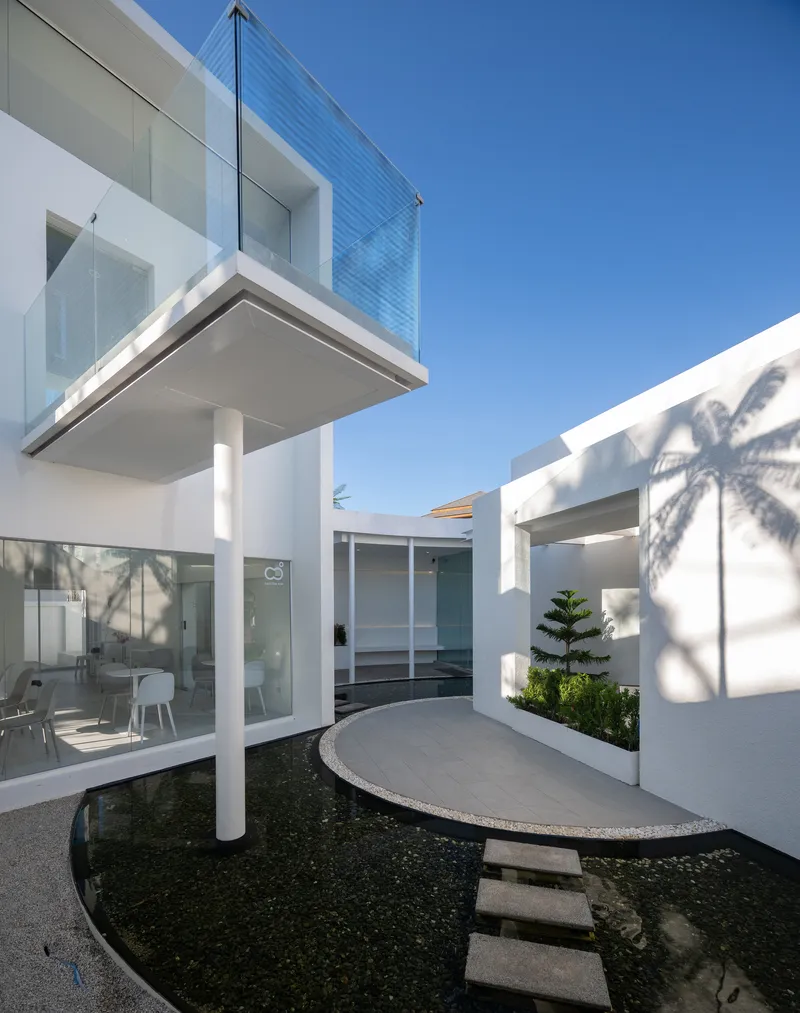
The interplay of curved and angular forms is where the design earns its complexity. A circular water feature anchors the plan, and a cantilevered upper floor hovers above it, casting sharp shadows onto the pool's surface. Openings are positioned so that you are always looking through one volume toward another, with courtyards acting as intermediary spaces that belong neither fully inside nor outside.
The multi-level façade reads as a kind of geometric stack: each floor presents a different proportion of solid wall to glass, so the building's face shifts depending on your vantage point and the time of day. Construction reportedly demanded exacting craftsmanship, particularly in the execution of the curved forms, where every edge had to be refined to maintain the seamless, almost inflatable quality of the surfaces.
Courtyards, Water, and the Sky Above
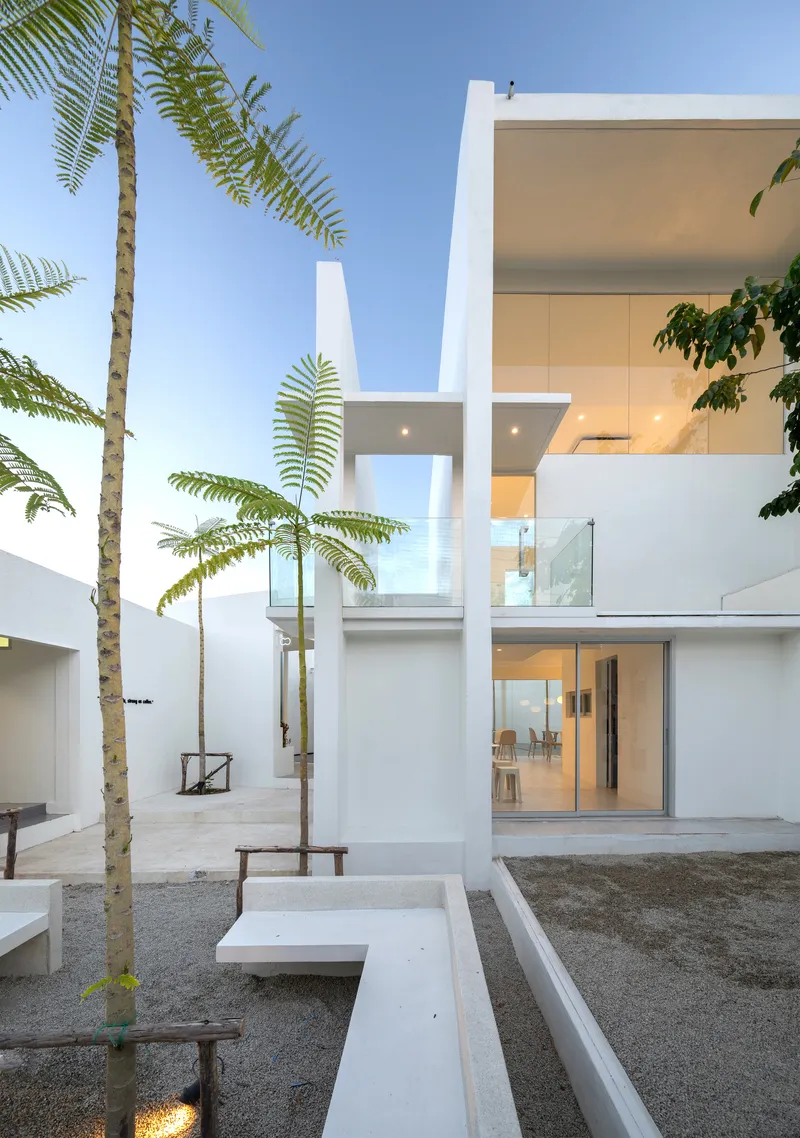
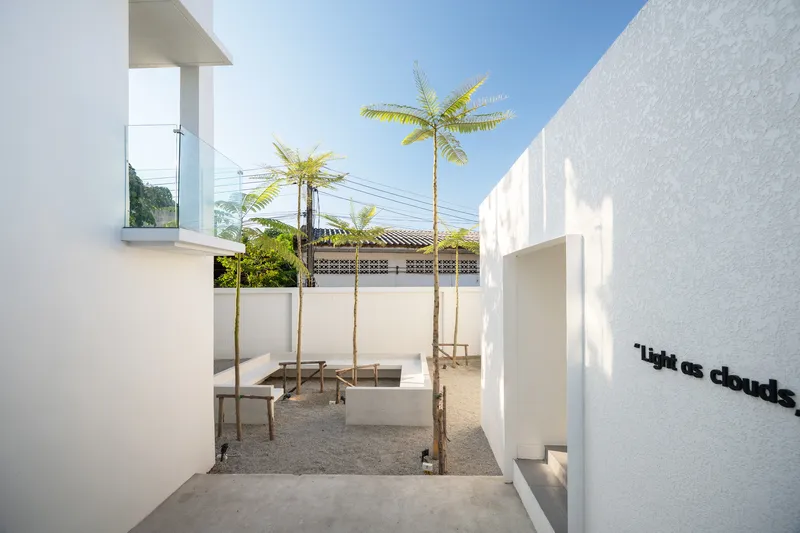

The central courtyard is the project's lungs. Tall palm trees rise from planted beds set into gravel, and concrete benches line narrow passages that feel more like cloisters than café seating. The landscape strategy is spare: white surfaces, gravel, and selective planting create a minimal palette that amplifies the greenery rather than competing with it. Under a bright midday sun, the courtyard becomes almost blindingly white, focusing your attention upward toward the only color available, the blue sky and green fronds overhead.
Water appears throughout the project as both reflective surface and cooling agent. A dark reflecting pool at the base of the glass pavilion doubles the columns and sky in its surface, while stepping stones introduce an element of play and slowness. You cannot rush across stepping stones; the architecture insists you take your time.
The Reflecting Pool Pavilion
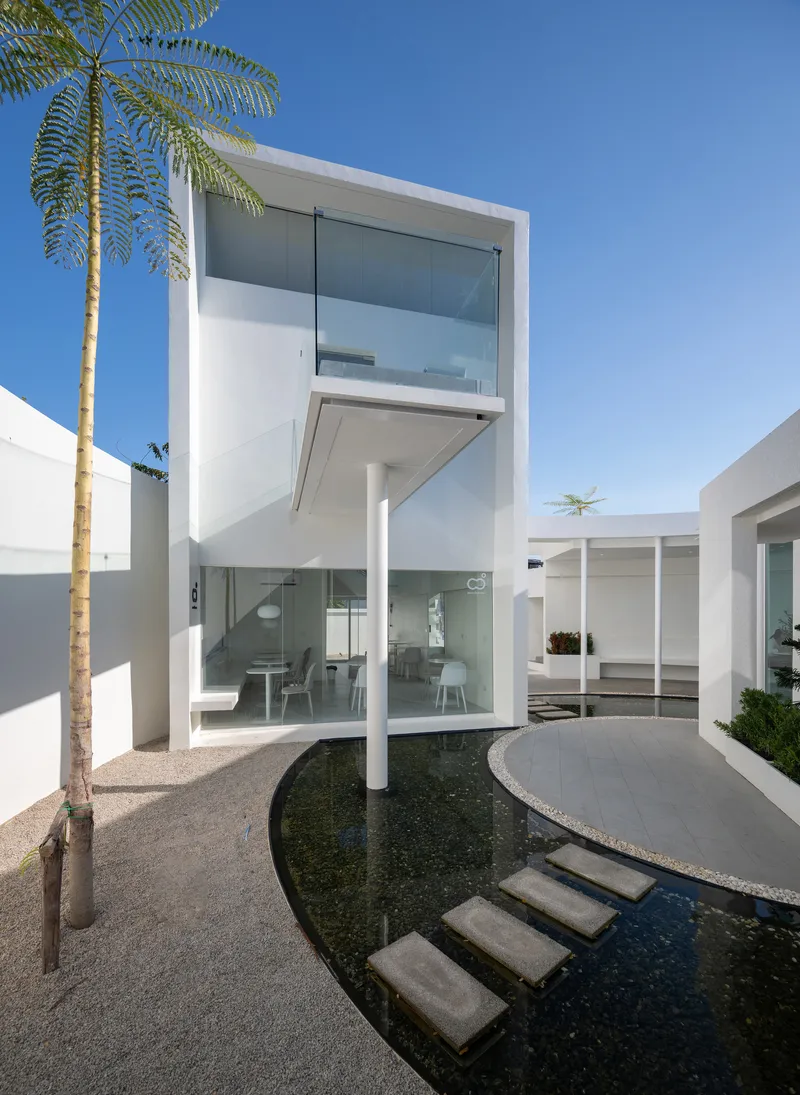


The glass pavilion hovering above the curved reflecting pool is the project's signature moment. Slender white columns lift a transparent volume above water, and from the covered terrace you look out across the pool's dark surface toward the planted courtyard beyond. It is a composition that works because of its restraint: the palette is limited to white structure, dark water, and glass, so every palm shadow and cloud reflection registers with unusual clarity.
The aerial view reveals that the rooftop continues this interplay of geometry and openness, with a curved canopy, louvered shading elements, and the pool below all visible as an integrated system. The 360-degree sky exposure that the designers sought is most palpable here, on the upper levels where the surrounding neighborhood drops away and the café's name finally makes literal sense.
Interior: Curves Under Cove Light
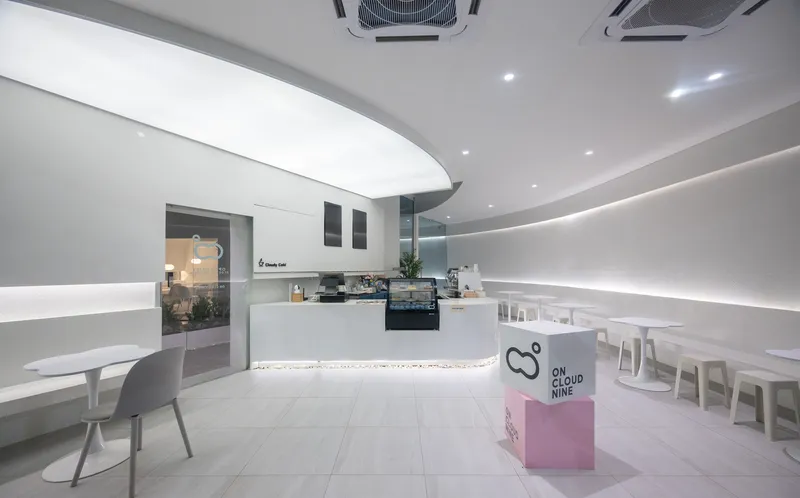

Inside, the curved counter and continuous LED cove lighting reinforce the cloud metaphor without overselling it. White seating, recessed ceiling fixtures, and smooth surfaces create a clean, almost clinical atmosphere that suits the healthy café program. The palette is intentionally humble: no exotic timber, no brass accents, just well-executed concrete, paint, and light.
A secondary passage features yellow ceiling panels, the one strong color moment in the project, which warm the descent toward a glass door overlooking the courtyard. It is a small but effective detail that breaks the monochrome just enough to signal a transition between zones. The glass storefront at the street level, with its logo graphics and warm interior glow at twilight, operates as a display case for the life inside, collapsing the distance between passerby and patron.
Landscape as Architecture


Raised white planting beds with young palm trees define edges and create a rhythm in the gravel-paved courtyard that mirrors the rhythm of the architecture itself. Curved paver walkways with gravel edges thread between volumes and planted beds, establishing a ground plane that is as carefully composed as the walls above it. These are not leftover spaces; they are designed with the same geometric rigor as the building.
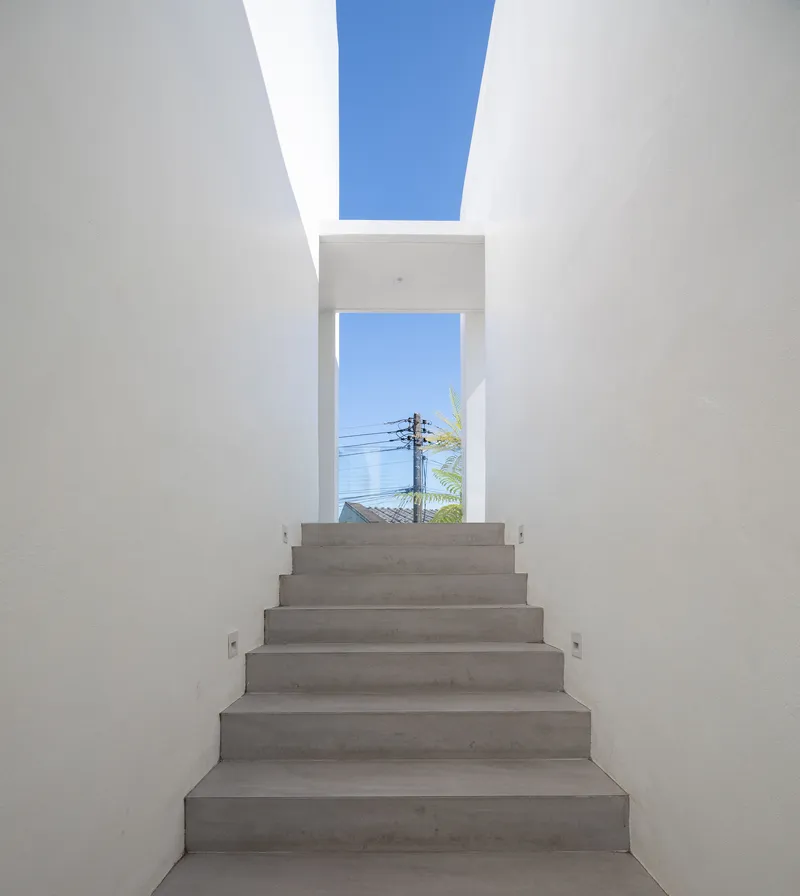
A concrete staircase ascending toward a framed opening, with a skylight pouring blue sky into the circulation, exemplifies how the project treats vertical movement as a series of curated views. Every turn reveals a new relationship between structure, landscape, and atmosphere. It is a strategy that makes 200 square meters feel expansive.
Plans and Drawings
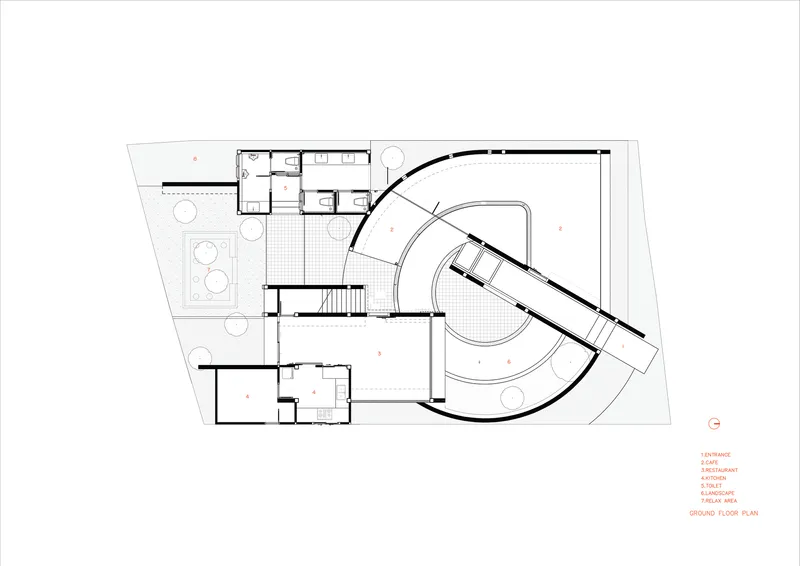
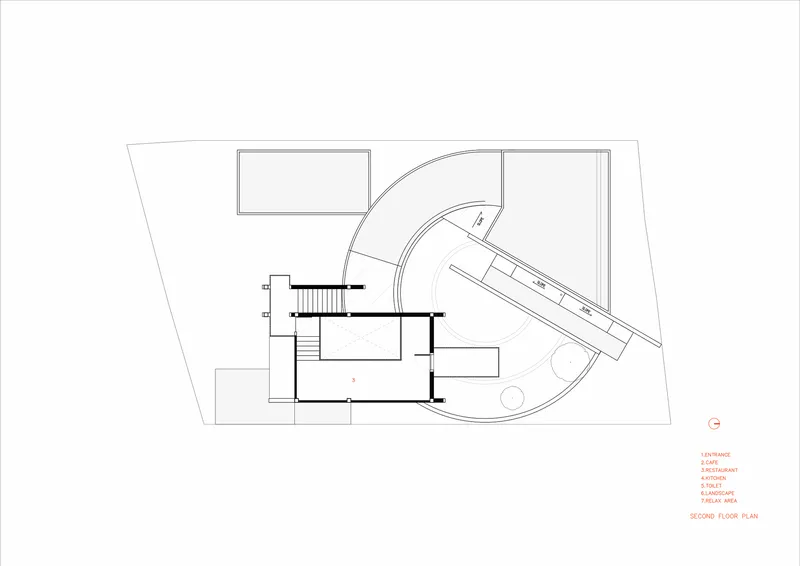
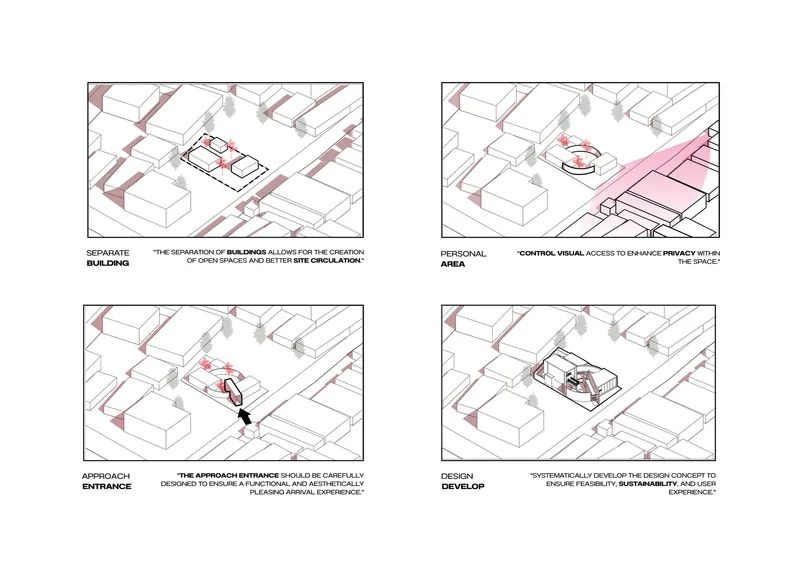
The ground floor plan makes the geometric logic legible: a curved volume wraps a circular void while an angled wing extends along a contrasting axis, creating the two primary courtyard spaces. The second floor plan shows a central stair core and a curved balcony that overlooks the circular space below, confirming that the section is as carefully considered as the plan. The axonometric diagram series is particularly revealing, breaking the design into discrete moves: site separation, privacy zoning, approach sequence, and formal development. It reads as a clear, didactic argument for how simple shapes can generate complex spatial experiences.
Why This Project Matters
On cloud9 hdy matters because it demonstrates that a modest café program on a constrained urban lot can produce architecture of genuine spatial ambition. The project does not rely on expensive materials or technological spectacle. Its tools are geometry, light, water, and a disciplined color palette. In a city like Hat Yai, where commercial architecture rarely aspires to more than functional adequacy, this kind of commitment to craft and concept sets a standard.
More broadly, the project is a reminder that the café typology, so often reduced to Instagram backdrops and trending finishes, can be a vehicle for serious architectural thinking. Sittikorn Suwannarat and Sitti Architects and Design have treated the brief not as a decoration exercise but as a problem of organizing space, framing sky, and guiding movement. That approach yields a place that people will want to return to long after the novelty of its appearance fades, which is more than most cafés can claim.
On cloud9 hdy café by Sitti Architects and Design, led by Sittikorn Suwannarat. Tambon Hat Yai, Thailand. 200 m². Completed 2026. Photography by Rungkit Charoenwat.
About the Studio
Share Your Own Work on uni.xyz
If projects like this are the kind of work you want to make, uni.xyz is a place to publish your own, find collaborators, and enter design competitions.


Popular Articles
Popular articles from the community


The Amber Palace Opera: A Geological Fiction Surfaces on Tallinn's Baltic Waterfront
Pierre Brillard reimagines a Baltic legend as a public landscape, opera house, and waterfront promenade rooted in Tallinn's coastal identity.

Opera on the Sea: Driftwood Logic Shapes a Timber Opera House on Estonia's Coast
Trevor Orgill's opera house translates the entangled drift of floating timber into a civic building where wood, water, and music converge.


David Ortega Stacks a Two-Story Mexico City Penthouse Around a Steel Stair and a Pergola-Shaded Roof Terrace
In Colonia Roma, a 300 m² penthouse uses oak joinery, a planted steel stair and a slatted roof pergola to make a new-build apartment feel like a house.

FCC Arquitectura Expands a Portuguese Granite House with a Board-Marked Concrete Wing
In Portugal, JV House pairs a cleaned-up whitewashed and granite dwelling with a timber-shuttered concrete extension, courtyards and a garden pool.

Similar Reads
You might also enjoy these articles

LAVA Architecten Gives Vocational Education a Sawtooth-Roofed Face on a Mechelen School Campus
In Mechelen, Belgium, a 2,053 m² STEM school on a 6×6 m grid turns workshops and classrooms into rooms that can be rearranged as teaching changes.

KEMA Studio Turns a Derelict Marvila Attic into a 60 m² Lighthouse Apartment Above Lisbon
In Lisbon's Marvila district, a rebuilt roof, four skylights and two plywood volumes turn an unlivable attic into a bright home facing the Tagus.

Pixel Gardens: One Repeated Module Stacked Into a Terraced Social Housing Tower for Famagusta
Salem Bader's shortlisted housing tower builds a vertical neighbourhood from one repeated module, offsetting units to carve terraces, light and air.

Bao Huynh Watercolor Atelier: A Serene Art Retreat in Hội An
Bao Huynh Watercolor Atelier in Hội An blends multifunctional art spaces, sustainable design, local materials, and family-friendly living in a serene environment.

Comments (0)
Please login or sign up to add comments
No comments yet. Be the first to comment!