
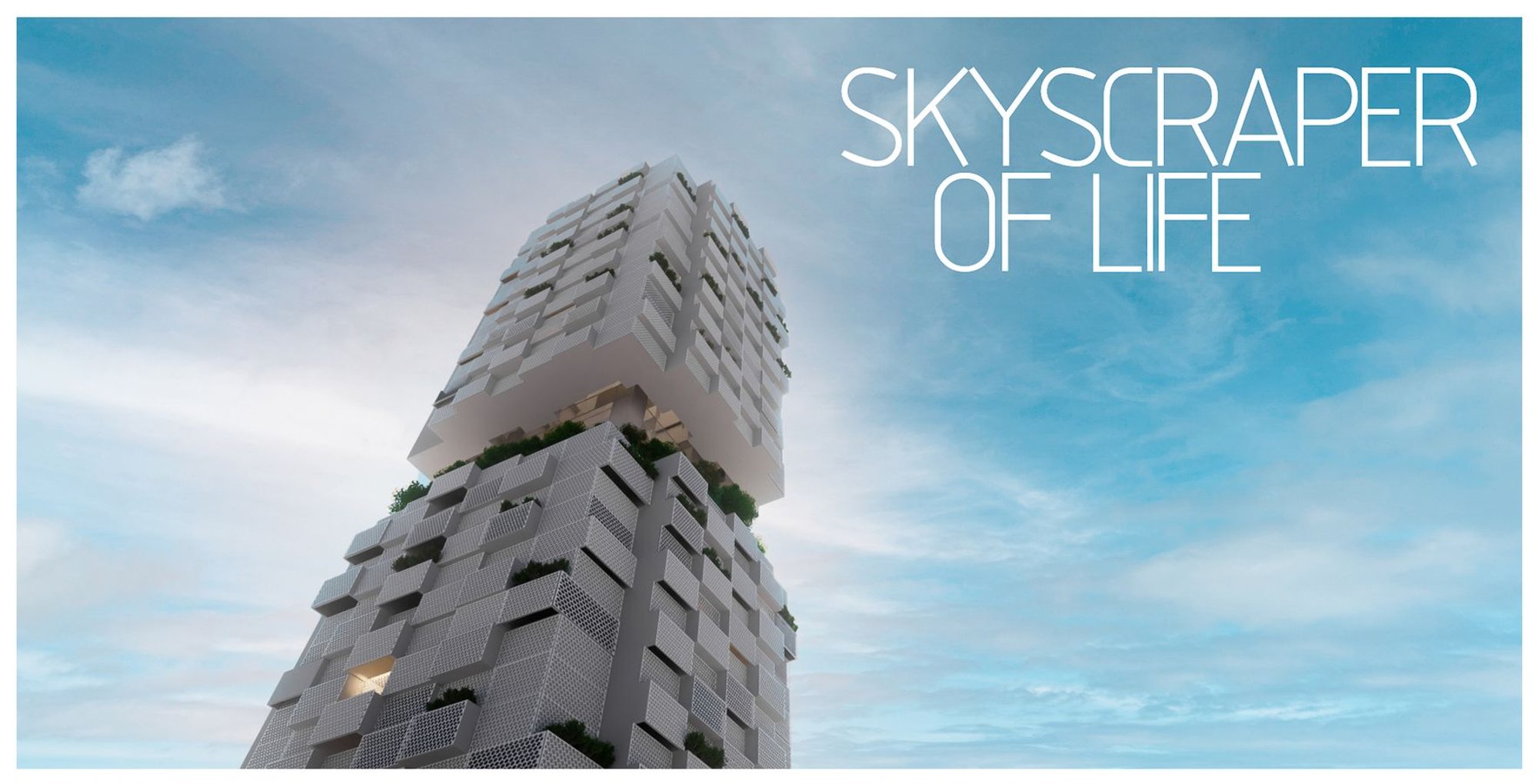
Skyscraper of Life: Modular Adaptive Reuse Turns Warsaw's Dead Office District Into a Living Tower
A prefabricated, spine-mounted modular system transforms Warsaw's abandoned Mordor district into a vertical community that grows and contracts on demand.

Warsaw's so-called "Mordor" district earned its nickname honestly. Once a thriving office hub, it decayed into a cluster of underutilized buildings abandoned as tenants migrated to better-connected, newer developments. The Skyscraper of Life takes this condition not as a problem to demolish but as raw material: a spine-based modular tower whose prefabricated units can be attached, removed, and reconfigured in response to real-time occupancy data. Housing, coworking, wellness centers, cafes, micro-apartments for young professionals: nothing is permanent except the structural core and the commitment to change.
Designed by Kamila Śniatkowska, Mateusz Czarnocki, Daniel Dubiejek, and Dominika Wodecka, the project was shortlisted in the CityScraper competition. Sited in central Warsaw between Saxon Park and Swietokrzyski Park, the tower bridges two major green spaces while reclaiming a stretch of city that had become synonymous with urban isolation. The proposal reframes the high-rise not as a static monument but as an evolving organism, one whose form is a direct expression of the lives happening inside it.
A Pixelated Mass That Breathes With the City
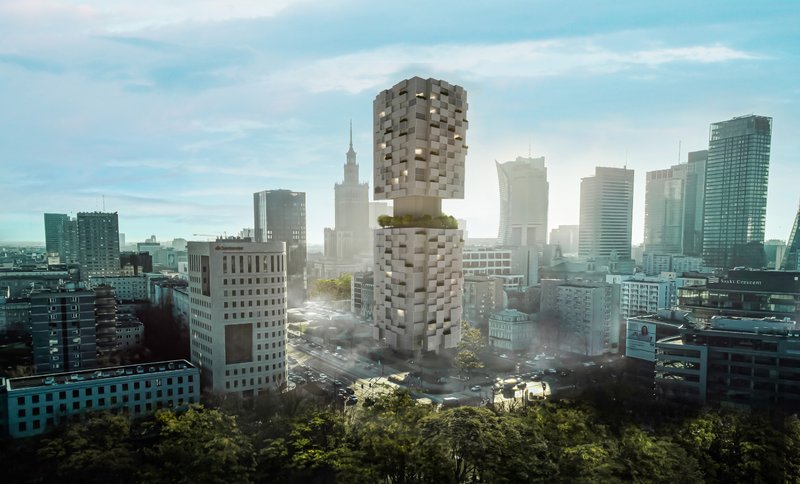
Seen from above in morning haze, the tower reads less like a conventional skyscraper and more like a pixelated stack of inhabitable volumes, each module stepping in and out of alignment with its neighbors. The irregularity is the point. Rather than expressing a single, frozen design intention, the massing reveals which units are occupied and which await new programs. The central spine holds it all together structurally, while a prominent vertical void runs through the building as a light well, distributing natural light to inner areas and reducing energy consumption through passive design. The result is a silhouette that changes over time, a building whose skyline profile is literally a record of how the city is using it.
Ground Level as Public Park, Not Private Lobby
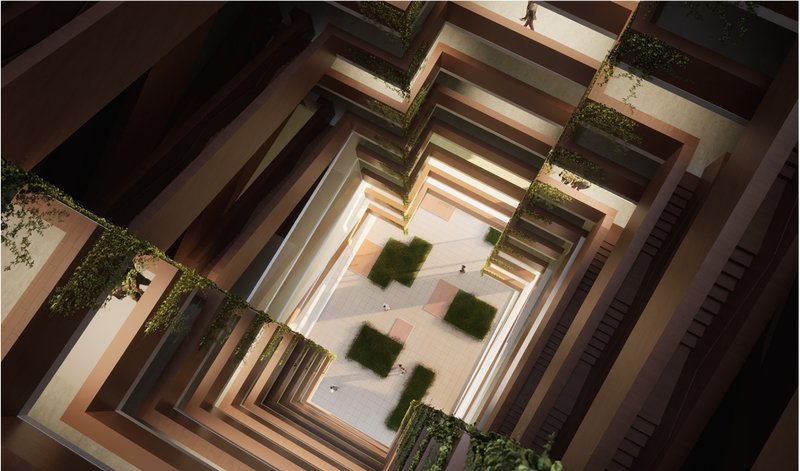
The overhead view into the terraced courtyard reveals the designers' ambition to collapse the distinction between tower and park. Planted boxes, paved walkways, and human figures moving freely across the ground plane confirm that the lower levels are not gated or privatized. The open base creates sightlines and pathways through the building, restoring walkability to an area long defined by dead zones between sealed office blocks. This "levitating" language, where the mass lifts to let the ground breathe, connects directly to Saxon Park on one side and Swietokrzyski Park on the other, establishing ecological and social continuity rather than interruption.
The green ground floor is not decoration. It functions as a continuation of the adjacent parks, pulling civic life into the building's foundations and providing a reason for pedestrians to move through the site rather than around it. In a district where isolation was the defining spatial experience, this porosity is a deliberate act of urban repair.
Lifecycle Thinking: Modules That Arrive, Serve, and Move On
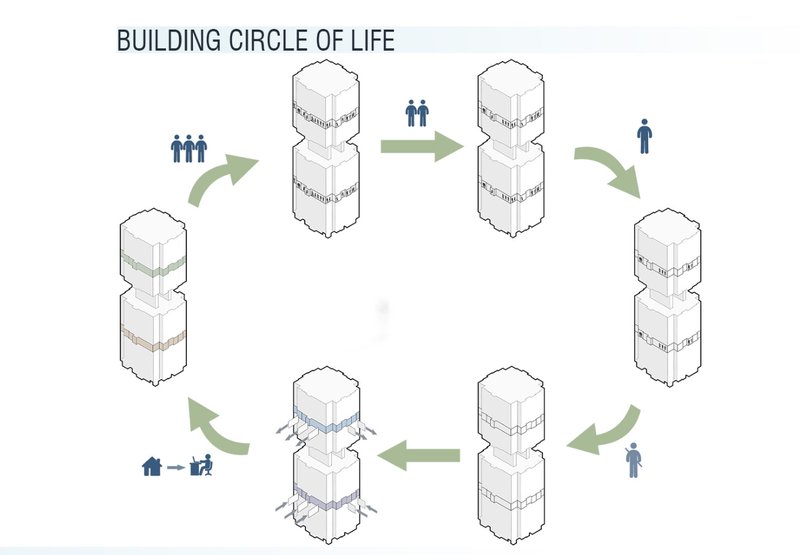
The lifecycle diagram strips away the tower's visual charm to reveal its operational logic. Each module passes through stages of occupancy and adaptation: installed when demand rises, reconfigured as uses shift, removed when no longer needed. Because the units are prefabricated and standardized yet combinable in multiple configurations, the system supports endless floor plan permutations. A collaborative office on one floor can become a private residence; a public atrium can contract into a cluster of micro-apartments. Construction timelines shorten because assembly happens on-site from factory-built components, and material waste drops because nothing is demolished, only detached and redeployed.
This is where the project's sustainability argument gets concrete. Minimizing demolition waste and carbon footprint is not achieved through better insulation or solar panels alone but through a fundamentally different relationship between building and time. The tower does not age toward obsolescence; it metabolizes change.
Urban Flows: How the Tower Redirects Movement at the City Scale
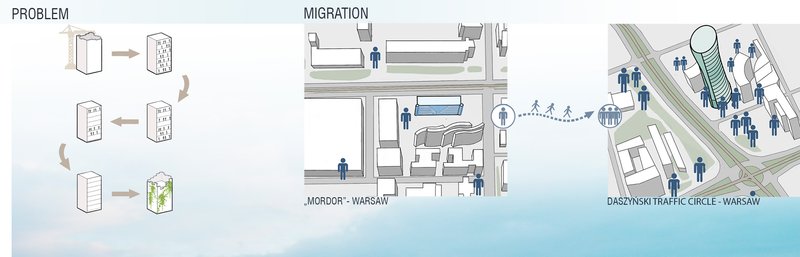
The final conceptual diagram zooms out to show unit migration patterns and urban traffic flow around the site. It reveals that the designers are thinking beyond the building envelope. The tower's modular growth and contraction influence pedestrian routes, transit loads, and the distribution of commercial activity across the surrounding blocks. By situating the project between two major parks in central Warsaw, the team positions the tower as an urban hinge, a point where movement patterns shift from car-dominated commuting to pedestrian-scale park life. The building does not just respond to the city; it actively reshapes how people circulate through this part of it.
Why This Project Matters
Adaptive reuse conversations tend to focus on beloved historic buildings: warehouses, churches, train stations. The Skyscraper of Life asks a harder question: what do you do with the unloved ones? Warsaw's Mordor district is full of structures nobody wants to preserve but everyone recognizes cannot simply be torn down without enormous environmental cost. The answer proposed here, a permanent skeleton that hosts temporary organs, offers a credible third path between demolition and neglect.
What elevates the proposal beyond a clever diagram is the attention to ground-level civic life and cross-city ecological connection. A modular tower that ignores its base is still an isolated object. By threading parkland through the building's foundations and opening sightlines between two major green spaces, the designers ensure that the tower's adaptability serves not just its residents but the broader urban fabric. It is a building designed to be incomplete, and that incompleteness is its greatest strength.
View the Full Project
About the Designers
Designers: Kamila Śniatkowska, Mateusz Czarnocki, Daniel Dubiejek, Dominika Wodecka
Enter a Design Competition on uni.xyz
uni.xyz runs architecture and design competitions year-round that reward proposals with spatial conviction and real site intelligence.
Project credits: Skyscraper of Life by Kamila Śniatkowska, Mateusz Czarnocki, Daniel Dubiejek, Dominika Wodecka CityScraper (uni.xyz).



Popular Articles
Popular articles from the community

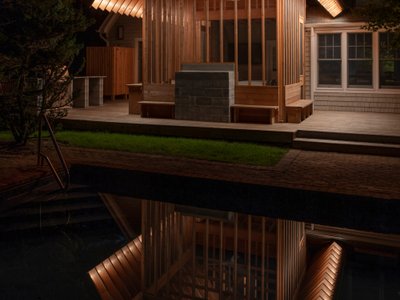
BLDUS Turns a 250-Square-Foot Screened Porch into a Pine Forest Temple in East Hampton
A gabled cedar pavilion mimics the rhythm of surrounding pines, anchoring a 1990s wooded home to its hollow in Long Island.
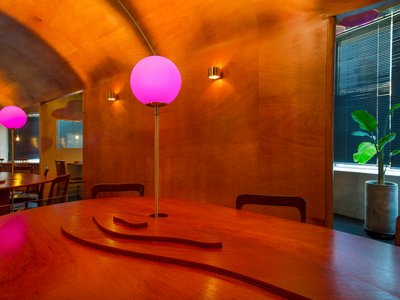
Indiesalon Carves a Plywood Cave into a Seoul Bistro's Second Floor
Munhwa Bistro's second Seongsu branch wraps diners in a laminated timber vault laced with colored light and mirror illusions.
Foster + Partners Wraps a 200-Meter Shanghai Tower in Stainless Steel and Industrial Memory
The Suhe Centre Office Tower anchors a regenerated waterfront district in Shanghai with an all-steel structure that nods to local warehouse heritage.
VEIVE Architects Builds a Mountain Hostel That Disappears into a Hangzhou Hillside
On the Huihang Ancient Trail in Xiangjian Village, a shelter of wood, steel, and rammed earth roots itself in the rural landscape.


Similar Reads
You might also enjoy these articles

317studio Turns an 87 m² Classroom into a Forest Clearing for Scouts in New Taipei City
A rope canopy, student-made specimens, and campfire geometry replace rows of desks in this Scouting classroom in Xizhi District.
24 7 Arquitetura Builds a Timber Pavilion as a Family's First Act on a 5,000 m² Brazilian Plot
In Jaguariúna, a prefabricated glulam house nestles among mature trees as the opening move of a larger residential masterplan.
1+1>2 Architects Build a School from 900 Blocks of Hmong Stone on Vietnam's Rocky Plateau
On a barren valley in Ha Giang province, a community quarried its own stone to raise a kindergarten and primary school rooted in Hmong identity.
100A Associates Builds a Volcanic Stone Retreat on Jeju Island Rooted in Ritual and Restraint
Watarstay [Wa:Tar] in Bongseong-ri channels Jeju's basalt, reed, and hemp into a 150 m² hospitality space shaped by contemplation.






Comments (0)
Please login or sign up to add comments
No comments yet. Be the first to comment!