
STRING
Weaving a string of empathy

Can design cater to the needs of a space where people of diverse age groups can gather and work towards the betterment of their community?
Empathetic architecture provides the answer. With its help, we can create spaces that enhance communication between people, improve their living conditions, and serve them. Empathetic design can also play a role in preventing segregation, so that all members of a community feel welcome and belong.
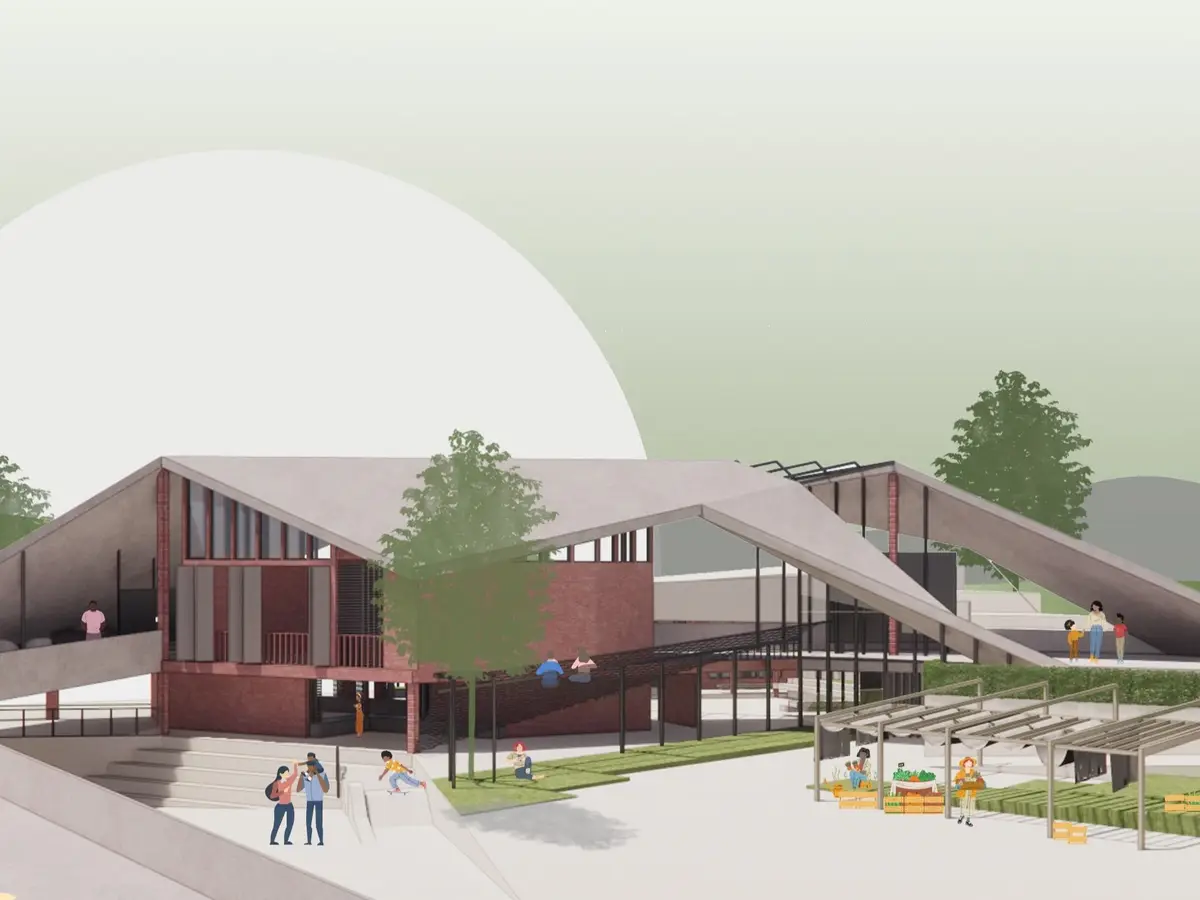
On this basis, our team has designed a youth center that not only provides a platform for volunteering activities but also serves as a local community center for social events.
The project has been designed with an empathetic approach in various sections; for example:
- Empathetic treatment of topography:
The project site has an upward slope on the north side. The sectional design has been done in accordance with the existing slope in such a way that it has not been completely destroyed and is present alongside the constructed volume. The agricultural lands also on the north side have been integrated into the design as a productive and recreational space.
- Empathetic treatment in form:
The form is designed to be completely permeable, listening, and inviting, with soft boundaries and multiple entrances.
- Empathetic treatment of the surrounding environment:
The project is adjacent to roads on three sides. By designing a blurred boundary between the building and these roads, we have eliminated the existing hard boundary and increased the pull towards the building. In addition, coordination with the height of the surrounding buildings is another example of the relationship with the surrounding environment.
- Empathetic treatment of different age groups:
Various spaces have been considered for children, young people, and the elderly, such as a skating and sports rink, a stage for performances, music and dance, a gallery, a rest area, and so on.
- Empathetic treatment of people with disabilities:
Stairs have not been used to move between different height levels so that people with disabilities can also move independently and without the need for help from others on standard ramps and have access to different sections.
- Empathetic treatment in the way spaces coexist with each other:
The classrooms are designed to be flexible and can be merged with each other. The existence of semi-open spaces also helps to blur the boundaries between closed and open spaces.
- Empathetic treatment in the construction and implementation method:
Participatory and gradual architecture, as a subset of empathetic architecture, brings with it hope for the future, a sense of belonging, a bond between participants, and trust. In the vicinity of the building under construction, seedlings and their natural growth process to become a mature tree play a special role in the gradual implementation of the project. During this process, people will initially participate and collaborate in the project process by providing suitable conditions for the growth of seedlings and then by erecting simple fabric canopies attached to the trees.
We hope that this volunteer center in the Bonela neighborhood can, like a string, strengthen the bond between people. In addition to the activities mentioned, other things such as practical learning through experience in agricultural lands and workshops such as pottery, presenting products and works in the gallery and stalls provided, participating in cooking food, and so on will contribute to this goal.

Popular Articles
Popular articles from the community


The Amber Palace Opera: A Geological Fiction Surfaces on Tallinn's Baltic Waterfront
Pierre Brillard reimagines a Baltic legend as a public landscape, opera house, and waterfront promenade rooted in Tallinn's coastal identity.

Aquadapt: An Underwater Habitat That Rewrites Its Rooms by the Hour
Curved modules ring the seabed while one shell shifts from breakfast room to cinema, farm and football pitch as residents' needs change.


LT2A and OPEN Architectes Thread a Brick and Glass High School Through a Wooded Belgian Campus
In Braine-l'Alleud, a 3,000 m² wing for Collège Cardinal Mercier pairs pale brick with a glazed colonnade, deferring to a small chapel and a dense wood.

Cube Design Draws an Ecological Corridor Between Two Shenzhen Hills with the Nankai Building
Beside Shenzhen's container docks, the Nankai Building pairs stacked balconies with a climbing green screen to connect two hillsides across its height.

Similar Reads
You might also enjoy these articles

The Rhythm of Seasons
A Farmers' Market Connecting Nature and the City

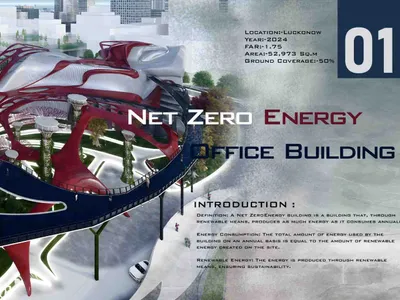
More Than a Building-Designing a Living System
More Than a Building-Designing a Living System
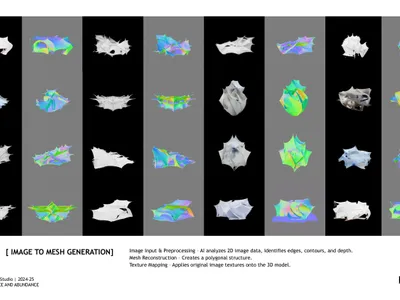
Base Beyond
DESERT COMPOUND ARID: TOURISM OF ABSENCE AND ABUNDANCE

Explore Public Building Competitions
Discover active competitions in this discipline


Challenge to design locus for the upliftment of human rights

Challenge to reimagine the Iron Throne

Photograph architecture without architects

Illustrate the lost glory of Angkor Wat - Render Challenge
Comments (0)
Please login or sign up to add comments
No comments yet. Be the first to comment!