
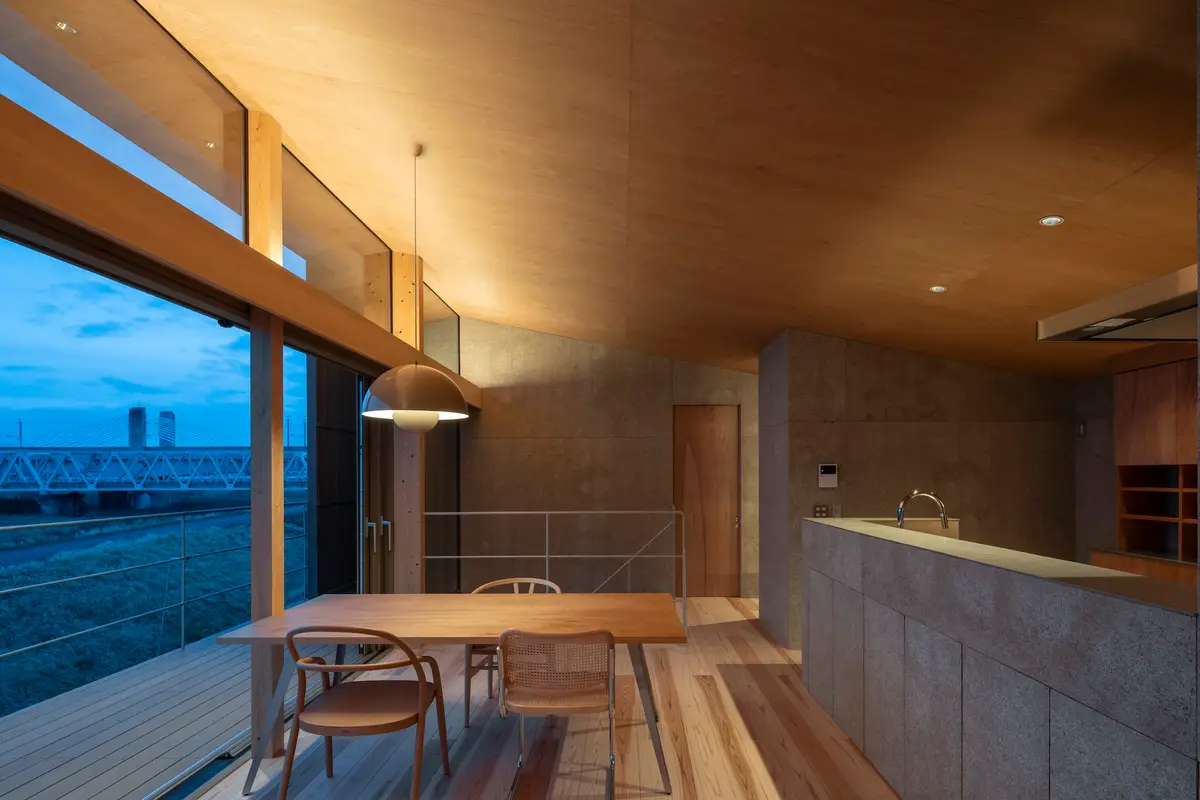
studioSHUWARI Frames the Tateyama Mountains from a Toyama Riverbank House
A 113 square meter split-level home in Toyama City organizes every room around borrowed views of Japan's northern alpine range.


Most houses respond to their site. A few actually construct a relationship with it that wouldn't exist otherwise. studioSHUWARI Inc's new residence in Toyama City belongs to the second category. Perched along an embankment overlooking the Tateyama mountain range, the house doesn't simply face the view: it choreographs a sequence of framed landscapes through section shifts, split levels, and carefully positioned openings that make the distant peaks feel like an extension of the interior.
What makes the project genuinely interesting is how it reconciles two opposing pressures. Toyama's dense residential fabric demands privacy and restraint at ground level, while the elevated site along the riverbank offers panoramic access to one of Japan's most dramatic mountain backdrops. The solution is a house that turns relatively inward on its lower floor, with concrete walls and controlled thresholds, then opens wide on the upper level with glazed facades, timber screens, and a terrace oriented directly toward the alpine horizon. The building doesn't just sit on a slope; it leverages that slope to create a view that the neighborhood itself barely registers.
A Street Presence That Gives Little Away

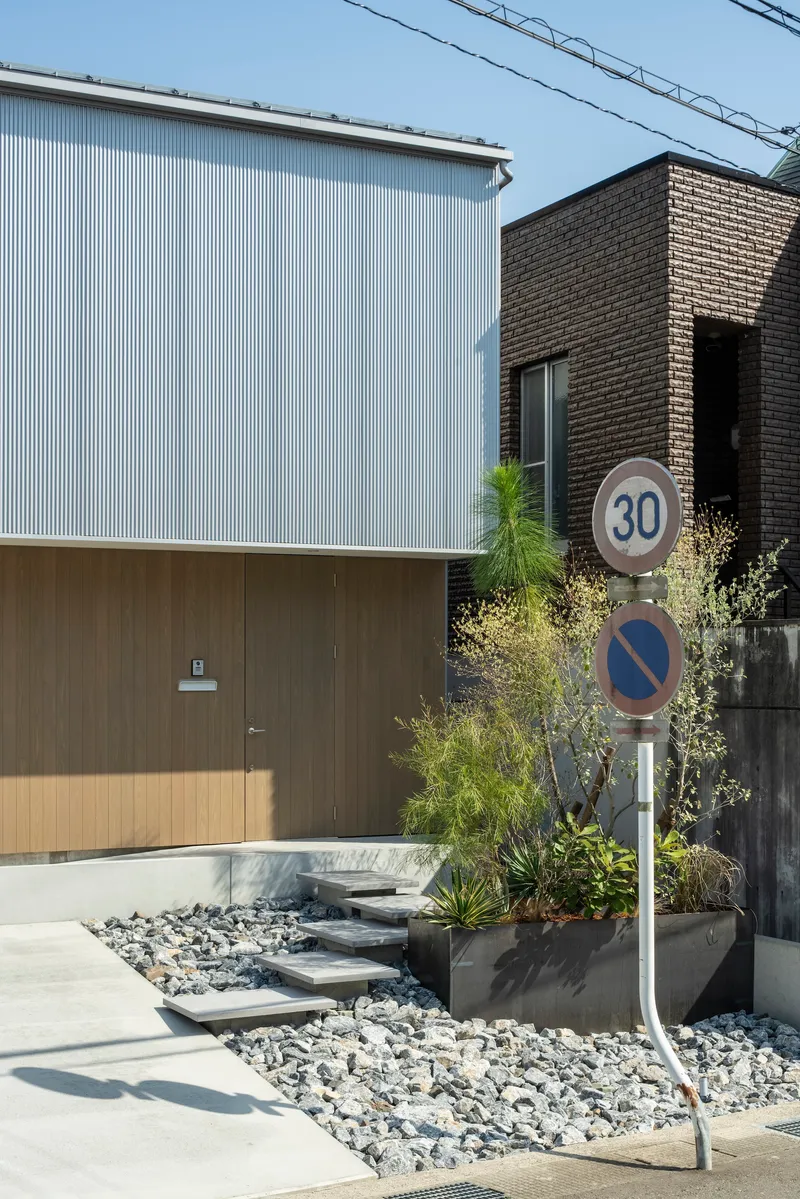

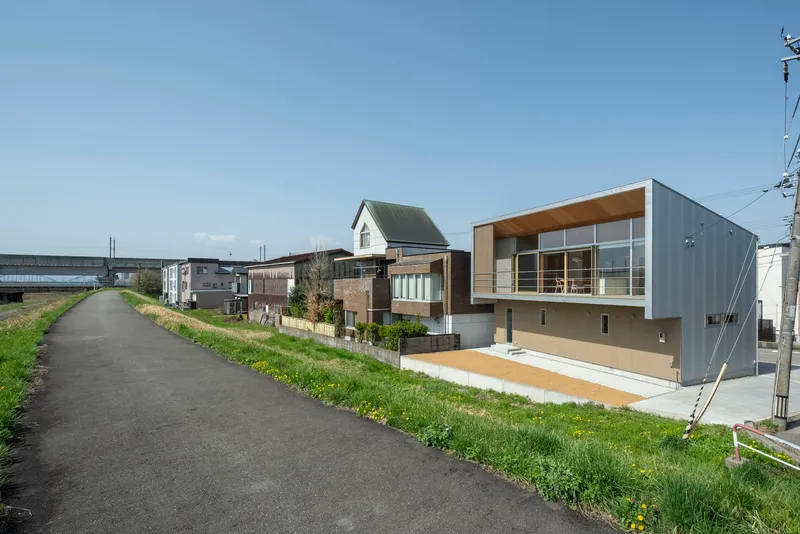
From the street, the house reads as a restrained composition of corrugated metal, vertical timber slats, and a beige concrete base. It sits comfortably within the scale of its neighbors without mimicking them. The entrance is recessed under a dark corrugated soffit, flanked by grasses, creating an almost threshold-like compression before you step inside. There's nothing showy here, and that's the point. The real drama is reserved for the other side.
The timber screening at the upper level is the facade's most legible gesture. It mediates between the need for openness toward the mountains and a degree of visual filtering from passersby. It's a practical detail that also gives the elevation rhythm, breaking up what could be a flat glass box into something more textured and considered.
Entering Through Concrete

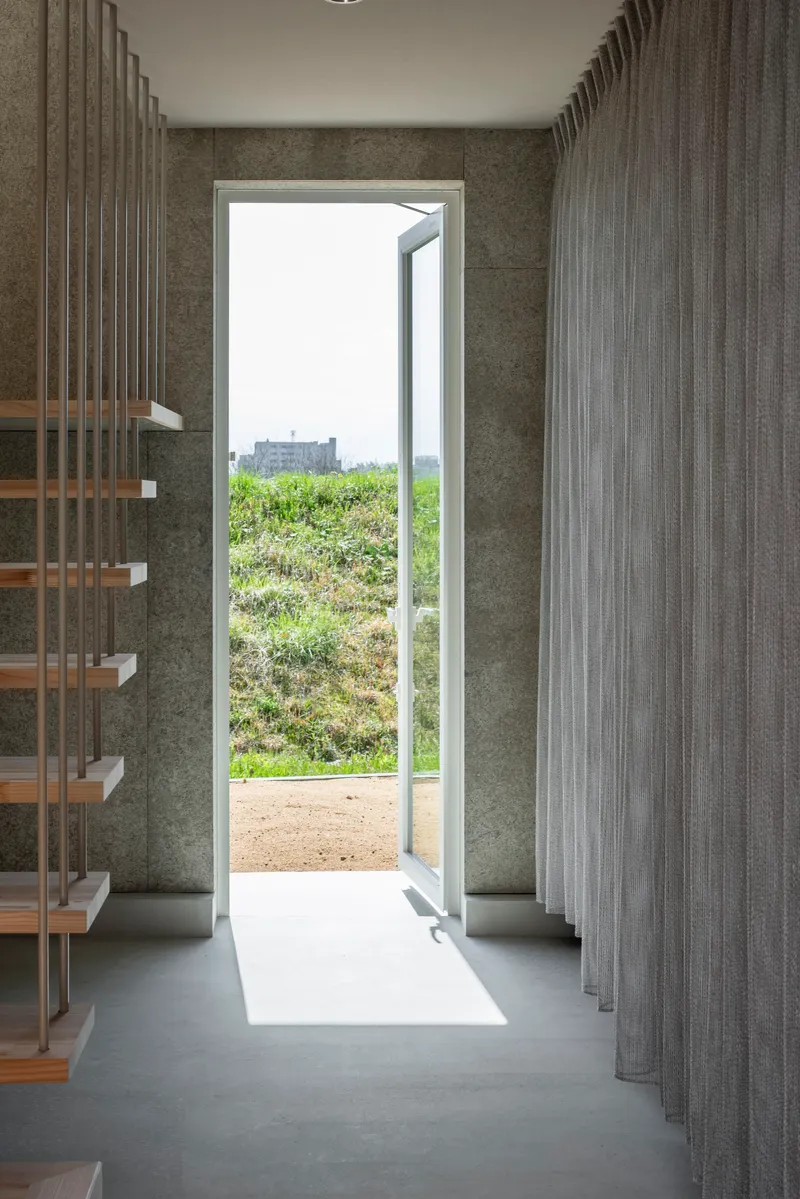
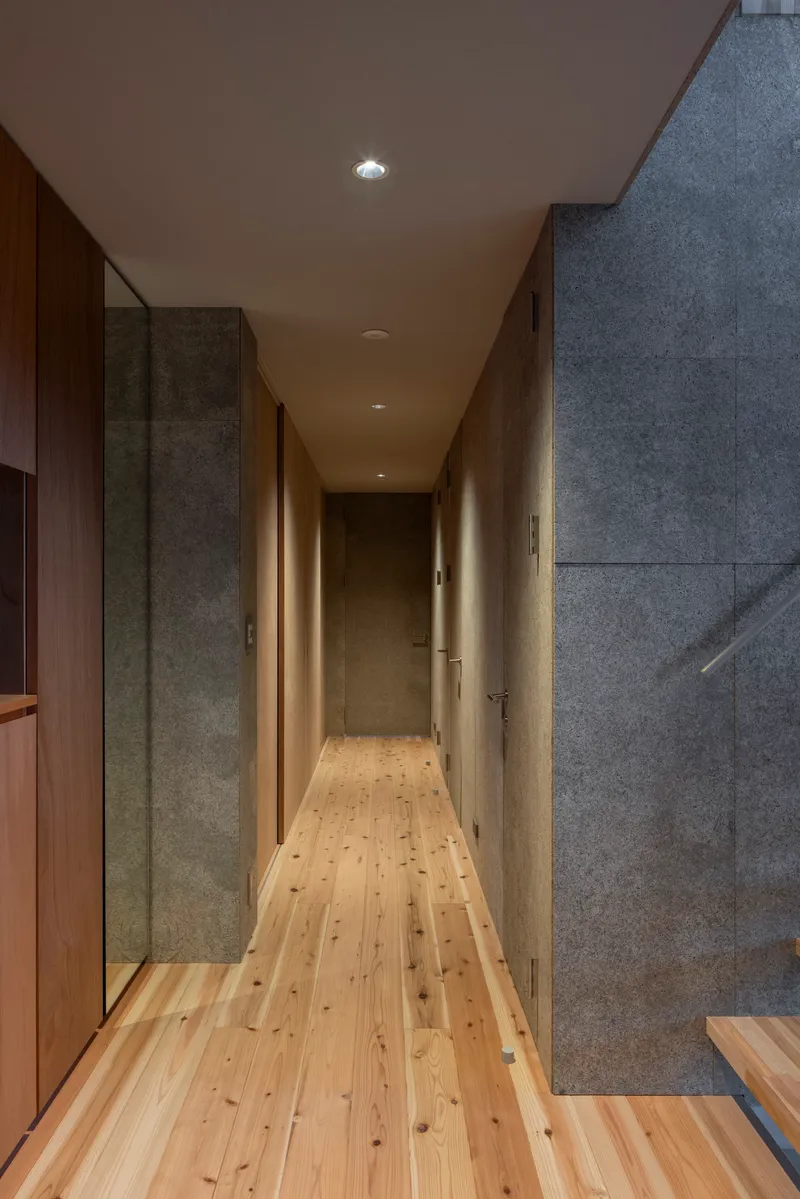
The ground floor sets a deliberately grounded tone. Concrete panel walls line the entry hall and corridors, paired with timber flooring and a plywood ceiling that softens the palette just enough to keep it from feeling institutional. A floating timber staircase with glass railings introduces a vertical pull almost immediately, signaling that the real spatial event is above.
Narrow hallways with recessed lighting compress the spatial experience, creating a sense of anticipation. Light enters selectively through vertical screen panels, casting controlled bands across polished floors. It's a studied approach: the lower floor belongs to the earth, literally anchored against the embankment, and the architecture makes that legible through weight, darkness, and material density.
Living Above the Landscape

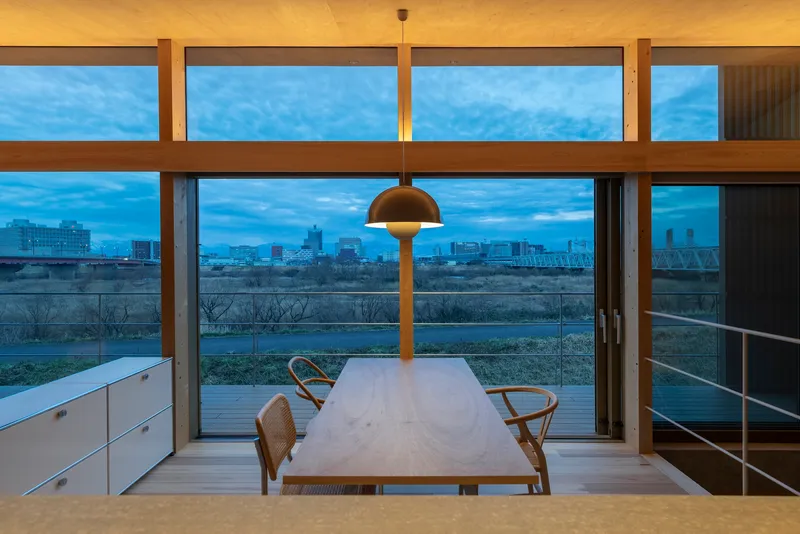

The upper floor is where the house makes its argument. An open-plan living and dining space wraps around a concrete kitchen island, with timber-lined ceilings stretching toward horizontal windows that frame the river and the mountains beyond. At dusk, these clerestory openings glow with the last light reflected off the Tateyama peaks. The dining table sits directly in front of one such window, turning a meal into a sustained encounter with the landscape.
The split-level section is critical to how this works. By dropping certain zones a few steps and raising others, studioSHUWARI creates sightlines that wouldn't be possible in a flat-floor plan. You're always looking slightly up or slightly through, and the mountain range enters the frame at different heights depending on where you stand. It's spatial curation of the highest order, executed in a house that measures just 113 square meters.
Material Dialogue: Concrete, Timber, Steel


The material palette is tightly controlled but never monotonous. Concrete appears as rough-cast wall panels and kitchen surfaces, lending structural gravity. Timber takes the form of built-in bench niches, cabinetry, flooring, and ceiling linings, softening every room it touches. Steel shows up in stair railings and corridor guards, always thin, always linear, always stepping back to let the primary materials speak.
The built-in timber bench niche on the upper floor deserves particular attention. Framed by concrete walls on either side and sheltered by the wood ceiling, it creates a cave-like recess within the otherwise open plan. It's a spot for reading, napping, or simply sitting still while the view does the work. These kinds of details reveal a practice thinking seriously about inhabitation, not just composition.
Dusk and the Double Facade
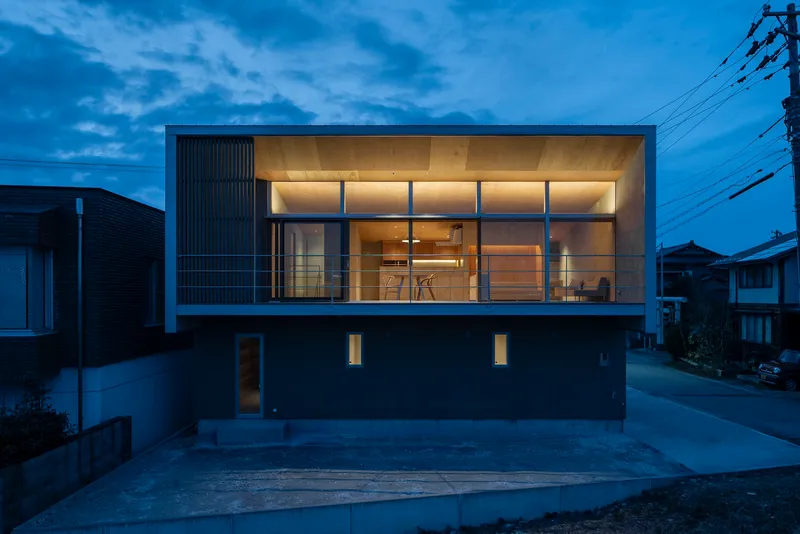


The house transforms at twilight. The ribbed metal cladding and timber screens that feel opaque during the day become translucent backdrops for the illuminated glass volume above. The upper floor glows like a lantern, broadcasting its interior life toward the river and the mountains. From the neighboring houses below, it reads as a warm, elevated presence rather than a closed box.
The glass balustrade on the terrace amplifies this effect, dissolving the boundary between inside and outside when viewed from across the street. It's a calculated reversal: during the day, the house borrows the mountain view; at night, it gives something back to the neighborhood by becoming the most legible structure on the embankment.
Private Rooms, Quiet Details

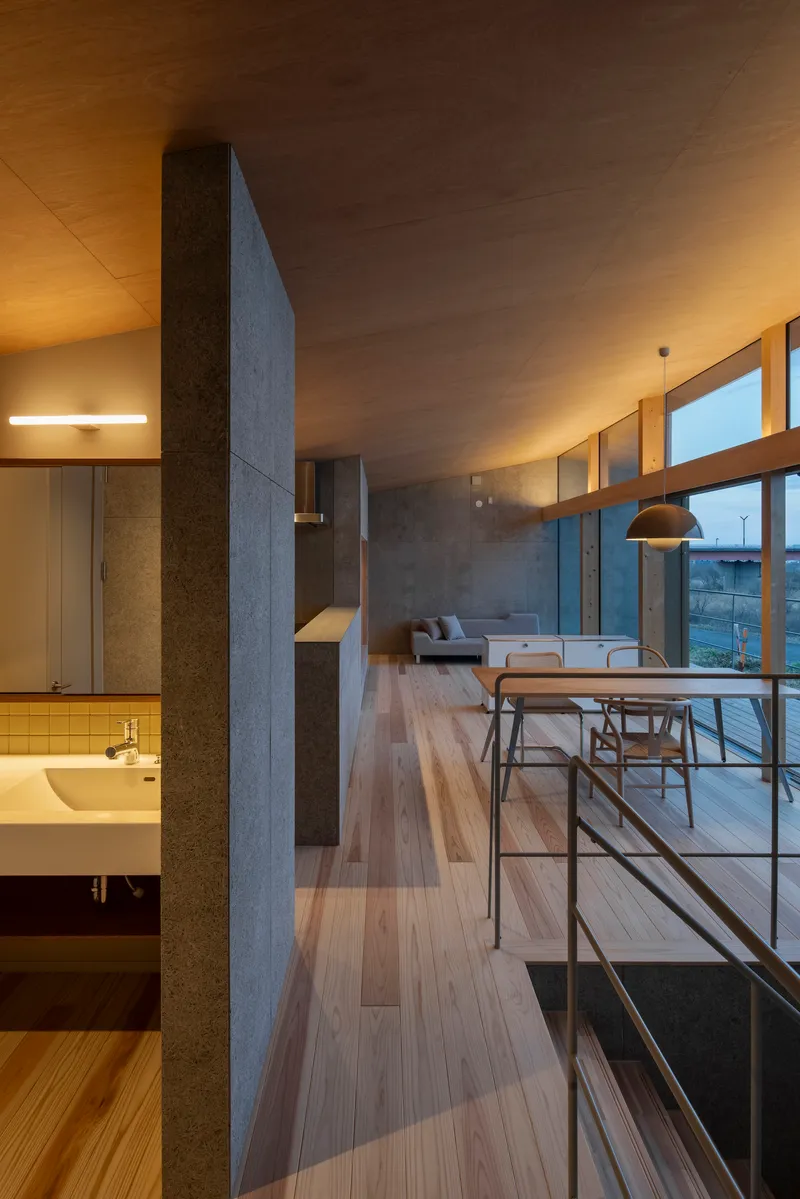

Even the secondary spaces receive careful attention. The bathroom features a cantilevered vanity counter with a backlit mirror set beneath an angled timber ceiling, a detail that could feel precious but instead reads as quietly luxurious. The upper-level corridor with its metal railing offers a vertiginous glimpse down into the main living area, reinforcing the section's spatial complexity.
The entry, too, is worth a second look. A vertical timber door with a simple mailbox sits beneath the dark corrugated soffit, all of it shaded and slightly compressed. It's the kind of threshold that makes arriving home feel like a deliberate act rather than an afterthought.
Context and Scale
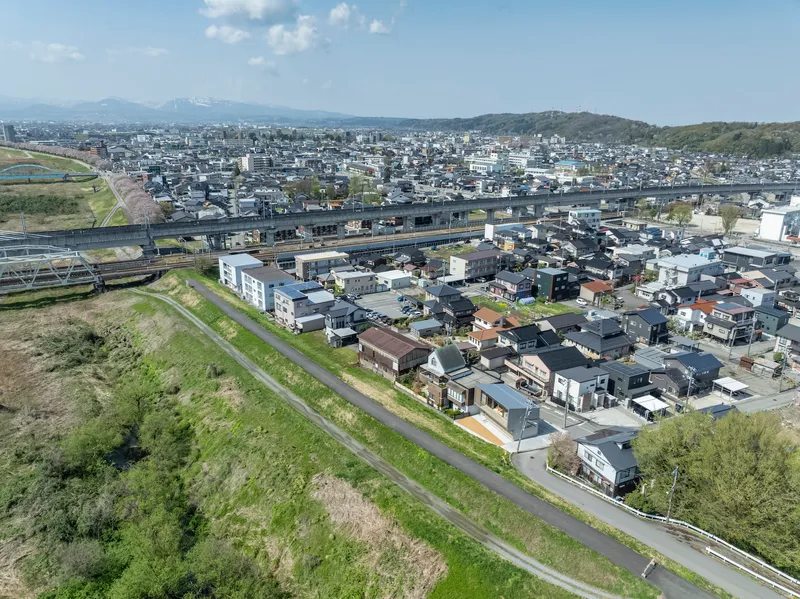
An aerial view reveals the true condition of the site: a dense residential neighborhood threaded by an elevated highway, with the mountains rising abruptly in the distance. It's not a pristine alpine setting. It's suburban Japan, with all the visual noise that entails. The house's achievement is in isolating the one extraordinary element of that context, the Tateyama range, and building an entire spatial strategy around it.
From the diagonal path beside the house, you can see how it sits among its neighbors: slightly taller, slightly more articulated, but fundamentally of the same grain. studioSHUWARI didn't try to stand apart. They tried to see further. That's the more interesting ambition.
Plans and Drawings
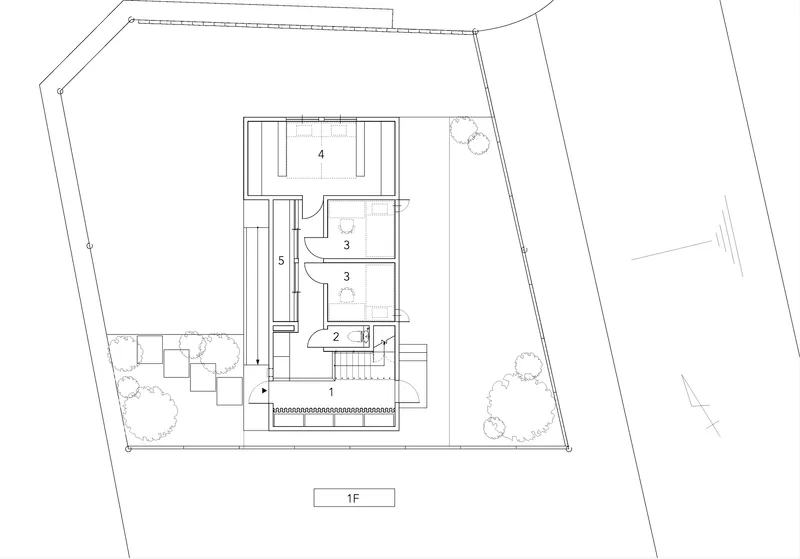

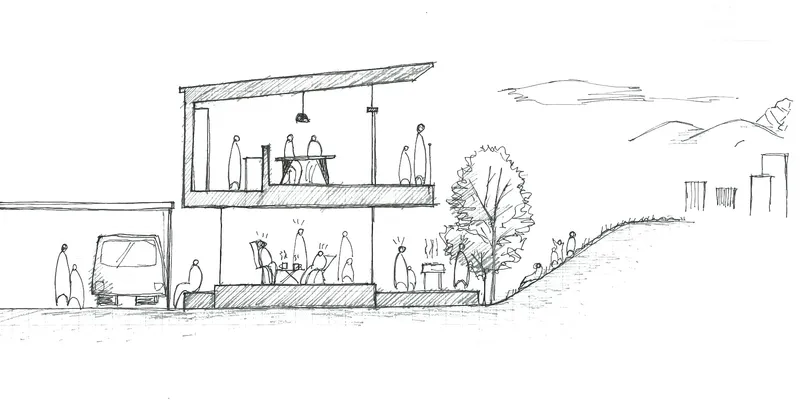
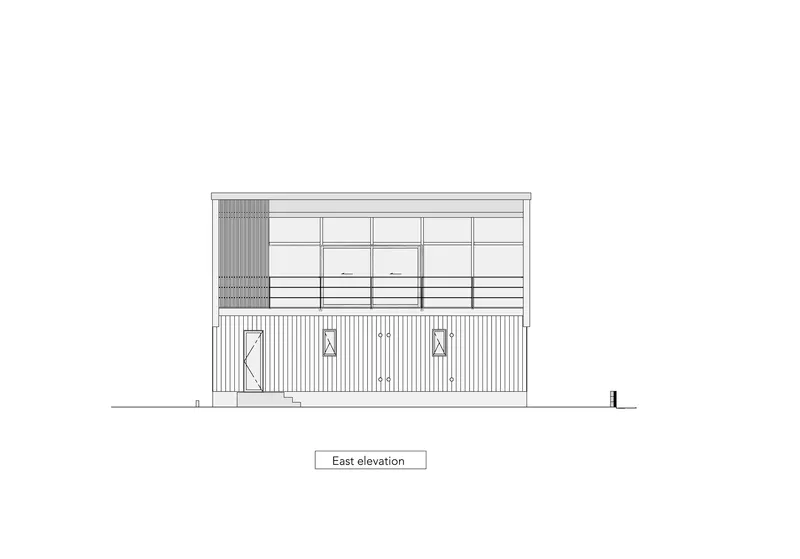
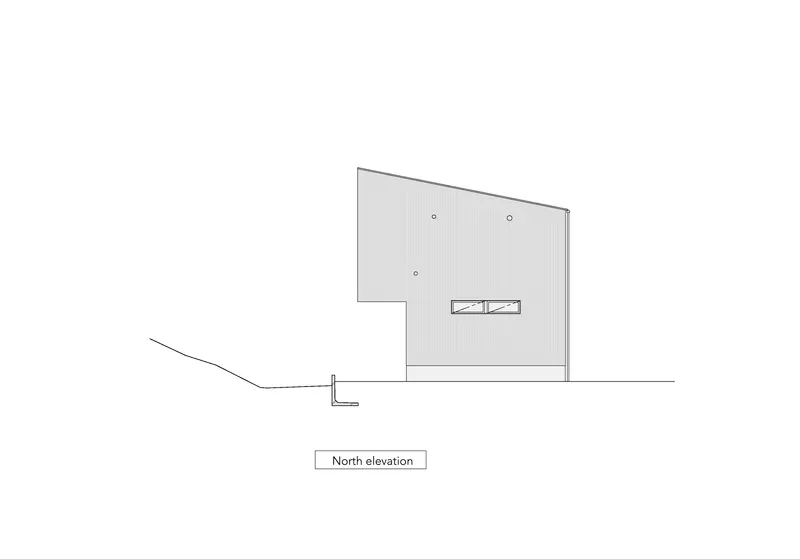
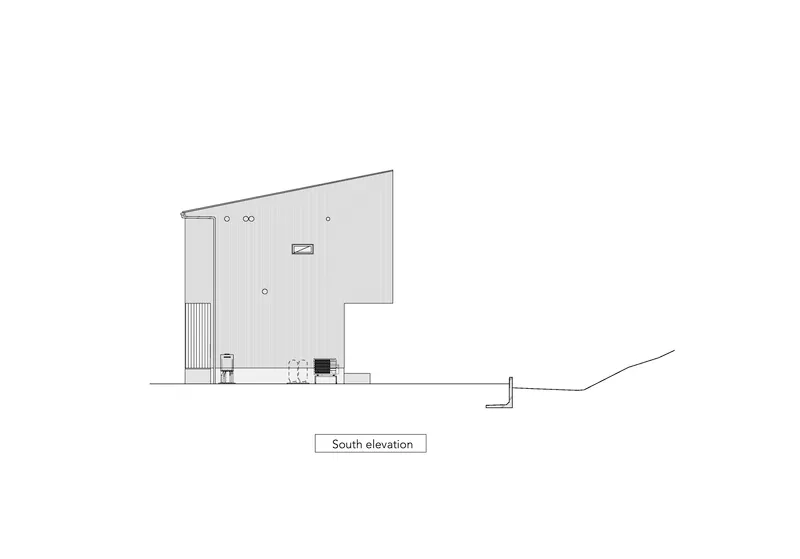
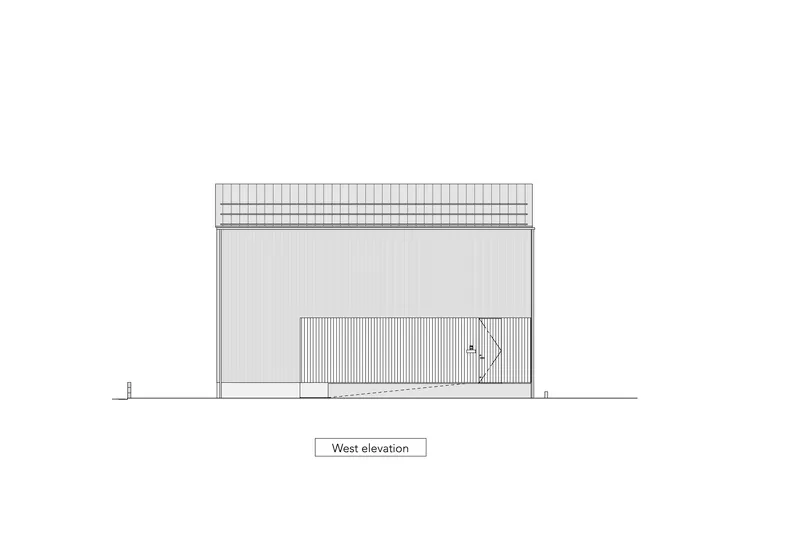
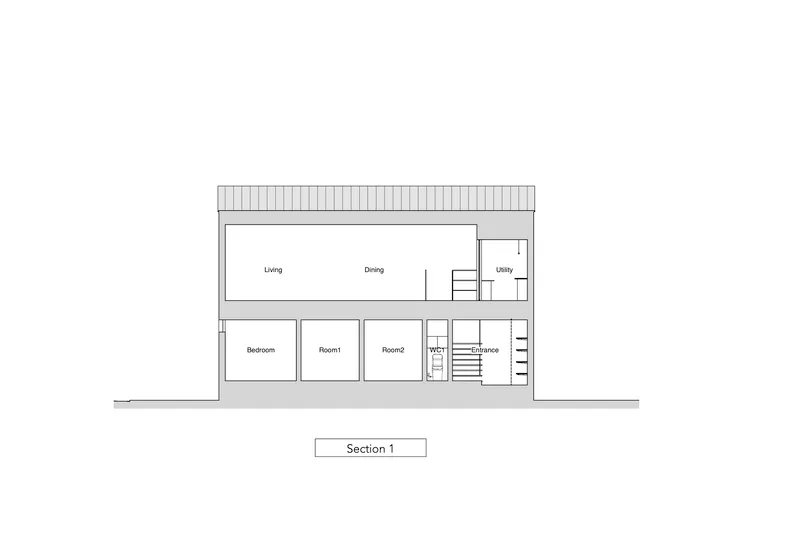
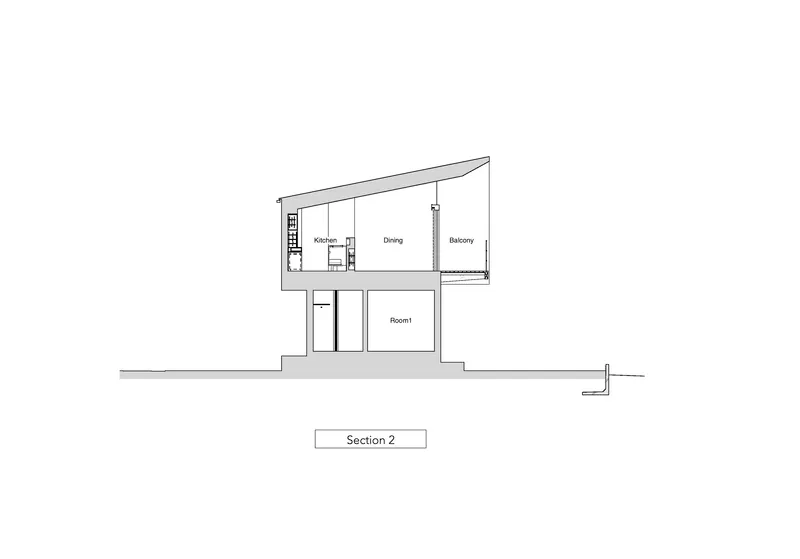
The floor plans confirm what the photographs suggest: the ground floor organizes bedrooms and service spaces in a compact footprint, while the second floor opens into a continuous living, dining, and kitchen zone oriented toward the river and mountains. The section drawings are the most revealing documents here. They show a curved roof profile and a split-level arrangement that manipulates sightlines across just two stories. A sketch section, complete with figures and a parked car, captures the project's essential proposition: stand on the embankment, look through the house, and find the mountains waiting.
The four elevation drawings reveal a building that presents a different character to each cardinal direction. The east and south faces are more closed, screened, and rhythmic, while the north and west elevations show the angular volume and clerestory bands that define the interior's relationship with light and landscape. Taken together, the drawings describe a house that is architecturally specific in every direction, never defaulting to a single strategy.
Why This Project Matters
In a discipline increasingly saturated with houses that photograph well but think poorly, this Toyama residence stands out for its sectional intelligence. The split-level strategy isn't novel in itself, but the way studioSHUWARI deploys it to manufacture a view from an ordinary suburban embankment is sharp, site-specific work. It reminds us that borrowed landscape, the Japanese garden concept of shakkei, can be updated for domestic architecture without nostalgia.
At 113 square meters, the house also demonstrates that compact plans don't have to feel constrained. Every square meter here has a job: framing a mountain, compressing a threshold, or creating a pocket of calm within the section. The result is a house that feels significantly larger than its footprint and significantly more connected to its environment than its neighbors. That's not styling. That's architecture doing its work.
The House That Creates a View by studioSHUWARI Inc, located in Toyama, Japan. 113 m², completed in 2025. Photography by ToLoLo studio Nakamura Mayu.
About the Studio
Share Your Own Work on uni.xyz
If projects like this are the kind of work you want to make, uni.xyz is a place to publish your own, find collaborators, and enter design competitions.


Popular Articles
Popular articles from the community


Manzana Morphosis: Stretching Barcelona's Grid into a Living Landscape for 2050
A radical reworking of the Eixample manzana turns density into a tool for generous public space, vertical ecology, and environmental performance.


David Ortega Stacks a Two-Story Mexico City Penthouse Around a Steel Stair and a Pergola-Shaded Roof Terrace
In Colonia Roma, a 300 m² penthouse uses oak joinery, a planted steel stair and a slatted roof pergola to make a new-build apartment feel like a house.

FCC Arquitectura Expands a Portuguese Granite House with a Board-Marked Concrete Wing
In Portugal, JV House pairs a cleaned-up whitewashed and granite dwelling with a timber-shuttered concrete extension, courtyards and a garden pool.

ETEH Reworks the Shared Spaces of São Domingos School in Brazil Around Timber, Color and Hanging Plants
At São Domingos School in Brazil, 436 m² of hall, refectory and library are recast with timber joinery, a yellow and blue code and trailing greenery.

Similar Reads
You might also enjoy these articles

LAVA Architecten Gives Vocational Education a Sawtooth-Roofed Face on a Mechelen School Campus
In Mechelen, Belgium, a 2,053 m² STEM school on a 6×6 m grid turns workshops and classrooms into rooms that can be rearranged as teaching changes.

KEMA Studio Turns a Derelict Marvila Attic into a 60 m² Lighthouse Apartment Above Lisbon
In Lisbon's Marvila district, a rebuilt roof, four skylights and two plywood volumes turn an unlivable attic into a bright home facing the Tagus.

Pixel Gardens: One Repeated Module Stacked Into a Terraced Social Housing Tower for Famagusta
Salem Bader's shortlisted housing tower builds a vertical neighbourhood from one repeated module, offsetting units to carve terraces, light and air.

Bao Huynh Watercolor Atelier: A Serene Art Retreat in Hội An
Bao Huynh Watercolor Atelier in Hội An blends multifunctional art spaces, sustainable design, local materials, and family-friendly living in a serene environment.

Explore 3D View Competitions
Discover active competitions in this discipline

Challenge to design mud housing for contemporary communities

Challenge to reimagine the Iron Throne

Photograph architecture without architects

Illustrate the lost glory of Angkor Wat - Render Challenge
Comments (0)
Please login or sign up to add comments
No comments yet. Be the first to comment!