

Classroom for Farmhouse School: Curved Earth Walls Built for $1700 in Six Weeks
A migrant school classroom in Mae Sot where hand-formed mud blocks, curved earthen walls and a light timber roof turn a tiny budget into durable space.


Give a school $1700 and six weeks, and most construction logic collapses. The Classroom for Farmhouse School treats that constraint as a design brief rather than a limitation. Its walls are shaped from local earth, its roof rides on a lightweight timber frame, and its builders include the children who now learn inside it. The result argues that a classroom does not need industrial materials to be durable, comfortable or dignified. It needs a clear structural idea and a community willing to put its hands in the mud.
Designed by Jan Jakob Glasmeier in collaboration with Simple Architecture, the project received a Jury Commendation in Education '20 on uni.xyz. The site is Mae Sot, a Thai border town shaped by ongoing migration, where Farmhouse School serves migrant families who sit outside the formal Thai education system. Schools like this run on thin funding, improvised infrastructure and little long-term support. As enrolment grew, the school needed more room, and conventional construction was neither affordable nor suited to the place.
Walls That Are Sculpted, Not Stacked


The defining move is the curve. Instead of laying out a rectilinear box, the earthen walls flow in a continuous, rounded line, and the first image shows how that line reads from outside: a low, soft enclosure tucked under tall trees, with the roof structure floating above it. The curvature does structural work. A curved earth wall stiffens itself against overturning and spreads its loads more evenly than a straight run, which matters when the material is unfired mud and the budget leaves no room for buttresses or reinforcement.
Inside, the same geometry becomes spatial. The interior view captures blue louvered panels set into the thick earthen surface, with patches of sunlight falling across the floor beneath the open timber frame. Earth's thermal mass dampens the heat of the day, while the small, strategically placed openings admit controlled daylight and cross-ventilation. It is a passive climate strategy assembled from almost nothing, and the tactile surface of the walls gives students a direct, physical relationship with the room they occupy.
The Construction Site as the First Lesson

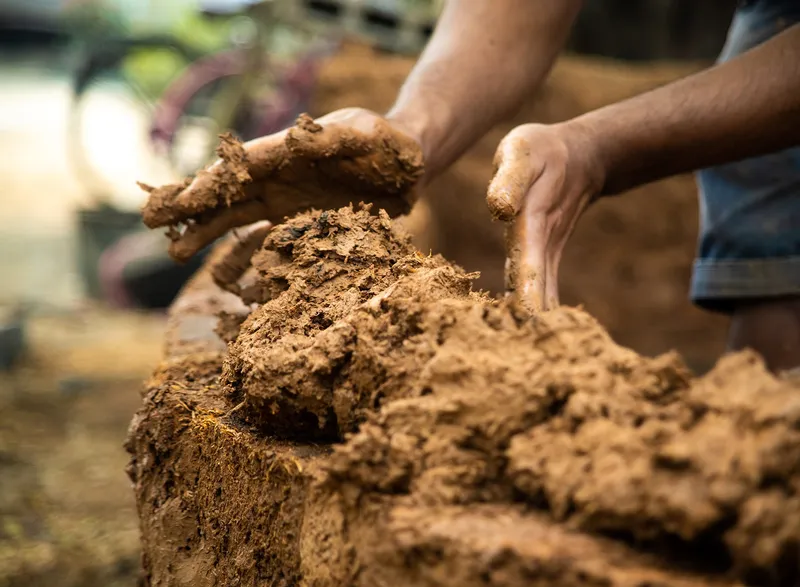
These two images say more about the project than any drawing. Children kneel in the dirt pressing wet clay into a wooden mould, with finished bricks lined up to dry in front of them; a pair of muddy hands works a heap of clay and straw. Students and local community members produced the earth blocks and helped assemble the structure, which turns a building programme into a teaching programme. The skills stay in the community after the scaffolding comes down.
This is where the low budget becomes an asset rather than a compromise. Hand-formed mud blocks need labour more than capital, and labour is something a school community can contribute. The participatory process also builds ownership: a wall you made yourself is a wall you will maintain, patch and defend. For migrant education, where institutional support is uncertain, that sense of shared authorship may prove as important as the building's thermal performance.
A Hybrid Frame That Keeps Earth Out of Harm's Way
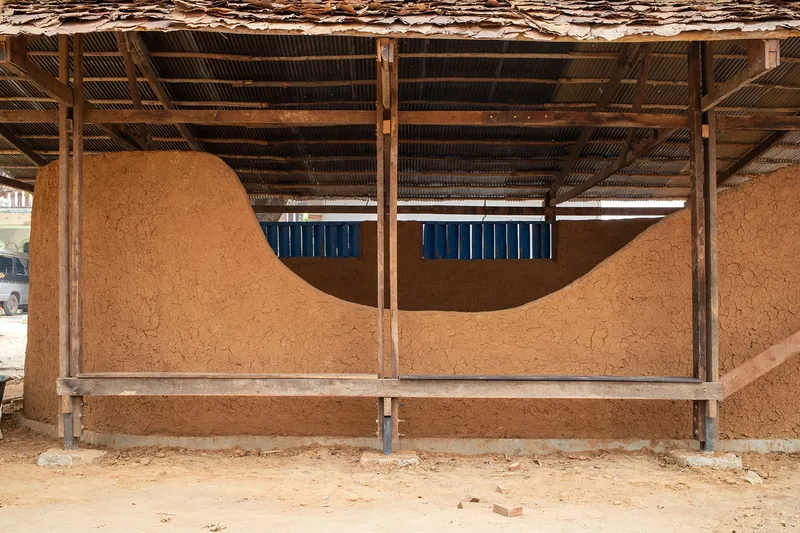

Glasmeier does not ask the earth to do everything. A lightweight timber frame carries a corrugated metal roof, separating the roof load from the walls and shielding the mud surfaces from heavy rainfall. The finished wall in the first image, cracked lightly from drying, sits safely beneath a generous overhang, its timber posts standing just clear of it. Splitting the jobs this way also sped up the build: the roof could go up quickly while the walls were still being shaped.
The detail in the second image is the quiet hero of the scheme. Each timber post sits in a steel bracket bolted to a minimal concrete footing, lifting the wood off the ground and protecting it from moisture and rot. It is a small concession to semi-industrial components, placed exactly where it extends the life of everything else. The project prioritises performance over material purity, and it is stronger for it.
An Open Plan With Rounded Edges
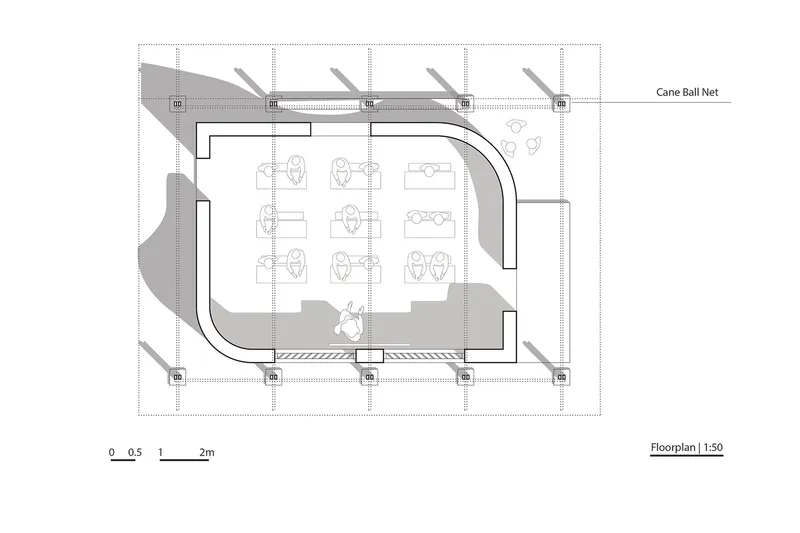
The 1:50 floor plan clarifies how the room is meant to work. Rounded corners soften the enclosure, desks fall into rows that can be rearranged, and a teacher figure anchors the space without fixing it. Above, a canopy grid of cane ball net is drawn with its cast shadows, a light, inexpensive layer that filters the space beneath the roof. With no internal partitions, the classroom can shift between lecture, group work and open activity as numbers and needs change.
The curved walls also generate informal niches and gradients of enclosure along the perimeter, places where smaller groups can gather away from the centre. In a school whose student population changes with migration patterns, this flexibility is a practical response to uncertainty: the room does not assume who will be in it next year.
Why This Project Matters
The Classroom for Farmhouse School shows how much architectural clarity can be extracted from a $1700 budget and a six-week programme. Every decision has a reason: curved walls for stability, a timber roof for speed and rain protection, steel shoes for durability, small openings for passive comfort. Nothing is decorative, yet the room has a distinct character, warm, tactile and unmistakably made by hand.
Its larger lesson concerns process. By making the community the workforce and the students the builders, the project treats architecture as a form of education before the first class is ever held. For designers working with underserved communities, it offers a replicable model: local earth, a modest hybrid frame and a construction process that leaves behind both a building and the knowledge to build another.
View the Full Project
About the Designers
Designer: Jan Jakob Glasmeier
Enter a Design Competition on uni.xyz
uni.xyz runs architecture and design competitions year-round that reward proposals with spatial conviction and real site intelligence.
Project credits: Classroom for Farmhouse School by Jan Jakob Glasmeier.


Popular Articles
Popular articles from the community


David Ortega Stacks a Two-Story Mexico City Penthouse Around a Steel Stair and a Pergola-Shaded Roof Terrace
In Colonia Roma, a 300 m² penthouse uses oak joinery, a planted steel stair and a slatted roof pergola to make a new-build apartment feel like a house.

FCC Arquitectura Expands a Portuguese Granite House with a Board-Marked Concrete Wing
In Portugal, JV House pairs a cleaned-up whitewashed and granite dwelling with a timber-shuttered concrete extension, courtyards and a garden pool.


Opera on the Sea: Driftwood Logic Shapes a Timber Opera House on Estonia's Coast
Trevor Orgill's opera house translates the entangled drift of floating timber into a civic building where wood, water, and music converge.

graciastudio Turns a Viewless Tijuana Lot Inward Around a Courtyard of Concrete, Timber and Trees
In Tijuana, Jorge Gracia's GA2 House stacks a timber-clad private floor over exposed concrete and replaces a missing view with a planted interior patio.

Similar Reads
You might also enjoy these articles
Healing Façade: A Modular Chapel System That Restores Ethiopia's Sacred Forests
Winner of the Eco-Chapel competition, this circular timber façade collects water from air to rebuild soil and reforest degraded Ethiopian landscapes.
Kaffeebühnen: Where Coffee Shop Architecture Becomes a Civic Stage in Vienna
A linear sequence of timber boxes, transparent shells, and open yards turns the Viennese café tradition into a public performance space.
Eco Chapel: A Modular Forest Pavilion That Grows Like the Landscape It Protects
Hexagonal timber modules weave through existing trees, turning a chapel into a living system for prayer, education, and reforestation.


Urban Forest: A Vertical Ecosystem for 5,000 Workers in Singapore's Changi Business Park
Radially stacked pods and layered green decks turn a 7-acre plot into 47 acres of ecological workspace projected for 2040.

Explore Mes School Of Architecture Competitions
Discover active competitions in this discipline

Challenge to design public laboratory

Challenge to reimagine the Iron Throne

Photograph architecture without architects

Illustrate the lost glory of Angkor Wat - Render Challenge
Comments (0)
Please login or sign up to add comments
No comments yet. Be the first to comment!