

Olympic Insertion: Modular Housing Grown from a Walnut's Logic
A steel-framed modular housing system for athletes in Bolivia's Olympic Villa, shaped by wind orientation and organic clustering.


What if a housing block could grow the way a walnut forms its shell: segmented, interlocking, and precisely fitted? Olympic Insertion takes that biomimetic premise and applies it to a 160-hectare sports campus in Santa Cruz de la Sierra, Bolivia, proposing modular steel-framed towers that cluster around shared green courtyards to house families and young athletes near the facilities where they train. The result is a housing typology that treats expansion not as an afterthought but as a core design principle.
Designed by Sebas Medrano, Natalia Gomez Justiniano, and Fabiana Martinez Vera, the project was shortlisted in the Plugin Housing Challenge 2020. Sited within the Olympic Villa 'Abraham Telchi,' a precinct already dedicated to developing sports disciplines, the proposal positions housing as infrastructure that serves a community's athletic mission rather than competing with it.
Stacked Volumes Over Athletic Ground

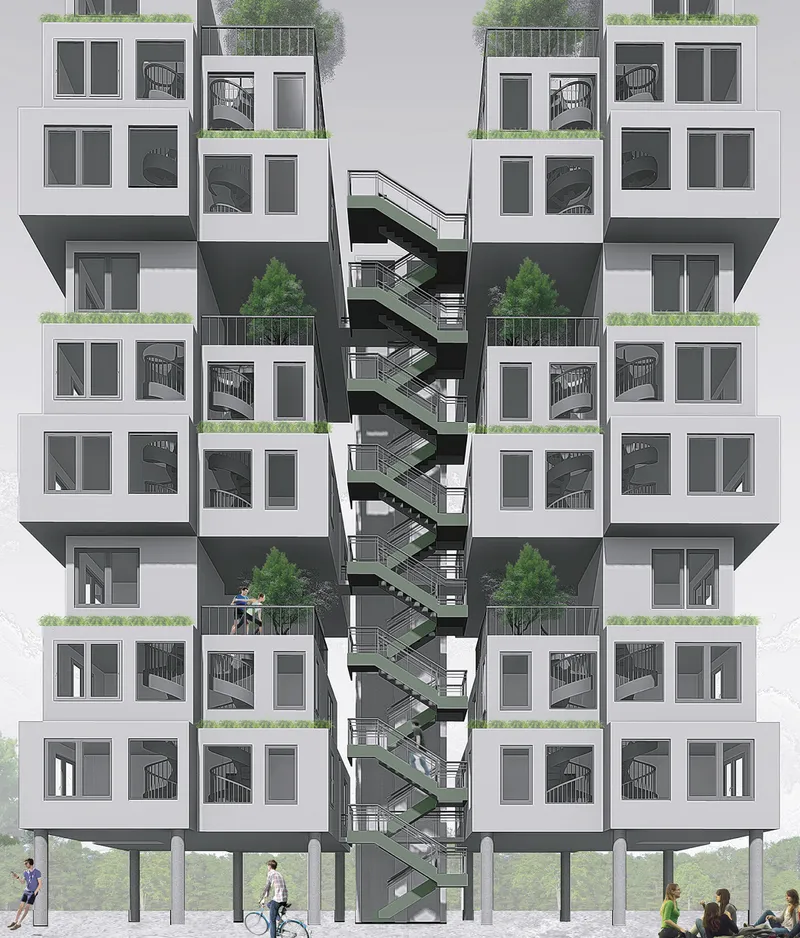
The axonometric diagram reveals the project's fundamental move: lifting residential volumes above a landscape of green spaces and athletic fields. Compact modular cubes stack vertically, freeing the ground plane for sport and circulation. A residential tower elevation shows a central zigzagging staircase flanked by planted balconies, giving each unit direct access to outdoor space while keeping the building's footprint tight. The vertical stacking keeps density high without consuming the campus's most valuable asset: its open land.
Two Units, One System: 28 and 65 Square Meters


The programmatic axonometric breaks the building into its constituent parts, color-coding residential and communal volumes. Single-occupancy units span two floors within 28.25 square meters, while double-occupancy units add a third floor to reach 65 square meters. The section drawing confirms how these units flank a central staircase core, each side receiving daylight and cross-ventilation. At street level, cyclists pass through, reinforcing the campus's emphasis on active mobility.
The construction system relies on cold-rolled galvanized steel framing, chosen for its durability, light weight, and capacity for prefabrication. Steel framing allows the modular units to be assembled and disassembled without heavy machinery, a practical advantage on a sports campus where construction disruption needs to be minimized. The adaptable structure is designed to accommodate future expansion, so a single-occupancy unit could, in theory, grow into a double-occupancy one as circumstances change.
Spiral Stairs and Shared Terraces as Social Connectors
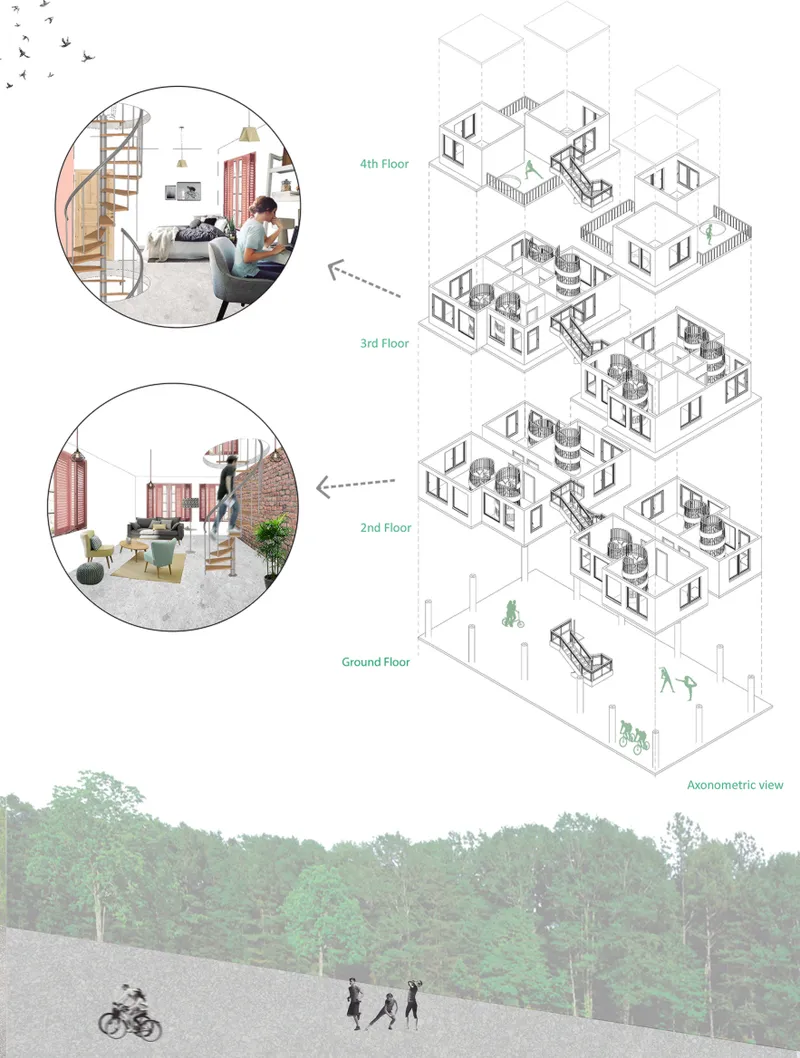
An exploded axonometric peels apart four residential floors to expose the project's social infrastructure. Spiral staircases link levels internally, but the shared terraces between units are where the design's morphological concept, inspired by the Persian walnut, becomes legible. Just as the walnut's segments fit tightly yet remain distinct, the housing blocks interconnect through common outdoor platforms that encourage interaction without erasing the boundaries of individual units. Green spaces between volumes serve as shared outdoor rooms rather than leftover voids.
Clustered Towers and Climate-Responsive Orientation


The aerial perspective shows how the towers cluster around a central courtyard and green field, creating a micro-neighborhood within the larger Olympic Villa. The north-south module orientation is strategic: it optimizes prevailing wind flow through the units while minimizing direct solar exposure on the longer facades, a critical consideration in Santa Cruz de la Sierra's tropical climate. The aerial site view contextualizes the proposal within the broader 160-hectare campus, showing pathways and dense vegetation that buffer the housing from the surrounding urban fabric.
The clustering pattern does more than manage climate. It defines a hierarchy of outdoor spaces, from the intimate planted balconies of individual units, to the shared terraces between towers, to the large communal courtyard at the center. Athletes returning from training encounter a sequence of thresholds rather than a single hard edge between public sport and private rest.
Why This Project Matters
Olympic Insertion challenges the disposable legacy of athlete housing. Most Olympic and sports villages become obsolete the moment competition ends, but a modular system built on steel framing and designed for expansion can adapt to post-event residential demand without demolition. The two unit types, 28.25 and 65 square meters, are sized not for spectacle but for real domestic life, a pragmatic decision that increases the likelihood of long-term occupation.
Medrano, Gomez Justiniano, and Martinez Vera demonstrate that modular housing need not look repetitive or feel institutional. By borrowing organizational logic from a natural form, orienting for climate, and layering social spaces at multiple scales, they propose an architecture that serves both individual comfort and community cohesion. For a sports campus in Bolivia, that combination of adaptability and identity is exactly what sustainable housing should deliver.
View the Full Project
About the Designers
Designers: Sebas Medrano, Natalia Gomez Justiniano, Fabiana Martinez Vera
Enter a Design Competition on uni.xyz
uni.xyz runs architecture and design competitions year-round that reward proposals with spatial conviction and real site intelligence.
Project credits: Olympic Insertion by Sebas Medrano, Natalia Gomez Justiniano, Fabiana Martinez Vera Plugin Housing Challenge 2020 (uni.xyz).


Popular Articles
Popular articles from the community


David Ortega Stacks a Two-Story Mexico City Penthouse Around a Steel Stair and a Pergola-Shaded Roof Terrace
In Colonia Roma, a 300 m² penthouse uses oak joinery, a planted steel stair and a slatted roof pergola to make a new-build apartment feel like a house.

Cube Design Draws an Ecological Corridor Between Two Shenzhen Hills with the Nankai Building
Beside Shenzhen's container docks, the Nankai Building pairs stacked balconies with a climbing green screen to connect two hillsides across its height.

Juan García Correa, John González and Claudia Rueda Sink a Circular Amphitheater into a Manizales Engineering Building
On the La Nubia campus in Manizales, Colombia, the S1 Building folds labs and offices into a hillside of ramped lawns that double as a campus route.

David Macias Steps a Doorless Stone and Plaster House Down a Tropical Colombian Hillside
In the humid hills of Colombia, Threshold House replaces the front door with an open void and terraces its 850 m² down the slope instead of fighting it.

Similar Reads
You might also enjoy these articles


Vereda Arquitetos Renovates a 40-Square-Meter Apartment Inside Niemeyer's Copan Building
A compact unit in São Paulo's most iconic residential tower gets a material overhaul that pairs exposed concrete with bold blue Formica.

Shakur's House: Exposed Brick as an Interior Organiser in a 168 m² Mashhad Residence
Brick moves indoors in this Mashhad residence, where masonry walls, glass partitions and teal planes sequence a compact home without closing it off.

Day and Night Park: A Time-Based Urban Newsstand in Beijing
A temporary urban newsstand in Beijing blending travel, light, and reading through poetic colors, compact form, and community-focused design.

Modernist Patio Renovation in El Masnou, Barcelona by Oliver Segura Arquitectura + Cebrià Arquitectura
Modernist patio renovation blending tradition and innovation with a movable pool, leveled floors, and Catalan materials in El Masnou.


Comments (0)
Please login or sign up to add comments
No comments yet. Be the first to comment!