
Studio Acis Rebuilds a 1941 Kerala School Around Courtyards, Brick Screens, and Passive Cooling
Set amid the paddy fields of Palakkad, C.A.H.S. School Ayakkad merges adaptive reuse with new construction across a phased master plan.


C.A.H.S. School Ayakkad has existed since 1941, but until recently its 2.53-acre campus in rural Palakkad was a collection of structures built at different times, in different orientations, with no unifying logic. Studio Acis, led by architect Rakesh Kakkoth, was brought in not to demolish and start over but to impose coherence on an accretion of decades. The result is a 29,379-square-foot campus for grades 5 through 12 that treats preservation, renovation, and new construction as equal tools in a six-phase master plan.
What makes the project genuinely interesting is the refusal to choose between old and new. Block H, the new administration building, is a raw concrete and brick volume that anchors the site with a clear linear axis. Block A, the renovated higher secondary building, gets an entirely new outer layer of columns and a terracotta roof canopy that turns the existing structure into something closer to a traditional Kerala veranda building. Neither move is nostalgic. Both are precise climate responses designed for passive cooling in a hot, humid landscape surrounded by paddy fields.
A Campus Carved from Courtyards
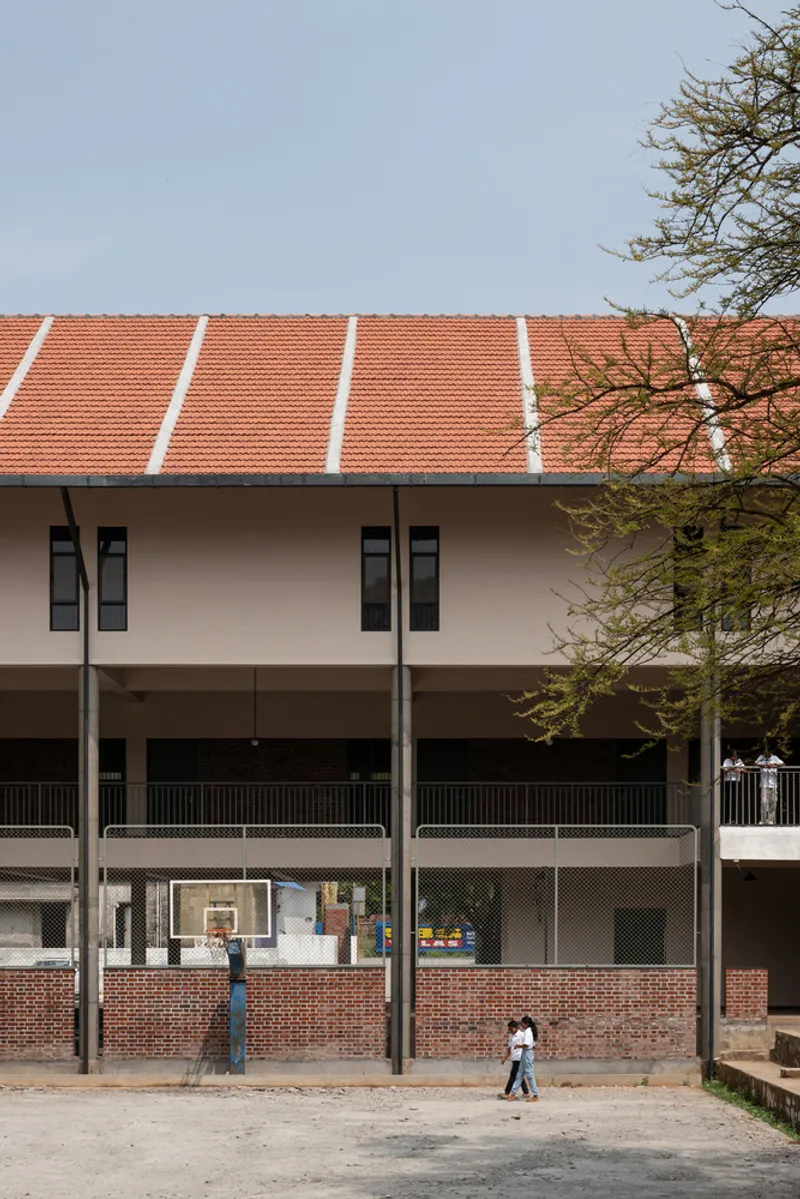
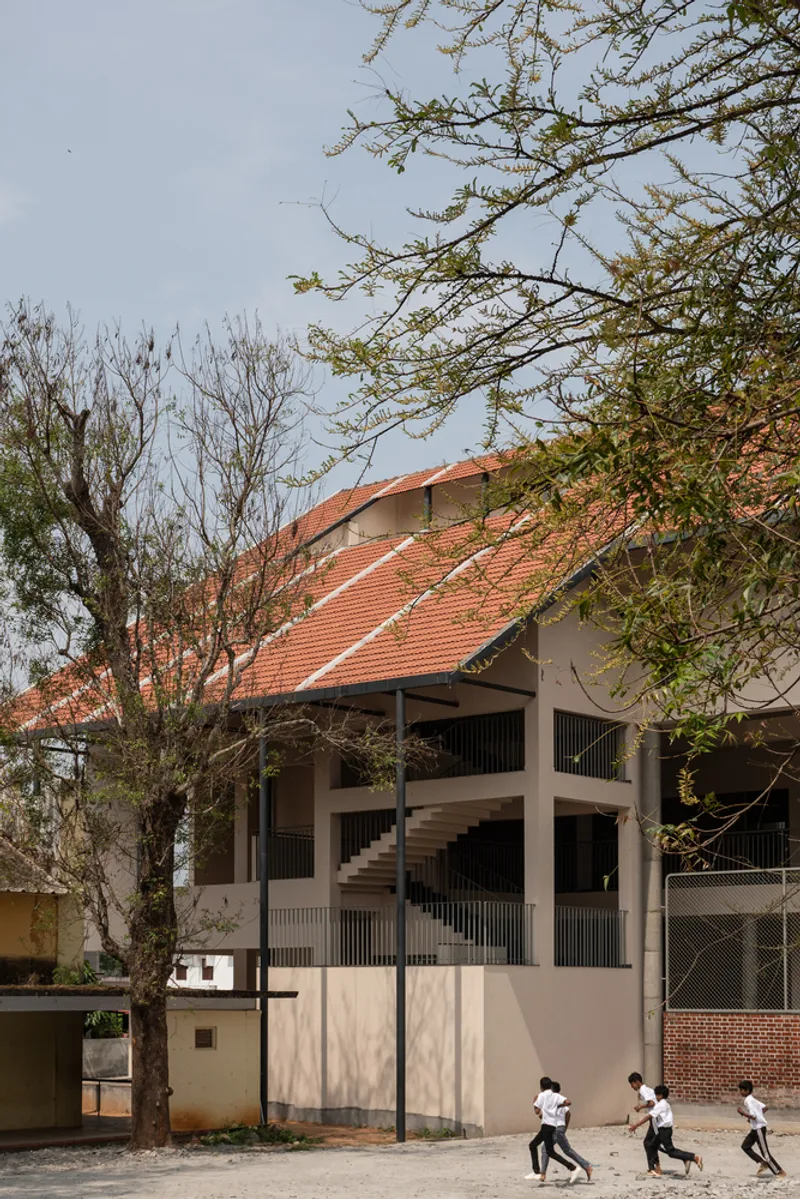
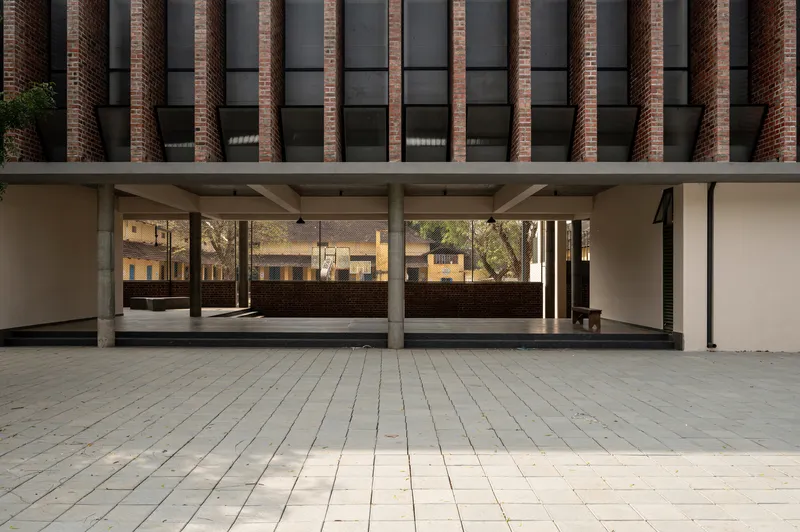
The organizational idea is straightforward: a linear spine that separates the public face of the school from its more private instructional zones. Block H runs along this spine, and its open ground floor acts as a permeable threshold rather than a barrier. Students pass through columned loggias that frame views of the surrounding landscape, and the courtyards between blocks function as outdoor rooms rather than leftover space.
The segmented terracotta roof volumes are visible from nearly every approach, breaking down the scale of what is, in total, a sizable institutional building. Viewed from the courtyard, the pale rendered walls and colonnade give the composition a civic presence that feels appropriate for a school without veering into monumentality. Students gather, run, and sit in these in-between spaces as if they were always there, which is probably the highest compliment a phased renovation can receive.
Brick as Both Structure and Screen
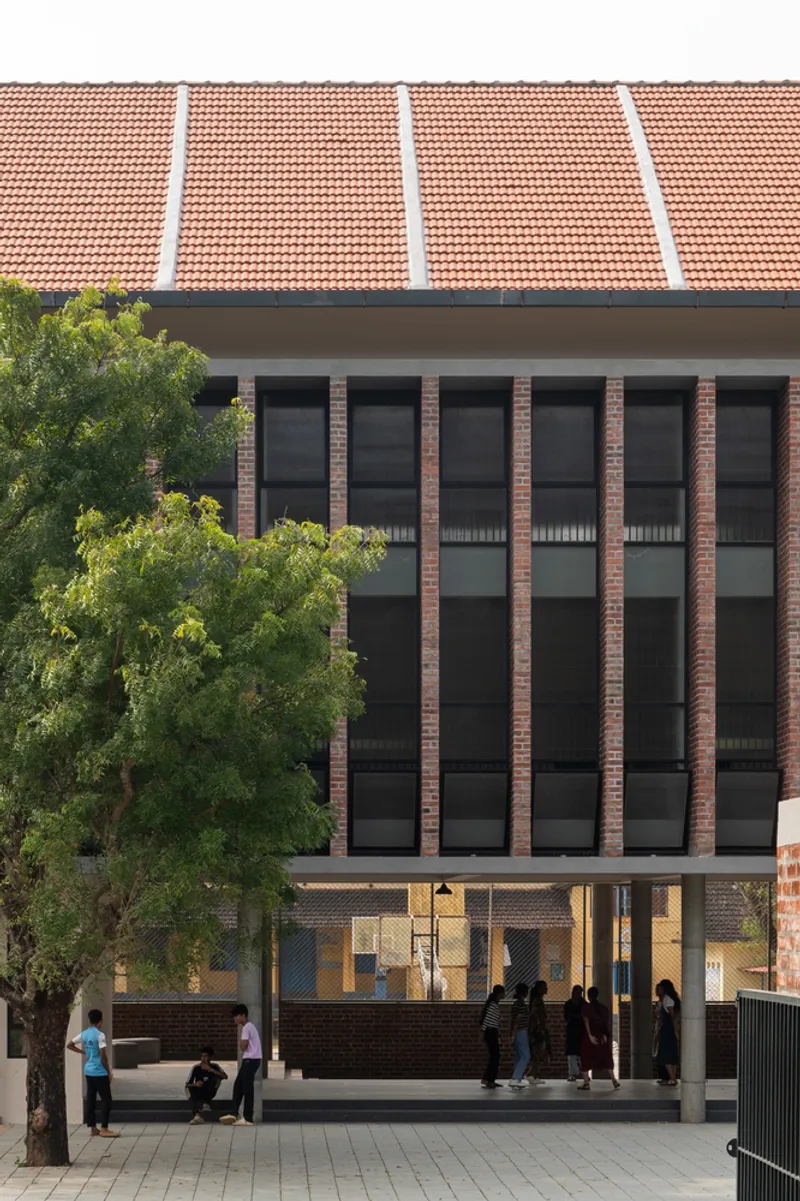
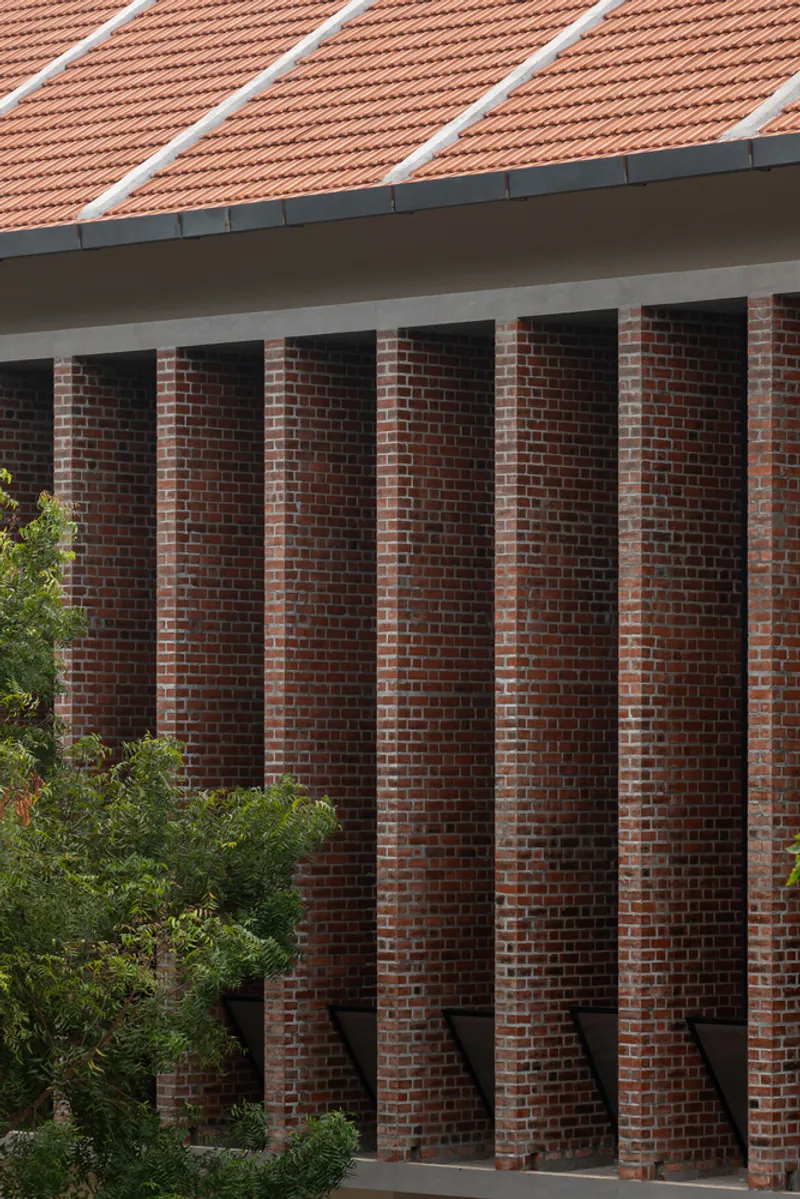
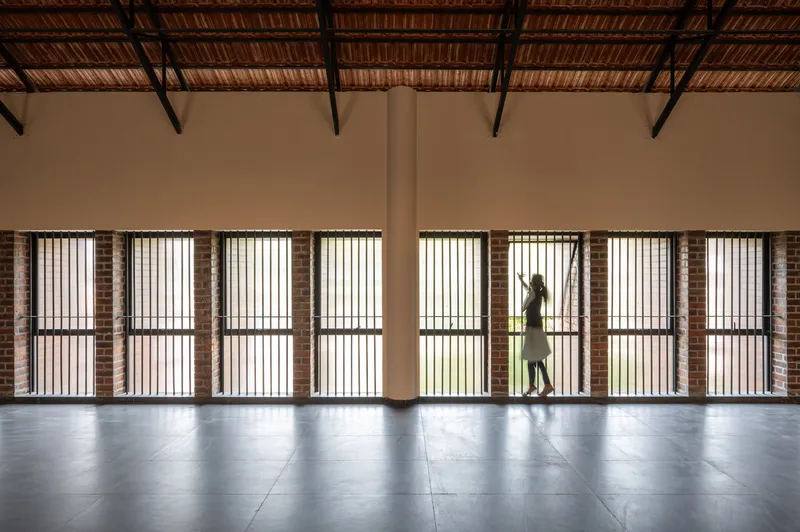
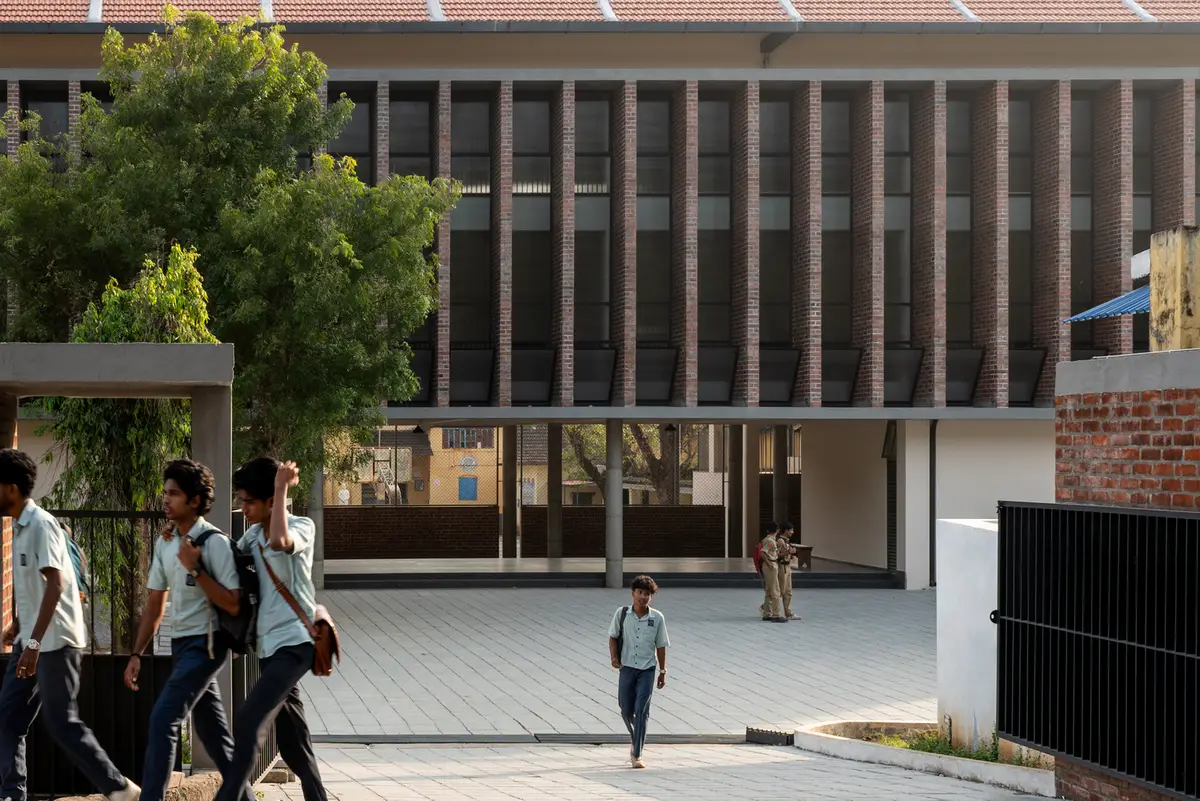
Brick does most of the expressive work here. The street-facing facade of Block A presents rhythmic piers with recessed vertical openings that filter light and air without fully enclosing the interior. This is not decorative brickwork; it is a climate device. The deep reveals create self-shading, and the slatted window bays behind them allow cross-ventilation even when it rains. The terracotta tile roof extends past the wall plane, giving the eaves enough overhang to protect the openings below.
Inside, the brick-framed corridors have a quality of light that is hard to manufacture. The vertical slats cast moving patterns on the exposed timber ceiling, and the warmth of the brick against the cooler tones of the concrete floor creates a material contrast that feels effortless. Studio Acis drew from traditional Kerala building principles here, but the execution is contemporary: clean joints, precise coursing, and a deliberate restraint that lets the material speak.
Interior Life Between Concrete and Light
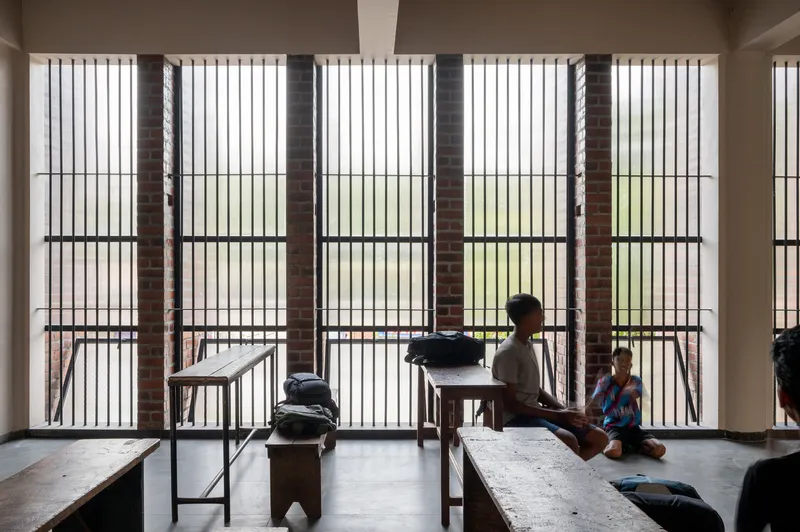
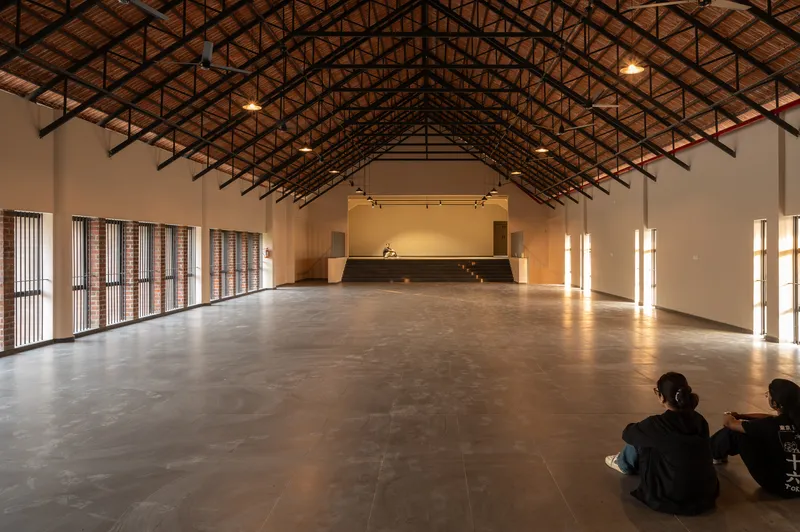
The interiors oscillate between two registers. In the multipurpose hall of Block H, exposed steel trusses span a generous open floor with minimal fuss. The concrete is left raw, the floor unfinished, and the space reads as a flexible container that could host an assembly, an exam, or a community event. This is economical architecture that doesn't apologize for its budget constraints.
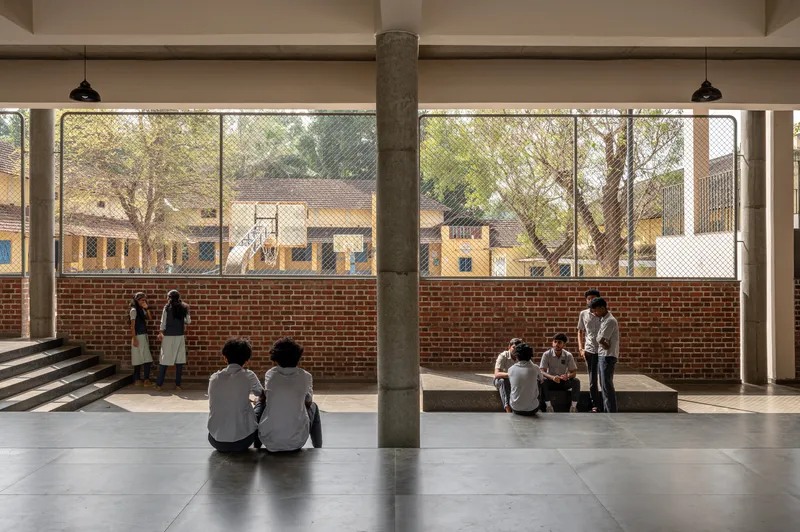
Elsewhere, the corridors are more carefully tuned. Brick half-walls with wire mesh openings allow students to see and be seen, collapsing the separation between circulation and instruction. Filtered daylight enters through the brick screen walls, giving common areas like the hall in image 8 a quality that sits somewhere between a classroom and a covered outdoor space. These in-between conditions are where the school's social life happens.
Vertical Circulation and Double-Height Connections
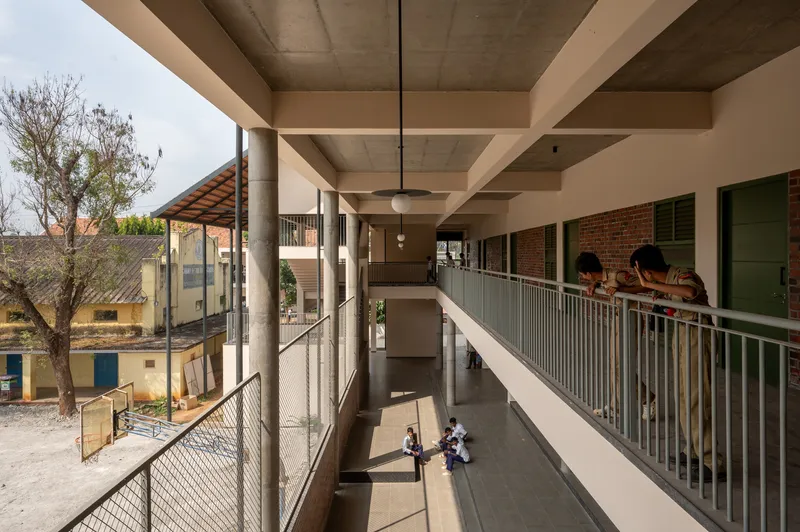
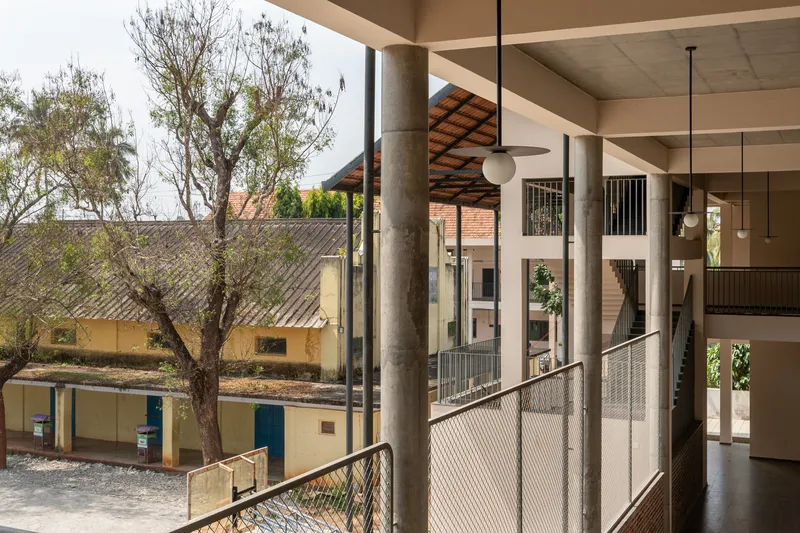
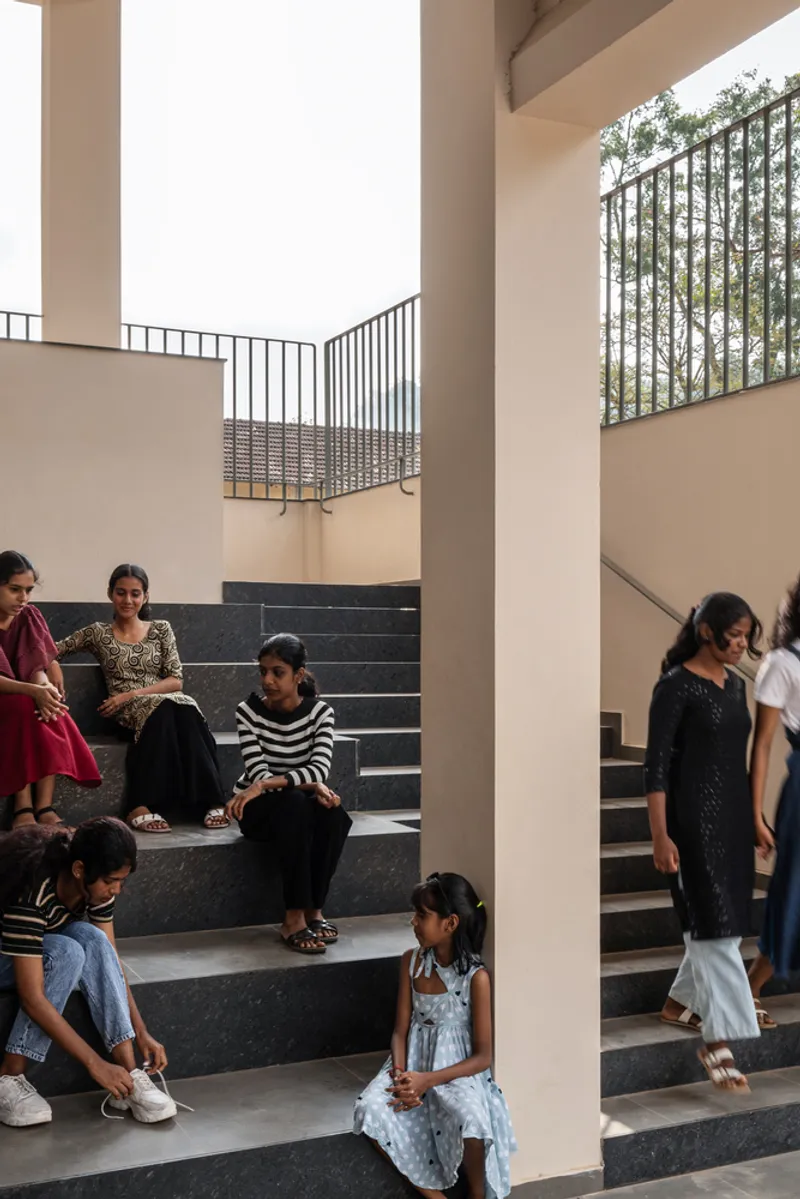
The double-height circulation corridor in Block H is the project's most spatially ambitious moment. Concrete ceiling coffers modulate the overhead plane, and metal mesh railings keep the upper walkway visually open to the courtyard below. Cylindrical concrete columns march through the space with an almost industrial regularity, but the effect is not oppressive. The columns frame glimpses of trees and neighboring buildings, anchoring the interior in its rural context.
The staircase with dark stone treads serves double duty as informal seating, a move that acknowledges how students actually use a school. People sit on steps, lean against columns, and occupy landings. Designing for that behavior rather than against it is a small but significant decision that reflects the project's broader philosophy: architecture that works with the patterns of daily life rather than imposing new ones.
Gathering Spaces and Stepped Courtyards
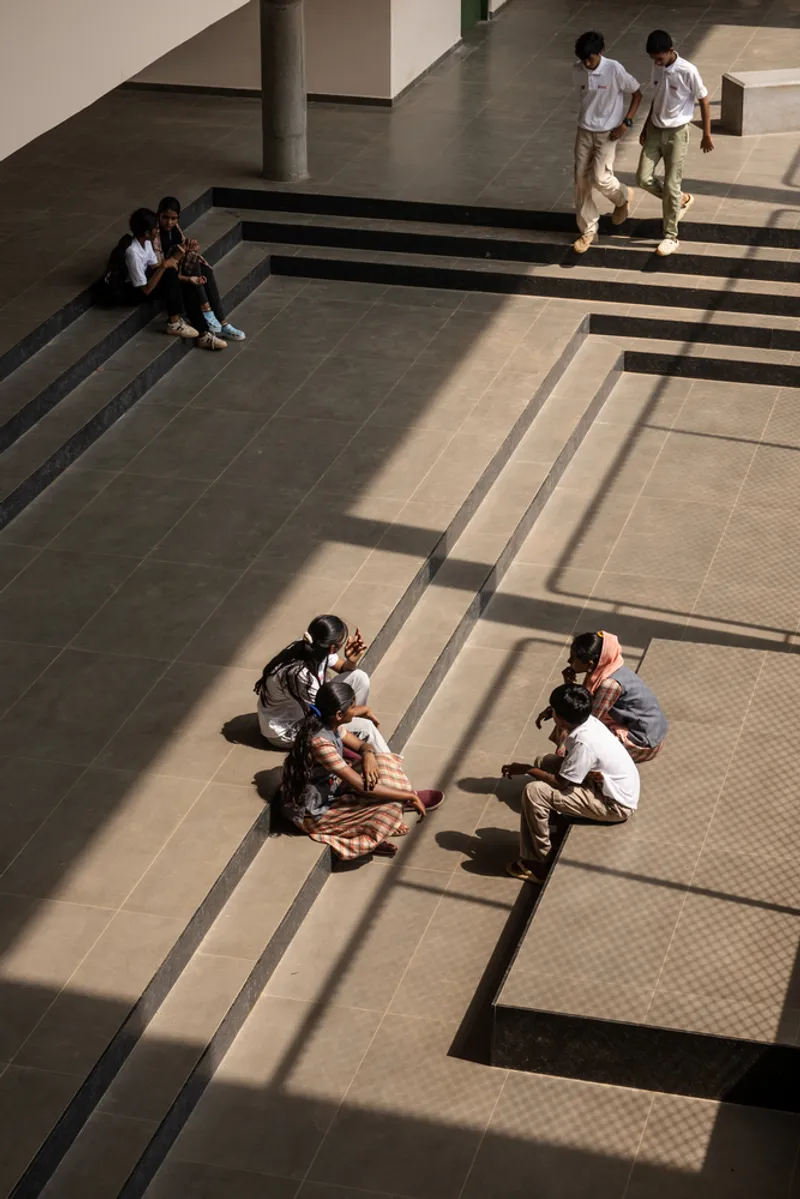
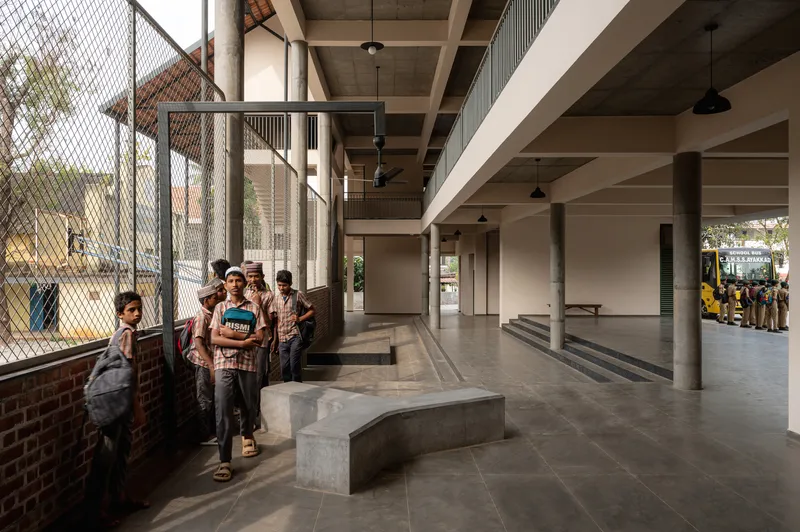
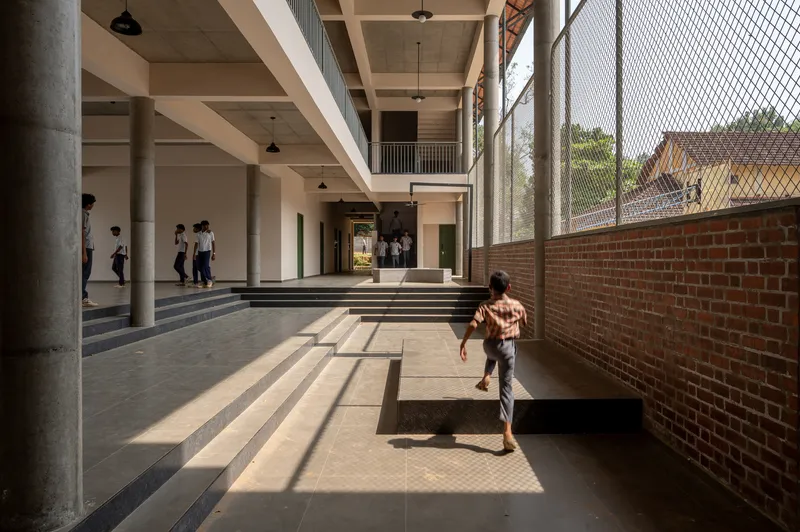
The tiled courtyard with stepped seating is one of the campus's strongest spatial moves. Seen from above, the geometry is simple: a series of low steps that create informal amphitheater seating around a paved gathering area. In the afternoon light, visitors cast long shadows across the tiles, and the space takes on a quality that is at once public and intimate. It is the kind of place that a school needs and rarely gets: somewhere that is neither classroom nor playground but something in between.
At ground level, the hall with concrete benches and cylindrical columns functions as a covered extension of the courtyard. The mesh-fenced boundary keeps the space open to air and light while defining a soft edge. Students gather here between classes, and the architecture accommodates them without forcing a particular arrangement. Shade, breeze, a place to sit: these are the fundamentals of passive design in a tropical climate, and Studio Acis delivers them without fanfare.
Rainwater and Detail
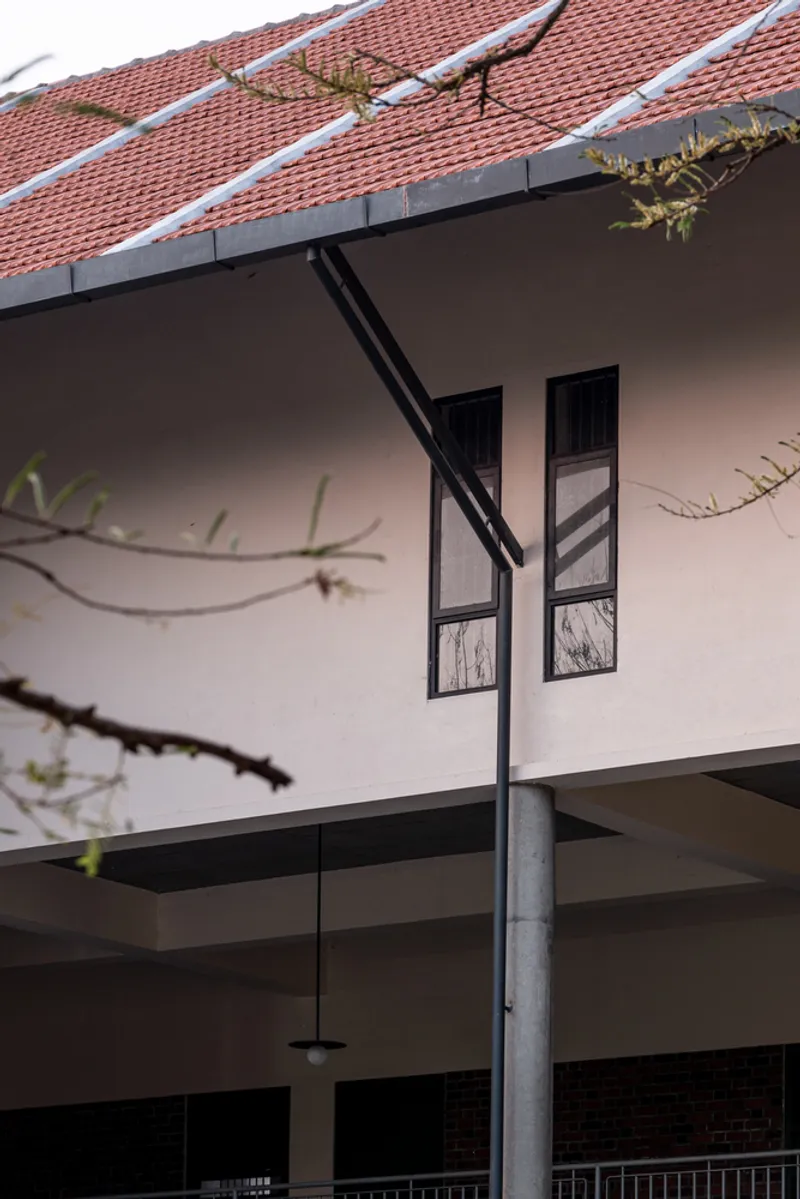
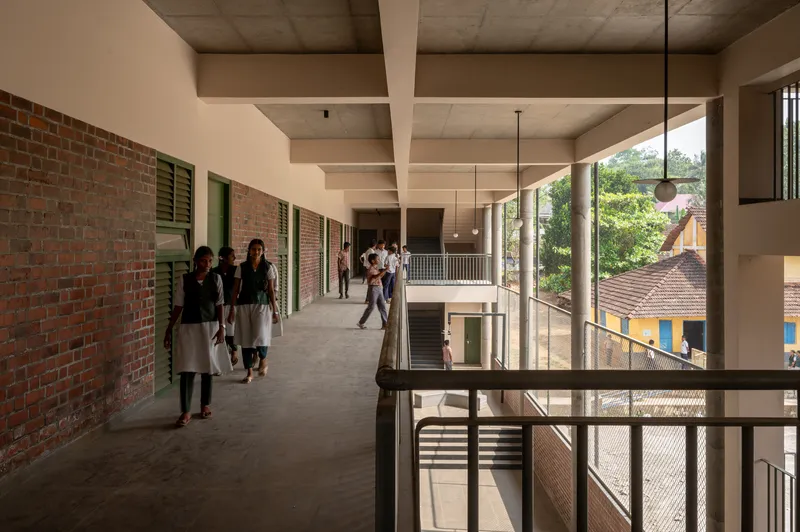
A steel rainwater downpipe running from the terracotta tile roof to the ground might seem like a minor detail, but it reveals the project's attitude toward infrastructure. Nothing is hidden. The pipe is an exposed element that connects the roof to the landscape, and its placement against the tree branches gives it an almost graphic quality. In a project built under tight budget constraints, this kind of honesty is not just an aesthetic choice; it is a practical one.
The open corridors with exposed concrete ceiling beams and green shutters reinforce this directness. Materials are what they are: concrete is concrete, brick is brick, and the green-painted timber shutters add a controlled note of color without pretending to be something else. The palette is restrained but not austere, warm but not sentimental.
Plans and Drawings
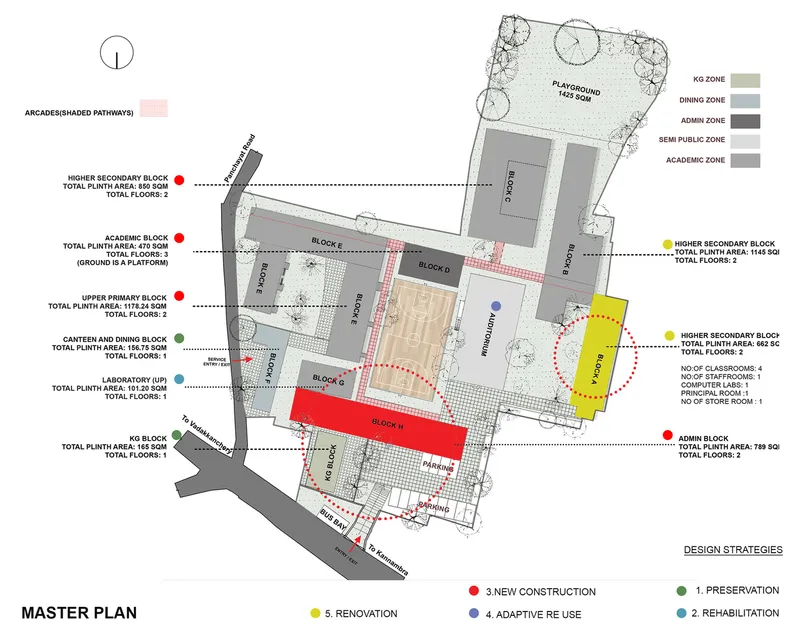
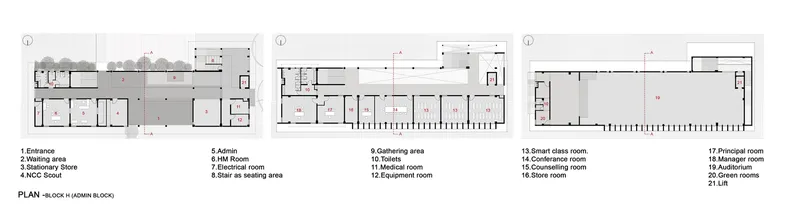
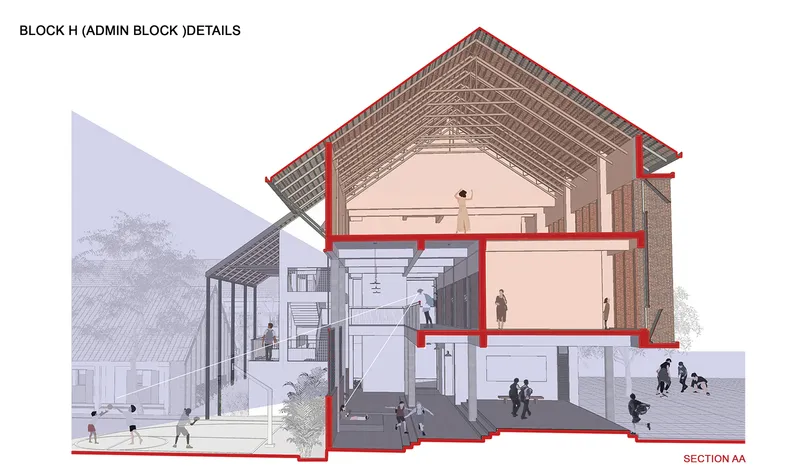
The master plan drawing reveals the full ambition of the six-phase strategy. Color-coded zones map the sequence of preservation, demolition, and new construction across the campus, making visible the logic that holds the project together. Block H's linear form is clearly the organizing move, establishing a central axis that gives the rest of the campus its orientation.
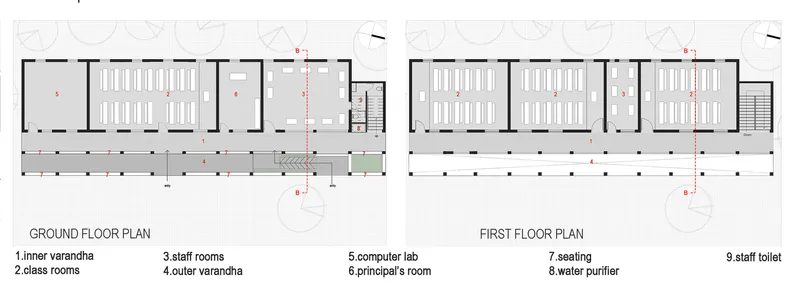
The floor plans for both blocks show tight, efficient layouts with classrooms arranged along single-loaded corridors that face the courtyards. The section through the gabled volume is particularly revealing: exposed timber trusses span the interior, and the multilevel spaces beneath them create opportunities for double-height gathering areas within a relatively modest structural envelope. Every square foot is working.
Why This Project Matters
Schools in rural India rarely get this level of architectural attention, and when they do, the temptation is either to import an urban typology or to retreat into a romanticized version of vernacular building. Studio Acis avoids both traps. The C.A.H.S. School Ayakkad is a genuinely site-specific project that treats budget constraints not as limitations but as design parameters. Passive cooling, adaptive reuse, and phased construction are not applied as sustainability labels; they are the fundamental logic of the project.
The larger lesson is about time. A school founded in 1941 cannot be redesigned in a single gesture. Studio Acis understood that the campus is a living thing that will continue to change, and they designed a master plan robust enough to guide that change without freezing it. The result is architecture that respects what came before, serves what exists now, and leaves room for what comes next. That is a rare combination in any building type. In a school, it is essential.
C.A.H.S. School Ayakkad by Studio Acis. Ayakkad, Palakkad, India. 29,379 sq. ft. on a 2.53-acre site. Completed 2024. Lead Architect: Ar. Rakesh Kakkoth. Design Team: Ar. Suraj S, Ar. Jeswin David. Structural Engineer: Er. Hariharan. Photography by Studio IKSHA.
About the Studio
Share Your Own Work on uni.xyz
If projects like this are the kind of work you want to make, uni.xyz is a place to publish your own, find collaborators, and enter design competitions.


Popular Articles
Popular articles from the community


Jaramillo Van Sluys Arquitectura and Urbanismo Turn a Demolished Registry Lot in Quito into an Orchard Plaza
In Quito's Centro Histórico, a 2,800 m² plaza exposes the San Agustín convent wall and redraws its lost Augustinian orchard in volcanic stone.

David Macias Steps a Doorless Stone and Plaster House Down a Tropical Colombian Hillside
In the humid hills of Colombia, Threshold House replaces the front door with an open void and terraces its 850 m² down the slope instead of fighting it.

David Ortega Stacks a Two-Story Mexico City Penthouse Around a Steel Stair and a Pergola-Shaded Roof Terrace
In Colonia Roma, a 300 m² penthouse uses oak joinery, a planted steel stair and a slatted roof pergola to make a new-build apartment feel like a house.

U.GA Architects Wraps an Oval Rooftop Pool in Curved Board-Formed Concrete on Busan's Jeollidan-gil
In Busan's Jeonpo-dong, a 454 m² mixed-use block stacks a neighborhood facility, guest rooms and an oval rooftop pool inside spiraling concrete walls.

Similar Reads
You might also enjoy these articles

Gil Mello Arquitetura Tilts a Single Roof Toward the Waterfalls on a Plateau Above Aiuruoca, Brazil
In Aiuruoca, Minas Gerais, a 200 m² house of local labor and reclaimed poles pairs a low valley veranda with a tall mountain one.
U.GA Architects Wraps an Oval Rooftop Pool in Curved Board-Formed Concrete on Busan's Jeollidan-gil
In Busan's Jeonpo-dong, a 454 m² mixed-use block stacks a neighborhood facility, guest rooms and an oval rooftop pool inside spiraling concrete walls.

Felipe Hess Arquitetos Turns a Blind Stone Wall to the Street and Opens a Brazilian House onto a Courtyard and Canal
A canal-front house in Brazil hides behind painted stone and planting, then opens to an olive-tree courtyard, a reed-ceilinged porch and a curving pool.
David Macias Steps a Doorless Stone and Plaster House Down a Tropical Colombian Hillside
In the humid hills of Colombia, Threshold House replaces the front door with an open void and terraces its 850 m² down the slope instead of fighting it.

Explore Mes School Of Architecture Competitions
Discover active competitions in this discipline

Challenge to design public laboratory

Challenge to reimagine the Iron Throne

Photograph architecture without architects

Illustrate the lost glory of Angkor Wat - Render Challenge
Comments (0)
Please login or sign up to add comments
No comments yet. Be the first to comment!