
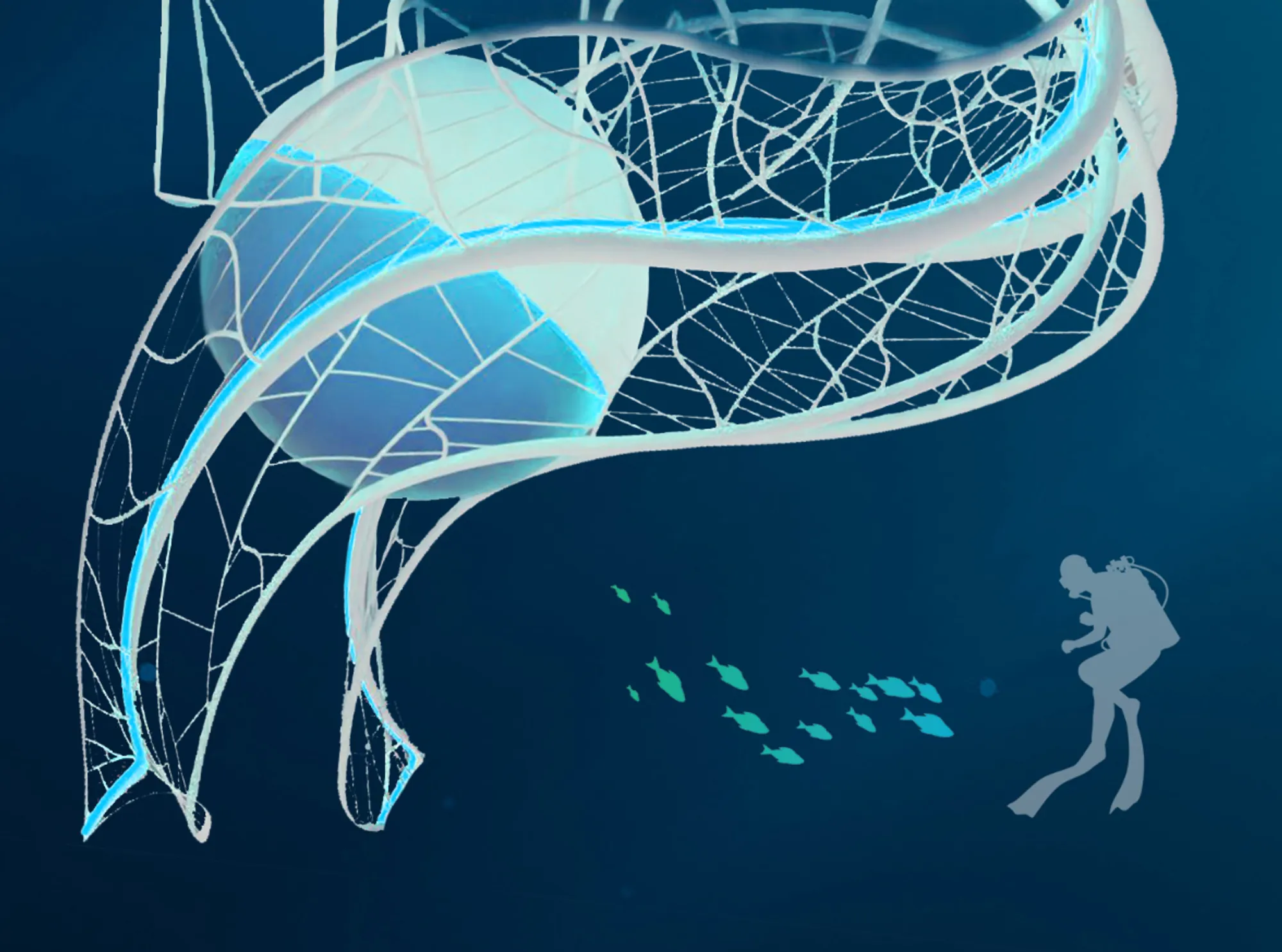
Tela Del Mar: Weaving Tensile Structures into Living Coral Reef Recovery
A lattice canopy suspended in open water becomes both scaffold for coral propagation and immersive observatory for visitors below.


What if the structural logic of a spider's web could be repurposed underwater, stretched taut between anchor points to catch not prey but new coral life? Tela Del Mar, which translates roughly to "fabric of the sea," proposes exactly that: a tensile lattice canopy deployed across open water, designed to serve simultaneously as a framework for coral cultivation and as an inhabited space where visitors confront marine ecosystems at eye level.
Designed by Edgar Salinas, Farruh Farhodov, and Alfredo Zuniga, the project was submitted to the Underwater Web competition on uni.xyz. The brief challenged participants to rethink humanity's relationship with the ocean through architectural intervention. Rather than dropping a monolithic object onto the seabed, this team chose to work with the water column itself, suspending a lightweight mesh system that distributes ecological function across a broad horizontal plane.
A Canopy That Farms the Sea
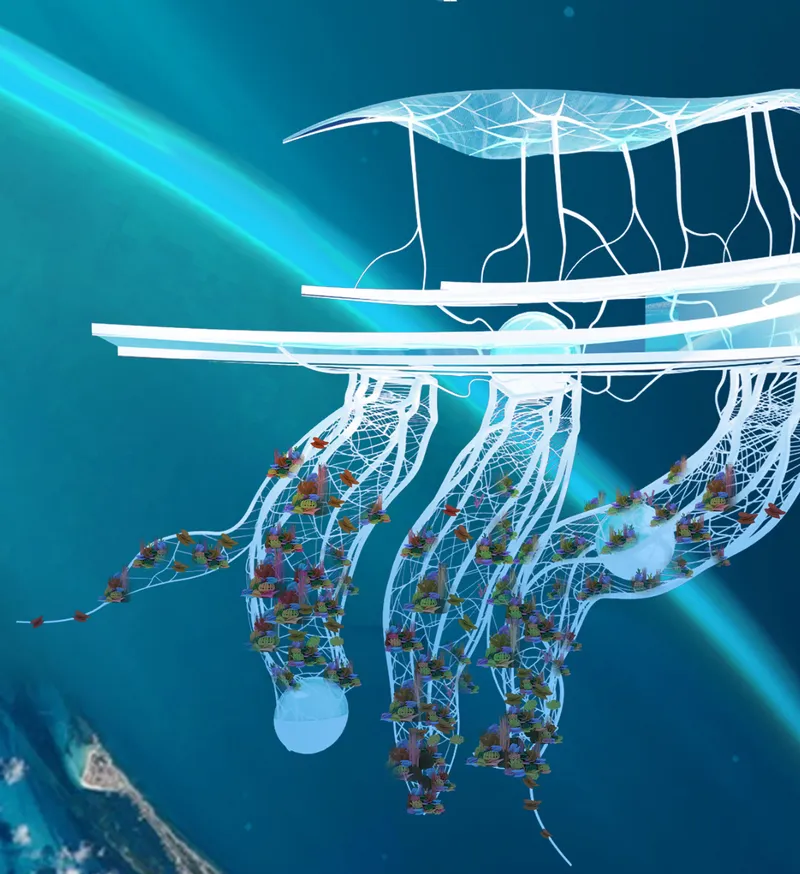
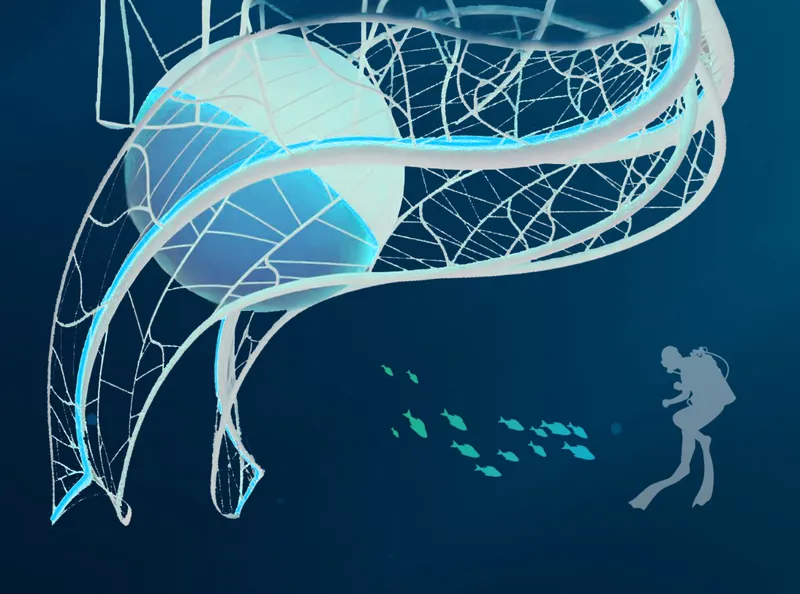
Seen from above, the structure reads as a tensile canopy hovering over a series of cultivated platforms in open water. The curved lattice framework, visible in the wireframe rendering, reveals how the designers resolved a core tension: the need for structural rigidity in a fluid environment without resorting to mass. The answer is curvature. Double-curved ribs distribute hydrodynamic forces across the mesh surface, allowing the structure to flex under current while maintaining its overall geometry. A diver passing through the wireframe view gives immediate scale to the ambition here. Schools of fish already weave through the lattice members, suggesting that the structure's porosity is a feature, not a limitation.
The cultivated platforms suspended beneath the canopy are intended as coral nurseries. Rather than relying on vertical reef walls, the design spreads propagation horizontally, maximizing light exposure for photosynthetic coral species while creating shaded microhabitats underneath. It's an agricultural logic applied to marine biology, and the tensile canopy becomes the trellis.
Habitat Pods as Underwater Gardens
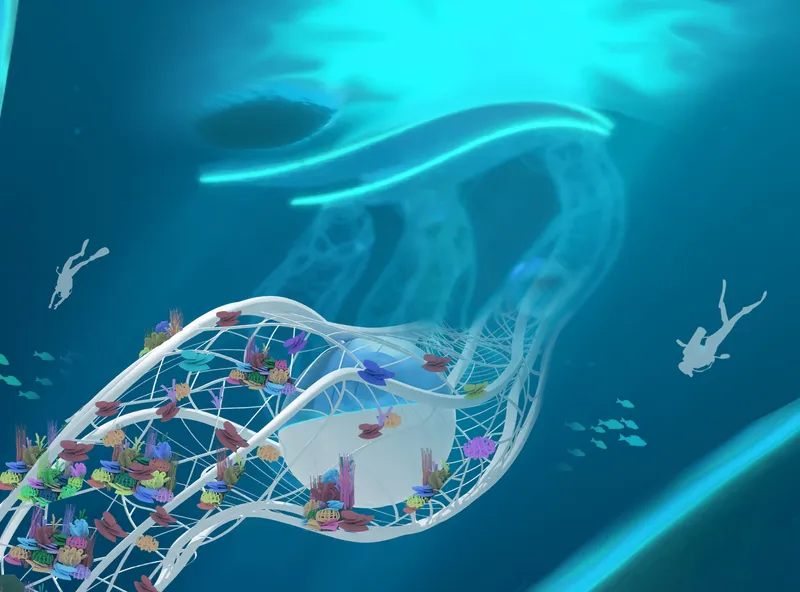
Below the canopy, mesh-enclosed habitat pods function as controlled coral gardens. The underwater rendering shows one such pod in detail: a semi-permeable enclosure where coral formations are planted and tended by divers. The mesh boundary is critical. It allows water exchange and nutrient flow while protecting young coral from predation and mechanical damage during early growth stages. Divers operate within and around these pods as caretakers, and the spatial arrangement implies a rotation system where pods at different stages of coral maturity coexist within the larger framework.
What's notable is the refusal to treat conservation infrastructure as purely utilitarian. The pods are spatially legible, almost garden-like in their composition. There is an implied choreography to the diver's movement through them, a sequence of encounters with coral at various scales. Architecture here isn't just supporting biology; it's organizing the human experience of tending to it.
Acrylic Portals That Frame the Ocean as Subject
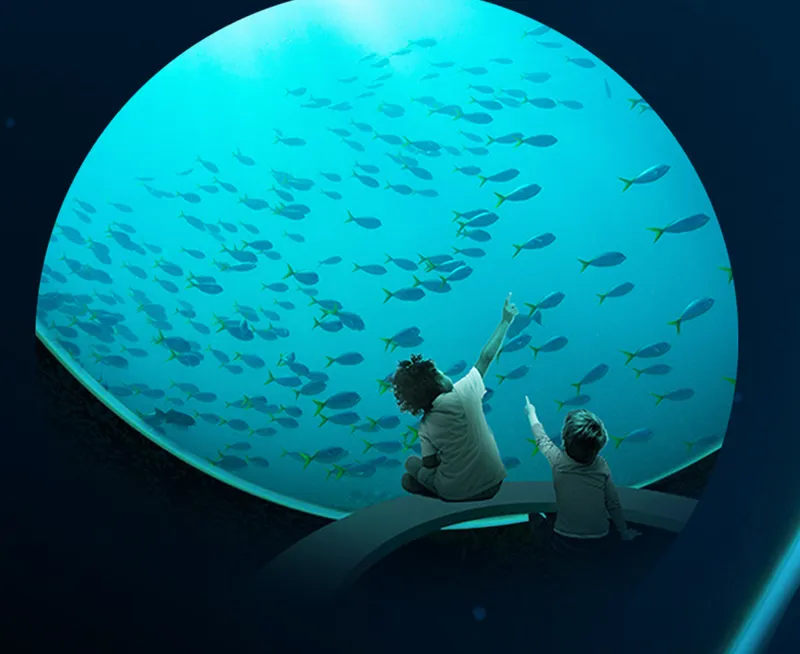
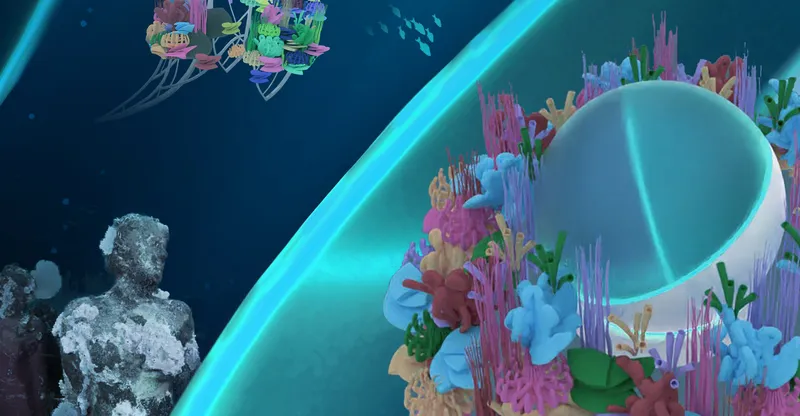
The most compelling moments in Tela Del Mar occur at the thresholds between dry and wet. Circular acrylic windows punch through the structure's inhabited zones, creating portals that frame the ocean not as backdrop but as active subject. In one interior view, two visitors stand behind a large circular aperture while fish swim directly overhead, the curvature of the glass warping the water surface into a living lens. A second detail shows a figure observing coral formations through a curved acrylic portal from below, the geometry of the opening directing the gaze toward specific biological features.
These are not observation decks in the conventional sense. The circular framing enforces a focused, almost telescopic relationship with the marine environment. Visitors don't passively scan a panorama; they look through a defined aperture at a curated slice of reef life. The designers clearly understand that how people see an ecosystem shapes whether they care about it. The portal is a pedagogical device as much as an architectural one.
Why This Project Matters
Tela Del Mar succeeds because it resists the temptation to treat underwater architecture as spectacle. There is no glass tunnel, no submerged hotel suite, no Instagram-ready infinity pool merged with the reef. Instead, the project operates on a quieter premise: that architecture can be woven into an ecosystem's recovery process, literally providing the scaffolding on which new coral colonies establish themselves. The tensile canopy is simultaneously infrastructure, habitat, and public space, and the transitions between those roles are handled with spatial intelligence rather than brute engineering.
For Salinas, Farhodov, and Zuniga, the "web" in the competition brief became more than metaphor. Their lattice is structurally web-like, ecologically web-like in its network of interdependent habitats, and experientially web-like in the way it draws visitors through a series of connected spatial encounters. In a competition field likely full of underwater domes and submerged towers, this project stands apart by asking what the ocean actually needs from architecture, then building the answer as lightly as possible.
View the Full Project
About the Designers
Designers: Edgar Salinas, Farruh Farhodov, Alfredo Zuniga
Enter a Design Competition on uni.xyz
uni.xyz runs architecture and design competitions year-round that reward proposals with spatial conviction and real site intelligence.
Project credits: Tela Del Mar by Edgar Salinas, Farruh Farhodov, Alfredo Zuniga Underwater Web (uni.xyz).




Popular Articles
Popular articles from the community


The Ocean Hive: Sustainable Architecture for a Self-Sufficient Civilization at Sea
The Ocean Hive imagines sustainable architecture at sea, where modular habitats, algae, wave power and ocean waste sustain a growing colony.

Hill & Cross Opera: Sculptural Opera House Architecture Shaped by Tallinn’s Landscape and Identity
Hill & Cross Opera reimagines opera house architecture in Tallinn through its sculptural hill, civic plaza, glass wave and a luminous cross.

Co-Life: Senior Housing Design That Reconnects Older Adults With the City
Co-Life reimagines senior housing design through healing gardens, shared streets, workshops, and a sustainable community across generations.

The Earth Pod: 3D Printed Homes for Resilient Refugee Communities
The Earth Pod reimagines refugee housing through 3D printed homes made from clay, combining resilience, self-sufficiency, and rapid shelter.

Similar Reads
You might also enjoy these articles

Day and Night Park: A Time-Based Urban Newsstand in Beijing
A temporary urban newsstand in Beijing blending travel, light, and reading through poetic colors, compact form, and community-focused design.

Modernist Patio Renovation in El Masnou, Barcelona by Oliver Segura Arquitectura + Cebrià Arquitectura
Modernist patio renovation blending tradition and innovation with a movable pool, leveled floors, and Catalan materials in El Masnou.

Alto Residencial Coop: Cooperative Housing Development in Santiago de Compostela by Carbajo Barrios Arquitectos
A linear cooperative housing complex blending white volumes and perforated metal façades, enhancing community living, natural light, privacy, and urban integration.
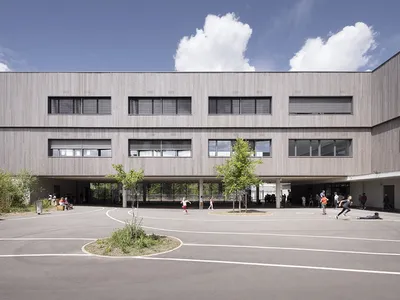
Vil Genis School by BPA ARCHITECTURE – Massy, France
Vil Genis School in Massy, France, features sustainable design, south-facing classrooms, community integration, accessible spaces, and modern educational architecture.


Explore Sustainable Design Competitions
Discover active competitions in this discipline



Challenge to design public laboratory


Design challenge to reuse E-waste
Comments (0)
Please login or sign up to add comments
No comments yet. Be the first to comment!