
The Empty Space: Modular Units That Turn Plazas, Parks and Streets into Open Stages
Lianping Xia's runner-up Opera Truck entry reads Peter Brook's empty space as a modular framework that performers, audiences and cities keep redefining.


Most theatres begin by drawing a wall between the performance and the city. The Empty Space begins by removing it. The proposal takes emptiness, usually read as a lack, and treats it as the most useful thing an architect can offer a performer: a neutral ground that only becomes meaningful once someone steps onto it. What results is less a building than a kit of parts, a modular system built to be redrawn by whoever occupies it.
Designed by Lianping Xia, the project was named a Runner-up in the Opera Truck competition on uni.xyz. Xia's entry takes on the relationship between performance, public space and the city, and positions architecture as a responsive, adaptable system rather than a fixed object. The scheme is tested across several urban conditions, including plazas, parks and dense city streets, and its argument depends on how well one system can hold up in very different places.
A Glass Stage Afloat Before the Monument

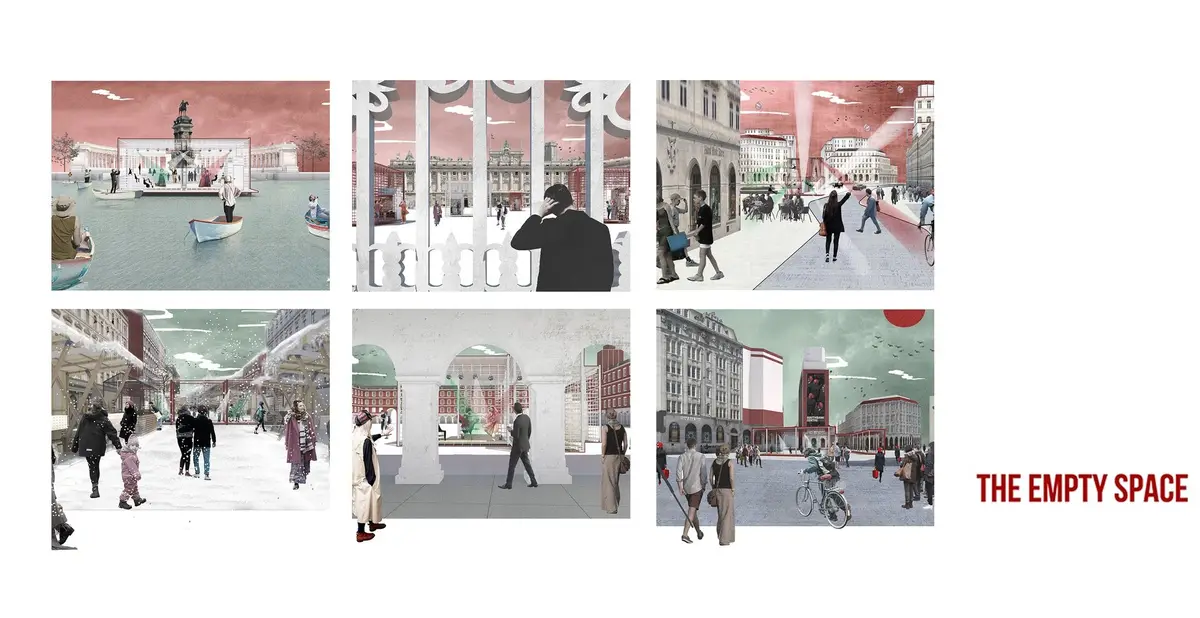
The opening collage sets out the project's attitude in a single frame. A glass-walled stage sits on a pond in front of a monument and colonnade, ringed by rowboats under a pink sky. The audience here has no seats and no foyer; they drift. The image draws directly on Peter Brook's idea that any space can become a stage through human interaction, and it treats water, boats and the historic backdrop as part of the auditorium.
The transparency matters. Xia describes the structure as lightweight and transparent so that it minimises visual intrusion in historic settings while activating underused spaces. The glass enclosure frames the performance without competing with the colonnade behind it, which is a measured response to a setting that could easily have been overwhelmed.
Street Art Logic Translated into a Timber Grid
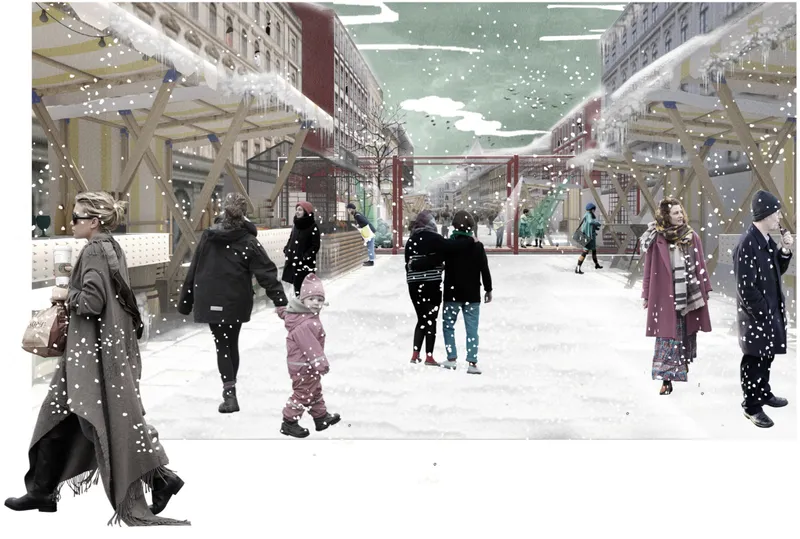
The project's second reference is street art, a practice rooted in expression, protest and public engagement that has always worked outside institutional boundaries. Xia's challenge is to keep that immediacy while giving it a structure. The snowy street scene shows how: a run of timber-framed canopies lines the pavement, sheltering pedestrians in winter coats, with a red frame marking the far end of the sequence.
This is the modular system working as infrastructure. Built from a minimum structural unit that can be replicated, aggregated and reconfigured, the canopies define spatial boundaries and also organise movement and sightlines. Performance is not confined to a single platform; it can occupy the length of the street. That move is ideological as much as spatial, since it questions the exclusivity of conventional venues and returns art to the public domain.
Thresholds Between the Watcher and the Watched


These two views are taken from the edges, and that is deliberate. The first looks through an ornate white iron gate at a man holding his head, facing red-framed kiosks across a palace forecourt. The second looks out from a stone arcade toward a lit stage pavilion in a red brick square, with passersby crossing the foreground. In both, the viewer stands behind an existing architectural threshold and the modular units appear beyond it, so the city itself becomes the proscenium.
This reflects what Xia calls interface relationships: the ways performers, audiences and urban environments meet within the modular framework. The system supports a range of audience-performer arrangements, from centralised stages to distributed, immersive settings, without changing its basic logic. The architecture acts as a mediator rather than a container, and the gate and arcade in these images make the point clearly, since the line between spectator and passerby is never firmly drawn.
Red Signals Across Everyday Streets and Plazas
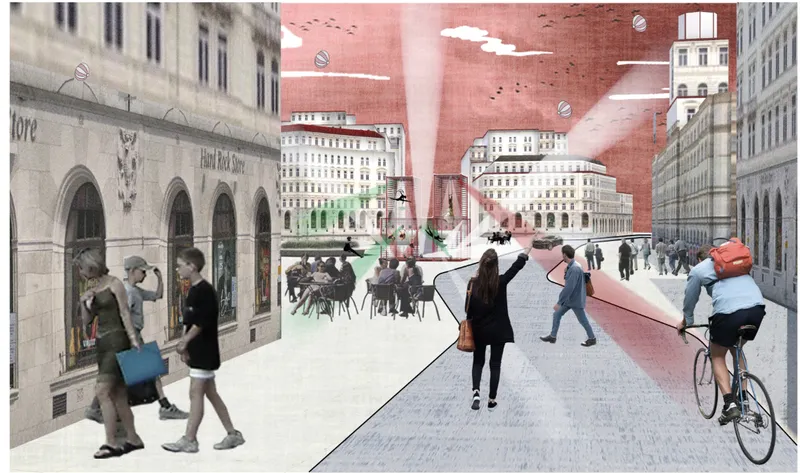

The final pair moves into contemporary, busy settings. A paved street with café tables, a cyclist and pedestrians carries on as usual while red light beams rise from a distant pavilion. A crowded plaza gathers under a red-trimmed canopy, with a camera on a tripod and a red sun overhead. The red that runs through the whole set works as a beacon here, signalling performance from a distance without blocking the ordinary life of the street.
Xia describes this integration as negotiated rather than imposed. The modular units respond to existing circulation, spatial hierarchies and cultural context, adding a layer of interaction to everyday places instead of clearing them out. The tripod is a telling detail: performance in this scheme can be recorded, shared and come across by chance, which is much closer to how street art reaches its audience than to the ticketed rituals of a conventional theatre.
Why This Project Matters
Proposals for mobile or temporary performance venues often stop at the object, a clever pavilion that unfolds. The Empty Space goes further by designing a system and then testing it convincingly against a pond, a snowbound street, a palace forecourt, a brick square and a crowded plaza. Its strength is restraint. By keeping the unit simple and the structure light and transparent, Xia leaves room for context and for performers to supply the meaning, which is exactly what Brook's empty space asks for.
The project also makes a clear civic argument. If any street can become a stage, the cultural life of a city no longer has to depend on the institutions that can afford to house it. As a runner-up entry, the scheme shows how a modular strategy can carry a political position about access and authorship, and it suggests that the most generous thing a performance architecture can do is know when to step back.
View the Full Project
About the Designers
Designer: Lianping Xia
Enter a Design Competition on uni.xyz
uni.xyz runs architecture and design competitions year-round that reward proposals with spatial conviction and real site intelligence.
Project credits: The Empty Space by Lianping Xia Opera Truck (uni.xyz).


Popular Articles
Popular articles from the community


Jaramillo Van Sluys Arquitectura and Urbanismo Turn a Demolished Registry Lot in Quito into an Orchard Plaza
In Quito's Centro Histórico, a 2,800 m² plaza exposes the San Agustín convent wall and redraws its lost Augustinian orchard in volcanic stone.

longwave studio Reorganizes a 112 m² Tainan Apartment Around the Daily Routines of a Family and Two Cats
In Tainan, Taiwan, birch plywood, rust-red furniture and a freestanding plaster wall link arrival, storage, work and family life in one apartment.

David Ortega Stacks a Two-Story Mexico City Penthouse Around a Steel Stair and a Pergola-Shaded Roof Terrace
In Colonia Roma, a 300 m² penthouse uses oak joinery, a planted steel stair and a slatted roof pergola to make a new-build apartment feel like a house.

David Macias Steps a Doorless Stone and Plaster House Down a Tropical Colombian Hillside
In the humid hills of Colombia, Threshold House replaces the front door with an open void and terraces its 850 m² down the slope instead of fighting it.

Similar Reads
You might also enjoy these articles
Healing Façade: A Modular Chapel System That Restores Ethiopia's Sacred Forests
Winner of the Eco-Chapel competition, this circular timber façade collects water from air to rebuild soil and reforest degraded Ethiopian landscapes.
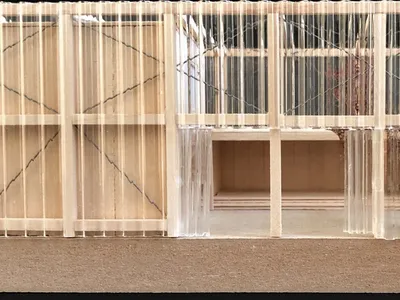
Kaffeebühnen: Where Coffee Shop Architecture Becomes a Civic Stage in Vienna
A linear sequence of timber boxes, transparent shells, and open yards turns the Viennese café tradition into a public performance space.
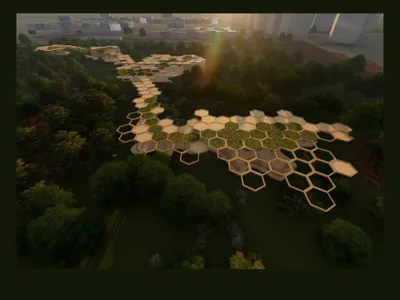
Eco Chapel: A Modular Forest Pavilion That Grows Like the Landscape It Protects
Hexagonal timber modules weave through existing trees, turning a chapel into a living system for prayer, education, and reforestation.


Urban Forest: A Vertical Ecosystem for 5,000 Workers in Singapore's Changi Business Park
Radially stacked pods and layered green decks turn a 7-acre plot into 47 acres of ecological workspace projected for 2040.

Explore Space Urbanism Competitions
Discover active competitions in this discipline

Challenge to visualize slums of 2080

Challenge to design locus for the upliftment of human rights

Design challenge to equip cities with modern furniture

Challenge to reimagine the Iron Throne
Comments (0)
Please login or sign up to add comments
No comments yet. Be the first to comment!