

Neue Bauhaus Villegiatura: A Buried School on an Italian Island
Three pavilions carved into Pianosa's hillside reimagine the gap between high school and college as a landscape of discovery.


What if a school disappeared into the ground? On the island of Pianosa, off the Tuscan coast, Andjela Krca proposes exactly that: an educational campus that buries its volumes beneath an undulating terrain, letting landscape and architecture merge into a single pedagogical surface. Neue Bauhaus Villegiatura treats the earth itself as a teaching tool, embedding three distinct pavilions into the hillside so that students move through programs the way water moves through topography, by following the contours of the land.
Submitted as an Editor's Choice entry in the Bauhaus Neue competition, the project takes on a specific educational challenge: designing a "school between schools," a transitional institution that bridges the foundational knowledge of high school and the specialization of college. Rather than defaulting to a conventional campus layout, Krca positions the school on Pianosa, a small, nearly uninhabited Italian island, and uses its isolation and ecology to shape both the architecture and the curriculum. The result is a self-sustaining educational ecosystem that operates through bio-climatic strategies, renewable energy, and a deep formal relationship with the ground plane.
Amphitheaters and Pools Carved into the Terrain
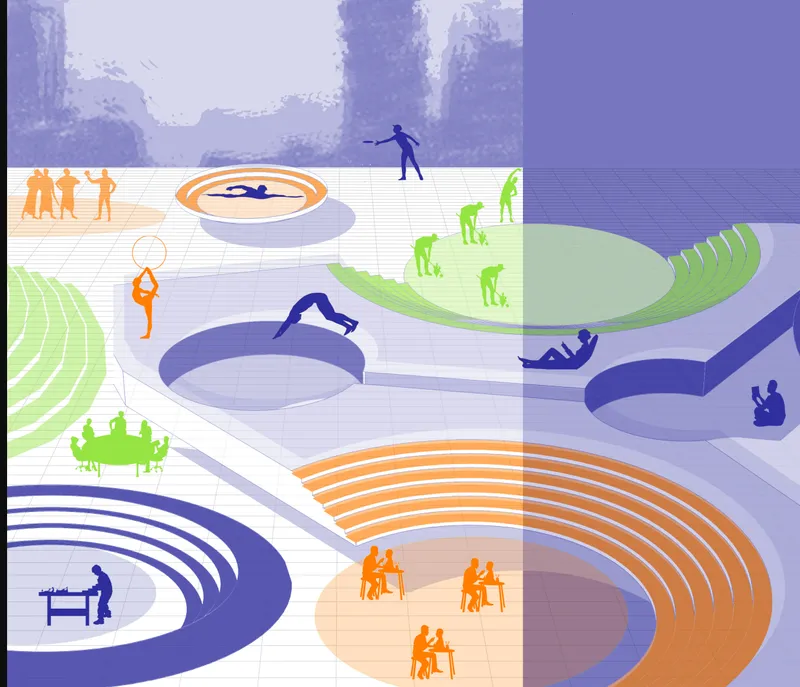
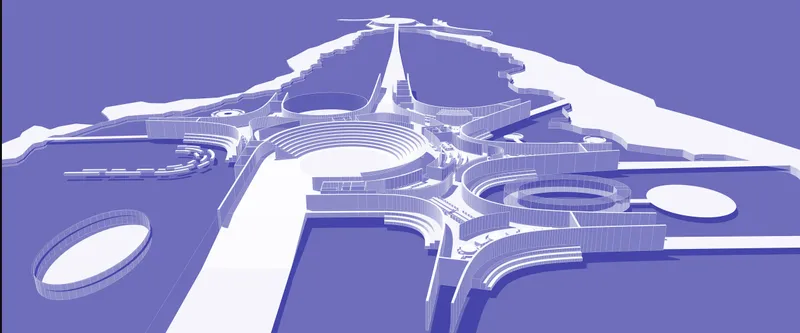
The axonometric drawings reveal the project's most striking move: curving terraced amphitheaters and circular pools that appear to have been scooped directly from the hillside. Silhouetted figures populate the stepped surfaces, suggesting that every gradient change doubles as a seat, a stage, or a social threshold. The concentric circular volumes visible in the aerial view reinforce a non-hierarchical spatial logic. There is no front door, no singular axis. Instead, students enter the landscape and gradually descend into program, encountering teaching spaces as they move through topographic layers.
The sprawling complex reads less like a building and more like an inhabited landform. Green spaces flow continuously between the circular volumes, blurring the distinction between exterior courtyard and interior classroom. This approach reflects the project's core ambition: to create multi-functional environments where ecological responsibility and spatial flexibility are not afterthoughts but the primary generators of form.
Below Grade: Structure Hidden Beneath an Undulating Ground Plane
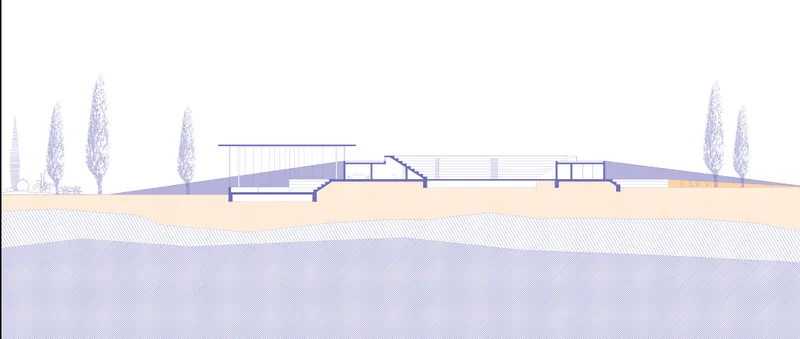
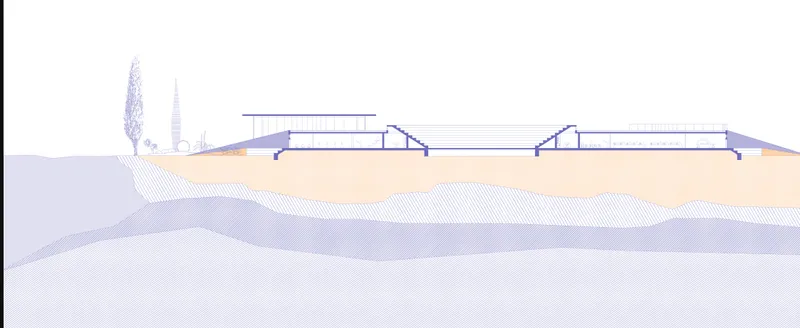
The section drawings make visible what the aerial views only hint at. The school's primary volumes sit below grade, accessed by staircases that descend through cuts in the landscape flanked by trees. Krca uses the ground plane as a thermal buffer, a strategy consistent with bio-climatic design principles suited to the Mediterranean climate. The buried condition also protects the island's visual character; from a distance, the school registers as terrain rather than building.
A second section reveals the full extent of the interment. The undulating surface overhead conceals distinct rooms and circulation routes, with trees planted at intervals that mark thresholds between programs. The spatial experience promises a constant dialogue between compression and release: tight corridors giving way to open amphitheaters, low-ceilinged workshops opening onto sky-lit pools. It is architecture that shapes experience through sequence and contrast, not through ornament.
Island as Campus: Scaling from Sea to Site
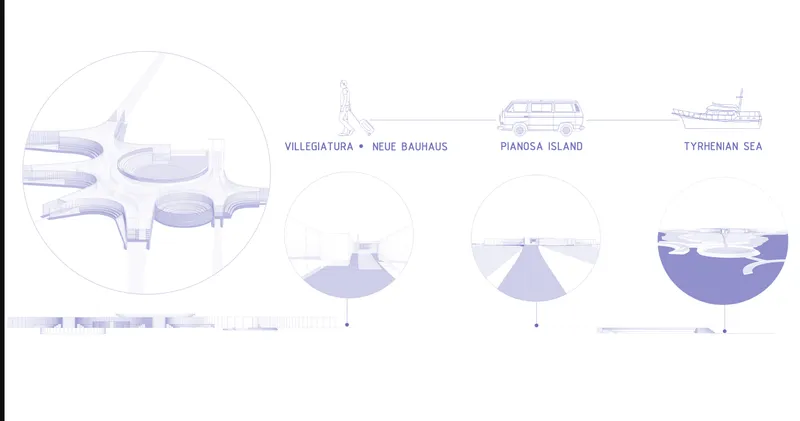
A diagrammatic sheet shows plan views at multiple scales, situating the project within its island and sea context. Pianosa is presented not merely as a location but as a pedagogical premise. The island's isolation removes the distractions of urban life and forces the school to function as a self-sustaining community. Krca uses this scalar analysis to argue that the relationship between building and territory is not incidental but foundational: the school's circular geometries echo the island's own rounded shoreline, and the campus boundary dissolves into the natural landscape at every edge.
Three Pavilions, Three Streams of Knowledge
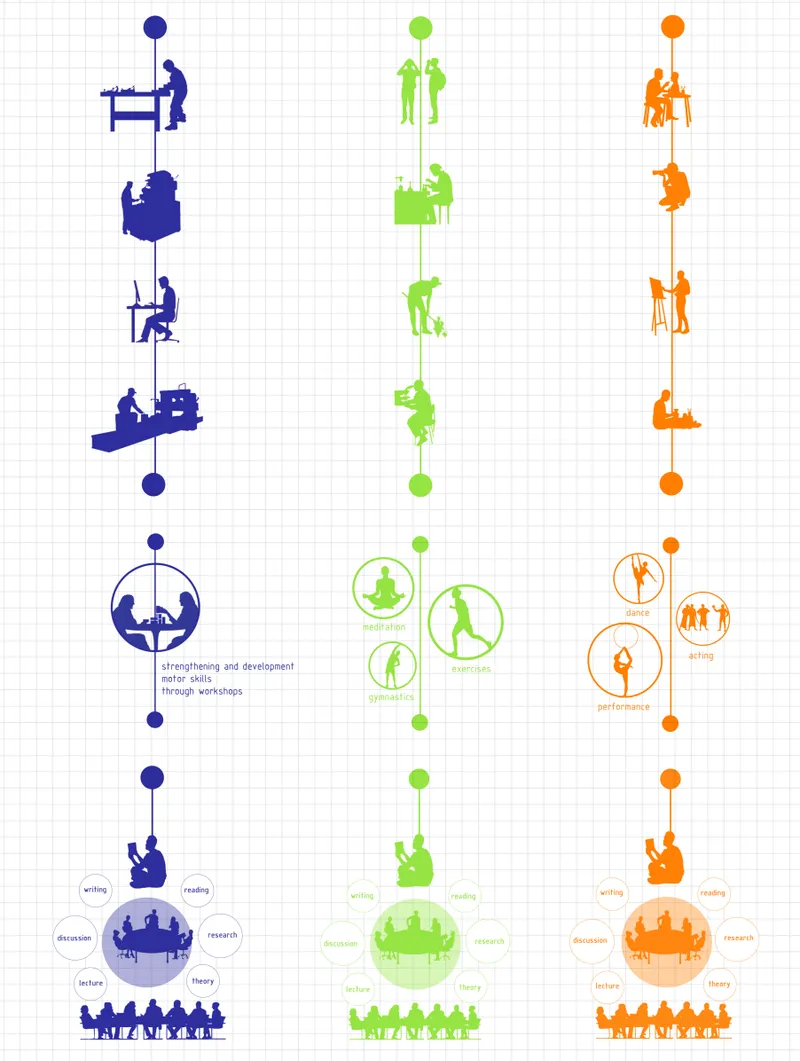
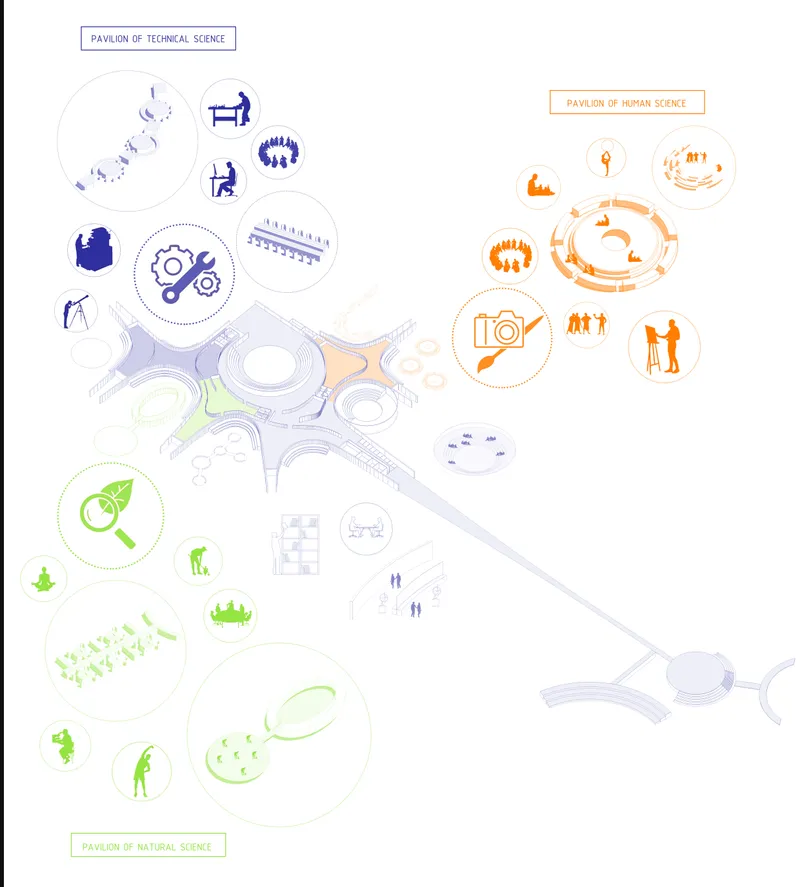
The program is organized around three core pavilions. The Pavilion of Technical Science focuses on hands-on mechanical and practical applications. The Pavilion of Natural Science centers on experimentation and sustainability-driven projects. The Pavilion of Human Science addresses artistic expression, social studies, and communication through creative mediums. A vertical program diagram color-codes these streams in blue, green, and orange, showing how silhouetted figures move through distinct but interconnected activity sequences.
The site plan confirms the spatial logic: three pavilion zones, each defined by clusters of circular program bubbles, distribute across the landscape without rigid separation. Students can follow a primary disciplinary track while physically crossing into adjacent pavilions, an arrangement that encourages the interdisciplinary overlap central to the project's educational philosophy. The school's layout does not dictate movement; it invites it, letting curiosity and terrain guide the daily experience of learning.
Why This Project Matters
Neue Bauhaus Villegiatura matters because it refuses to treat education and architecture as separate problems. By burying its volumes, organizing its program around topographic movement, and siting itself on an isolated Mediterranean island, the project collapses the distance between environment and curriculum. The architecture does not house learning; it performs it. Every slope is a lesson in gradient, every buried room a lesson in climate, every circular pavilion a lesson in social organization.
Krca's proposal also poses a provocative question about the future of transitional education. If the gap between high school and college is a period of identity formation, what kind of space best supports that transformation? The answer offered here is not a building with classrooms but a landscape with thresholds: a place where discovering who you are requires navigating where you are. That spatial argument, grounded in real site conditions and coherent bio-climatic strategies, gives the project conviction that extends well beyond the competition brief.
View the Full Project
About the Designers
Designer: Andjela Krca
Enter a Design Competition on uni.xyz
uni.xyz runs architecture and design competitions year-round that reward proposals with spatial conviction and real site intelligence.
Project credits: Villegiatura by Andjela Krca Bauhaus Neue (uni.xyz).


Popular Articles
Popular articles from the community

Tsunami Convergenics: Turning Catastrophic Ocean Forces into Underwater Housing Infrastructure
A speculative underwater settlement off the coast of Onagawa, Japan, treats tsunamis and typhoons as energy sources rather than threats.

Manzana Morphosis: Stretching Barcelona's Grid into a Living Landscape for 2050
A radical reworking of the Eixample manzana turns density into a tool for generous public space, vertical ecology, and environmental performance.

Faces of the Soviet Avant-Garde: Turning Moscow's Street Names into an Open-Air Museum
A network of sculptural installations across a Moscow residential district transforms forgotten architect names into spatial encounters with cultural memor

Singing Woman: An Opera House That Performs Before the Curtain Rises
Ovidiu Cristian Pavel's conceptual opera house translates Estonia's choral identity into a sculpted waterfront landmark facing the Baltic Sea.

Similar Reads
You might also enjoy these articles

Shakur's House: Exposed Brick as an Interior Organiser in a 168 m² Mashhad Residence
Brick moves indoors in this Mashhad residence, where masonry walls, glass partitions and teal planes sequence a compact home without closing it off.

Day and Night Park: A Time-Based Urban Newsstand in Beijing
A temporary urban newsstand in Beijing blending travel, light, and reading through poetic colors, compact form, and community-focused design.

Modernist Patio Renovation in El Masnou, Barcelona by Oliver Segura Arquitectura + Cebrià Arquitectura
Modernist patio renovation blending tradition and innovation with a movable pool, leveled floors, and Catalan materials in El Masnou.

Alto Residencial Coop: Cooperative Housing Development in Santiago de Compostela by Carbajo Barrios Arquitectos
A linear cooperative housing complex blending white volumes and perforated metal façades, enhancing community living, natural light, privacy, and urban integration.

Explore New Bauhaus Competitions
Discover active competitions in this discipline

Challenge to design public laboratory

Challenge to reimagine the Iron Throne

Photograph architecture without architects

Illustrate the lost glory of Angkor Wat - Render Challenge
Comments (0)
Please login or sign up to add comments
No comments yet. Be the first to comment!