
The Home On Ryhavevej - Sustainable Housing Architecture
A sustainable housing architecture redefining urban living by blending diverse communities into a cohesive, shared residential ecosystem.


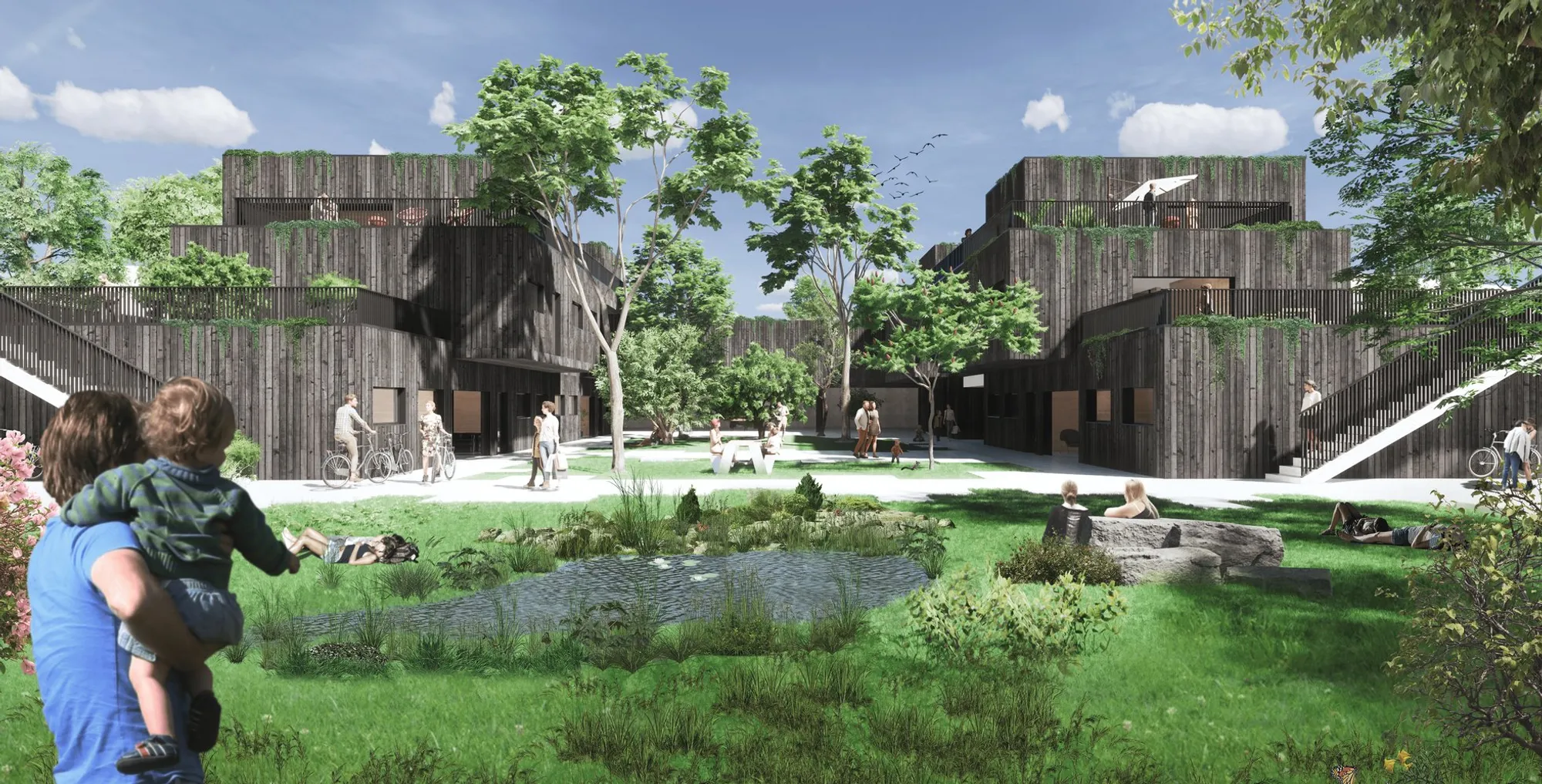
The Home on Ryhavevej by Ondřej Slunečko stands as a compelling exploration of sustainable housing architecture, challenging conventional urban segregation by rethinking how different groups of residents coexist within a shared environment. As a shortlisted entry in Habitats '20, the project proposes a progressive residential model that dissolves rigid boundaries between demographics and instead fosters interaction, inclusivity, and community-driven living.
At its core, the project addresses a critical urban condition: the fragmentation of housing typologies based on socioeconomic or demographic divisions. Traditional city planning often separates families, individuals, students, and elderly populations into distinct zones. The Home on Ryhavevej disrupts this pattern by integrating diverse residential units within a single architectural framework, encouraging a dynamic and socially cohesive neighborhood.
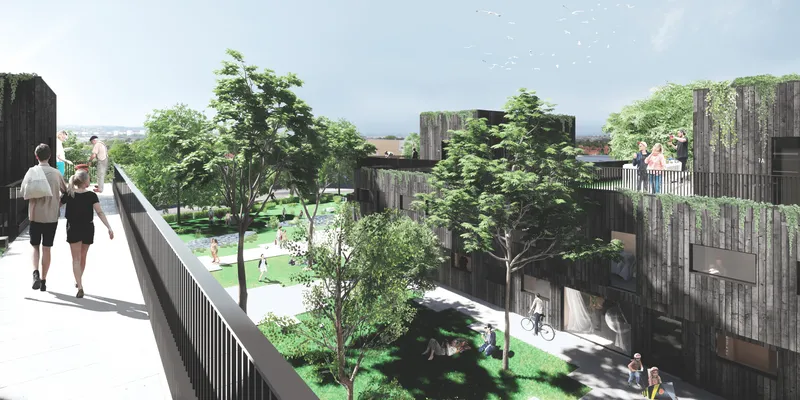
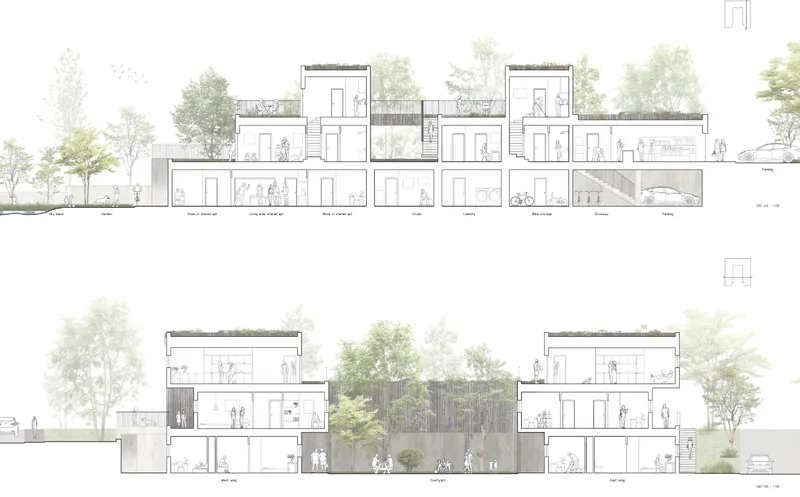
The architectural strategy is deeply rooted in sustainable housing architecture principles, both environmentally and socially. The design introduces a layered composition of volumes that step with the site, creating a porous and human-scaled environment. This stepped configuration allows for visual connections across levels, promoting interaction while maintaining individual privacy.
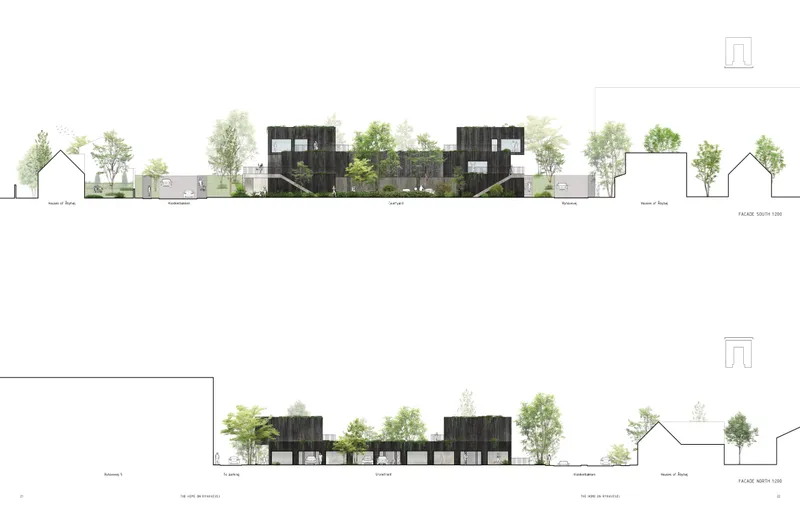
A defining feature of the project is its central courtyard, which operates as the social heart of the development. This green communal space is not merely an aesthetic addition but a functional landscape that supports everyday activities. Residents are encouraged to occupy, traverse, and engage with this shared ground, transforming it into a living ecosystem of movement and interaction.
Circulation plays a pivotal role in reinforcing the project’s social agenda. Elevated walkways and interconnected terraces act as transitional zones between private and public realms. These pathways are designed not just for movement but for encounter, enabling spontaneous interactions among residents. The architecture thus shifts from being a static container to an active facilitator of community life.
Materiality further strengthens the project’s sustainable narrative. The use of timber cladding creates a warm and tactile exterior while aligning with environmentally conscious construction practices. Green roofs and integrated vegetation enhance thermal performance, reduce urban heat island effects, and contribute to biodiversity within the site.
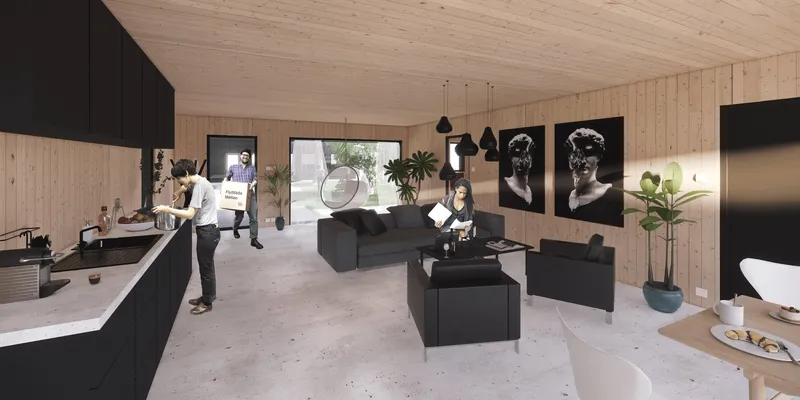
Internally, the residential units are designed with flexibility in mind. The project accommodates a spectrum of living arrangements, including shared apartments, studios, and family units. This diversity ensures adaptability over time, allowing the architecture to respond to changing user needs without requiring structural transformation.
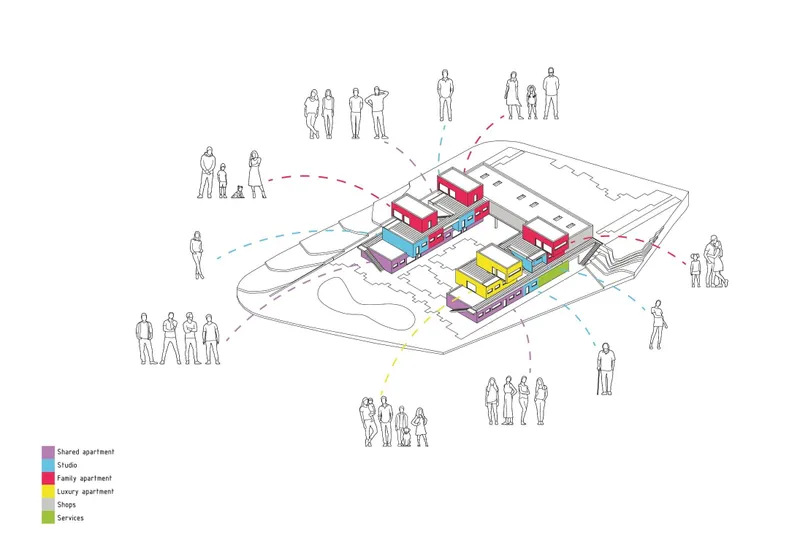
The ground floor is strategically activated with services, parking, and shared amenities, ensuring that the development remains functional and efficient. By embedding these infrastructural elements within the architectural mass, the project maintains a clean and uninterrupted landscape above.
What distinguishes The Home on Ryhavevej within the discourse of sustainable housing architecture is its emphasis on social sustainability. While environmental strategies are integral, the project equally prioritizes human relationships, recognizing that resilient communities are built through connection and shared experiences.
The sectional design reveals a carefully orchestrated layering of spaces, where private dwellings, semi-public terraces, and communal zones coexist in a balanced hierarchy. This vertical integration allows for density without compromising quality of life, demonstrating how compact urban housing can remain both livable and engaging.
Ultimately, The Home on Ryhavevej is not just a residential proposal but a prototype for future urban living. It challenges architects and planners to reconsider the role of housing as a social infrastructure, one that has the potential to bridge divides and cultivate meaningful connections.
By merging environmental responsibility with a strong social agenda, the project redefines sustainable housing architecture as a holistic approach that extends beyond energy efficiency to encompass inclusivity, adaptability, and community resilience.



Popular Articles
Popular articles from the community


The Ocean Hive: Sustainable Architecture for a Self-Sufficient Civilization at Sea
The Ocean Hive imagines sustainable architecture at sea, where modular habitats, algae, wave power and ocean waste sustain a growing colony.

The Earth Pod: 3D Printed Homes for Resilient Refugee Communities
The Earth Pod reimagines refugee housing through 3D printed homes made from clay, combining resilience, self-sufficiency, and rapid shelter.

Hill & Cross Opera: Sculptural Opera House Architecture Shaped by Tallinn’s Landscape and Identity
Hill & Cross Opera reimagines opera house architecture in Tallinn through its sculptural hill, civic plaza, glass wave and a luminous cross.

Play: Fragments of Their World
Familiar architecture becomes modular playground design, creating safe spaces where displaced children can learn, connect, imagine and play.


Similar Reads
You might also enjoy these articles

Eco Chapel: A Green Architecture Pavilion Designed in Symbiosis with the Forest
Eco Chapel uses green architecture to weave prayer, learning and reuse into a forest pavilion shaped by modular hexagonal canopies for life.
Kaffeebühnen: Coffee Shop Architecture Designed as a Civic Stage Between Vienna’s City and Park
Kaffeebühnen turns coffee shop architecture into a civic stage, linking Vienna’s park edge, urban life, warm timber yards, and coffee craft.
Healing Façade: Sustainable Architecture for Reforestation, Community, and Sacred Ecology in Ethiopia
Healing Façade reimagines sustainable architecture as a living wall that restores soil, catches water and renews Ethiopia's forest churches.


Urban Forest: A Vertical Ecosystem for 5,000 Workers in Singapore's Changi Business Park
Radially stacked pods and layered green decks turn a 7-acre plot into 47 acres of ecological workspace projected for 2040.



Comments (0)
Please login or sign up to add comments
No comments yet. Be the first to comment!