

The Metro Bowl: Soft Infrastructure for a Hard City
Sponge-based urban furniture turns New York's most stressful spaces into zones of rest, from Times Square to the subway platform.


What if the antidote to a concrete city were, literally, a sponge? The Metro Bowl starts from a provocation that sounds absurd until you sit with it: New York's hardscape dominance, its relentless grid of asphalt, steel, and glass, can be softened not through parks or greenery alone but through the introduction of pliable, body-conforming furniture deployed at the city's most punishing pressure points. The result is a family of oversized, candy-pink installations made from condensed sponge, waterproof membranes, and LED-integrated frosted plastic, each calibrated to a specific urban condition: the crowd, the commute, the transit hub, the waterfront.
Designed by Xirui Zhang, Ziqing Chen, and Xiang Zhao, the project won the People's Choice Award in the Urbanscape: Symbiosis competition. Set across New York City, a metropolis of over 8.623 million residents contending with population density, traffic congestion, light pollution, and rigid non-ergonomic surfaces, the Metro Bowl reframes each of these stressors as a design brief. Rather than retreating from the city's intensity, it meets that intensity head-on with soft, interactive, almost playful interventions.
The Mega Couch Takes Over Times Square
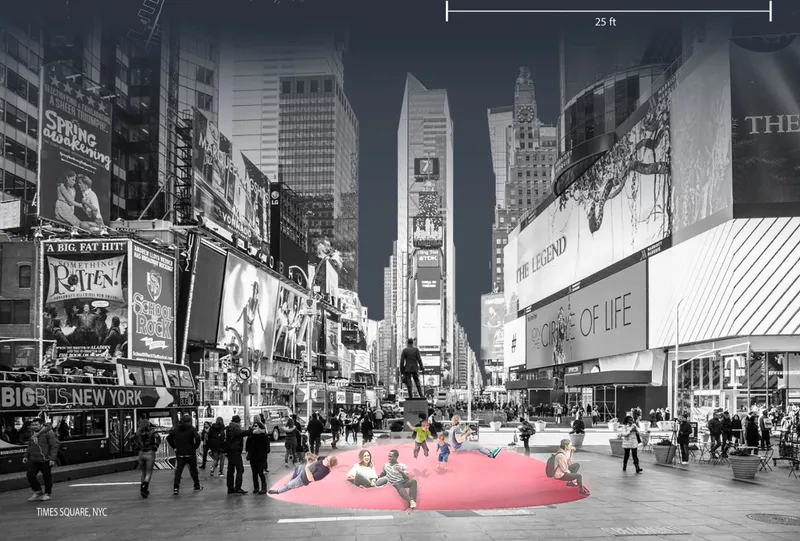
The most immediately striking application is the Mega Couch, a massive inflatable-looking seating installation positioned in high-density nodes like Times Square and Bryant Park. In the rendering, the object glows a warm pink against the dusk light and neon signage of Midtown, drawing pedestrians toward it rather than past it. Its form is deliberately non-architectural: there are no armrests, no backrests, no prescribed orientation. People drape themselves across it however they please. The condensed sponge surface gives just enough to feel like relief after a day spent navigating concrete, while the waterproof membrane ensures the piece survives rain, snow, and the general abuse of a New York sidewalk.
What makes this more than a novelty is its strategic placement. Times Square is arguably the city's most overstimulating public space, a place where crowding, noise, and artificial light converge at maximum intensity. Inserting a soft, low-to-the-ground resting surface here doesn't erase those conditions, but it offers a physical counter-rhythm. You can still hear the honking; you just happen to be lying down.
Underground Bubbles and the Commuter's Reprieve
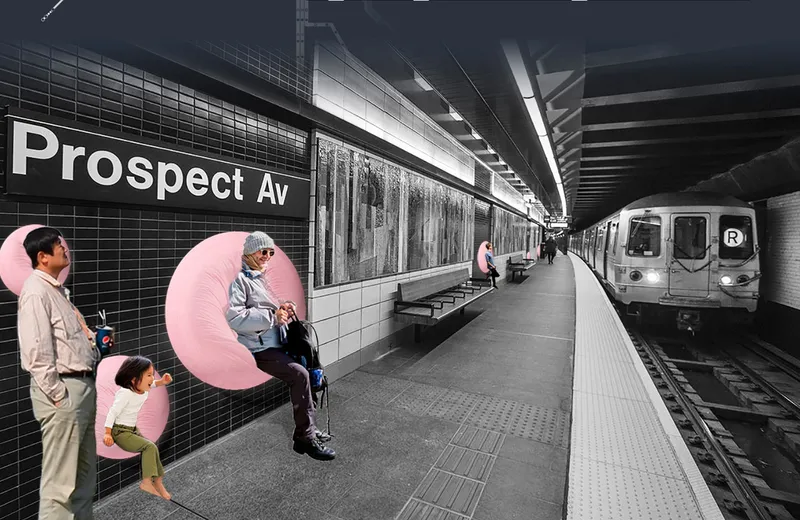
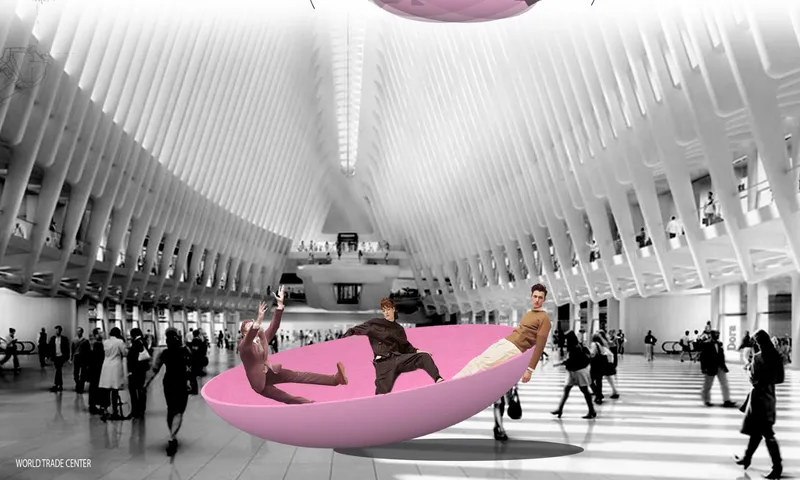
Below ground, the project takes a different tack. The Underground Bubble deploys ergonomic pods within subway stations, offering commuters a moment of sensory reprieve from the screech of braking trains and the press of rush-hour crowds. The platform rendering shows pink circular wall graphics that signal the presence of the intervention, while the transit hall image depicts an oval seating element nestled within a white ribbed concourse, figures reclining on its surface as other passengers walk by. The contrast is deliberate: stillness set against flow, softness against the hard tile and steel of the MTA system.
The designers describe this as addressing the "sensory intensity of transit environments," and the form supports that claim. The pod's curved profile creates a partial enclosure that dampens peripheral visual noise without fully isolating the user. You remain part of the station; you simply occupy a different register of it.
Equilibrium at the World Trade Center and Silence at the Waterfront
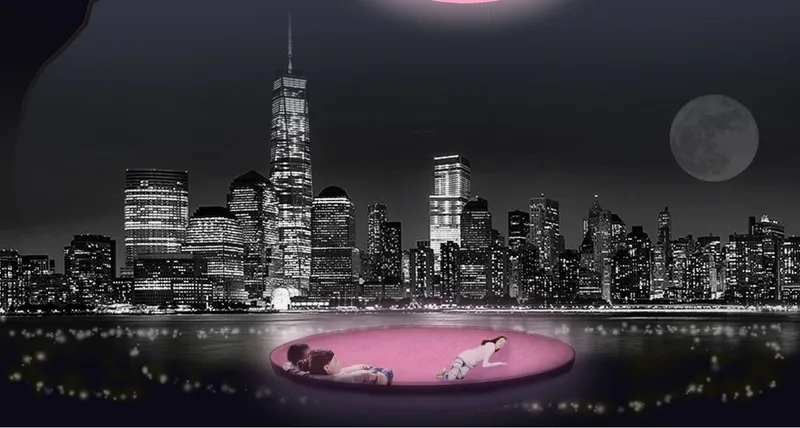
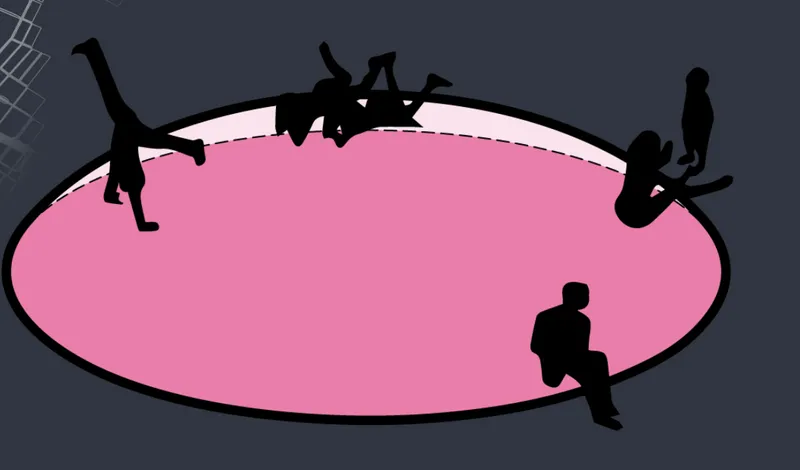
The Balance Bowl, installed at the World Trade Center hub, introduces kinetic responsiveness: the structure shifts subtly in response to user movement, embodying what the designers call "a metaphor for equilibrium within the urban milieu." Meanwhile, the Floating Silence takes the opposite approach, leveraging the inherent calm of waterfront settings. In the nighttime rendering, a pink circular platform sits at the water's edge against an illuminated skyline and full moon, figures reclining in near-total stillness. The diagram of use positions shows how the oval surface accommodates sitting, lying, leaning, and sprawling, all on a single continuous form.
Together, these four typologies constitute a system rather than a single object. Each responds to a distinct urban condition: crowd density in public plazas, sensory overload underground, transit-hub restlessness, and the underused potential of waterfront edges. The consistency of material and color across all four creates a legible urban language, a pink signal that says "pause here."
Diagnosing Density, Then Designing Against It
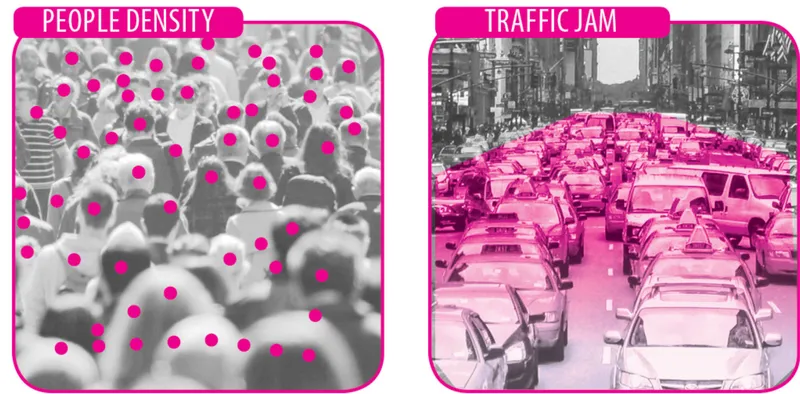
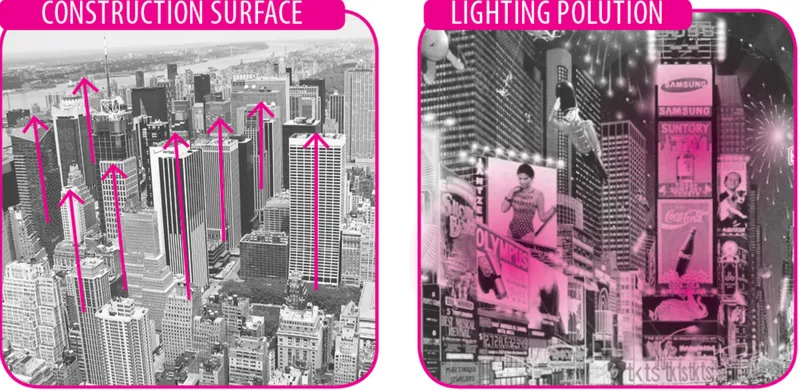
The analytical work underpinning the project is visible in side-by-side diagrams that map pedestrian density patterns against vehicular traffic flow, both highlighted in the project's signature pink. The designers conducted what they term a "spatial diagnosis" of discomfort-inducing urban conditions, identifying the precise intersections where crowd stress, vehicular noise, and hardscape rigidity compound one another. The installations are not dropped at random; they are placed where the data says people suffer most.
This rigor lends credibility to what might otherwise read as pure provocation. Soft pink furniture in Times Square could be dismissed as Instagram bait, but the mapping exercise reveals a considered logic: each placement corresponds to a documented friction point in the city's daily rhythm.
A Sponge Sandwich: Material Assembly in Detail
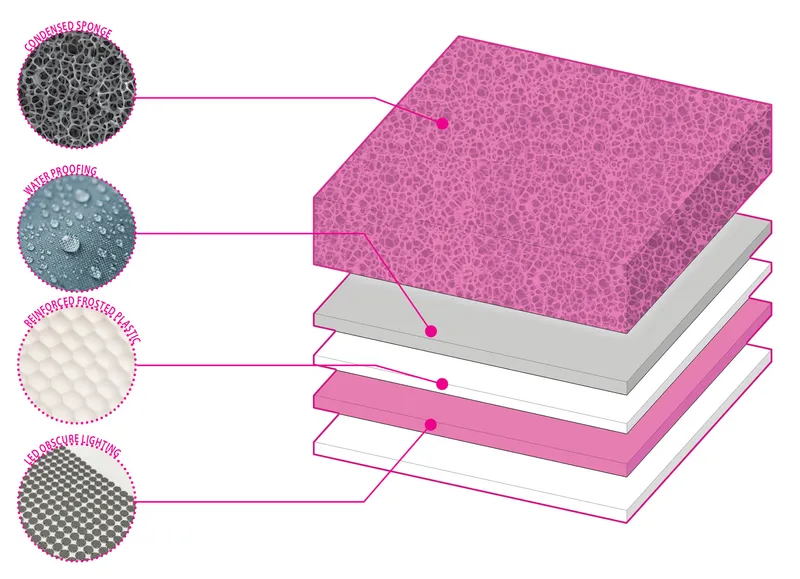
An exploded axonometric drawing lays bare the material logic. The assembly reads from the inside out: a core of condensed sponge for comfort and pliability, wrapped in a waterproof membrane for weather resistance, supported by reinforced frosted plastic for structural integrity, and integrated with LED illumination for ambient engagement. Circular callouts zoom into surface textures, making clear that the softness is engineered, not accidental. The sponge is condensed to balance give and durability; the frosted plastic diffuses embedded light while bearing loads.
The material palette is deliberately limited. By using the same layered system across all four installation types, the designers achieve both visual coherence and fabrication efficiency. It also means the system is scalable: the same sandwich of sponge, membrane, plastic, and light could, in theory, be adapted to cities well beyond New York.
Why This Project Matters
The Metro Bowl takes seriously an idea that much of urban design pays only lip service to: that the physical texture of a city affects mental health. Stress in dense environments is not just a matter of noise levels or crowd counts; it is also about what your body touches when you finally stop moving. By replacing rigid surfaces with yielding ones at the city's most intense pressure points, the project proposes a simple, almost radical inversion. Softness becomes infrastructure.
The People's Choice recognition in Urbanscape: Symbiosis suggests the idea resonates beyond the design jury. There is something immediately legible about a pink sponge bowl sitting in the middle of Times Square: it communicates care, rest, and permission to stop. Whether or not these specific objects ever get built, the framework they establish, a systematic approach to locating, designing, and deploying restorative furniture across a city's stress map, offers a genuinely useful model for urban wellness design.
View the Full Project
About the Designers
Designers: Xirui Zhang, Ziqing Chen, Xiang Zhao
Enter a Design Competition on uni.xyz
uni.xyz runs architecture and design competitions year-round that reward proposals with spatial conviction and real site intelligence.
Project credits: The "Metro Bowl by Xirui Zhang, Ziqing Chen, Xiang Zhao Urbanscape: Symbiosis (uni.xyz).


Popular Articles
Popular articles from the community


Juan García Correa, John González and Claudia Rueda Sink a Circular Amphitheater into a Manizales Engineering Building
On the La Nubia campus in Manizales, Colombia, the S1 Building folds labs and offices into a hillside of ramped lawns that double as a campus route.

GROUP A Strips a 1969 Rotterdam Harbor Headquarters to Its Frame and Wraps It in Timber Louvers
In Rotterdam's M4H harbor district, Ferro Offices reuses a 1969 frame, adds one timber storey and reaches BREEAM-NL Outstanding.

U.GA Architects Wraps an Oval Rooftop Pool in Curved Board-Formed Concrete on Busan's Jeollidan-gil
In Busan's Jeonpo-dong, a 454 m² mixed-use block stacks a neighborhood facility, guest rooms and an oval rooftop pool inside spiraling concrete walls.

Cube Design Draws an Ecological Corridor Between Two Shenzhen Hills with the Nankai Building
Beside Shenzhen's container docks, the Nankai Building pairs stacked balconies with a climbing green screen to connect two hillsides across its height.

Similar Reads
You might also enjoy these articles


Aquadapt: An Underwater Habitat That Rewrites Its Rooms by the Hour
Curved modules ring the seabed while one shell shifts from breakfast room to cinema, farm and football pitch as residents' needs change.

Play: Fragments of Their World: Remembered Architecture Rebuilt as a Modular Playground for Refugee Camps
Tom Gardner abstracts domes, arches and towers from the homelands of displaced families into a kit of child-scaled play parts for camp settlements.
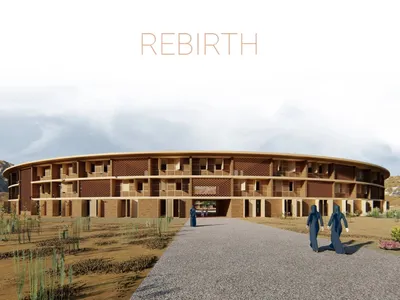
REBIRTH: A Circular Settlement Where Afghan Widows and Their Children Rebuild Life Together
A shortlisted Resile entry turns the circle into a protective ring of timber and brick, gathering homes, classrooms and gardens around a shared landscape.
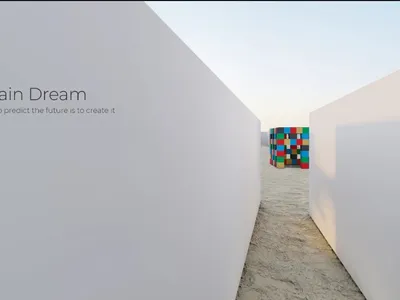
The Main Dream: A Recycled Plastic Kit That Lets Refugee Children Build Their Own Playground
Thirty-centimetre interlocking cubes that connect on three axes turn play into construction, letting children author the spaces they occupy.

Explore Urban Design Competitions
Discover active competitions in this discipline

Design challenge to equip cities with modern furniture

Competition to design a workstation for architects
Comments (0)
Please login or sign up to add comments
No comments yet. Be the first to comment!