
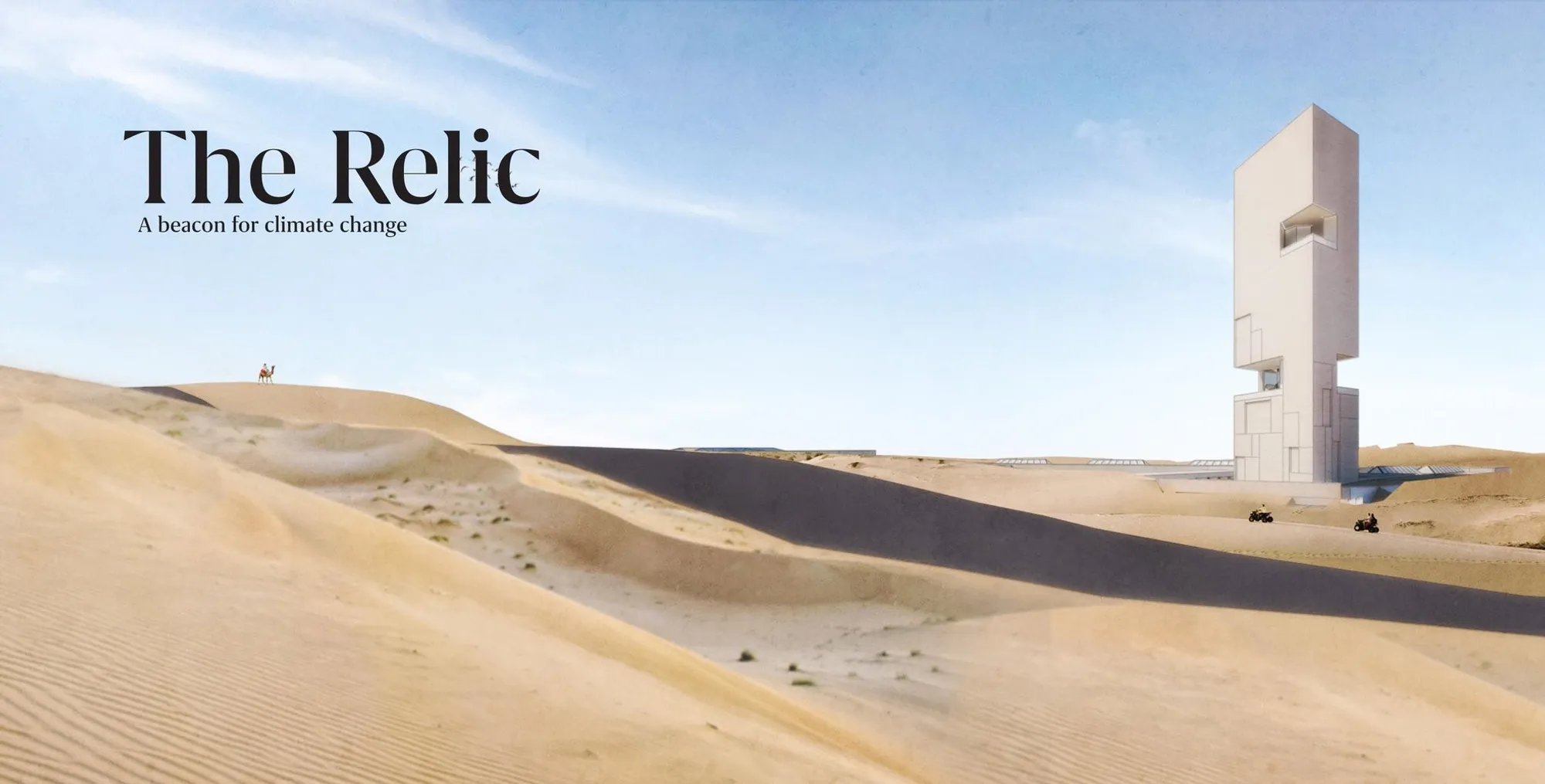
The Relic: A Vision of Sustainable Architecture and Climate Awareness
A sustainable architecture landmark in Cairo that merges memory, climate awareness, and immersive spatial storytelling into a timeless global relic.


In the evolving discourse of sustainable architecture, projects that transcend function and enter the realm of cultural symbolism hold a unique position. The Relic, designed by NTCHWAIDUMELA THOMAS and shortlisted in the Hourglass competition, is one such proposal. Positioned near the historic pyramids of Giza, this architectural intervention is not merely a building, but a spatial narrative that addresses climate change through education, experience, and emotional resonance.
Sustainable Architecture Rooted in Context
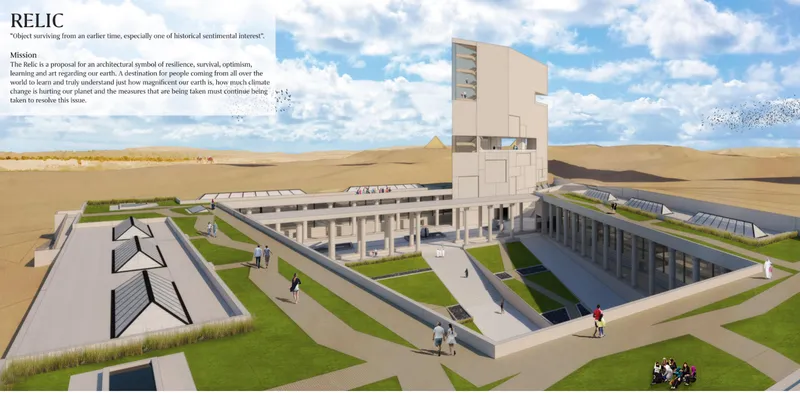
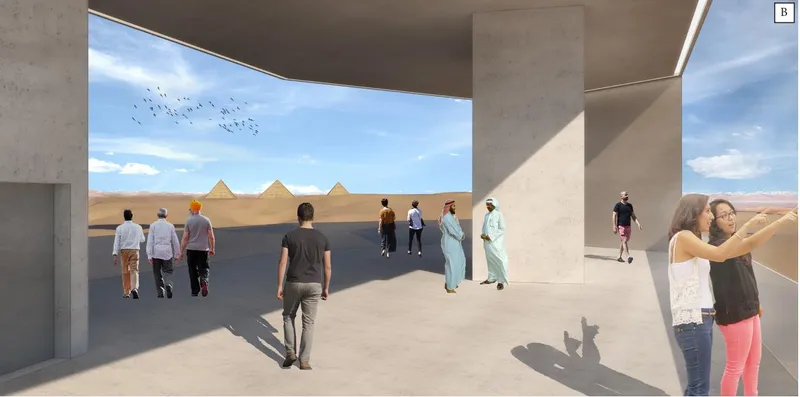
Located in Cairo, Egypt, a region defined by both ancient heritage and environmental vulnerability, The Relic integrates itself into the landscape with deliberate sensitivity. The design references the monumental geometry and materiality of nearby pyramids, using limestone block construction and axial planning to establish continuity with historical architecture.
However, this is not a nostalgic imitation. Instead, the project reinterprets traditional forms through the lens of sustainable architecture. Modern materials such as polycarbonate panels and steel are introduced strategically, creating a hybrid language that bridges past and present. This balance ensures that the structure feels both timeless and forward-looking.
Architecture as a Processional Journey
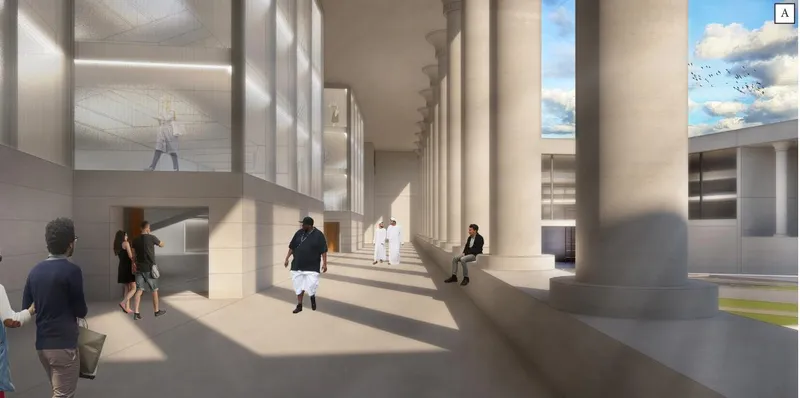
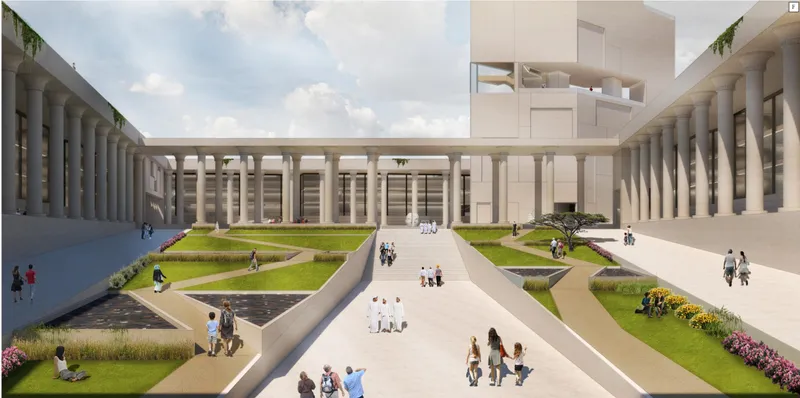
The core concept of The Relic is structured around procession. Visitors do not simply enter a building; they embark on a curated journey that unfolds spatially and intellectually. The experience begins at a sunken entrance, guiding visitors downward into the colonnade court, establishing a sense of transition from the external world into a reflective environment.
This processional sequence is critical to the project’s architectural strategy. Movement becomes a narrative device, leading users through exhibition spaces, educational galleries, and contemplative zones. Each transition is carefully calibrated to build awareness around climate change, gradually immersing visitors in the urgency of environmental issues.
The Colonnade Court: Spatial and Climatic Mediation
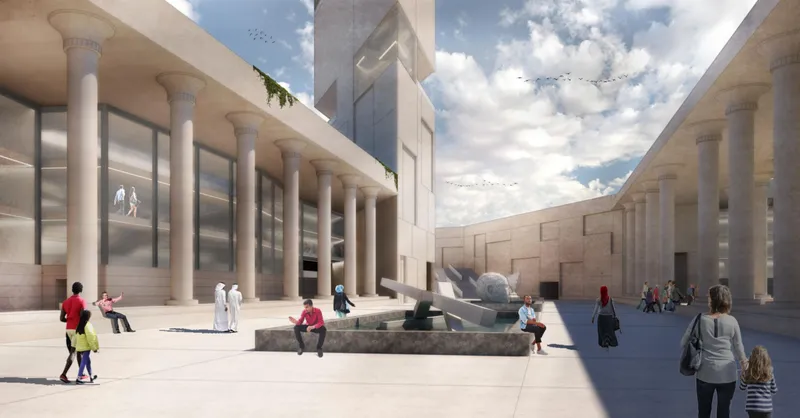
At the heart of the project lies the colonnade court, a large open space surrounded by rhythmic columns. This space serves multiple functions. Architecturally, it acts as a central organizing element, connecting different programmatic zones. Environmentally, it provides passive cooling through shading and air movement, demonstrating principles of sustainable architecture in action.
The court also operates as a social condenser, allowing visitors to gather, reflect, and interact. The integration of water features and vegetation further enhances microclimatic comfort, referencing traditional desert cooling strategies while reinforcing ecological awareness.
The Tower: A Monument of Observation and Reflection
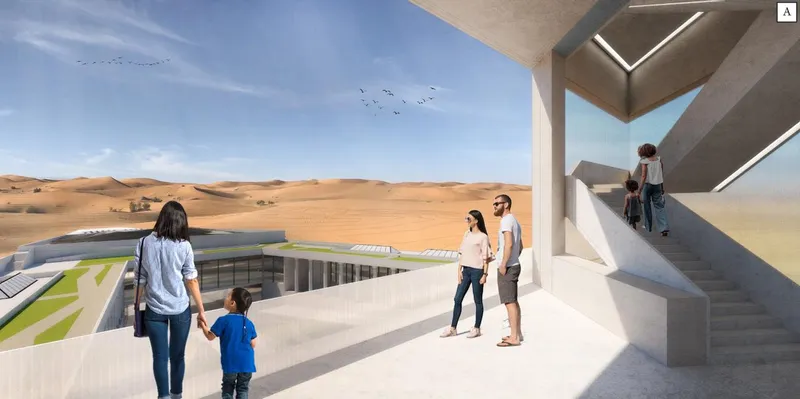
Rising above the horizontal composition is a vertical tower, the most iconic element of The Relic. This structure functions both symbolically and programmatically. As a monument, it acts as a visual anchor within the vast desert landscape. As an observatory, it provides panoramic views of Cairo, the pyramids, and the surrounding terrain.
The tower reinforces the project’s narrative of perspective. By elevating visitors physically, it encourages a broader understanding of environmental impact, linking local context to global climate systems. It is both a destination and a moment of pause within the larger architectural sequence.
The Room of Worlds: Immersive Climate Education
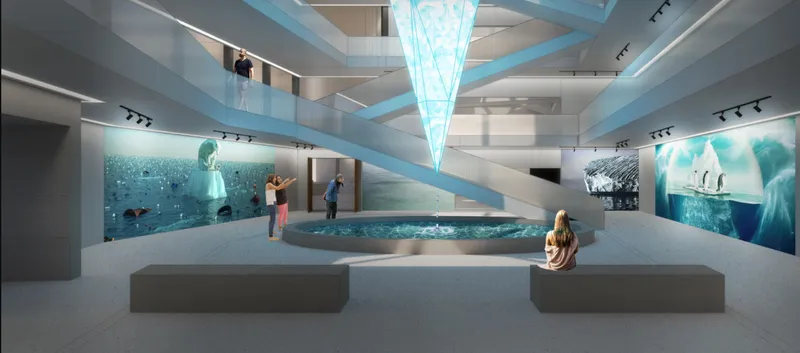
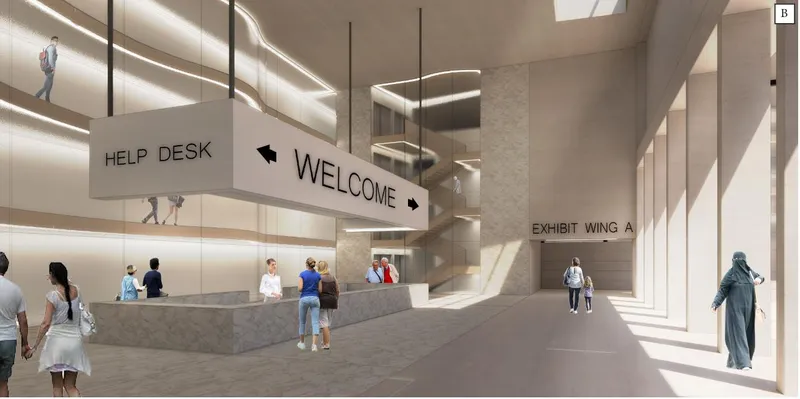
The culmination of the visitor journey is the Room of Worlds, an advanced exhibition space designed to merge data, art, and interaction. This environment uses large-scale projections, dynamic displays, and immersive installations to communicate the realities of climate change.
Rather than presenting static information, the space creates an experiential interface where visitors engage with environmental data visually and emotionally. The use of programmable LED systems and interactive media allows for constantly evolving content, ensuring relevance over time.
This approach positions The Relic within a new typology of sustainable architecture, where buildings act as educational platforms rather than passive containers.
Programmatic Integration: Learning, Culture, and Community
The project is organized into multiple exhibition wings, including spaces dedicated to scientific data, artistic interpretations, and solution-driven innovations. Visitors move through galleries that address topics such as deforestation, energy consumption, industrial impact, and renewable technologies.
Additional amenities such as food courts, gardens, and event spaces ensure that the complex remains active and accessible. The inclusion of a large event venue within the Room of Worlds enables global conferences, climate summits, and cultural programs, reinforcing the project’s role as an international hub.
Landscape Strategy and Ecological Design
The surrounding landscape is designed as an extension of the architecture. Native plant species are introduced to create resilient green zones that require minimal water. Gardens are strategically placed to enhance thermal comfort and provide areas for rest and contemplation.
Water features are integrated not only as aesthetic elements but also as passive cooling systems, drawing inspiration from historical desert architecture. Solar panel farms and renewable energy systems further reinforce the project’s commitment to sustainability.
Materiality and Timelessness
Material selection plays a critical role in achieving the project’s long-term vision. The use of durable, locally sourced limestone ensures longevity while reducing environmental impact. Contemporary materials are used selectively to introduce lightness and transparency, creating a dialogue between solidity and permeability.
This duality allows The Relic to exist as both an ancient artifact and a modern intervention, embodying the idea of a structure that has always been present and will continue to endure.
A Global Platform for Climate Awareness
Beyond its physical form, The Relic is conceived as a global platform. It is designed to host organizations, researchers, and policymakers working on climate solutions. By combining exhibition spaces with event infrastructure, the project facilitates collaboration and knowledge exchange.
The architecture itself becomes a medium of communication, translating complex environmental issues into spatial experiences that are accessible to a broad audience.
The Relic exemplifies how sustainable architecture can move beyond technical performance to address cultural and emotional dimensions of environmental challenges. Through its processional design, contextual sensitivity, and immersive programming, the project creates a powerful narrative that engages visitors at multiple levels.
As a shortlisted entry in the Hourglass competition, it demonstrates the potential of architecture to act as both a memorial and a catalyst for change. The Relic is not just a building; it is an evolving symbol of resilience, urging humanity to reflect, learn, and act in the face of climate change.




Popular Articles
Popular articles from the community


Riyadh For All: Intergenerational Urban Design for Active Aging in Rabat
Riyadh For All reimagines urban design in Rabat with intergenerational co-living, adaptive courtyards, and Moroccan cultural exchange today.

Conexión: Biophilic Design Reimagines High-Rise Living in Hong Kong
Conexión reimagines high-rise living in Hong Kong through biophilic design, green facades, shared spaces, daylight, water and nature within.

The Ocean Hive: Sustainable Architecture for a Self-Sufficient Civilization at Sea
The Ocean Hive imagines sustainable architecture at sea, where modular habitats, algae, wave power and ocean waste sustain a growing colony.

Co-life: Sustainable Architecture for Age-Friendly Community Living
Co-life reimagines sustainable architecture for seniors through courtyards, rammed earth, shared gardens, and spaces designed for belonging.

Similar Reads
You might also enjoy these articles

Eco Chapel: A Green Architecture Pavilion Designed in Symbiosis with the Forest
Eco Chapel uses green architecture to weave prayer, learning and reuse into a forest pavilion shaped by modular hexagonal canopies for life.
Kaffeebühnen: Coffee Shop Architecture Designed as a Civic Stage Between Vienna’s City and Park
Kaffeebühnen turns coffee shop architecture into a civic stage, linking Vienna’s park edge, urban life, warm timber yards, and coffee craft.
Healing Façade: Sustainable Architecture for Reforestation, Community, and Sacred Ecology in Ethiopia
Healing Façade reimagines sustainable architecture as a living wall that restores soil, catches water and renews Ethiopia's forest churches.


Urban Forest: A Vertical Ecosystem for 5,000 Workers in Singapore's Changi Business Park
Radially stacked pods and layered green decks turn a 7-acre plot into 47 acres of ecological workspace projected for 2040.




Comments (0)
Please login or sign up to add comments
No comments yet. Be the first to comment!