

The Stitch: A Recycling Hybrid That Mends the Outer Ring Road's Cut Through Bengaluru
A linear hybrid spans the Outer Ring Road divide in Bengaluru, fusing plastic recycling, R&D and public decks into one civic spine.


Most cities treat the land beneath a flyover as a problem to be fenced off. The Stitch treats it as a seam waiting for thread. The project takes the residual edges left behind by a major ring road, the dark underpasses, orphaned parcels and inaccessible verges, and sews them back into the city with a linear building that is part factory, part public promenade. Its argument is direct: if infrastructure split a neighbourhood apart, architecture can use that same infrastructure as the armature for putting it back together.
Designed by Chethan P as an Institutional Excellence Award entry to UnIATA '19, the proposal sits at Azeez Sait Industrial Estate along the Outer Ring Road in Nayandahalli, Bengaluru. The road carved through a dense industrial and residential precinct, breaking pedestrian routes, informal economies and everyday social exchange. Chethan's response pairs plastic recycling and small-scale manufacturing with inclusive public space, proposing a building that processes roughly 25 tons of the city's plastic waste each day while giving residents a reason to linger at the edge they once avoided.
Reading the Underpass as Leftover Ground, Not Dead Space


The opening views place the proposal exactly where the problem lives. An elevated deck with a yellow railing hovers above an underpass crowded with motorbikes, a truck and a passing SUV, while a second image shows a tall concrete retaining wall with coloured massing laid over it as vans move along the road below. These are not idealised sites. They are the hazy, traffic-heavy conditions that most Bengaluru commuters pass through without a second look.
What makes these images persuasive is their refusal to erase the road. The traffic stays; the building simply occupies the space above and alongside it. That is the core of the project's reading of urban regeneration: the underpasses and leftover parcels created by the Outer Ring Road are not failures to be hidden but latent ground that can carry new programme, provided someone is willing to build on the awkward geometry infrastructure leaves behind.
A Truss Roof Tested at the Scale of the Hand
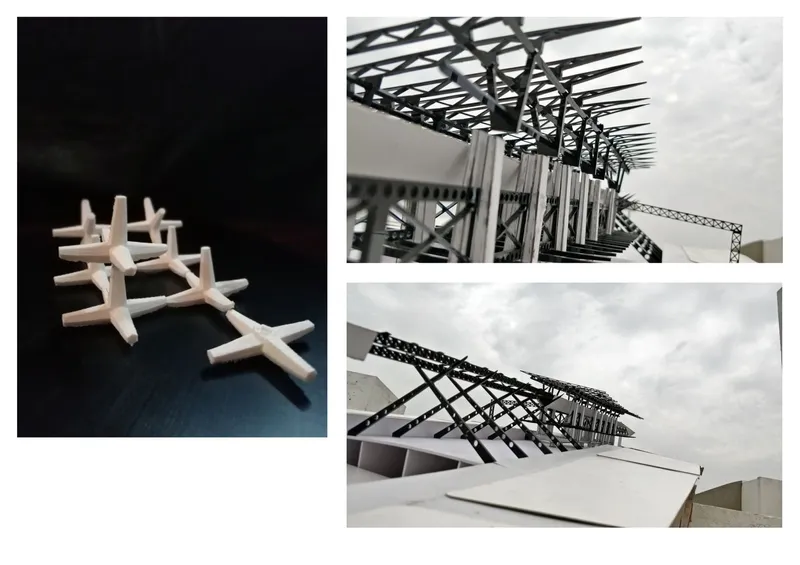

The physical models reveal how the stitch is meant to hold. White cross-shaped pieces sit beside close views of a black steel truss roof, and further crops show diagonal black members resting on slender white columns, photographed outdoors against an overcast sky. The contrast between the heavy dark lattice and the thin pale supports reads as a deliberate structural hierarchy: a spanning roof that does the bridging work, carried by a forest of light verticals that keep the ground below open.
Shooting the model against real sky rather than a studio backdrop is a smart move. It lets the truss read as a canopy at urban scale, and it suggests the kind of filtered, sheltered daylight that a linear public spine along a highway would need. The diagonals also carry the metaphor of the title in physical form, as if the structure itself were a row of stitches pulled tight across the cut.
Putting the Recycling Line on Public Display

The interior render is where the hybrid becomes legible. Blue recycling machines sit among red perforated steel beams, framed by a gridded facade, with silhouetted figures standing within the workspace. The programme layers manufacturing zones for plastic recycling and small-scale production with design and R&D spaces focused on adding value to recycled material, then wraps them in wholesale and retail edges that meet the street.
The decisive gesture is visibility. Rather than pushing production to the urban periphery, the project exposes it, threading ramps, walkways, viewing decks and gathering areas through the building so that citizens can watch waste become product. Production stops being a hidden function and becomes a civic activity. That transparency does real work: it educates, it builds a sense of ownership, and it gives the public spaces a reason to exist beyond leftover circulation.
A Night Spine Where Waste Becomes Visible Urban Resource

The night aerial pulls back to show the full ambition. A red-lit roof and plaza sit beside a train line while traffic draws long light trails below, and the building reads as a glowing band laid along the infrastructure corridor rather than a block dropped beside it. This is the civic spine the project promises: a continuous surface that ties industry, movement and public life into one strip.
The figure of 25 tons of plastic per day gives the image weight. Waste sourced from the city enters at one end of this spine and is recycled, manufactured, displayed and sold along its length, turning a closed-loop system into something people can walk through. The circular economy is no longer an abstract policy claim; it becomes a spatial sequence, extending regeneration from repairing the urban fabric to repairing environmental and economic flows as well.
Why This Project Matters
Indian cities are building highways and flyovers faster than they are learning what to do with the spaces underneath. The Stitch offers a usable model: accept the infrastructure as permanent, then load its residual edges with programme that serves both livelihoods and public life. By choosing plastic recycling, an industry that already intersects with Bengaluru's informal economies, the project grounds its idealism in work that the neighbourhood around Azeez Sait Industrial Estate could plausibly sustain.
Its strongest lesson is that mixed use can mean more than shops below flats. Chethan P stacks production, research, trade and open public decks into a single linear structure and lets each one make the others legible. The result reframes industry as a neighbour rather than a nuisance, and infrastructure as a scaffold rather than a scar, a stance more urban regeneration projects should be willing to take.
View the Full Project
About the Designers
Designer: Chethan P
Enter a Design Competition on uni.xyz
uni.xyz runs architecture and design competitions year-round that reward proposals with spatial conviction and real site intelligence.
Project credits: The Stitch, An Industrial + Public Hybrid, by Chethan P UnIATA '19 (uni.xyz).


Popular Articles
Popular articles from the community


graciastudio Turns a Viewless Tijuana Lot Inward Around a Courtyard of Concrete, Timber and Trees
In Tijuana, Jorge Gracia's GA2 House stacks a timber-clad private floor over exposed concrete and replaces a missing view with a planted interior patio.

Opera on the Sea: Driftwood Logic Shapes a Timber Opera House on Estonia's Coast
Trevor Orgill's opera house translates the entangled drift of floating timber into a civic building where wood, water, and music converge.

Manzana Morphosis: Stretching Barcelona's Grid into a Living Landscape for 2050
A radical reworking of the Eixample manzana turns density into a tool for generous public space, vertical ecology, and environmental performance.

Aquadapt: An Underwater Habitat That Rewrites Its Rooms by the Hour
Curved modules ring the seabed while one shell shifts from breakfast room to cinema, farm and football pitch as residents' needs change.

Similar Reads
You might also enjoy these articles

Maya Harvest: A Cacao Resort Village Rooted in Mayan Tradition and Local Craft
Situated within a Tabasco cacao plantation, this shortlisted resort proposal merges vernacular materials with hands-on cultural immersion.
Harmonia: A River-Shaped Community That Grows Over Decades in Boa Vista
Curved pathways and modular grid structures along the Branco River create a phased settlement designed to evolve from 2030 to 2050.

The Architecture of Bathing: A Mughal Hammam Reimagined Across the Yamuna
Charlotte May's honorable mention entry for The Black Taj reinterprets Agra's bathing rituals through red sandstone, water, and framed views of the Taj Mah
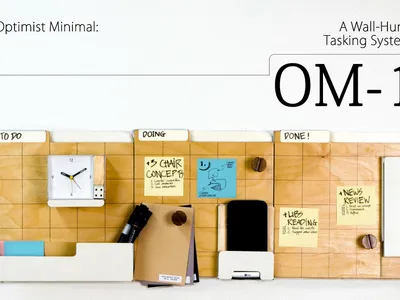
Om-1: A Wall-Hung System That Moves Your Workspace Off the Desk
Modular plywood boards, magnetic pegs, and utility elements migrate clutter from the horizontal surface to the vertical plane.

Explore Urban Infrastructure Competitions
Discover active competitions in this discipline

Challenge to reimagine the Iron Throne

Photograph architecture without architects

Illustrate the lost glory of Angkor Wat - Render Challenge

Design challenge to reuse E-waste
Comments (0)
Please login or sign up to add comments
No comments yet. Be the first to comment!