

The Swarm: A Mycelium Megastructure for Repopulating a Post-Apocalyptic Earth
A beehive-inspired colony built from genetically modified mycelium deploys capsules to detoxify ecosystems over a 600-year recovery timeline.


What if the architecture of human survival looked less like a bunker and more like a beehive? The Swarm proposes a circular megastructure housing 160 initial inhabitants, built from genetically modified mycelium, that operates as a self-sufficient colony capable of deploying smaller capsules to purify a ravaged Earth. It is speculative architecture at its most disciplined: every system, from rainwater harvesting to a 300 m² community garden simulating four seasons, serves the singular goal of guiding humanity back to a habitable planet over an estimated 600-year timeline.
Designed by Kaja Lewandowska, Julia Michalska, and Ilona Iskrzyńska, The Swarm was a People's Choice Award entry in the Architecture of the Apocalypse competition. The project refuses the usual post-apocalyptic tropes of fortress walls and scarcity rationing. Instead, it frames survival as an act of ecological reciprocity: the colony exists not just to protect its residents but to actively heal the landscape around it.
Domed Colonies Scattered Across a Recovering Landscape

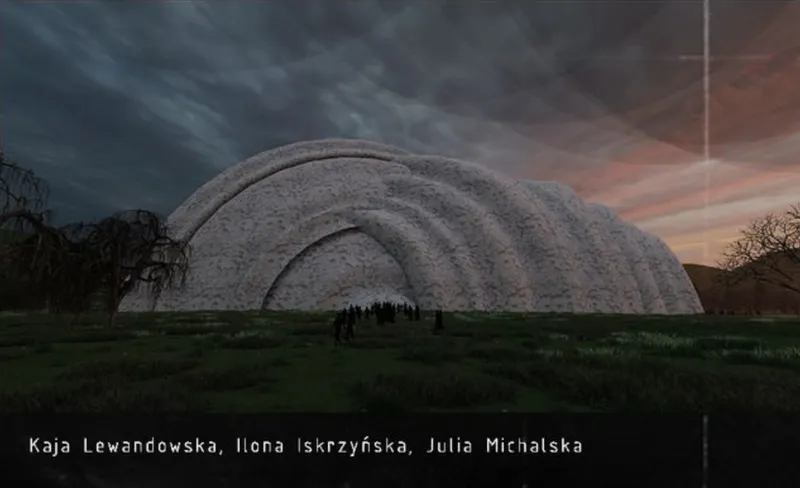
The renderings show the Main Unit as a ribbed dome set within a valley flanked by mountains, its form softened by the grassland surrounding it and the silhouetted human figures that give it scale. Across multiple atmospheric conditions, from dramatic cloud cover to the amber glow of dusk, the structure reads as something grown rather than built. That reading is intentional. The mycelium construction decomposes without environmental harm, enriches the soil beneath it, and allows the form to adapt to terrain over time. The cocoon-like geometry is not aesthetic posturing; it is a direct consequence of a material that literally grows.
The project operates in three distinct phases: landing the Main Unit, deploying capsules for ecosystem purification, and eventually dispersing new human colonies outward, like bees leaving the hive. The valley siting visible in these views is strategic. It positions the megastructure within a protected topography while giving the capsules access to varied terrain for their two-week decontamination missions across 50 km² zones.
A Starlit Biosphere at the Water's Edge

Seen at night beside a body of water under a dense field of stars, the Main Unit reveals its relationship to the broader ecology it is designed to restore. The capsules that deploy from this structure are engineered to fly, float, or cling to mountainsides, releasing organic materials that detoxify soil and water. The proximity to water in this rendering is not accidental. Rainwater harvesting and purification form a critical loop within the Main Unit's life support systems, and the capsules' missions prioritize hydrological recovery in damaged zones. The image conveys a stillness that belies the intensity of the environmental work the structure facilitates.
Radial Logic: Ten Departments Inside a Circular Plan
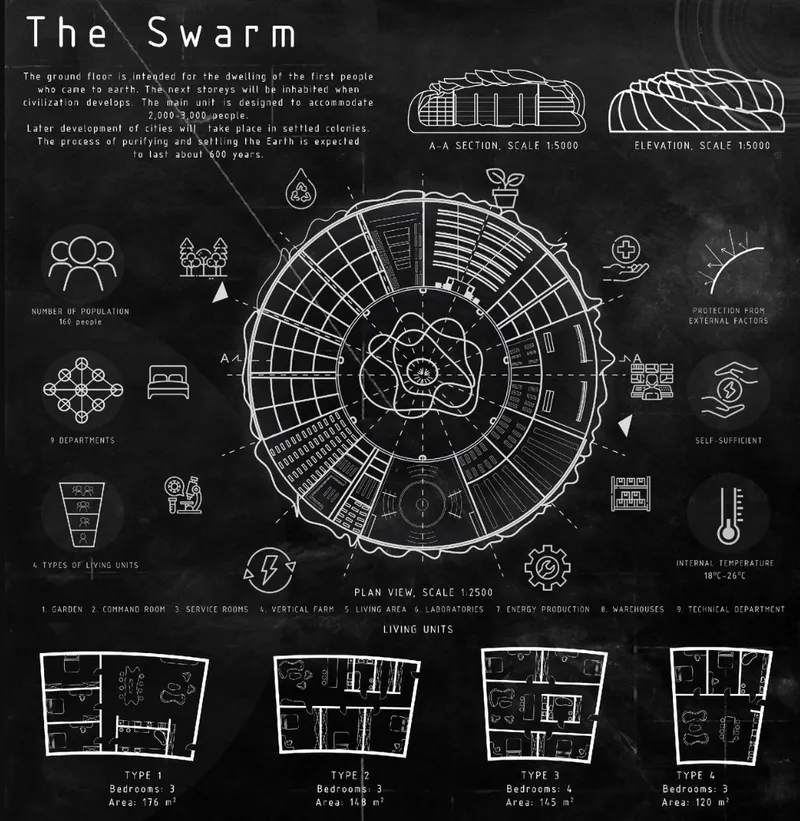
The plan drawing dissects the Main Unit's nine floors into a radial diagram of ten departments, each represented by icons that communicate function at a glance. A command room occupies the operational core, flanked by laboratories for Earth sample research and chemical testing. Four distinct residential module types accommodate the initial 160 residents, while a vertical farm and warehouse system ensure food and supply continuity. The service sector houses clinics and essential services, and a dedicated energy unit produces clean, CO₂-free power. The closed-loop biosphere logic is legible in the plan itself: every department feeds into or draws from another, eliminating waste streams.
The circular geometry is more than organizational convenience. With a maximum capacity of 3,000 people as Earth heals, the structure functions as a seed for future urban expansion. The radial divisions allow modular growth without compromising the closed-loop integrity of the original systems. It is urban planning conceived not for a decade but for six centuries.
A 300 m² Garden That Cycles Through Four Seasons

Perhaps the most emotionally resonant element of The Swarm is its community garden: a 300 m² interior courtyard that simulates spring, summer, autumn, and winter within the confines of the megastructure. The four renderings show the same space transformed by seasonal light, foliage density, and ground cover, from the green abundance of spring to the bare branches and snow of winter. For residents who may never have experienced a natural season on Earth, this space serves as both psychological anchor and living memory. It is a park, yes, but it is also a promise that the cycles being simulated indoors will one day resume outside.
The seasonal simulation is not purely ornamental. It connects to the vertical farm and laboratory programs, providing a controlled environment for studying plant growth cycles and testing soil rehabilitation techniques drawn from the capsules' field missions. The garden sits at the intersection of well-being and science, a characteristic overlap that defines much of The Swarm's programmatic thinking.
Why This Project Matters
Post-apocalyptic architecture competitions tend to produce two kinds of proposals: hardened survival bunkers or ethereal utopias disconnected from material reality. The Swarm occupies a rare middle ground. Its mycelium construction is grounded in real biomaterial research, its closed-loop systems follow established principles of ecological engineering, and its phased deployment strategy acknowledges that planetary recovery is measured in centuries, not election cycles. The 600-year timeline is not a weakness; it is the project's most honest assertion.
Lewandowska, Michalska, and Iskrzyńska demonstrate a sophisticated understanding of biomimicry that goes beyond formal imitation. The beehive metaphor structures not just the shape of the colony but its operational logic: a central unit sustains the collective while smaller agents venture out to gather resources and prepare new territory. Architecture here is not a static shelter. It is a living system with agency, one that decomposes to feed the ground it lands on and grows to accommodate the civilization it nurtures back into existence.
View the Full Project
About the Designers
Designers: Kaja Lewandowska, Julia Michalska, Ilona Iskrzyńska
Enter a Design Competition on uni.xyz
uni.xyz runs architecture and design competitions year-round that reward proposals with spatial conviction and real site intelligence.
Project credits: The Swarm by Kaja Lewandowska, Julia Michalska, Ilona Iskrzyńska rchitecture of the Apocalypse (uni.xyz).


Popular Articles
Popular articles from the community


Manzana Morphosis: Stretching Barcelona's Grid into a Living Landscape for 2050
A radical reworking of the Eixample manzana turns density into a tool for generous public space, vertical ecology, and environmental performance.


ETEH Reworks the Shared Spaces of São Domingos School in Brazil Around Timber, Color and Hanging Plants
At São Domingos School in Brazil, 436 m² of hall, refectory and library are recast with timber joinery, a yellow and blue code and trailing greenery.

The Amber Palace Opera: A Geological Fiction Surfaces on Tallinn's Baltic Waterfront
Pierre Brillard reimagines a Baltic legend as a public landscape, opera house, and waterfront promenade rooted in Tallinn's coastal identity.

Cube Design Draws an Ecological Corridor Between Two Shenzhen Hills with the Nankai Building
Beside Shenzhen's container docks, the Nankai Building pairs stacked balconies with a climbing green screen to connect two hillsides across its height.

Similar Reads
You might also enjoy these articles

Vereda Arquitetos Renovates a 40-Square-Meter Apartment Inside Niemeyer's Copan Building
A compact unit in São Paulo's most iconic residential tower gets a material overhaul that pairs exposed concrete with bold blue Formica.

Shakur's House: Exposed Brick as an Interior Organiser in a 168 m² Mashhad Residence
Brick moves indoors in this Mashhad residence, where masonry walls, glass partitions and teal planes sequence a compact home without closing it off.

Day and Night Park: A Time-Based Urban Newsstand in Beijing
A temporary urban newsstand in Beijing blending travel, light, and reading through poetic colors, compact form, and community-focused design.

Modernist Patio Renovation in El Masnou, Barcelona by Oliver Segura Arquitectura + Cebrià Arquitectura
Modernist patio renovation blending tradition and innovation with a movable pool, leveled floors, and Catalan materials in El Masnou.

Comments (0)
Please login or sign up to add comments
No comments yet. Be the first to comment!