
The White Piano: A Grand Piano Reimagined as a Waterfront Cultural Pavilion in Rio
A 10,000 square meter cultural building in Flamengo takes its flowing form from the silhouette of a grand piano, bridging ocean and city.


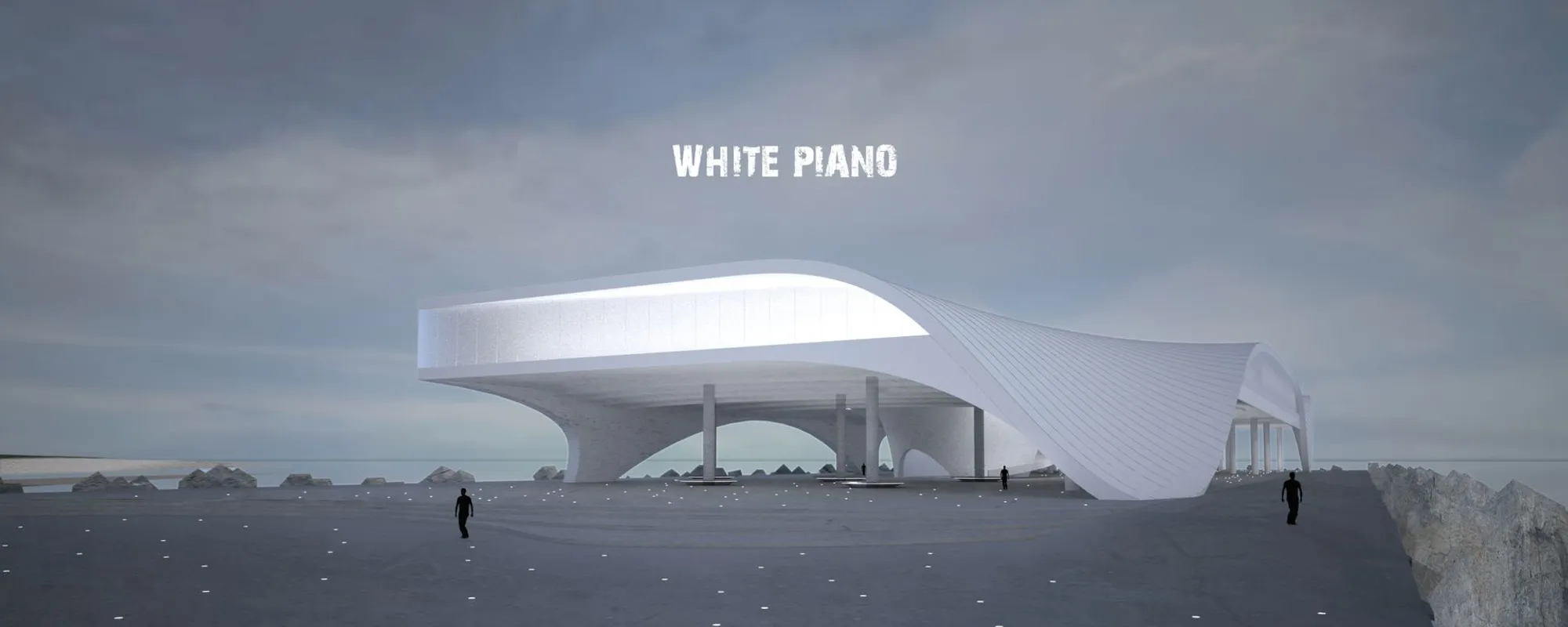
A grand piano, stretched to the scale of a city block and set at the edge of Guanabara Bay, becomes a public library, lecture hall, and waterfront plaza all at once. The White Piano takes one of Western culture's most recognizable silhouettes and transforms it into an undulating roof canopy that hovers 15 meters above the water, its curves reflecting in shallow pools below. The result is a building that reads as both monument and invitation: monumental in profile, permeable at ground level.
Designed by Zhang Yiran, the project was shortlisted in the Athenaeum competition, which challenges participants to conceive new models for public knowledge spaces. Sited on a 20,000 square meter plot in Rio de Janeiro's Flamengo Precinct, near existing museums and plazas, the building occupies 10,000 square meters and positions itself as a cultural gateway between the dense urban fabric of the city and the open expanse of the Atlantic.
A Roof That Floats Above the Water's Edge
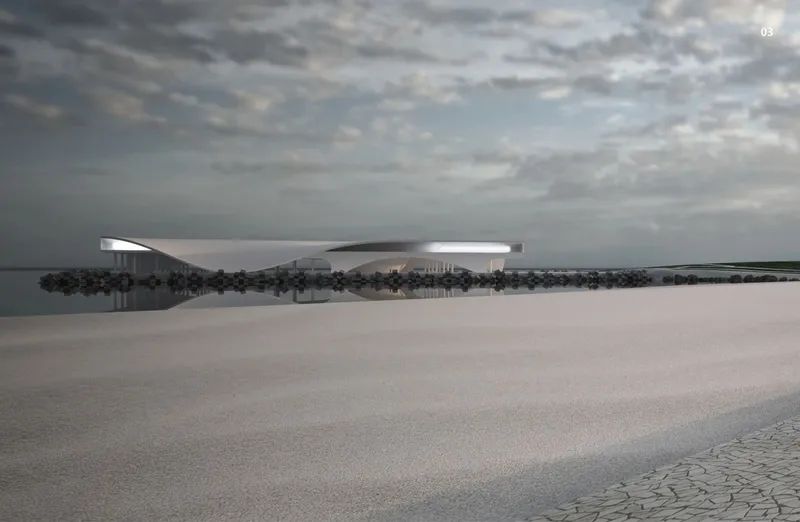
The defining gesture of the White Piano is its roof: a continuous, wave-like canopy that rises and dips in long curves, echoing both the lid of a grand piano and the movement of ocean swells. From across the bay, the roof reads as a single sweeping form. Up close, the undulations create distinct spatial zones beneath: higher vaults over public gathering areas, lower compressions above intimate reading rooms. A shallow reflective pool wraps the building's base, doubling the roof's profile in water and dissolving the boundary between architecture and landscape.
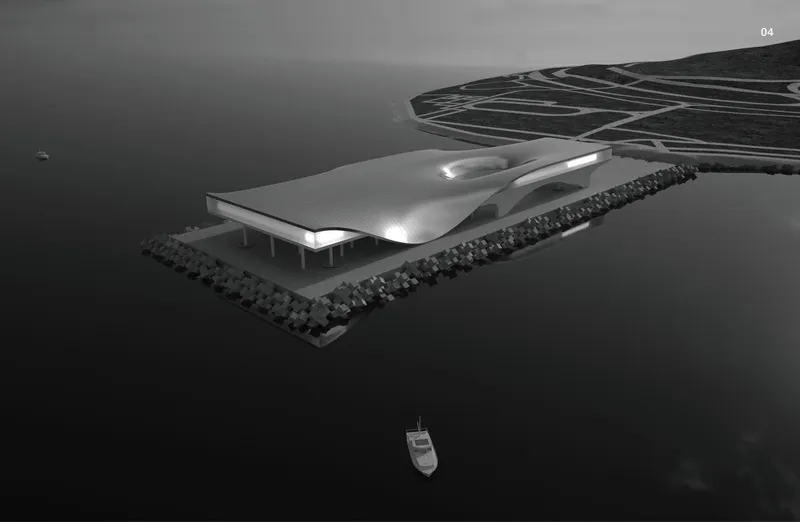
The aerial perspective reveals how the pavilion sits on a raised waterfront platform, its organic footprint contrasting sharply with the rectilinear street grid of Flamengo behind it. A small boat approaches the edge, suggesting that the design considers arrival not only from the road but from the water itself. The strategic positioning near cultural hubs in the precinct means the building functions less as an isolated object and more as a node in a larger civic network.
Framing the Bay: The View from the Waterfront
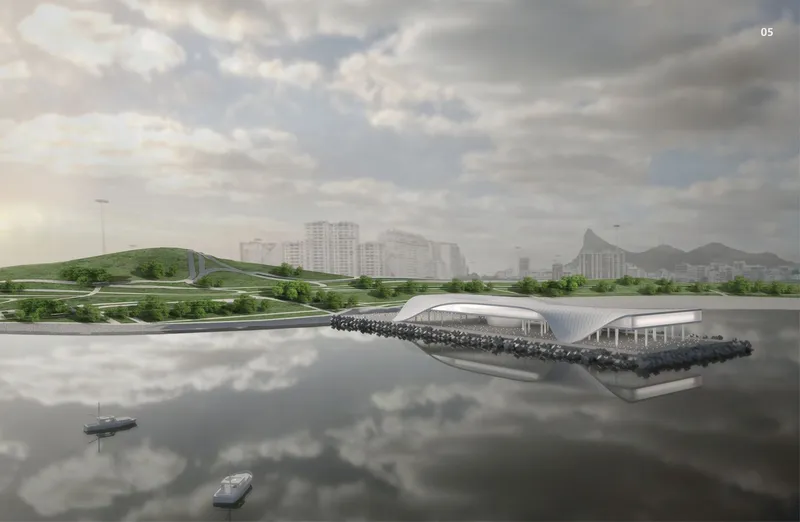
Seen from the water, the White Piano asserts its presence without competing with Rio's mountainous backdrop. The roof's white surface catches and scatters natural light, making the building shimmer against the skyline like a piece of origami set on the shore. Boats in the foreground establish scale: the building is substantial, but its flowing lines prevent it from feeling heavy. The facade beneath the roof appears largely glazed, suggesting transparency at the ground level that invites passersby inward. This tension between the solid, opaque canopy above and the open, permeable base below is a core architectural strategy, encouraging visitors to connect from surrounding roads and engage with the site effortlessly.
Sculptural Columns and Vaulted Ceilings Inside
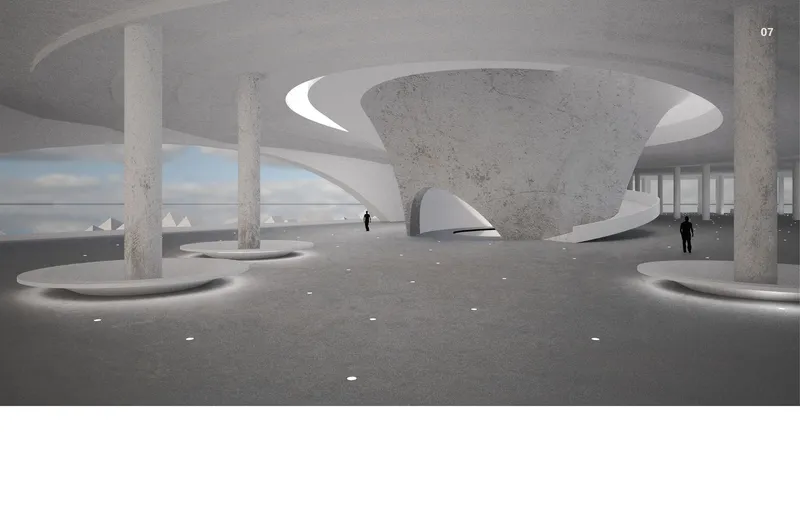
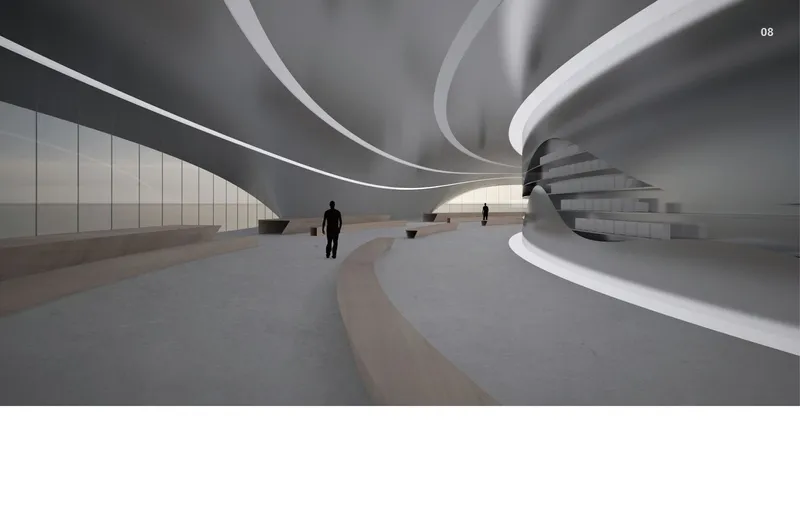
The interior reveals how the roof's curves translate into habitable space. Sculptural concrete columns branch upward into curved ceiling vaults, creating a forest-like structural rhythm that guides movement through the building. In the main hall, the ceiling arches open toward the waterfront through full-height glazing, pulling daylight deep into the plan and framing panoramic views of the bay. Two figures standing near the glass wall give a sense of the generous floor-to-ceiling height, confirming the 15-meter dimension stated in the concept.
A secondary corridor shows a different character: flowing ceiling forms compress into a more intimate scale, while a helical staircase spirals upward beside paneled storage walls. The programme here accommodates lecture halls, reading areas, reception spaces, and public zones, all connected by ramps and pathways that encourage continuous circulation rather than dead-end corridors. Natural ventilation strategies work in concert with these open pathways, drawing air through the building's cross-section and reducing reliance on mechanical systems.
From Model to Section: Structural Logic Exposed
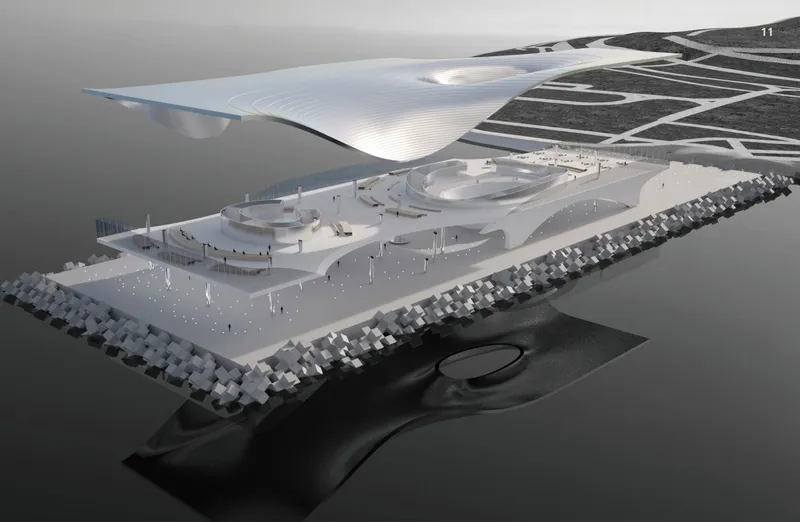
The physical model strips the project to its essentials: a curved canopy roof supported by a platform, bounded by a rock breakwater along the water's edge. The breakwater is not merely functional protection; it grounds the otherwise ethereal pavilion in the raw materiality of its coastal site. The model also shows the extent of the public plaza beneath and around the canopy, reinforcing the idea that this is as much an outdoor civic space as an enclosed building.
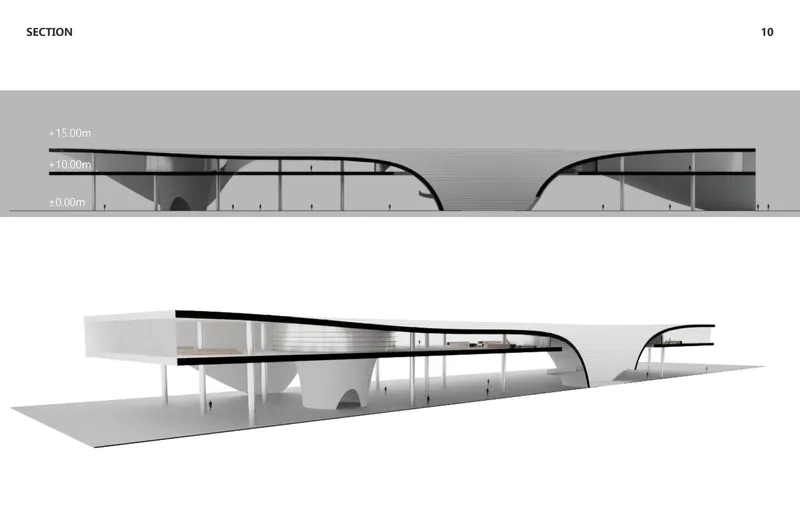
The section drawing makes the structural ambition legible. The roof is supported by a truss system that spans wide, column-free interiors at the lower levels, with glazed walls opening the ground floor to the surrounding plaza and waterfront. Multiple curved roof peaks create varied ceiling heights within, allowing the programme to differentiate spatially: tall, cathedral-like volumes for lecture halls and lower, sheltered zones for reading and study. The drawing confirms that the building's formal exuberance is not arbitrary; it is the direct expression of a structural and programmatic logic working together.
Why This Project Matters
The White Piano succeeds because it treats metaphor as a starting point rather than an endpoint. The grand piano silhouette is immediately legible, but the design moves beyond the gesture to address real questions about public space, coastal siting, natural ventilation, and programmatic variety. The 10,000 square meter building packs lecture halls, reading rooms, and open plazas into a single flowing form that connects to the street grid of Flamengo on one side and the open bay on the other. That dual orientation, toward city and toward water, is what makes the project feel genuinely public rather than merely iconic.
Zhang Yiran's entry demonstrates a confident command of form at scale, paired with an awareness of Rio de Janeiro's specific conditions: its oceanic climate, its culture of outdoor public life, and its tradition of bold, curvilinear architecture. In a competition asking how to house knowledge in the 21st century, the White Piano argues that a library can also be a plaza, a waterfront promenade, and a civic landmark. It is a generous proposition, and it earned its place on the Athenaeum shortlist.
View the Full Project
About the Designers
Designer: Zhang Yiran
Enter a Design Competition on uni.xyz
uni.xyz runs architecture and design competitions year-round that reward proposals with spatial conviction and real site intelligence.
Project credits: White Piano by Zhang Yiran Athenaeum (uni.xyz).



Popular Articles
Popular articles from the community


Co-Life: Senior Housing Design That Reconnects Older Adults With the City
Co-Life reimagines senior housing design through healing gardens, shared streets, workshops, and a sustainable community across generations.

Hill & Cross Opera: Sculptural Opera House Architecture Shaped by Tallinn’s Landscape and Identity
Hill & Cross Opera reimagines opera house architecture in Tallinn through its sculptural hill, civic plaza, glass wave and a luminous cross.

Co-life: Sustainable Architecture for Age-Friendly Community Living
Co-life reimagines sustainable architecture for seniors through courtyards, rammed earth, shared gardens, and spaces designed for belonging.

Play: Fragments of Their World
Familiar architecture becomes modular playground design, creating safe spaces where displaced children can learn, connect, imagine and play.


Similar Reads
You might also enjoy these articles

Day and Night Park: A Time-Based Urban Newsstand in Beijing
A temporary urban newsstand in Beijing blending travel, light, and reading through poetic colors, compact form, and community-focused design.

Modernist Patio Renovation in El Masnou, Barcelona by Oliver Segura Arquitectura + Cebrià Arquitectura
Modernist patio renovation blending tradition and innovation with a movable pool, leveled floors, and Catalan materials in El Masnou.
Alto Residencial Coop: Cooperative Housing Development in Santiago de Compostela by Carbajo Barrios Arquitectos
A linear cooperative housing complex blending white volumes and perforated metal façades, enhancing community living, natural light, privacy, and urban integration.
Vil Genis School by BPA ARCHITECTURE – Massy, France
Vil Genis School in Massy, France, features sustainable design, south-facing classrooms, community integration, accessible spaces, and modern educational architecture.





Comments (0)
Please login or sign up to add comments
No comments yet. Be the first to comment!