

This is Not a Subway, This is the FUNWAY by Selin Demirel
Prologue Pulse: Analyzing Urban Rhythms with Homo Ludens


In the bustling metropolis, where every day is a symphony of movement and sound, "This is not a subway, this is the FUNWAY" emerges as a transformative urban project by Selin Demirel. This innovative composition consists of two distinct parts: Prologue Pulse and Epilogue Funway. While Prologue Pulse delves into the intricate rhythms of urban life through the lens of Johan Huizinga’s seminal work, Homo Ludens, Epilogue Funway reimagines our daily commutes, proposing a new, playful way to navigate the city inspired by the works of Constant.

The Essence of Play in Urban Life
Prologue Pulse, as its name suggests, serves as a prelude to the project, capturing the pulse of urban life by integrating the concept of ‘ludus’ – the play element in culture. Drawing from Huizinga’s assertion that Homo Ludens, or "Man the Player," is as fundamental to human identity as Homo Sapiens or Homo Faber, the project explores how play can be a vital component in the regulation of urban life and its inherent rhythms. Music and play, both extraordinary tools in harmonizing urban life, form the backbone of this analysis. The city, akin to a polyphonic symphony, becomes a stage where human interactions play out as a grand performance.

Urban Rhythm and Homo Ludens
Huizinga’s Homo Ludens introduces the notion that humans are inherently players. He suggests that play is as significant as reasoning and making in defining human existence. This concept of play, or ludus, permeates Prologue Pulse, highlighting its importance in shaping the urban environment. As Sora Adhitya’s Musical Cities proposes, urban rhythm – the approximate repetition of urban interactions at a spatial-temporal scale – is a natural phenomenon influenced by both organic and human-made processes.
Epilogue Funway: Redefining the Commute
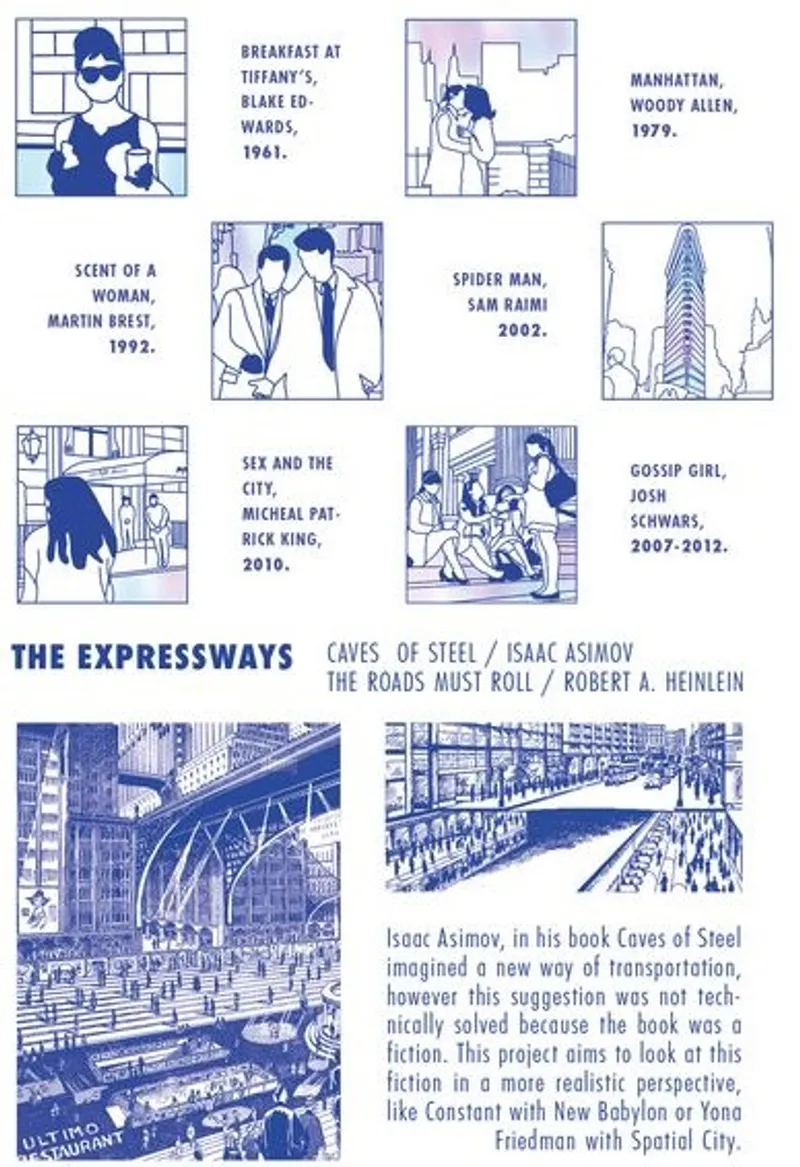
Shifting from analysis to application, Epilogue Funway reimagines the daily commute. Inspired by the fictional expressways of Isaac Asimov’s Caves of Steel, this project introduces a novel means of transportation through multi-layered, multi-speed conveyor belts. The Funway transforms the mundane act of commuting into a meaningful, playful experience. It proposes converting idle commuting time into productive and enjoyable moments, aligning with the ethos of creating a city that not only facilitates movement but also fosters joy and creativity.

Funway: Infrastructure and Interaction
The Funway is a multi-faceted infrastructure that integrates various design elements to enhance the commuting experience. It includes funstations, which serve as the core hubs featuring technical voids and food stands, funwalks – conveyor belts of varying speeds, and funstops, where the act of ‘making’ occurs. These components are strategically placed to create engaging, interactive zones within the city.
Zoom Points: Integrating Play with the Cityscape
The concept of Zoom Points integrates the Funway with the city’s iconic landmarks. Each Zoom Point draws inspiration from its surroundings, extending its architectural program to enhance the urban experience. For instance, near St. Patrick’s Cathedral, high-end luxury stores inspire a funstop featuring the virtual distortion and destruction of building facades through interactive installations. Similarly, Duke Ellington’s Circle, known for its 24/7 dancing, features a sky/jazz club, merging underground funlines with above-ground activities.

Rhythmanalysis: Mapping Urban Happiness
Epilogue Funway also explores the correlation between urban rhythm and happiness. A rhythmanalysis conducted in Paris revealed that people with commutes within a 15-minute radius are generally happier and have more leisure time compared to those with longer commutes. This insight drives the Funway’s design, aiming to create time and space gaps that convert commuting time into opportunities for play and interaction.

The Vision of Funway: A Playful Urban Future
Selin Demirel’s Funway project envisions a future where commuting is not just a necessity but a delightful journey. By altering the speed and nature of urban mobility, Funway transforms the daily grind into an opportunity for creativity and enjoyment. In a consumerist world, finding moments of play and joy is essential, and Funway offers a unique approach to achieving this by integrating play into the very fabric of urban infrastructure.
"This is not a subway, this is the FUNWAY" redefines urban commuting by blending the concepts of play, rhythm, and mobility. It transforms the city into a playground where every journey is an adventure, encouraging inhabitants to embrace the joy of movement and interaction in their daily lives.


Popular Articles
Popular articles from the community


longwave studio Reorganizes a 112 m² Tainan Apartment Around the Daily Routines of a Family and Two Cats
In Tainan, Taiwan, birch plywood, rust-red furniture and a freestanding plaster wall link arrival, storage, work and family life in one apartment.

Jaramillo Van Sluys Arquitectura and Urbanismo Turn a Demolished Registry Lot in Quito into an Orchard Plaza
In Quito's Centro Histórico, a 2,800 m² plaza exposes the San Agustín convent wall and redraws its lost Augustinian orchard in volcanic stone.

U.GA Architects Wraps an Oval Rooftop Pool in Curved Board-Formed Concrete on Busan's Jeollidan-gil
In Busan's Jeonpo-dong, a 454 m² mixed-use block stacks a neighborhood facility, guest rooms and an oval rooftop pool inside spiraling concrete walls.

GROUP A Strips a 1969 Rotterdam Harbor Headquarters to Its Frame and Wraps It in Timber Louvers
In Rotterdam's M4H harbor district, Ferro Offices reuses a 1969 frame, adds one timber storey and reaches BREEAM-NL Outstanding.

Similar Reads
You might also enjoy these articles


Vereda Arquitetos Renovates a 40-Square-Meter Apartment Inside Niemeyer's Copan Building
A compact unit in São Paulo's most iconic residential tower gets a material overhaul that pairs exposed concrete with bold blue Formica.

Shakur's House: Exposed Brick as an Interior Organiser in a 168 m² Mashhad Residence
Brick moves indoors in this Mashhad residence, where masonry walls, glass partitions and teal planes sequence a compact home without closing it off.

Day and Night Park: A Time-Based Urban Newsstand in Beijing
A temporary urban newsstand in Beijing blending travel, light, and reading through poetic colors, compact form, and community-focused design.

Modernist Patio Renovation in El Masnou, Barcelona by Oliver Segura Arquitectura + Cebrià Arquitectura
Modernist patio renovation blending tradition and innovation with a movable pool, leveled floors, and Catalan materials in El Masnou.

Explore Urban Design Competitions
Discover active competitions in this discipline

Design challenge to equip cities with modern furniture

Challenge to reimagine the Iron Throne

Photograph architecture without architects

Illustrate the lost glory of Angkor Wat - Render Challenge
Comments (0)
Please login or sign up to add comments
No comments yet. Be the first to comment!