
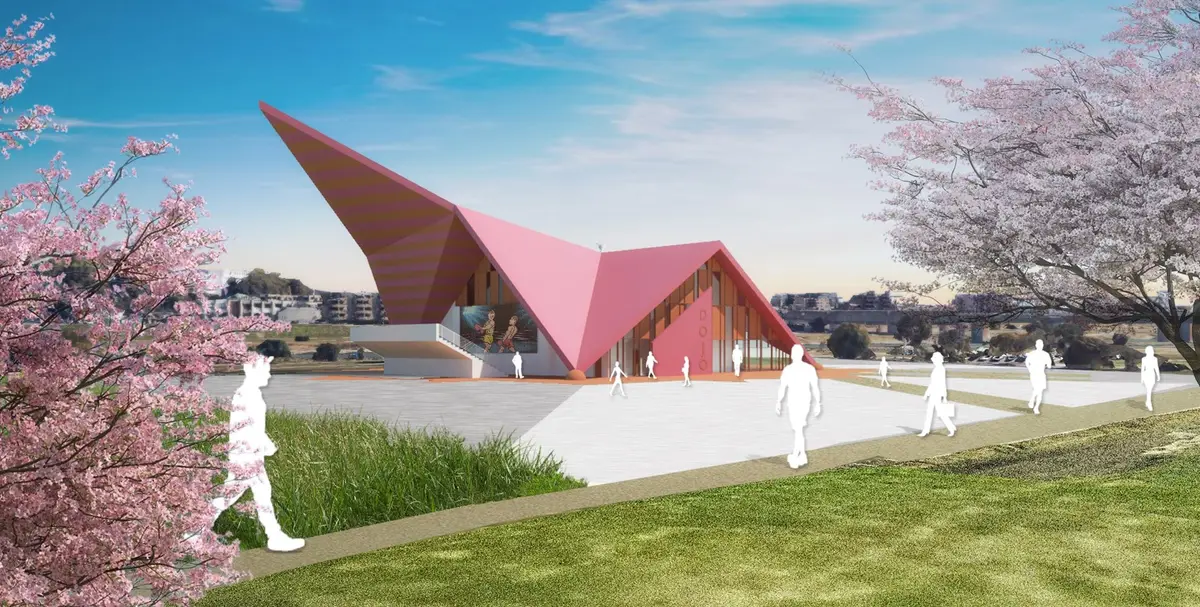
Tokyo Dojo 2020: A Folded Pink Roof That Turns a Riverside Fight Venue into a Public Landmark
Simon Rocheleau's shortlisted entry folds a 22-metre origami roof over a sunken hall, staging events for 204 inside and 180 outdoors.


Most sports venues hide their spectacle behind blank walls and charge for the view. Tokyo Dojo 2020 does the opposite. Its pink roof folds upward to a 22-metre peak like a sheet of creased paper, broadcasting the building's purpose to the riverbank long before anyone steps inside, and it splits every event between an indoor hall and an open-air terrace. The core idea is simple and quietly radical: a fight venue that behaves like a public square.
Designed by Simon Rocheleau and shortlisted in the Tokyo Dojo competition, the proposal takes on a brief that asks for two things that often pull against each other: a landmark that draws visitors in, and a flexible, immersive room that works equally well for participants and spectators. Rocheleau sets the project near a riverfront lined with cherry trees and answers the brief with a hybrid programme of sports matches, film screenings and live performances, held together by one emphatic piece of geometry.
An Origami Fold That Borrows Its Colour from the Cherry Trees
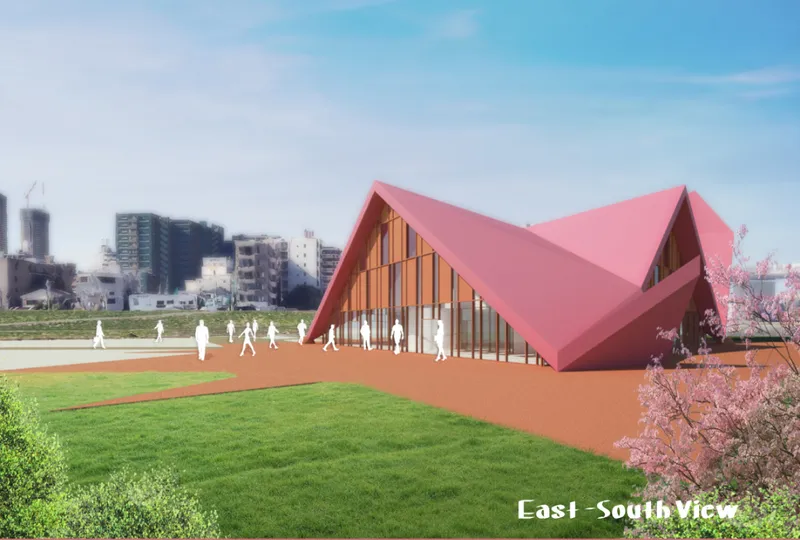
The approach view makes the argument at once. A pink folded roof hovers over a timber-clad, glazed facade, while figures cross a red gravel plaza beside a flowering cherry tree. The origami logic is legible from the ground: planes crease and lift, so the volume reads as a single gesture yet keeps shifting as you walk around it. Rocheleau describes the form as both simple and complex, and the render bears that out. A child could sketch the silhouette from memory, but each face catches the light differently.
The colour is the boldest decision and the smartest one. Pink is an unusual choice for a combat venue, and that friction is the point. By echoing the blossoms along the river, the roof ties a loud civic object to its landscape instead of fighting it. The timber and glass below keep the base calm and porous, so the drama stays overhead and the ground plane stays welcoming.
One Event, Two Audiences: The Hall and the Terrace
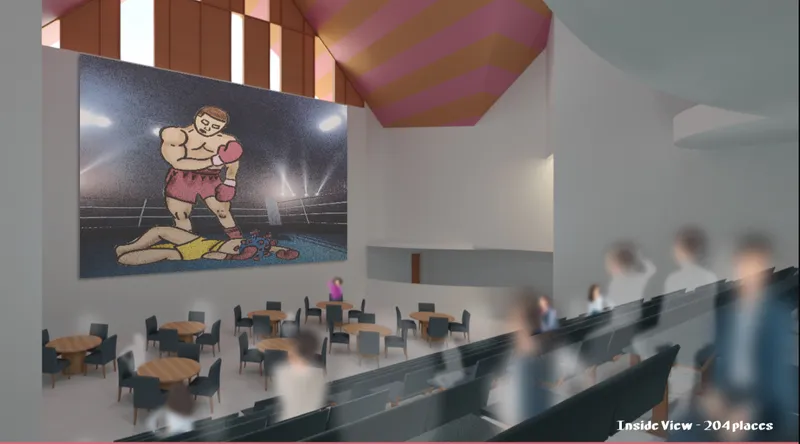
Inside, the hall seats approximately 204 visitors across an amphitheatre with balcony seating and cabaret-style arrangements. The interior render shows pews alongside round tables, a large boxing mural acting as a backdrop, and a striped pink and orange ceiling that carries the exterior's identity indoors. Mixing tiered seating with tables is a shrewd move: the same room can host the focused tension of a bout, the slower rhythm of a screening, or the social looseness of a performance with drinks. Circulation links reception, lounges and viewing zones, and the master space is planned so visitors take in the full volume the moment they enter.
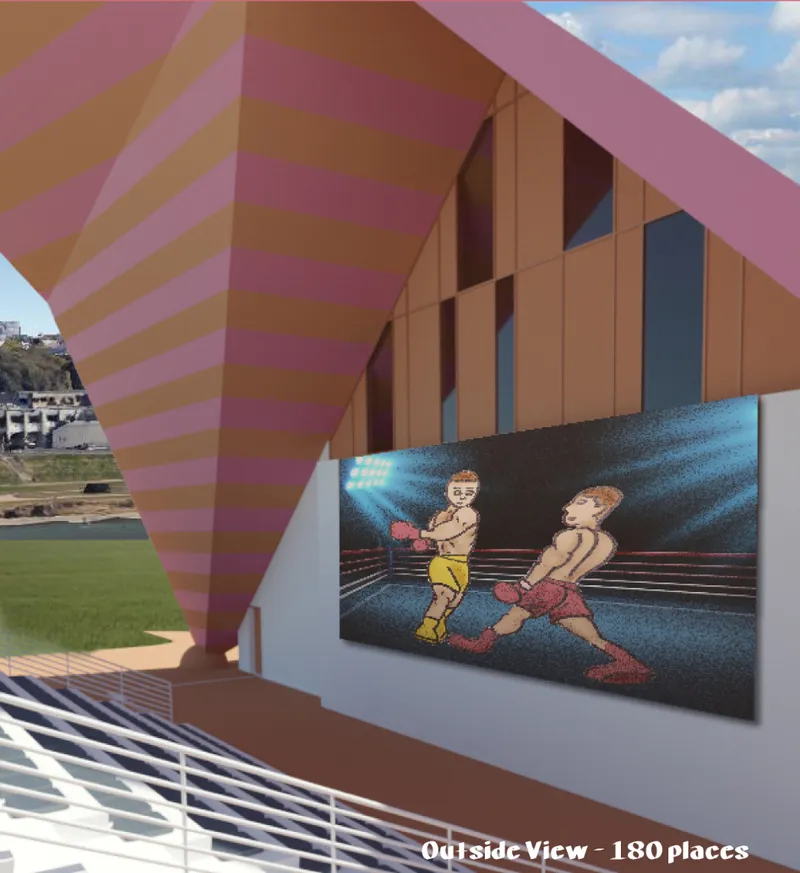
The second image is where the project earns its civic ambition. An outdoor viewing platform with railings and tiered seating holds 180 people, facing its own screen beneath a fold of the striped roof. This dual-screen strategy lets indoor and outdoor audiences watch the same event at once, almost doubling capacity without enlarging the enclosed hall. More importantly, it lowers the threshold: someone passing through the plaza can drift onto the terrace and become part of the crowd. The open plaza then extends that invitation to informal gatherings and community use on days with nothing scheduled.
A Sunken Hall Under a Column-Free Span
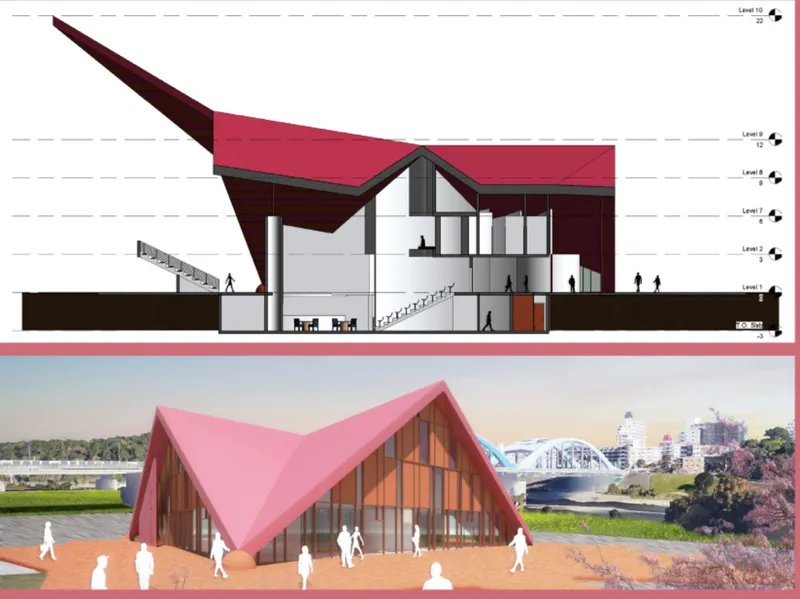
The section explains how the roof's theatre becomes usable space. Part of the programme is pushed below ground, and the drawing shows the folded red roof sweeping over a mezzanine and stair. Sinking the hall does two jobs: it stabilises the structure, and it gives the main room a sense of enclosure and protection, the feeling of descending into an arena rather than walking into a shed. Above it, the roof spans the primary volume without columns, leaving the floor free to be rearranged for each type of event.
The roof also manages light. Rocheleau alternates opaque and transparent surfaces, so sunlight falls into the hall in shifting patches and the atmosphere changes across the day. Inside, a neutral palette keeps sightlines clear during events, letting the bold colour stay on the outside where it does civic work. The rendered view beneath the section, with an arched bridge behind the pink building, confirms the riverside setting and how the peak registers against the wider skyline.
Why This Project Matters
Tokyo Dojo 2020 shows how a single formal idea can carry an entire brief. The origami fold supplies the landmark, shelters the terrace, spans the hall without columns and filters daylight, while the sunken floor gives the room its intensity. Few competition entries let one move do this much, and the discipline is what makes the project persuasive rather than merely striking.
Its larger lesson concerns access. By pairing 204 seats indoors with 180 on an open terrace and a public plaza, Rocheleau treats spectatorship as something shared with the street, not sold behind a wall. For a city that hosts global sporting events, that is a useful provocation: venues can be generous to passers-by, rooted in their landscape through something as simple as a colour, and still deliver the focused drama an audience comes for.
View the Full Project
About the Designers
Designer: Simon Rocheleau
Enter a Design Competition on uni.xyz
uni.xyz runs architecture and design competitions year-round that reward proposals with spatial conviction and real site intelligence.
Project credits: Tokyo Dojo by Simon Rocheleau Tokyo Dojo (uni.xyz).


Popular Articles
Popular articles from the community


Aquadapt: An Underwater Habitat That Rewrites Its Rooms by the Hour
Curved modules ring the seabed while one shell shifts from breakfast room to cinema, farm and football pitch as residents' needs change.

The Amber Palace Opera: A Geological Fiction Surfaces on Tallinn's Baltic Waterfront
Pierre Brillard reimagines a Baltic legend as a public landscape, opera house, and waterfront promenade rooted in Tallinn's coastal identity.


Cube Design Draws an Ecological Corridor Between Two Shenzhen Hills with the Nankai Building
Beside Shenzhen's container docks, the Nankai Building pairs stacked balconies with a climbing green screen to connect two hillsides across its height.

ETEH Reworks the Shared Spaces of São Domingos School in Brazil Around Timber, Color and Hanging Plants
At São Domingos School in Brazil, 436 m² of hall, refectory and library are recast with timber joinery, a yellow and blue code and trailing greenery.

Similar Reads
You might also enjoy these articles
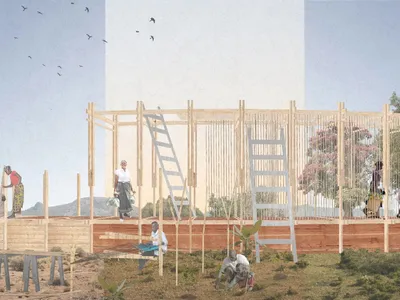
Healing Façade: A Modular Chapel System That Restores Ethiopia's Sacred Forests
Winner of the Eco-Chapel competition, this circular timber façade collects water from air to rebuild soil and reforest degraded Ethiopian landscapes.
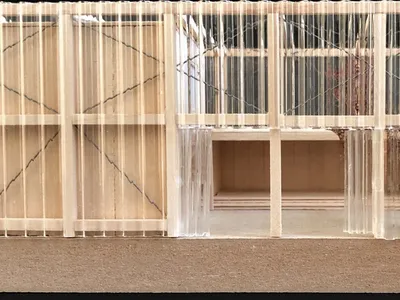
Kaffeebühnen: Where Coffee Shop Architecture Becomes a Civic Stage in Vienna
A linear sequence of timber boxes, transparent shells, and open yards turns the Viennese café tradition into a public performance space.
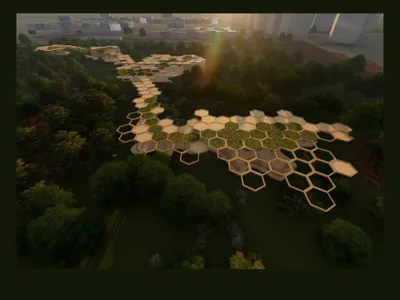
Eco Chapel: A Modular Forest Pavilion That Grows Like the Landscape It Protects
Hexagonal timber modules weave through existing trees, turning a chapel into a living system for prayer, education, and reforestation.


Urban Forest: A Vertical Ecosystem for 5,000 Workers in Singapore's Changi Business Park
Radially stacked pods and layered green decks turn a 7-acre plot into 47 acres of ecological workspace projected for 2040.

Explore Urban Design Competitions
Discover active competitions in this discipline

Design a brochure to showcase the effects of the technosphere

Challenge to illustrate ‘A tale of Two Cities’

Deconstructivism - Illustration Design Challenge
Comments (0)
Please login or sign up to add comments
No comments yet. Be the first to comment!