

Tokyo Meta Tower: Metabolic Architecture Meets Hyper-Dense Urban Evolution
Simeon Chua's shortlisted tower reimagines Tokyo's urban fabric through modular, ever-evolving structures rooted in metabolist principles.


Tokyo resists being captured in a single frame. Hyper-dense, always moving, always mutating, the city's urban fabric defies any fixed reading. So what happens when you design a building that refuses to be fixed too? The Tokyo Meta Tower takes that restlessness seriously, proposing a multi-layered structure that functions less as a finished object and more as an incubator: a place where the past, present, and future aspects of the city can connect, interact, and reconfigure over time. It draws directly from the metabolist tradition, treating architecture not as a static monument but as a living organism capable of evolving alongside the city it inhabits.
The project is a shortlisted entry in the Di - Generic Cities: Tokyo competition, designed by Simeon Chua. It merges tradition with futuristic adaptability, engaging with the principles of Void Metabolism pioneered by architects such as Kisho Kurokawa. Where those earlier metabolists imagined capsule cities and plug-in megastructures, Chua translates the impulse into a contemporary tower that addresses Tokyo's pressing need for adaptable, sustainable density.
Four Generations of Residential Form
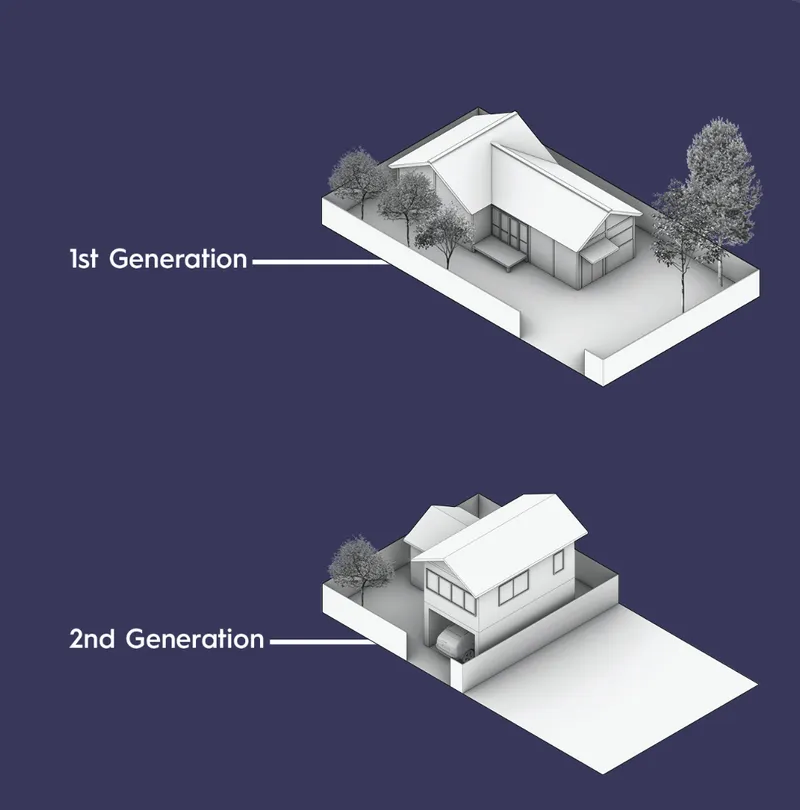
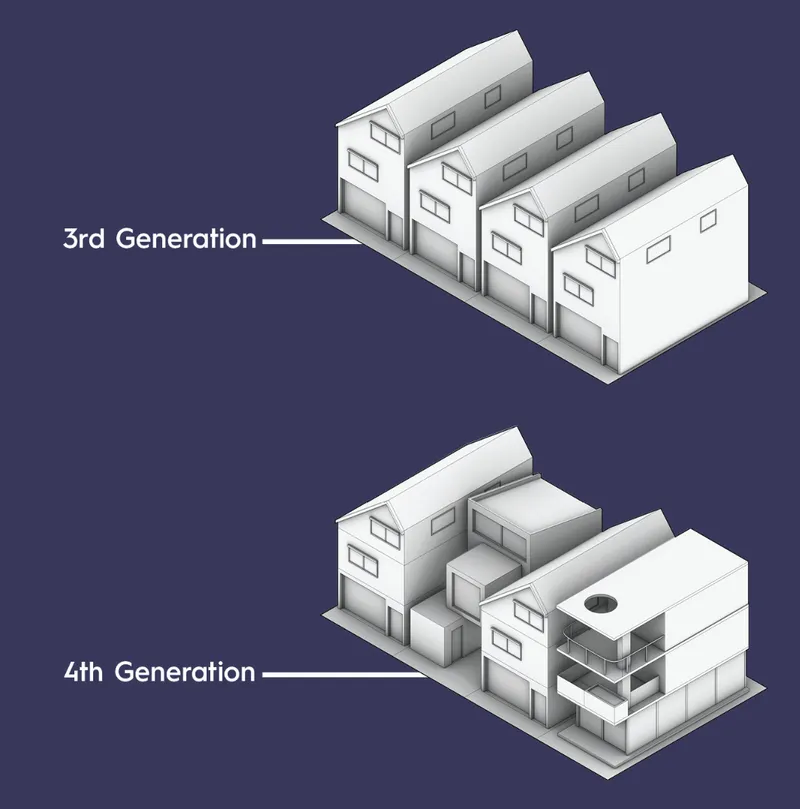
The project begins by reading Tokyo's housing evolution as a generational sequence. The first pair of isometric drawings traces two early generations of residential forms: low-rise, landscaped platforms that suggest a domestic scale still tied to the ground. The second pair escalates sharply. Third and fourth generation typologies pile on density and complexity, compressing program and circulation into increasingly vertical configurations. This is not merely a historical survey; it is the project's argumentative backbone. By mapping how Tokyo's domestic architecture has intensified over time, Chua establishes the logic for a tower that treats density not as a problem to solve but as a condition to design with.
Capsules Around a Core: The Metabolist Engine

The axonometric diagram of the tower's structural logic is where the metabolist lineage becomes most legible. Modular capsule units stack around a central core, elevated above a podium on columns. The arrangement invites the obvious Kurokawa comparison, but what matters here is the proposition that individual units can be reconfigured or replaced as urban needs shift. The capsules are not ornamental gestures toward modularity; they are the building's organizational principle.
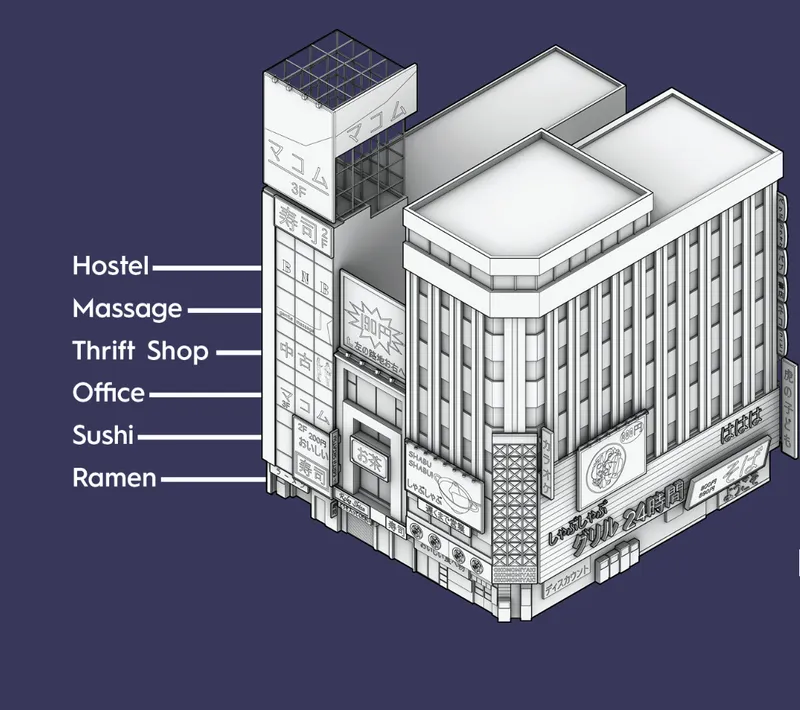
Adjacent to that structural diagram sits an isometric of a mixed-use corner building, with commercial and residential programs clearly labeled. This is the tower's urban interface: the place where the metabolic superstructure meets the street. Retail and public program occupy the ground and lower levels, ensuring the tower participates in the existing grain of the neighborhood rather than hovering above it as an autonomous object.
Concentric Connections: Situating the Tower in Tokyo's Network
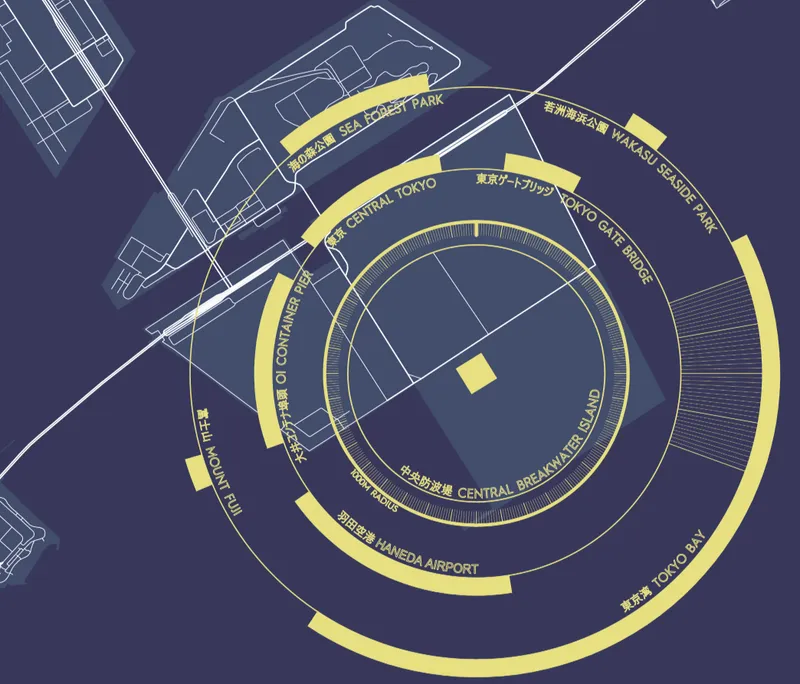
A concentric ring diagram maps the tower's relationship to Tokyo's broader transportation infrastructure, with labeled connections radiating outward to various destinations. The drawing makes an important argument: the Meta Tower is not a self-contained utopia. Its viability depends on its integration into the city's existing transit networks. Placing the project within these concentric rings of connectivity reinforces Chua's understanding that metabolic architecture succeeds only when it plugs into larger urban systems rather than attempting to replace them.
Exploded Plates: Reading the Tower Layer by Layer
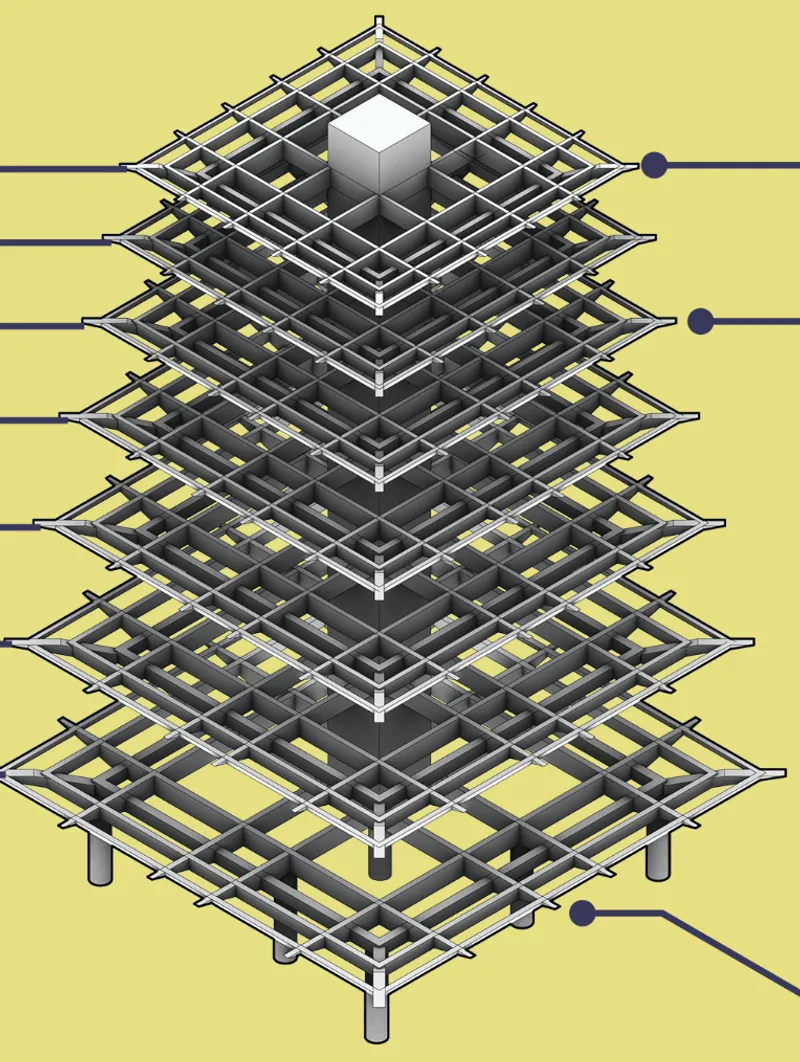


Three exploded axonometric drawings disassemble the tower into its constituent parts. The first reveals seven floor plates organized around a central core, all raised on cylindrical supports that liberate the ground plane. The second, set against a yellow background, emphasizes the vertical stacking and the relationship between each plate and the core. The third adds signage and rooftop elements, hinting at the building's public identity and the programmatic variety layered across its upper levels.
Read together, these three drawings articulate the tower as a kit of parts rather than a monolithic form. Each plate carries its own program, its own spatial character, and each can, in principle, be adapted independently. This is the metabolist promise made diagrammatically explicit: the building is designed to be incomplete, always open to the next iteration.
Why This Project Matters
The metabolist movement left Tokyo with some of its most iconic structures and some of its most instructive failures. Kurokawa's Nakagin Capsule Tower, demolished in 2022, proved that modularity without maintenance infrastructure becomes a monument to obsolescence. Chua's Meta Tower engages honestly with that legacy, proposing adaptability not as a slogan but as a structural and programmatic strategy. The generational housing analysis, the concentric transit mapping, and the exploded axonometrics all work together to argue that a truly metabolic building must be embedded in the city's networks, not just its skyline.
For a competition asking designers to grapple with Tokyo's generic urbanism, the Meta Tower offers a specific and grounded response. It does not romanticize density or flee from it. Instead, it treats the city's relentless transformation as the design brief itself, proposing a tower that is less a building than a process: always under construction, always becoming something else. That willingness to design for incompleteness, rather than perfection, is what gives the project its conviction.
View the Full Project
About the Designers
Designer: Simeon Chua
Enter a Design Competition on uni.xyz
uni.xyz runs architecture and design competitions year-round that reward proposals with spatial conviction and real site intelligence.
Project credits: Tokyo Meta Tower by Simeon Chua Di - Generic Cities: Tokyo (uni.xyz).




Popular Articles
Popular articles from the community


The Ocean Hive: Sustainable Architecture for a Self-Sufficient Civilization at Sea
The Ocean Hive imagines sustainable architecture at sea, where modular habitats, algae, wave power and ocean waste sustain a growing colony.

The Musturak Paradise: Senior Living Architecture for a Connected Future in Temara, Morocco
The Musturak Paradise reimagines senior living architecture in Temara via private homes, social spaces, culture, community, and shared care.

Hill & Cross Opera: Sculptural Opera House Architecture Shaped by Tallinn’s Landscape and Identity
Hill & Cross Opera reimagines opera house architecture in Tallinn through its sculptural hill, civic plaza, glass wave and a luminous cross.

The Earth Pod: 3D Printed Homes for Resilient Refugee Communities
The Earth Pod reimagines refugee housing through 3D printed homes made from clay, combining resilience, self-sufficiency, and rapid shelter.


Similar Reads
You might also enjoy these articles

Day and Night Park: A Time-Based Urban Newsstand in Beijing
A temporary urban newsstand in Beijing blending travel, light, and reading through poetic colors, compact form, and community-focused design.

Modernist Patio Renovation in El Masnou, Barcelona by Oliver Segura Arquitectura + Cebrià Arquitectura
Modernist patio renovation blending tradition and innovation with a movable pool, leveled floors, and Catalan materials in El Masnou.

Alto Residencial Coop: Cooperative Housing Development in Santiago de Compostela by Carbajo Barrios Arquitectos
A linear cooperative housing complex blending white volumes and perforated metal façades, enhancing community living, natural light, privacy, and urban integration.
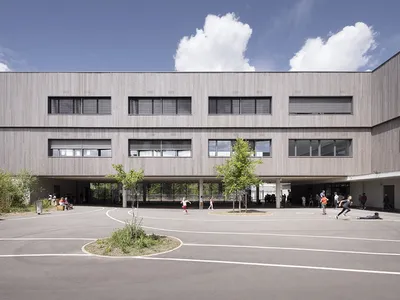
Vil Genis School by BPA ARCHITECTURE – Massy, France
Vil Genis School in Massy, France, features sustainable design, south-facing classrooms, community integration, accessible spaces, and modern educational architecture.


Explore Tokyo Competitions
Discover active competitions in this discipline


Challenge to design a portable theatre


Design Challenge - Contemporary interpretation of a religious complex


Challenge to design a portable music platform

Challenge to design an open learning module for the elderly
Comments (0)
Please login or sign up to add comments
No comments yet. Be the first to comment!