
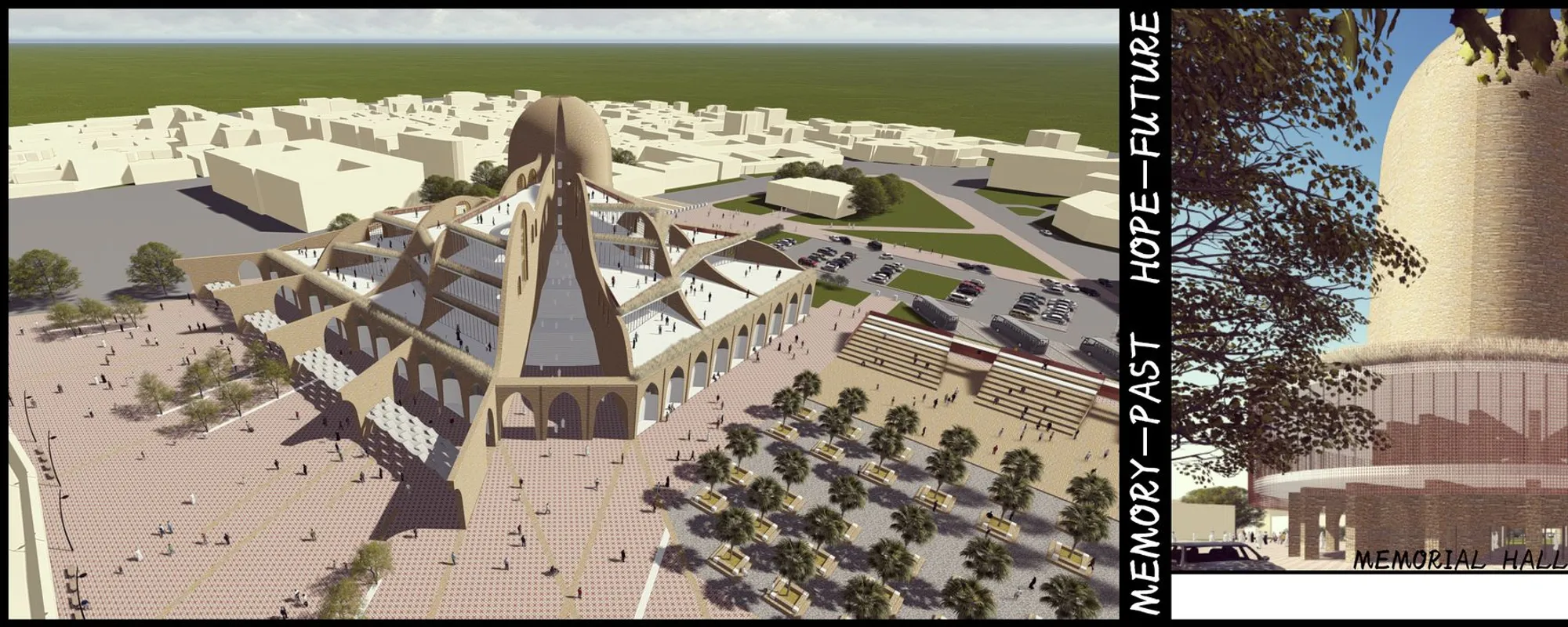
Tower of Hope: A Memorial Hall That Rebuilds Aleppo Through Cultural Architecture
A shortlisted entry for the Memory competition proposes a sanctuary of reflection, education, and hope on war-torn ground in Aleppo.


What does it mean to build a memorial in a city where destruction is not history but lived experience? In Aleppo, where entire neighborhoods have been reduced to rubble, the act of constructing a monument is inseparable from the act of reconstruction itself. The Memorial Hall, centered on a soaring Tower of Hope, proposes that architecture can hold two truths at once: it can honor irreversible loss while generating the civic energy needed to rebuild. The building does not mask its context. It absorbs it, using local brick, stone, and adobe to grow directly from the scarred landscape, its domes and pointed arches speaking the spatial language of the city's pre-war identity.
Designed by Wang Yibin and shortlisted in the Memory competition, the project is titled "Memorial Hall: Past and Future, Memory and Hope." The masterplan divides the site into two functional zones, tourism and spirituality, linked by a pedestrian-centric urban framework. At its core stands the Tower of Hope, flanked by a cultural exhibition hall that documents the timeline of Aleppo's urban reconstruction through models, archives, and immersive installations. The proposal is ambitious in scope, integrating environmental strategies, accessible design, and deep cultural symbolism into a single civic gesture.
Brick, Arches, and a Tilted Wall: Anchoring the Memorial in Local Material Culture
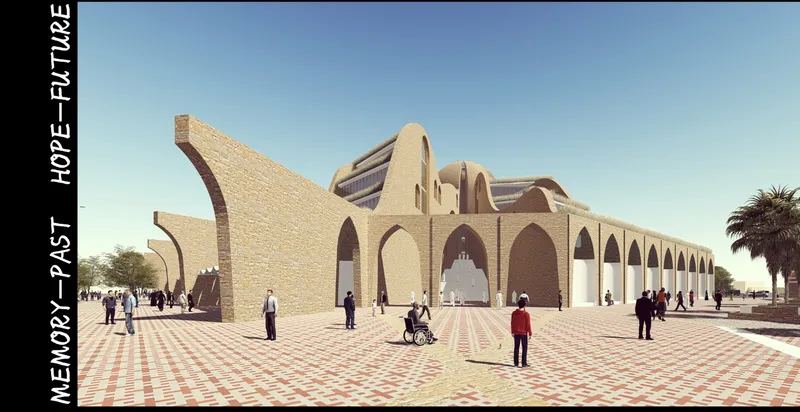
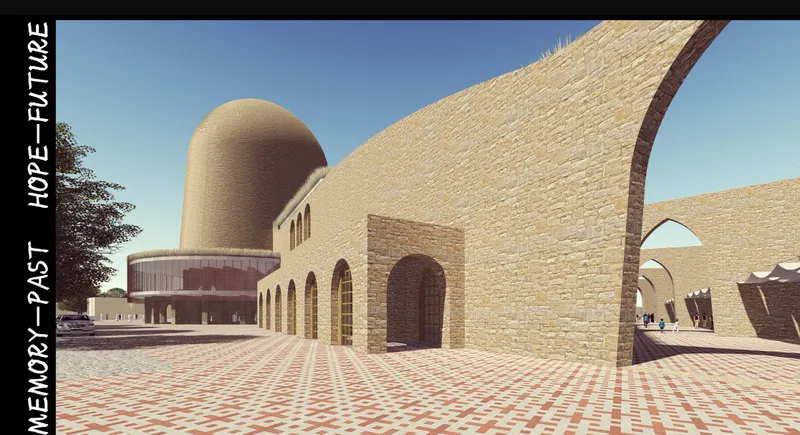
The exterior facade immediately establishes the project's material convictions. Brick dominates, laid in patterns that reference traditional Middle Eastern masonry while accommodating a striking formal move: a tilted wall plane that leans outward, creating visual tension against the solidity of pointed arches below. The effect is deliberate. Where the arches ground the building in familiar typologies, the canted surface introduces instability, a reminder that the ground on which this memorial stands was recently a theater of conflict. The domed volume visible from an oblique angle reinforces the architectural vocabulary of the region, its curved profile sitting comfortably alongside the angular geometry of the leaning wing.
The choice of local materials, including brick, stone, and adobe, is not merely aesthetic. These materials reduce ecological impact by minimizing transportation and embodied energy, and they anchor the building in its geographic context. The orientation of the structure is calibrated to maximize natural ventilation and daylighting, while planted roofs and bioswales contribute to thermal performance and stormwater management. Sustainability here is not an add-on; it is a principle of responsible post-conflict rebuilding.
A Plaza Framed by Palm Trees and Low Brick Volumes
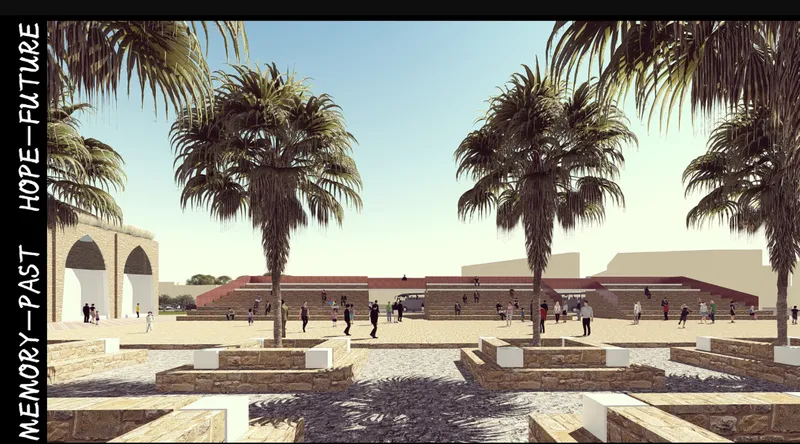
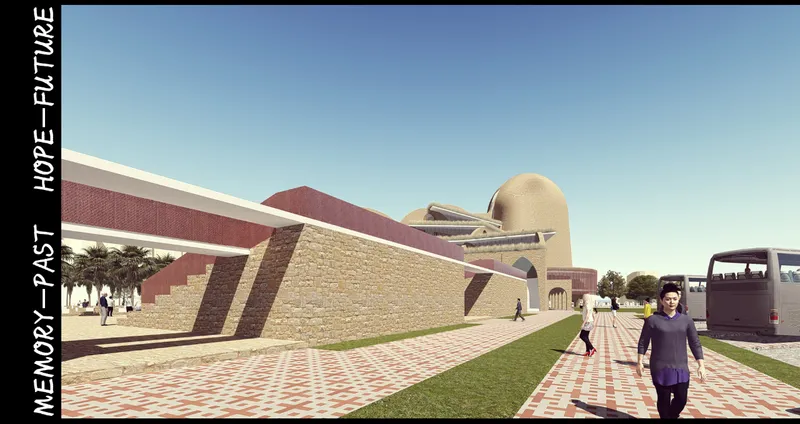
Moving from the monumental facade to the public realm, the project reveals its urban intelligence. The plaza is framed by palm trees and low brick volumes punctuated by planted beds, creating a sequence of shaded gathering zones and open courtyards designed for year-round use. A paved walkway stretches alongside a grassed embankment where visitors stroll at midday, the scale carefully modulated to feel intimate rather than overwhelming. The landscape design follows the logic of ancient city planning, with axes that align with former public spaces, heritage sites, and civic routes in Aleppo.
Accessibility is embedded in these spaces. Wide walkways and ramps accommodate visitors of all abilities, while multilingual signage and interactive exhibits ensure that the memorial serves not only those who endured trauma but also younger generations who come to learn. The plaza functions as a threshold between the spiritual and touristic zones of the masterplan, a place where casual visitors and contemplative mourners share the same ground.
An Arched Colonnade at Dusk: The Memorial as Civic Ritual
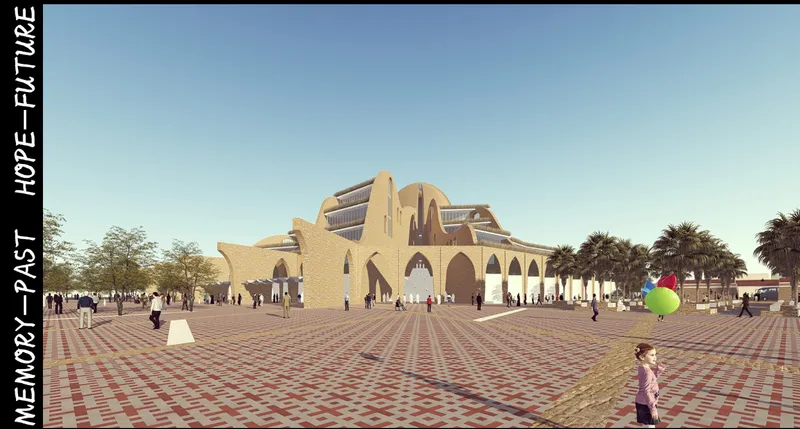
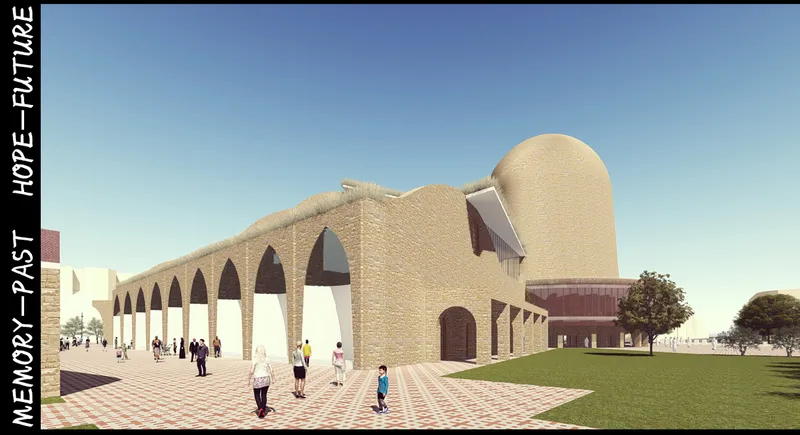
The most evocative images of the project arrive at dusk, when the arched colonnade that defines the entrance plaza is lit with a warm glow and visitors, some carrying balloons, gather beneath its vaults. The colonnade recalls the covered souks and arcaded streets that once defined Aleppo's public life, but its proportions are generous, its rhythm deliberate. Beyond the colonnade, the cylindrical Tower of Hope rises above a wide lawn, its vertical presence pulling the eye upward and out of the horizontal layers of loss and remembrance that define the ground plane.
It is in this juxtaposition, the horizontal documentation of the past against the vertical aspiration of the tower, that the project finds its emotional core. The cultural exhibition hall within the complex houses a timeline of urban reconstruction, including models and immersive installations that allow visitors to trace the path from devastation to recovery. The architecture does not ask its audience to forget. It asks them to stand inside the full arc of the story and to find, in the act of walking through it, something that feels like a beginning.
Why This Project Matters
Post-conflict memorials are among the most difficult commissions in architecture. They must resist sentimentality without becoming cold, and they must speak to survivors without excluding those who come later. Wang Yibin's proposal navigates these tensions with a clear strategy: root the building in the material and spatial traditions of Aleppo, then use formal disruptions, a tilted wall, a soaring tower, to signal that the city's story is still being written. The integration of sustainable systems, from bioswales to passive ventilation, adds a layer of ethical seriousness that elevates the project beyond symbolism.
What ultimately distinguishes the Memorial Hall is its insistence on participation. By designing for multiple audiences, from trauma survivors to students to spiritual seekers, the project positions the memorial not as a static monument but as an active piece of civic infrastructure. The scars of war are not erased; they are made legible, educational, and, in the best sense, generative. For a city rebuilding from its foundations, that kind of architecture is not a luxury. It is a necessity.
View the Full Project
About the Designers
Designer: Wang Yibin
Enter a Design Competition on uni.xyz
uni.xyz runs architecture and design competitions year-round that reward proposals with spatial conviction and real site intelligence.
Project credits: Memorial hall - past and future, memory and hope by Wang Yibin Memory (uni.xyz).




Popular Articles
Popular articles from the community


The Musturak Paradise: Senior Living Architecture for a Connected Future in Temara, Morocco
The Musturak Paradise reimagines senior living architecture in Temara via private homes, social spaces, culture, community, and shared care.

Hill & Cross Opera: Sculptural Opera House Architecture Shaped by Tallinn’s Landscape and Identity
Hill & Cross Opera reimagines opera house architecture in Tallinn through its sculptural hill, civic plaza, glass wave and a luminous cross.

Co-life: Sustainable Architecture for Age-Friendly Community Living
Co-life reimagines sustainable architecture for seniors through courtyards, rammed earth, shared gardens, and spaces designed for belonging.

Conexión: Biophilic Design Reimagines High-Rise Living in Hong Kong
Conexión reimagines high-rise living in Hong Kong through biophilic design, green facades, shared spaces, daylight, water and nature within.


Similar Reads
You might also enjoy these articles

Day and Night Park: A Time-Based Urban Newsstand in Beijing
A temporary urban newsstand in Beijing blending travel, light, and reading through poetic colors, compact form, and community-focused design.

Modernist Patio Renovation in El Masnou, Barcelona by Oliver Segura Arquitectura + Cebrià Arquitectura
Modernist patio renovation blending tradition and innovation with a movable pool, leveled floors, and Catalan materials in El Masnou.

Alto Residencial Coop: Cooperative Housing Development in Santiago de Compostela by Carbajo Barrios Arquitectos
A linear cooperative housing complex blending white volumes and perforated metal façades, enhancing community living, natural light, privacy, and urban integration.

Vil Genis School by BPA ARCHITECTURE – Massy, France
Vil Genis School in Massy, France, features sustainable design, south-facing classrooms, community integration, accessible spaces, and modern educational architecture.


Explore Cultural Architecture Competitions
Discover active competitions in this discipline



Design Challenge - Contemporary interpretation of a religious complex


Bring back Drive In's
Comments (0)
Please login or sign up to add comments
No comments yet. Be the first to comment!