
Trahan Architects Wraps Louisiana's First CLT Structure in Handmade Italian Brick for Loyola's New Chapel
A circular sanctuary of translucent terra-cotta and Southern Yellow Pine rises on Loyola University's century-old New Orleans quad.


A chapel built in the round is an inherently provocative gesture for a Jesuit university. The form suggests communal equality over liturgical hierarchy, a gathering rather than a procession. At Loyola University New Orleans, Trahan Architects has made exactly that gesture with the Chapel of St. Ignatius and Gayle and Tom Benson Jesuit Center, a 4,620-square-foot drum of handmade terra-cotta brick and Cross Laminated Timber that replaces a former library on the university's historic quad. The building is modest in footprint but dense with intention: every material, every axis, every source of light has been calibrated to compress centuries of sacred architecture into a single, quietly radical cylinder.
What makes this project genuinely interesting is not the circular plan alone but the material logic that holds it together. The CLT structure, the first of its kind in Louisiana, was erected in roughly two weeks from 32-foot-tall panels of sustainably harvested Southern Yellow Pine sourced within 350 miles of the site. Those panels are then sheathed in Italian-made translucent bricks, white-glazed over red clay, that serve double duty as thermal insulation, eliminating the need for polymer insulation entirely. The result is a building that is simultaneously high-tech in its fabrication and almost premodern in its environmental strategy. It sits among Tudor-Gothic neighbors without mimicking them, offering a contemporary interpretation of the campus's century-old brick vocabulary.
A Drum on the Quad
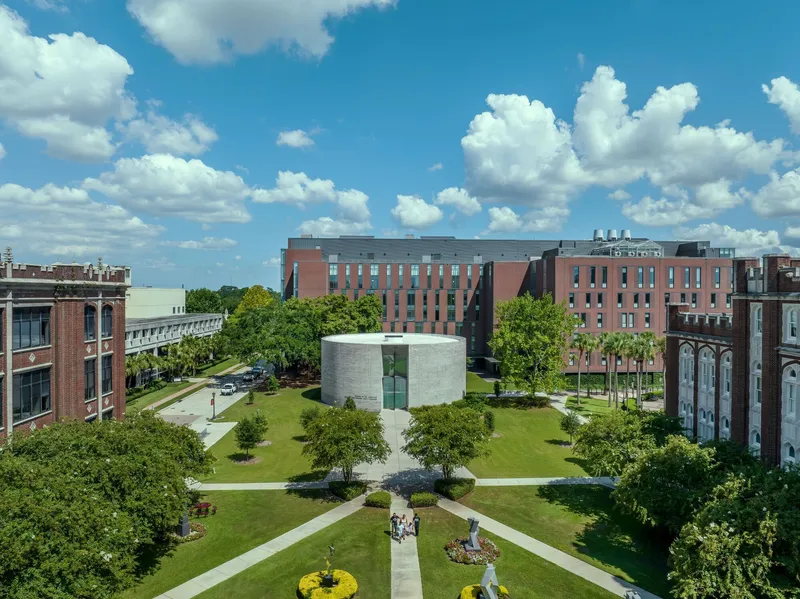
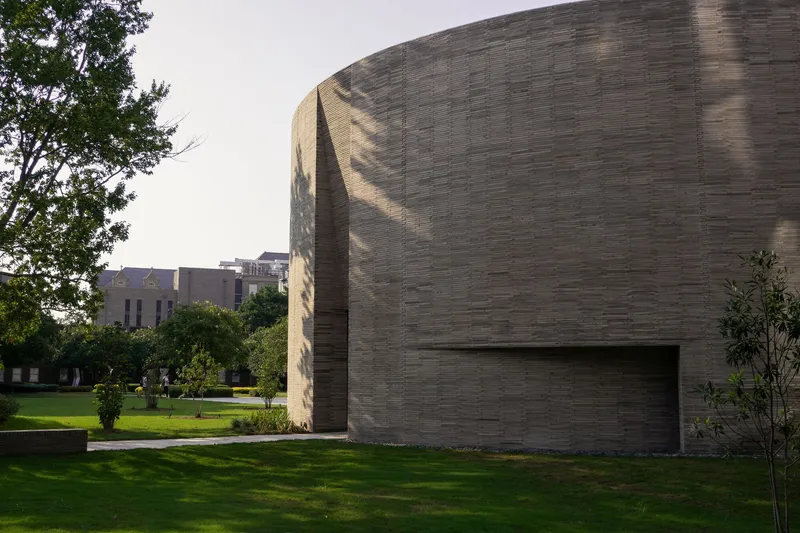

From the air, the chapel reads as a clean geometric punctuation mark on a campus composed of spiky Gothic profiles and sprawling academic wings. Loyola's 24-acre site in the Audubon neighborhood is hemmed in by Tulane on one side and high-end residential on the other, leaving little room for architectural grandstanding. Trahan's cylinder is deliberately understated in scale, rising just high enough to hold its own against the adjacent Gothic revival buildings without competing with their vertical ambitions.
The landscaping reinforces the building's circularity. Palm trees frame a circular landscape feature that echoes the plan, while carefully placed openings in the brick wall direct sightlines toward the campus quad and a growing oak tree. The building does not sit on the quad so much as it belongs to it, absorbing the axes that already existed and giving them a new terminus.
Translucent Brick and Tactile Surface

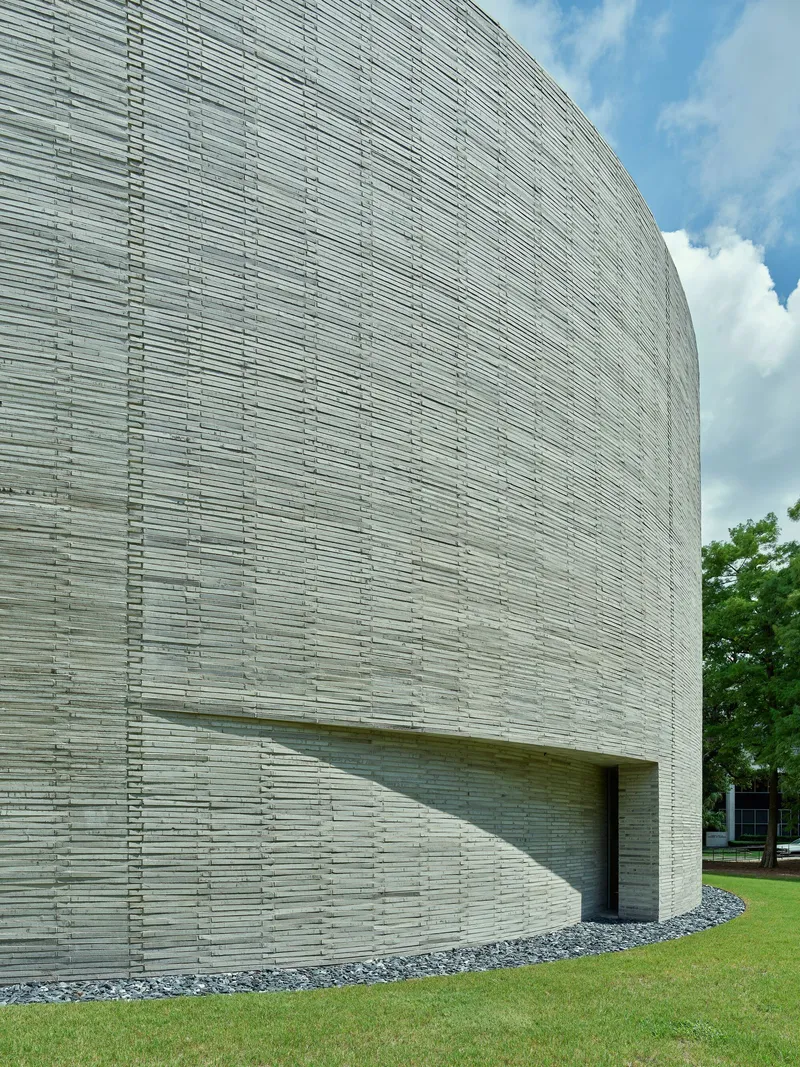
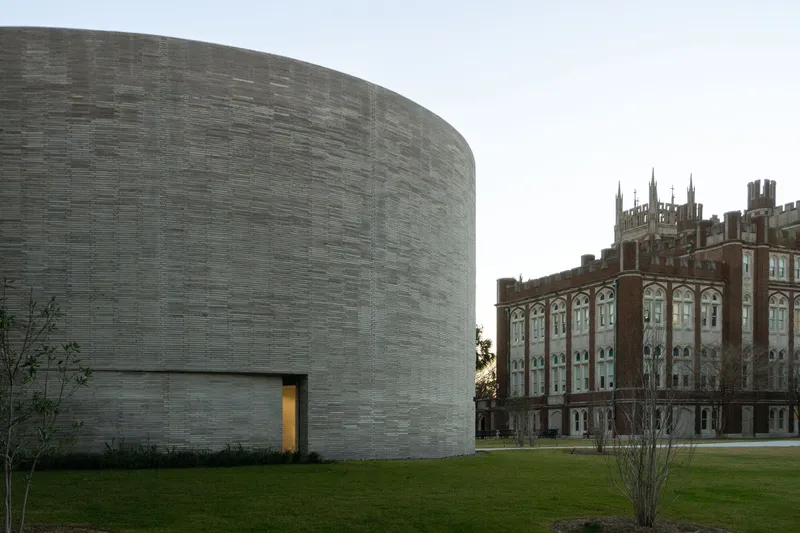
The exterior envelope deserves close attention. These are not standard bricks. Each unit is a thin, translucent terra-cotta piece, handmade in Italy with a white glaze fired over a red clay body. The horizontal coursing creates a striated texture that shifts in character throughout the day: cool and monolithic under overcast skies, warm and layered when raked by afternoon sun. The curvature of the wall prevents the facade from ever reading as flat, so the striations pick up subtle shadow gradients that animate the surface continuously.
Anchored directly to the CLT panels behind them, the bricks serve as the building's thermal skin. The elimination of polymer insulation is a bold call in a humid subtropical climate, but the logic is sound: the mass of the brick combined with the thermal properties of the CLT creates a composite wall assembly that manages heat gain passively. It is an old idea executed with contemporary precision.
The Entrance as Threshold

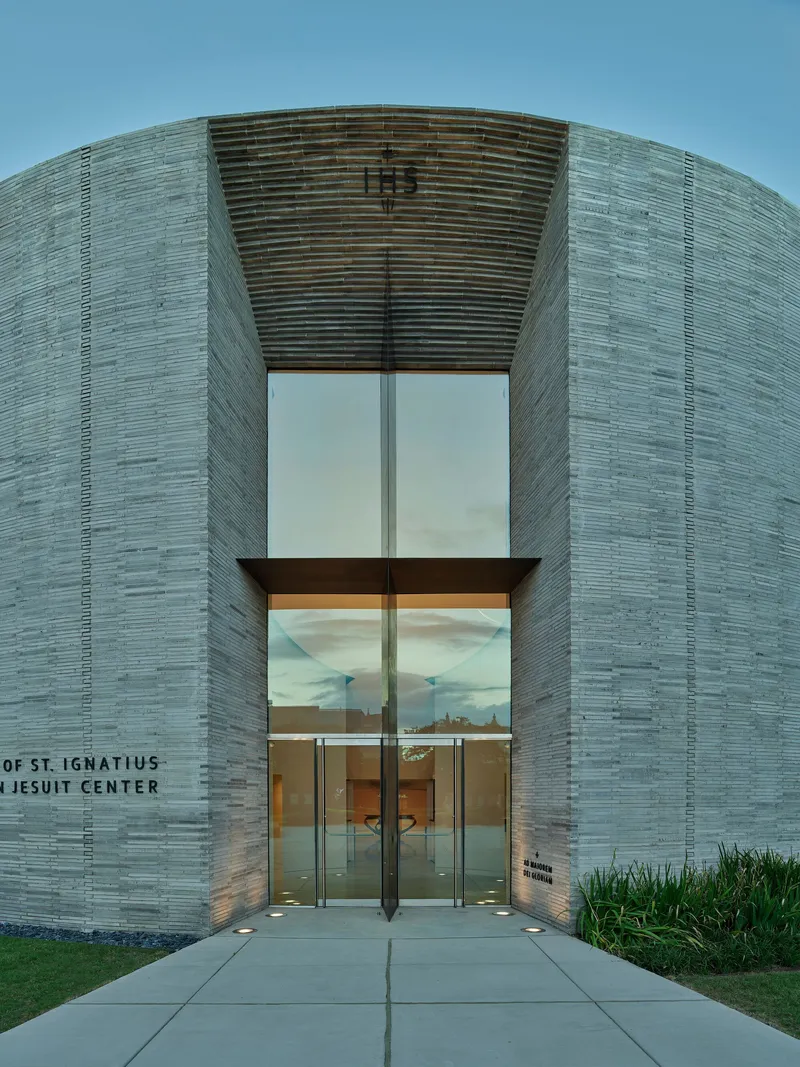

The west-facing entrance is marked by a blackened-brass cross that reads as both symbol and sun screen. The cross is set into the glazed opening as a brise-soleil, shading the interior from the punishing western light while announcing the building's program with zero ambiguity. It is a rare instance of iconography and environmental performance occupying the same piece of material.
Passing through the tall glass doors, you move from bright New Orleans daylight into a compressed, softly lit corridor that prepares the senses for the sanctuary beyond. The transition is theatrical without being overwrought. Trahan cites Jun'ichirō Tanizaki's In Praise of Shadows as an influence, and the calibrated dimming from exterior to interior bears that out. Light is treated as a material here, rationed and directed with the same care as the brick and timber.
Gathering in the Round


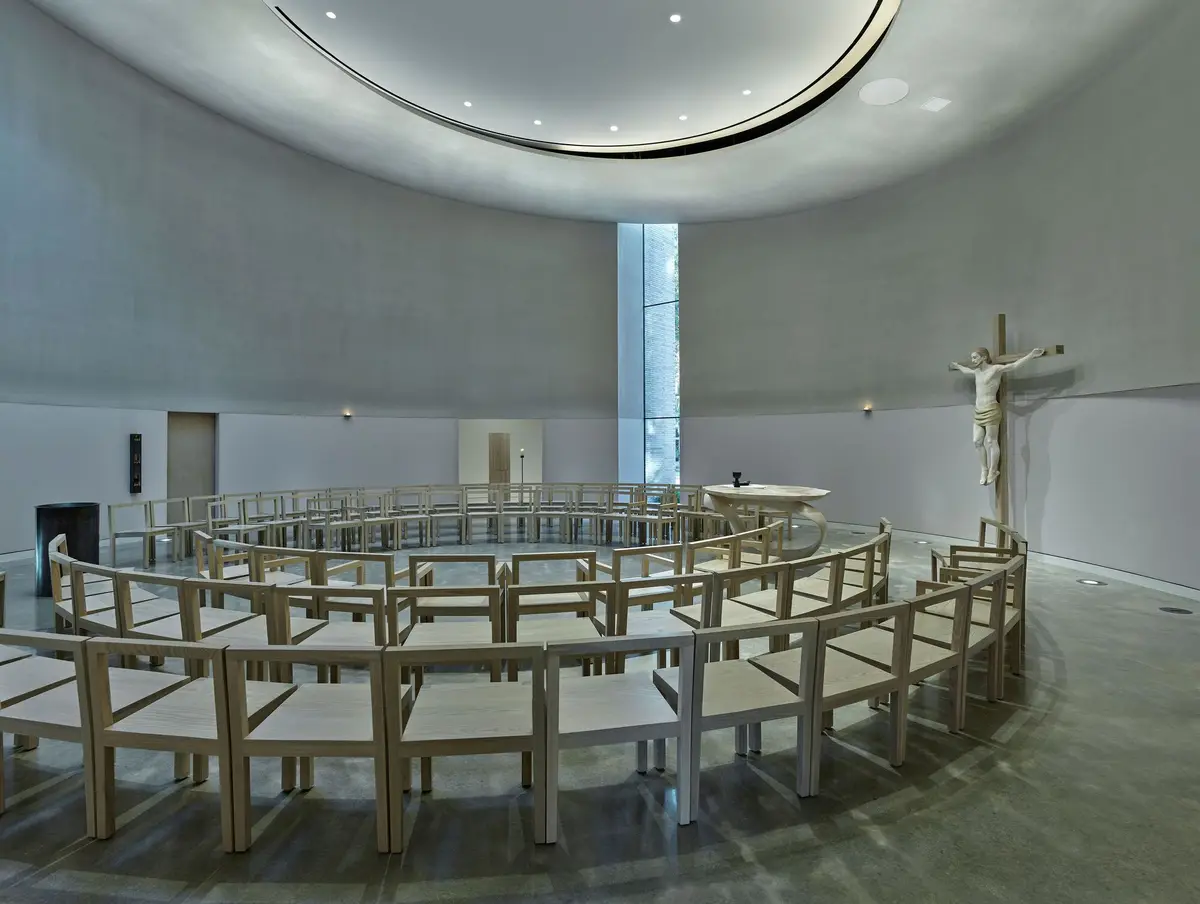
The 120-seat sanctuary is arranged in concentric arcs around a central altar, with a baptismal font placed at the geometric center of the building. The seating, white ash chairs designed in collaboration with Paris-based Studio Goons, curves to follow the walls, eliminating the traditional nave-and-aisle hierarchy. No congregant is more than a few rows from the altar. This is worship as participation, not observation.
Overhead, a circular skylight draws a column of natural light down to the altar, supplemented by five vertical window slots cut into the perimeter. The CLT structure is left exposed on the interior, its warm Southern Yellow Pine surfaces finished with natural clay plaster on the curved walls. The effect is a space that feels simultaneously ancient and impossibly clean, like a Romanesque baptistery rebuilt with CNC precision. The reference to Peter Zumthor's Bruder Klaus Field Chapel is acknowledged by the architects, but where Zumthor's chapel is a dark, scorched void, Trahan's is luminous and communal.
Interstitial Spaces and the Community Center
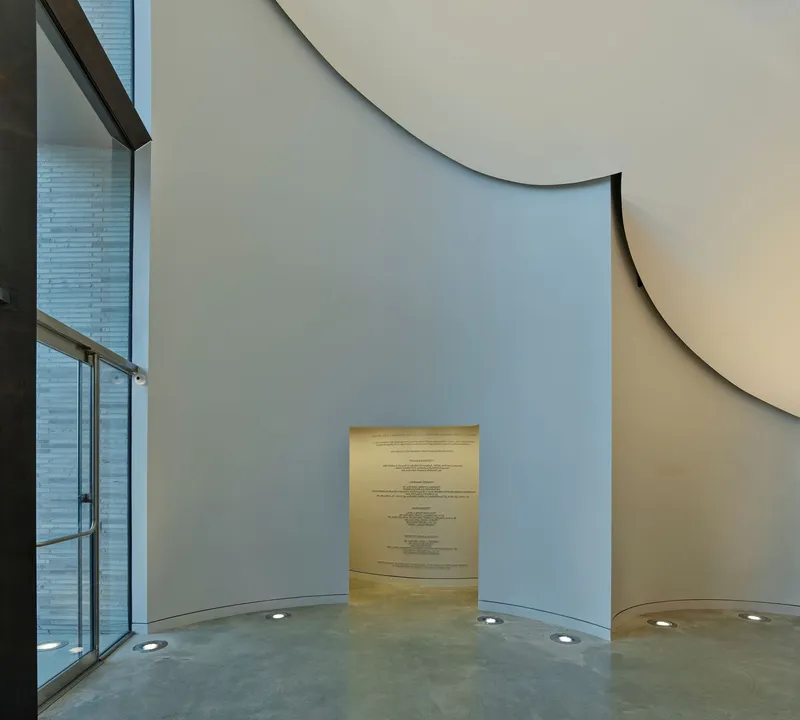
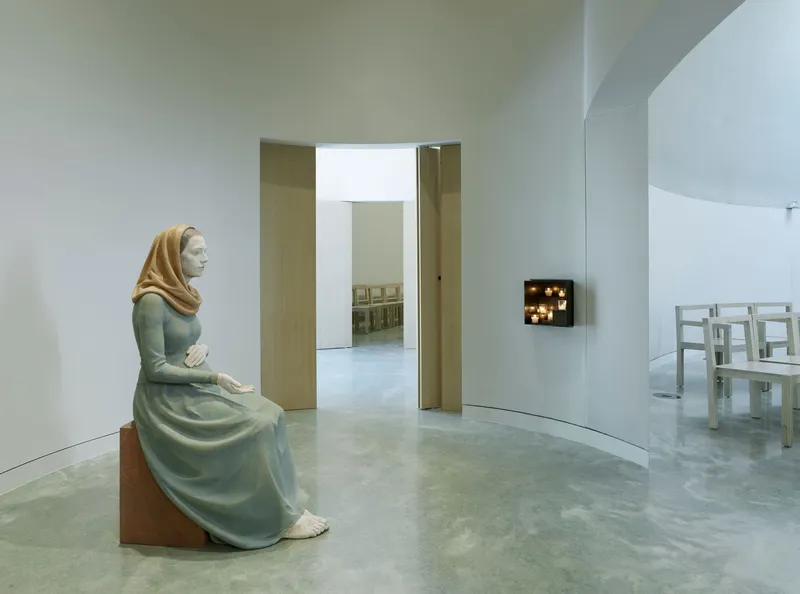
The plan is generated by a series of intersecting circles, and the residual spaces between those circles become the building's secondary program: a 50-seat community center, circulation areas, and contemplative niches. These interstitial zones are shaped by the geometry rather than imposed on it, producing curved alcoves and narrow passages that feel discovered rather than designed. Trahan describes the overlapping circles as producing forms resembling a fish, a traditional representation of Christ, though you can appreciate the spatial richness without knowing the symbolism.
The gallery-like community space, with its polished concrete floor and white curved walls, functions as a flexible room for interfaith dialogue and campus events. It is a smart programmatic move: by cross-weaving interfaith activities within a Catholic building, Loyola signals openness without diluting its Jesuit identity. The architecture accommodates this dual purpose without resorting to generic neutrality.
Material Research and Prototyping

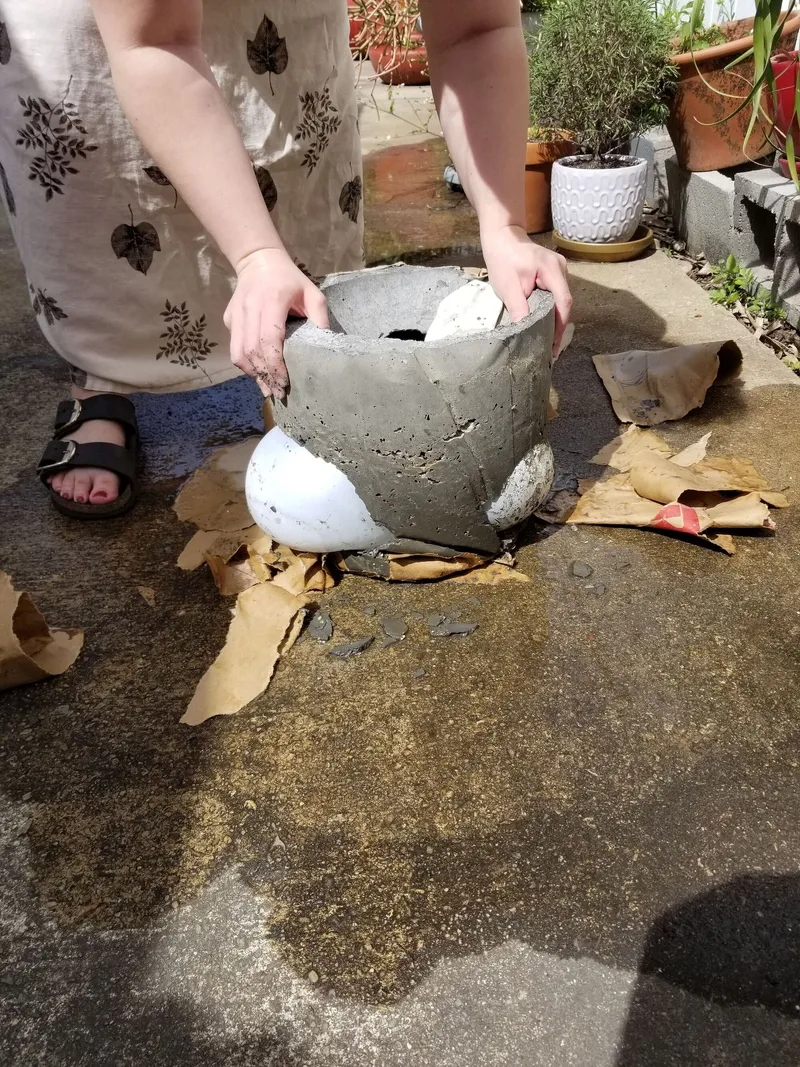
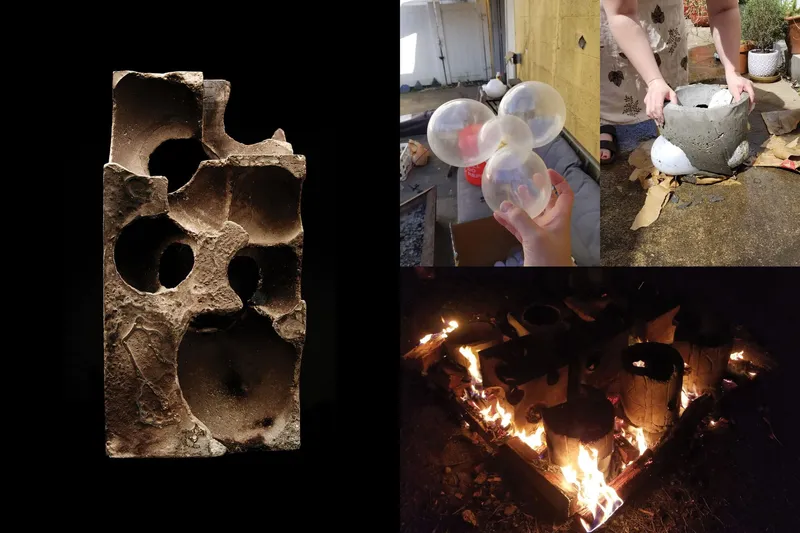
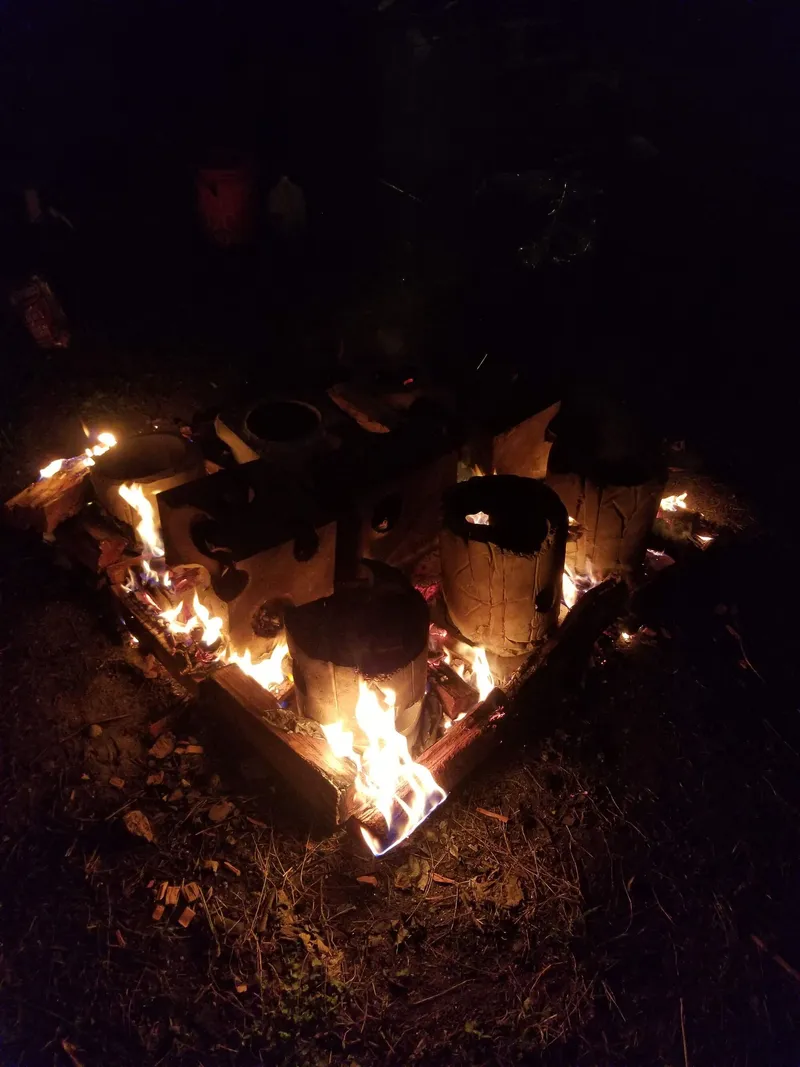
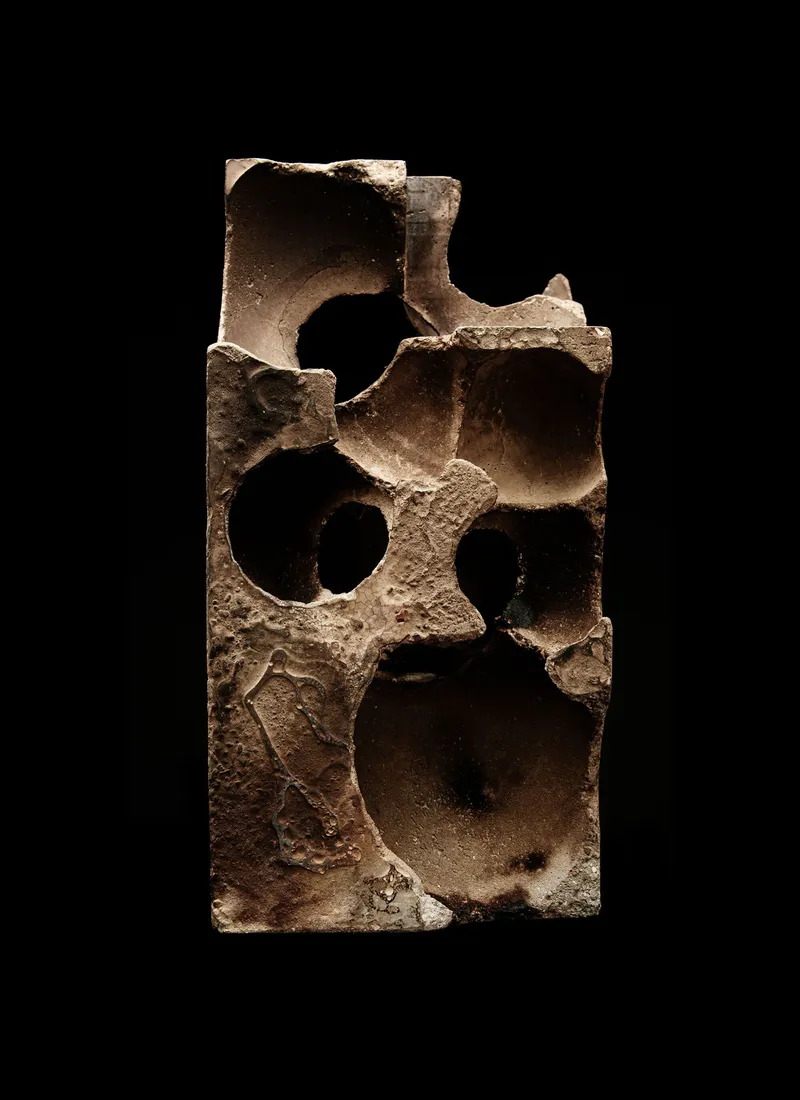


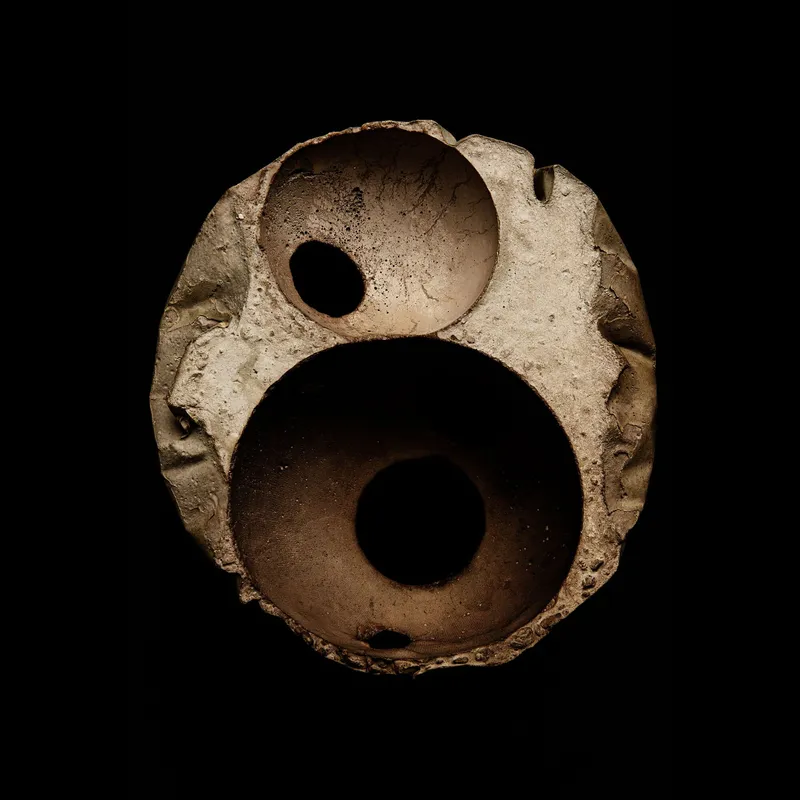
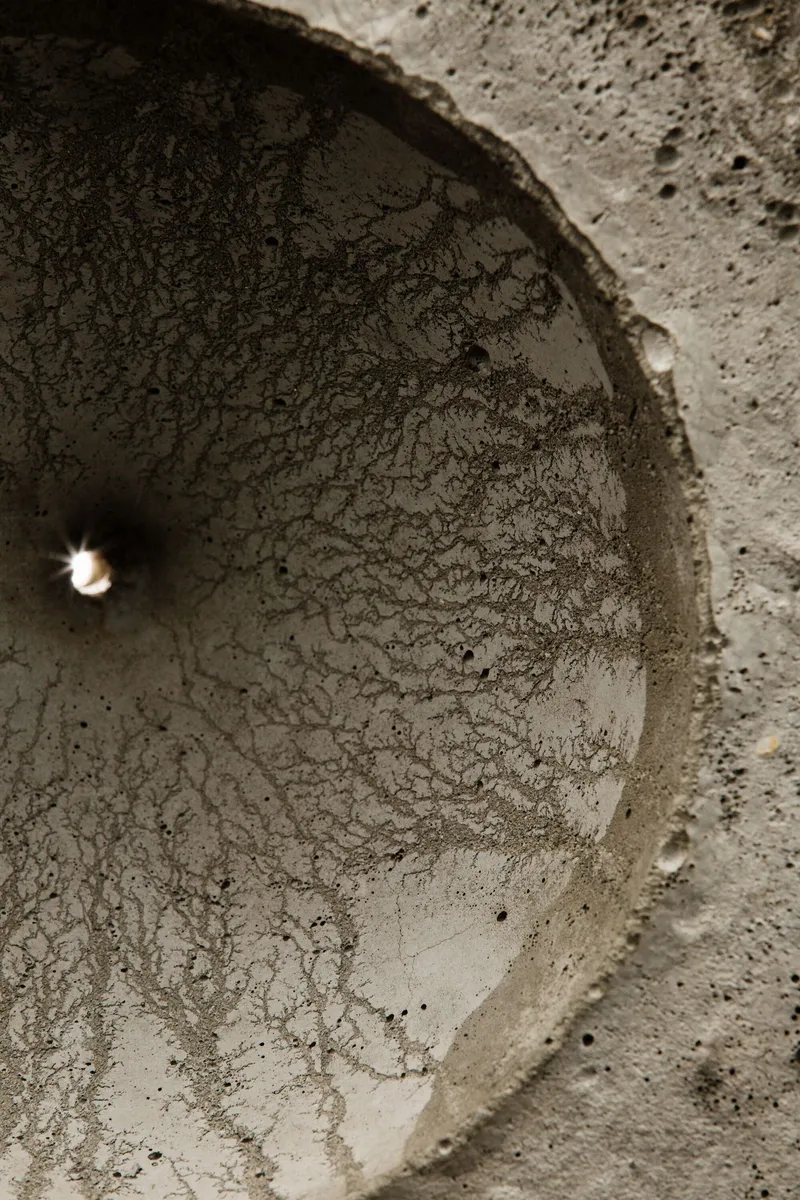
The design process involved extensive physical prototyping, including poured-concrete experiments with inflated balloons during the COVID-19 pandemic. These studies, visible in the workshop images, explored how circular voids could be cast into solid masses to create interstitial chambers. Fired ceramic test pieces with perforated cavities were developed alongside the concrete models, testing how light would filter through layered, curved surfaces.
While not all of these experiments translated directly into the final building, they reveal a design method rooted in physical making rather than purely digital iteration. The circular plan, the translucent brick, the calibrated light slots: all of these were tested at material scale before they became architecture. In an era when many firms leap from parametric model to construction document, Trahan's workshop-driven process is a reminder that hands-on prototyping still yields spatial intelligence that screens cannot.
Plans and Drawings

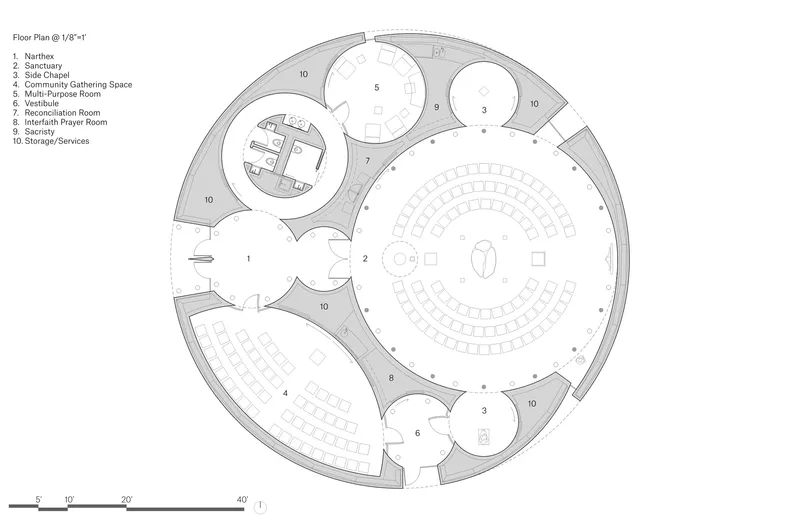
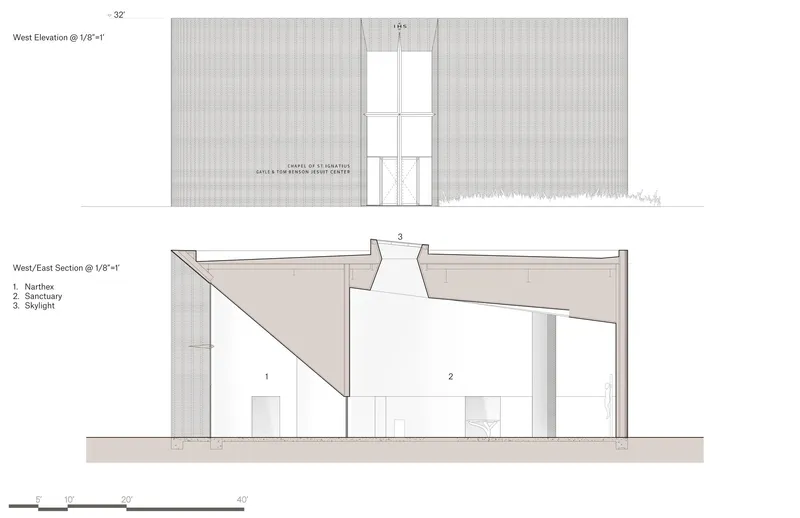


The site plan reveals how precisely the cylinder is positioned within the quad, its axes locking into existing campus geometries while the circular landscape feature radiates outward. The floor plan makes the intersecting-circles logic legible: the sanctuary and community center are two overlapping rounds, with secondary chambers filling the vesica piscis between them. The section drawing exposes the wall assembly in detail, showing how the CLT panels, waterproofing barrier, and handmade brick layer up into a composite envelope.
The conceptual sketches and diagrams trace the project's evolution from abstract circular studies to built form. The six-diagram sequence illustrating overlapping plan configurations is particularly instructive, showing how the architects tested variations of circle intersection before settling on the final arrangement. A clay model paired with a freehand sketch captures the project at its most intuitive, before the geometry was locked down by engineering.
Why This Project Matters
Sacred architecture in the 21st century often defaults to one of two modes: timid historicism that cosplays as tradition, or self-conscious abstraction that alienates its community. Trahan Architects has found a third path. The Loyola chapel is unambiguously contemporary, from its CLT structure to its CNC-fabricated panels, yet it is also deeply rooted in material craft, site history, and liturgical purpose. The handmade Italian bricks, the regionally sourced timber, the passive thermal strategy: these are not decorative gestures but structural commitments that tie the building to a specific place and a specific set of values.
As Louisiana's first CLT structure, the chapel also sets a precedent for timber construction in a region dominated by concrete and steel. The fact that the CLT went up in two weeks and can withstand hurricane-force winds challenges the assumption that mass timber is a technology suited only to temperate, low-risk climates. For a building of this scale and ambition, the chapel is remarkably economical in its means, proving that constraint and craft are not obstacles to great architecture but preconditions for it.
Loyola University Chapel (Chapel of St. Ignatius and Gayle and Tom Benson Jesuit Center) by Trahan Architects, New Orleans, United States. 4,620 square feet. Completed 2025. Photography by Timothy Hursley.
About the Studio
Share Your Own Work on uni.xyz
If projects like this are the kind of work you want to make, uni.xyz is a place to publish your own, find collaborators, and enter design competitions.


Popular Articles
Popular articles from the community


Singing Woman: An Opera House That Performs Before the Curtain Rises
Ovidiu Cristian Pavel's conceptual opera house translates Estonia's choral identity into a sculpted waterfront landmark facing the Baltic Sea.


ETEH Reworks the Shared Spaces of São Domingos School in Brazil Around Timber, Color and Hanging Plants
At São Domingos School in Brazil, 436 m² of hall, refectory and library are recast with timber joinery, a yellow and blue code and trailing greenery.

The Amber Palace Opera: A Geological Fiction Surfaces on Tallinn's Baltic Waterfront
Pierre Brillard reimagines a Baltic legend as a public landscape, opera house, and waterfront promenade rooted in Tallinn's coastal identity.

Cube Design Draws an Ecological Corridor Between Two Shenzhen Hills with the Nankai Building
Beside Shenzhen's container docks, the Nankai Building pairs stacked balconies with a climbing green screen to connect two hillsides across its height.

Similar Reads
You might also enjoy these articles

LAVA Architecten Gives Vocational Education a Sawtooth-Roofed Face on a Mechelen School Campus
In Mechelen, Belgium, a 2,053 m² STEM school on a 6×6 m grid turns workshops and classrooms into rooms that can be rearranged as teaching changes.

KEMA Studio Turns a Derelict Marvila Attic into a 60 m² Lighthouse Apartment Above Lisbon
In Lisbon's Marvila district, a rebuilt roof, four skylights and two plywood volumes turn an unlivable attic into a bright home facing the Tagus.

Pixel Gardens: One Repeated Module Stacked Into a Terraced Social Housing Tower for Famagusta
Salem Bader's shortlisted housing tower builds a vertical neighbourhood from one repeated module, offsetting units to carve terraces, light and air.

Bao Huynh Watercolor Atelier: A Serene Art Retreat in Hội An
Bao Huynh Watercolor Atelier in Hội An blends multifunctional art spaces, sustainable design, local materials, and family-friendly living in a serene environment.

Explore Chapel Competitions
Discover active competitions in this discipline

Design Challenge - Contemporary interpretation of a religious complex

Challenge to design public laboratory
Comments (0)
Please login or sign up to add comments
No comments yet. Be the first to comment!