
UID Architects Suspends a Spider-Web Roof Over Four Plywood Boxes in Suburban Japan
A 70-square-meter family house in Fukuyama rotates 45 degrees on its lot to trade privacy for openness beneath an octagonal canopy.


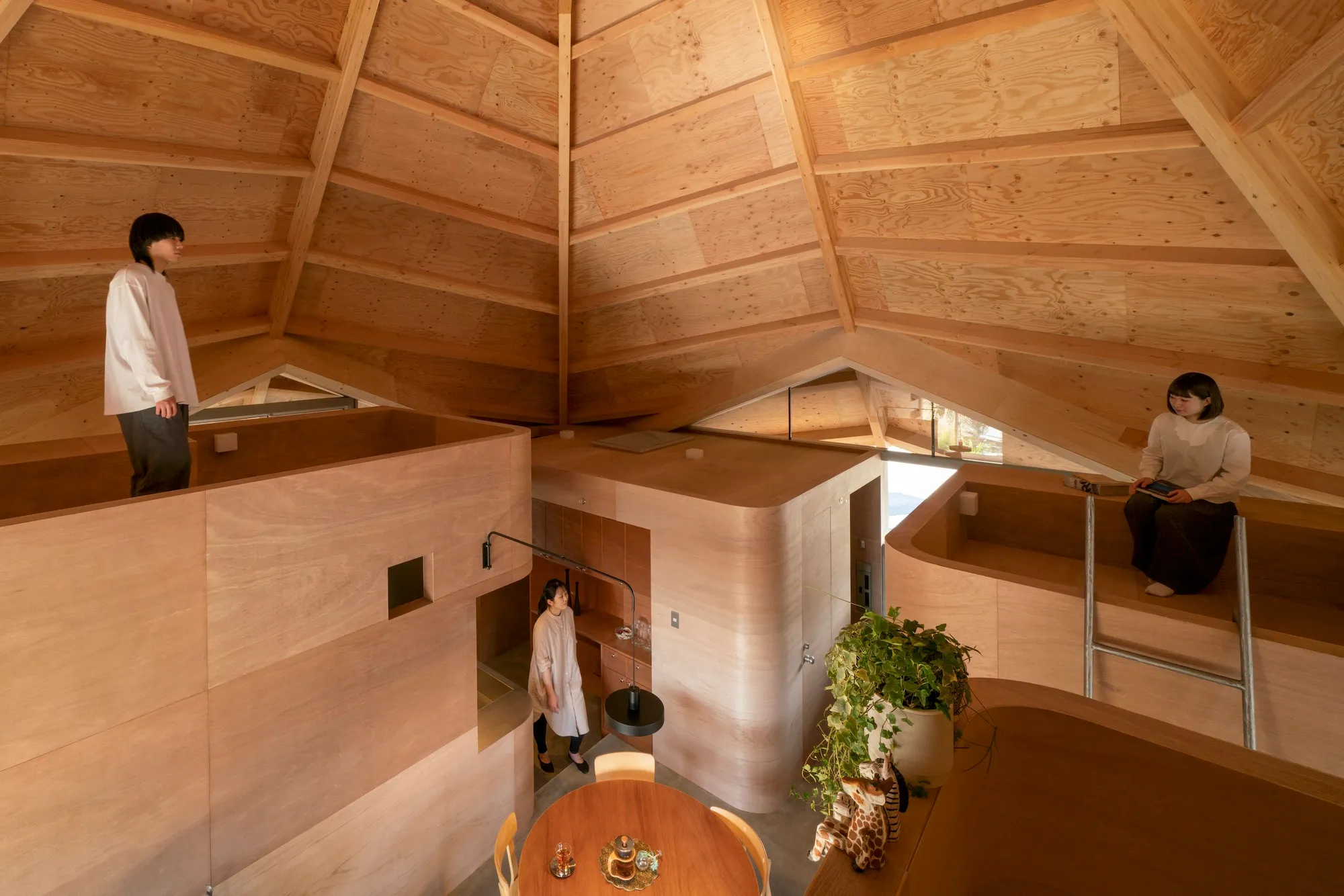
In the subdivided hillside neighborhoods of Fukuyama, where houses line up obediently along plot boundaries, UID Architects and lead architect Keisuke Maeda have placed a house that refuses to play along. The Su-pider House sits rotated 45 degrees to its site, presenting triangular gaps where its neighbors show walls. The name is a portmanteau that earns its conceit: the octagonal roof structure really does read like a web, its radiating timber beams descending from a central skylight to four grounded support points. At just 70 square meters of floor area on a 230-square-meter lot, the project is small in plan but spatially generous, its pyramidal ceiling lifting the interior into a volume that far exceeds what the footprint suggests.
What makes the project genuinely interesting is not the novelty of the form but the domestic logic it enables. Maeda distributes four plywood box-volumes at opposing corners of the plan, leaving a continuous corridor of open space at the center that serves as kitchen, dining room, and family room all at once. None of the boxes carry fixed program labels. The idea, frankly stated, is that the house will reorganize itself as the family's two children grow: a sleeping nook becomes a study becomes something else entirely. The architecture does not prescribe life; it loosely contains it.
A Roof That Organizes Everything

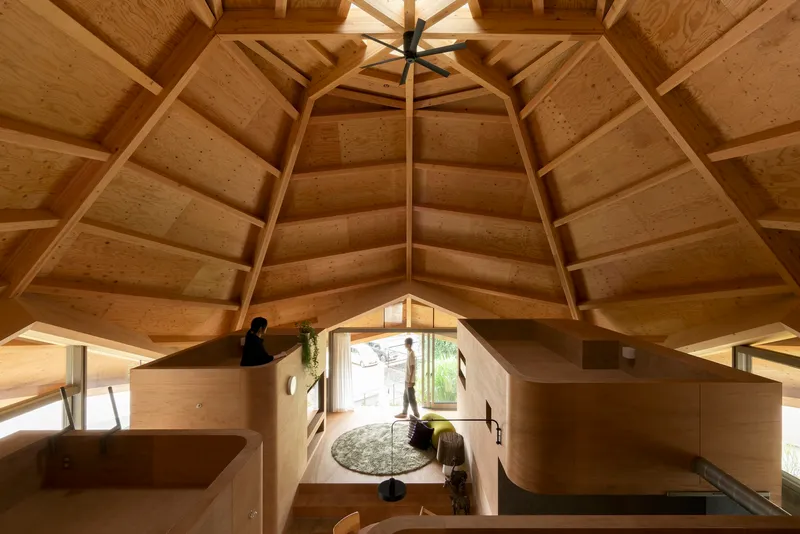
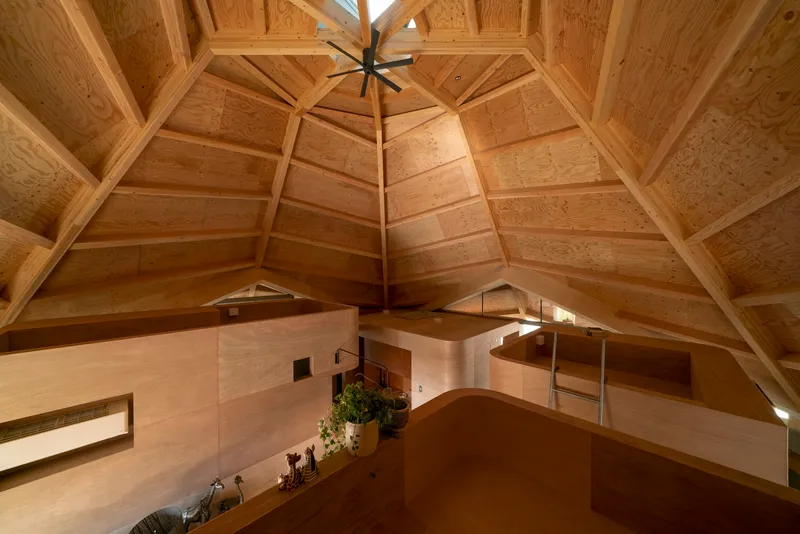
The octagonal roof is the project's primary architectural move, and it does almost all of the heavy lifting. Eight slanting planes converge at 45 degrees to a central oculus, where a skylight floods the dining table below with natural light. The timber framing is left fully exposed, its radial geometry giving the ceiling the legibility of a diagram. You can stand anywhere in the house and read the structure.
Structurally, the web descends to only four support points, freeing the perimeter and allowing the triangular openings between the legs to serve as thresholds between inside and outside. A steel roof caps the timber frame, its faceted surface visible from the street as a sharp, crystalline mass rising above the uniform rooflines of the neighborhood.
Plywood Boxes Without Labels
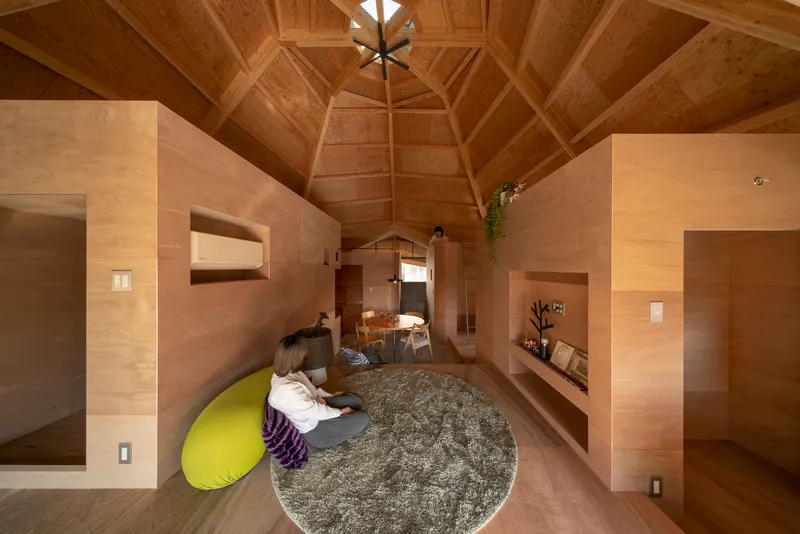

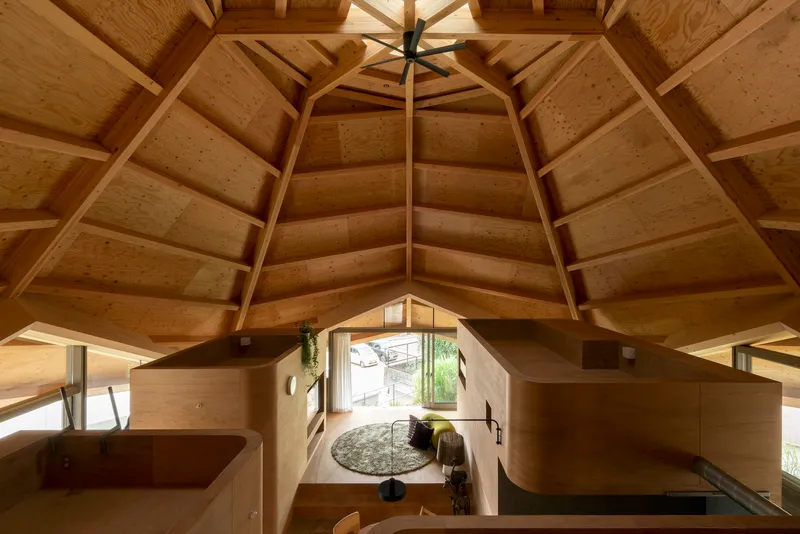
The four plywood volumes are deliberately left without assigned functions. Their curved edges and recessed niches suggest occupation rather than dictate it. A person might sit in an alcove reading; the same alcove might later hold a mattress, or a desk, or nothing at all. Maeda's refusal to name rooms is a specific bet on flexibility over legibility, and in a house this small, it is probably the right one.
The boxes are clad inside and out in birch plywood, giving the interior a warm, continuous materiality that contrasts with the rougher texture of the exposed roof framing above. The effect is of objects placed under a canopy: the boxes belong to the domestic realm, the roof to something more public and structural.
Living in the Gaps
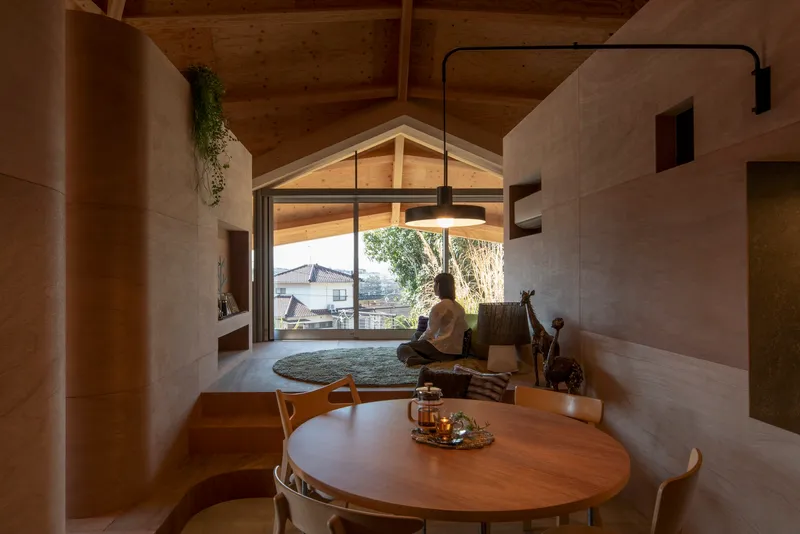
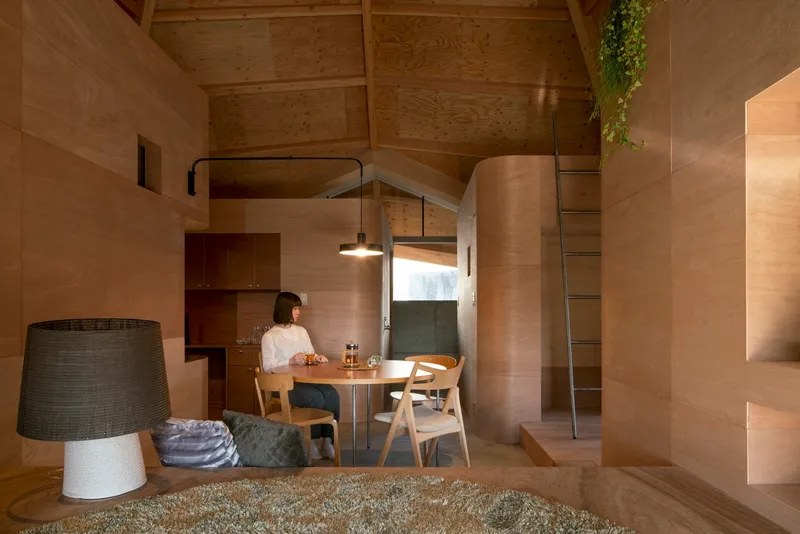
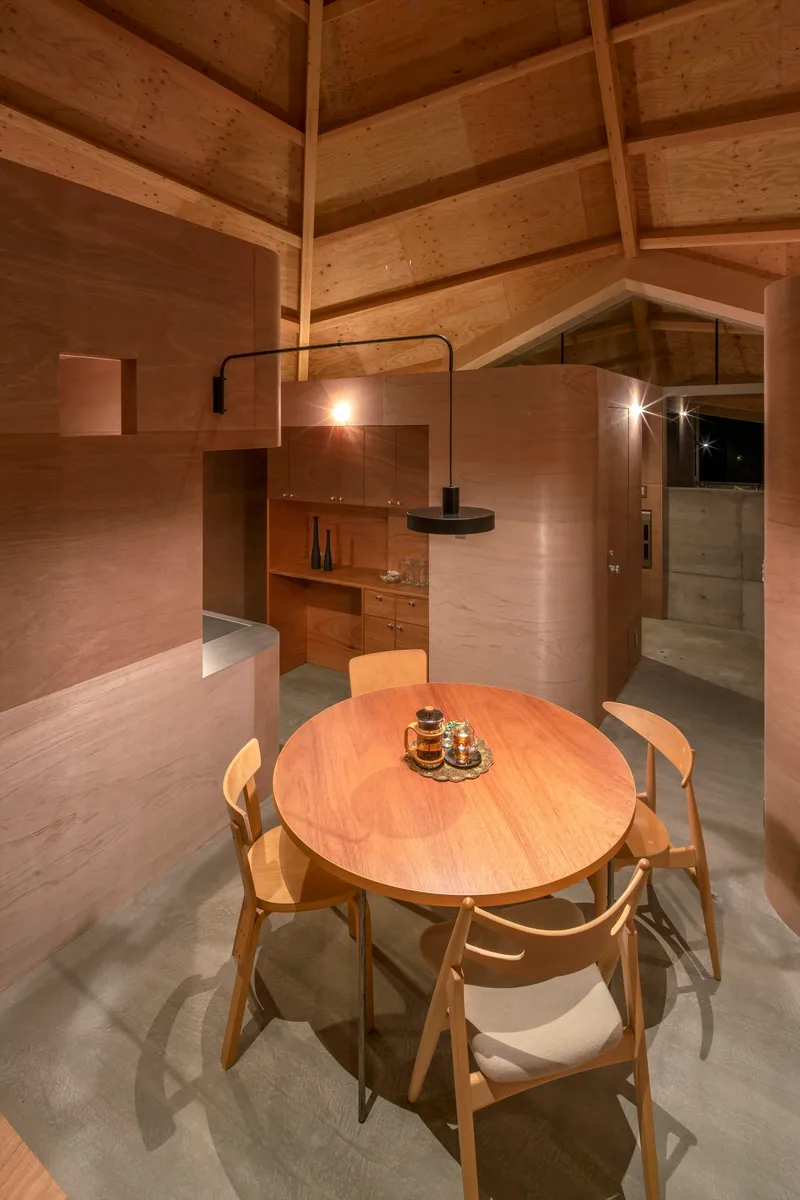
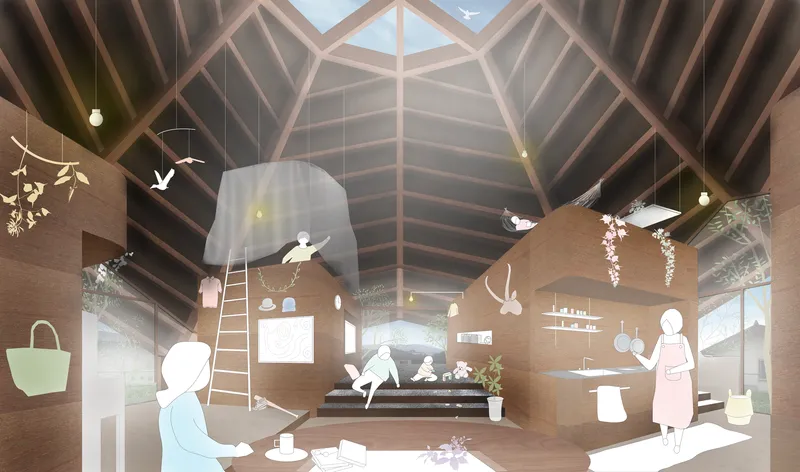
The family's daily life happens not inside the boxes but between them. The central corridor, running diagonally through the plan, holds a round timber dining table positioned directly beneath the oculus. A polished concrete floor anchors the kitchen and dining zone, while the plywood boxes define the edges. Pendant fixtures drop from the high ceiling to bring the scale of the dining area back down to something intimate.
The round table is a smart choice in a house organized around angular geometry. It softens the gathering point and avoids the head-of-table hierarchy that a rectangular surface would impose. At night, warm sconces on the plywood walls and the pendant lights create a lantern effect visible through the triangular openings.
Vertical Play and Multi-Level Living
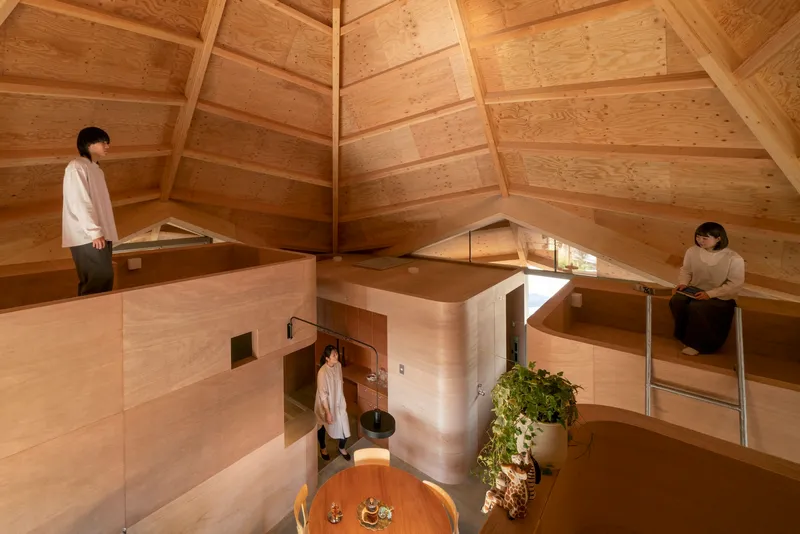

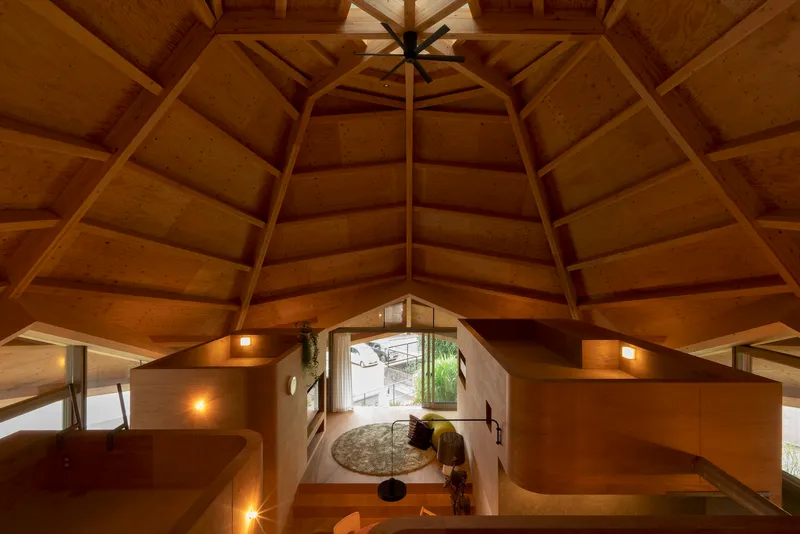
The pyramidal ceiling creates a gradient of heights that Maeda exploits with elevated platforms and loft-like perches within the plywood boxes. Family members occupy the house at different levels, sometimes looking down into the central living space, sometimes retreating upward toward the roof structure. It is a compact version of the split-level trick, but here the section is continuous rather than stepped, so transitions feel organic.
From the overhead vantage points, the plan reads clearly: four boxes, a central void, and the radiating beams of the roof converging above. The house is legible from every angle, which is a quality that many larger, more expensive projects never achieve.
Inside and Outside, Negotiated
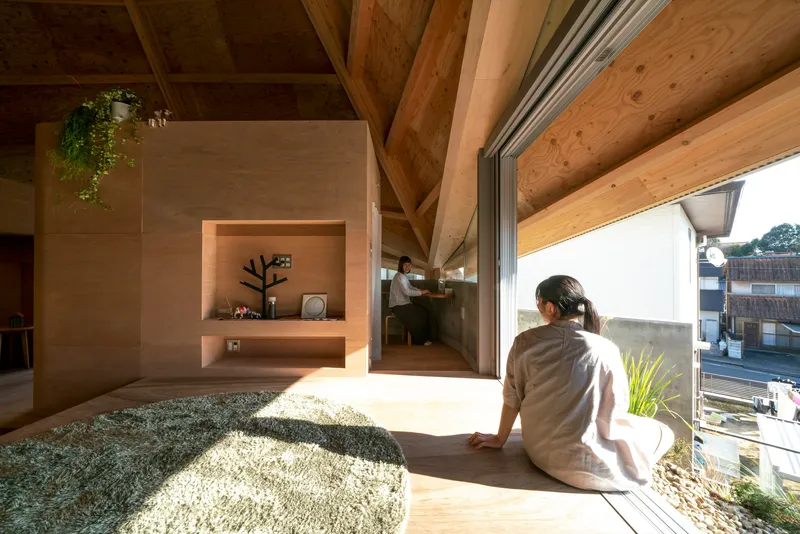
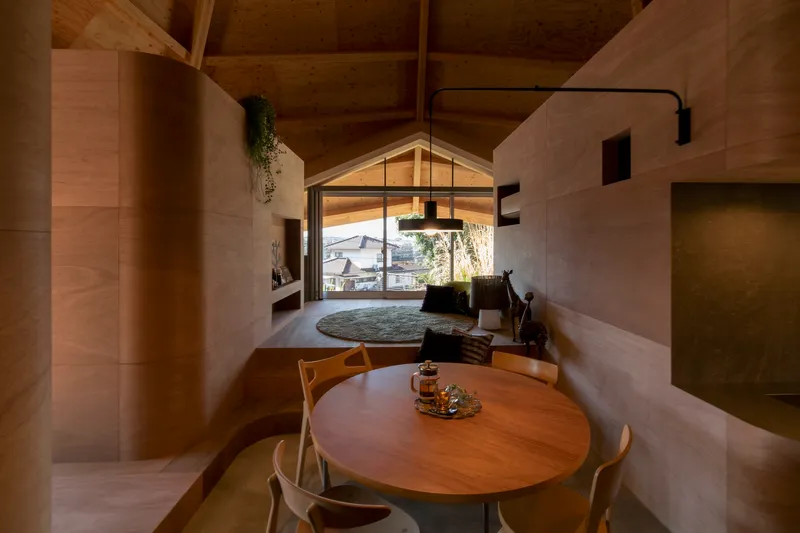
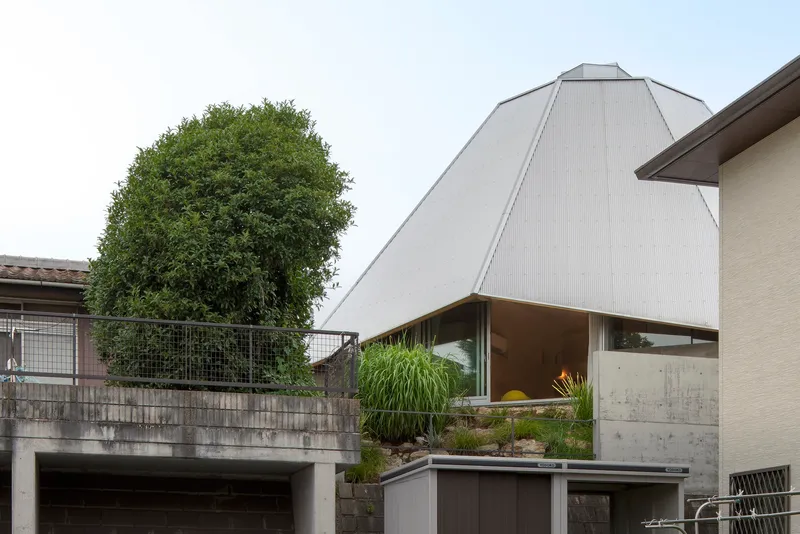
The 45-degree rotation creates triangular leftover spaces between the house and the rectangular site boundary. These become gravel courtyards and planted zones that serve multiple purposes: they admit light and ventilation through the openings between the four support legs, they buffer the interior from neighboring properties, and they provide the family with small outdoor spaces that feel surprisingly private given the dense suburban context.
One particularly effective moment occurs where an alcove opens directly onto a gravel courtyard, framing afternoon sunlight as it streams across the concrete floor. The gabled window on the opposite side captures views of neighboring rooftops, turning the subdivision's banality into a composed backdrop. The tiered topography of the site, with a significant elevation drop to the south, gives the house unexpected long views in that direction.
Kitchen and Material Warmth
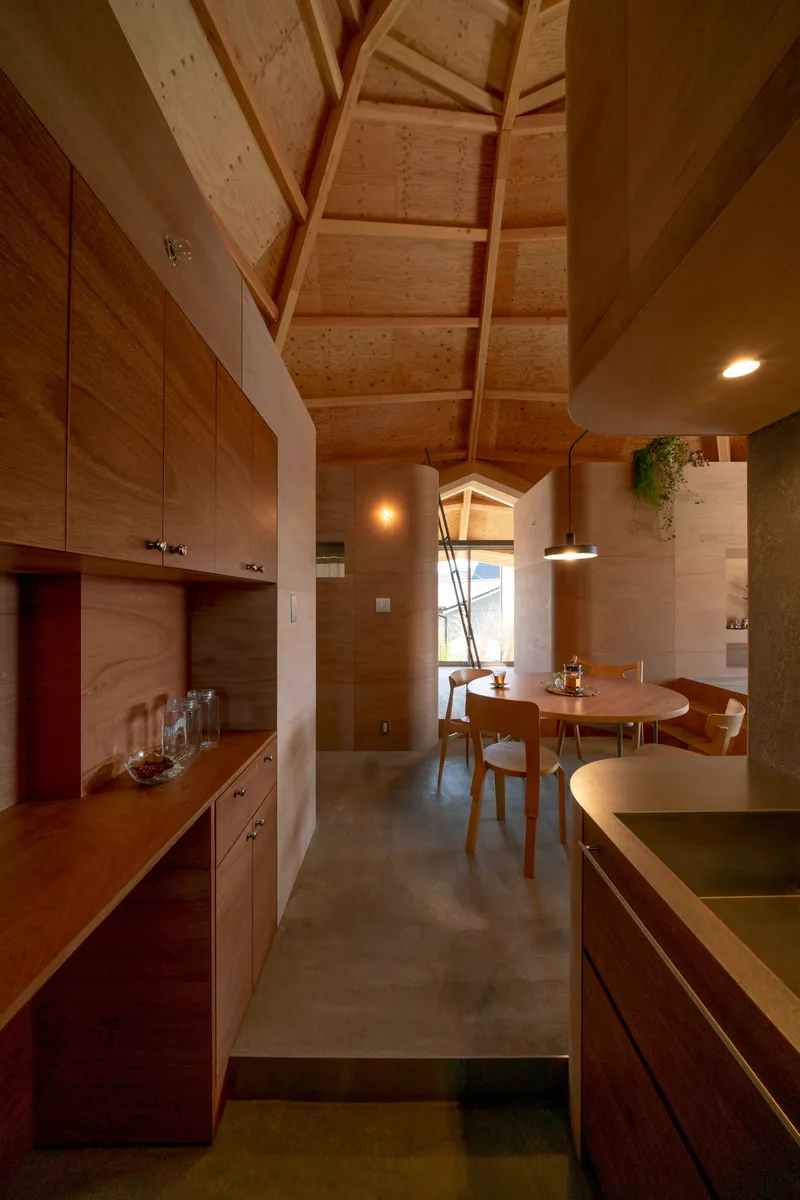
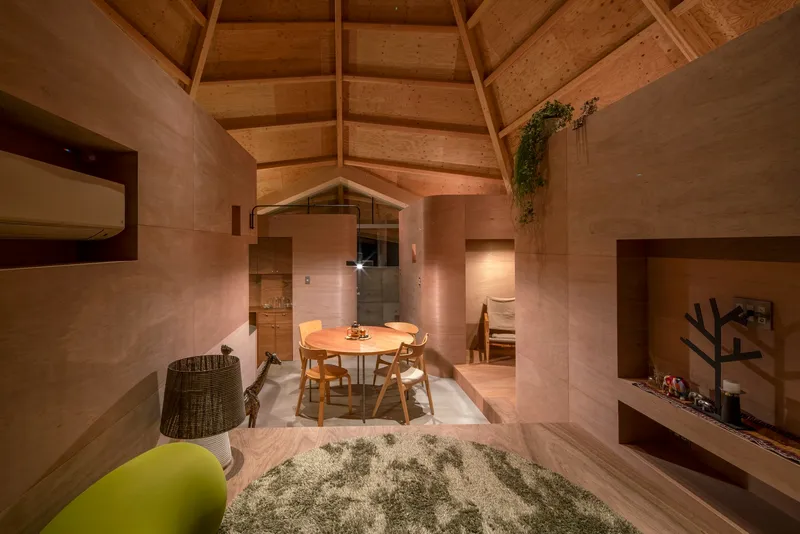
The kitchen occupies one edge of the central corridor, its plywood cabinetry and open shelving integrated seamlessly into the box volumes. The vaulted ceiling above the work surface gives the cook a sense of space that a flat ceiling never could. It is a working kitchen, not a display kitchen, and the open shelving reflects that: things are within reach, not behind glass.
The evening views of the interior, with greenery trailing from the upper structure and warm light pooling on the plywood surfaces, reveal a house that is genuinely comfortable. The material palette, limited to birch plywood, exposed timber framing, concrete, and steel, is disciplined without being austere. Every surface earns its place.
Plans and Drawings
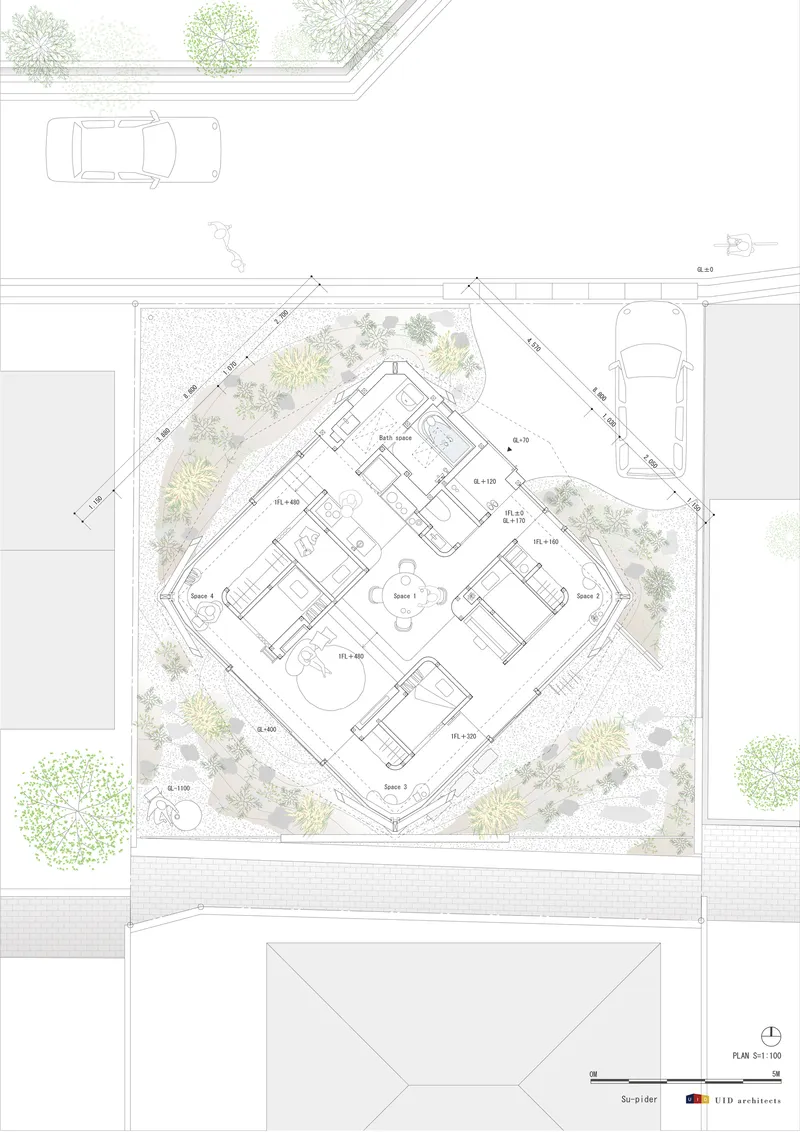

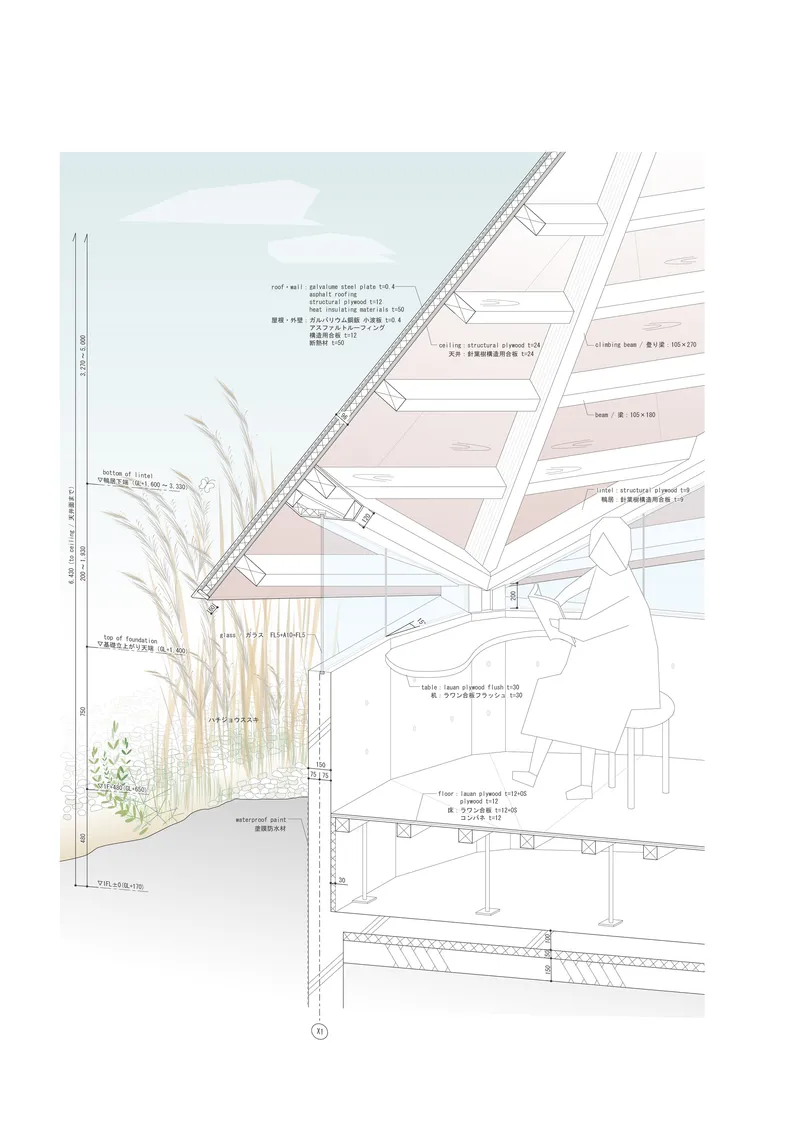
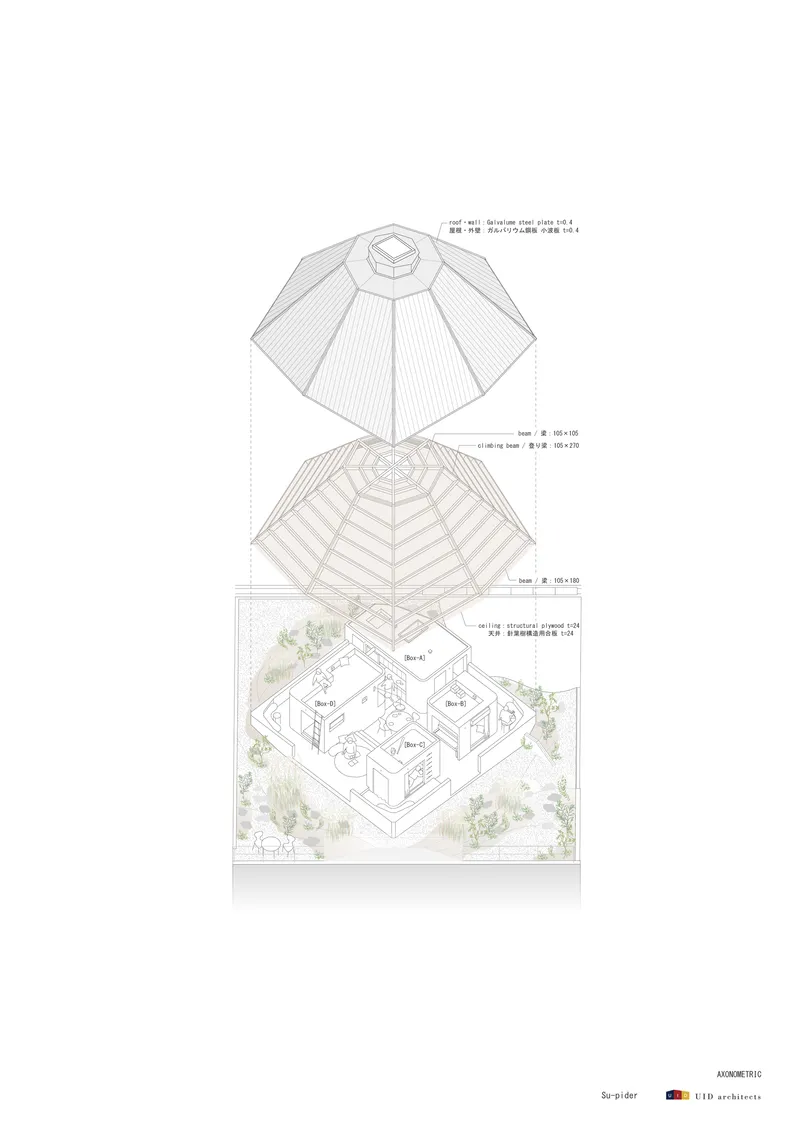
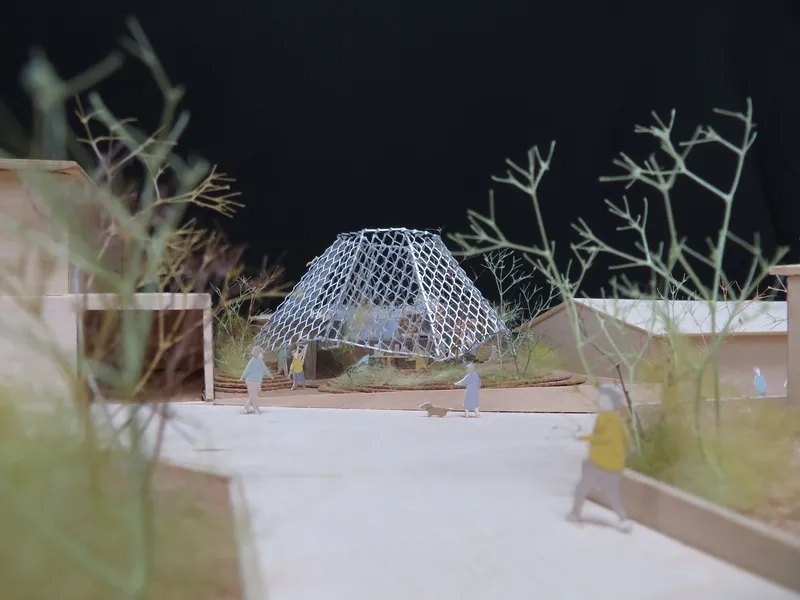

The site plan confirms the 45-degree rotation and shows how the planted courtyard beds fill the triangular residual spaces along the perimeter. The section drawing is the most revealing: the pyramidal timber frame is legible as a single structural move, its rafters spanning from the oculus down to the four ground points with the plywood boxes nestled underneath like furniture beneath a tent. The exploded axonometric separates the roof layers from the floor plan, making the relationship between canopy and ground-level program explicit.
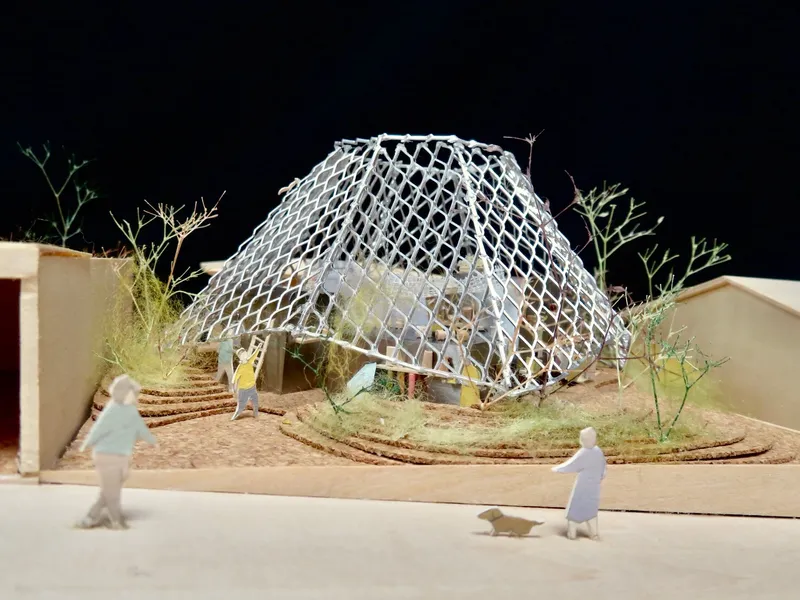
The physical models are worth studying. One shows the lattice roof structure over a planted courtyard with miniature figures, revealing how the triangular openings between the legs frame garden views. Another presents a geodesic variation of the wire-mesh structure, suggesting that Maeda explored more radically skeletal options before settling on the octagonal timber web. The rendered interior view, with hanging plants and skylights, closely matches the built result, indicating a design process where the vision remained consistent from model to construction.
Why This Project Matters
The Su-pider House is a convincing argument that small houses in ordinary suburban contexts do not need to be ordinary. Maeda's strategy of rotating the footprint, lifting the roof into a legible structural figure, and distributing program into four unlabeled boxes produces a house that is spatially rich at 70 square meters. The design does not rely on expensive materials or unusual construction techniques; it relies on geometric intelligence and a willingness to leave things undefined.
More importantly, the house takes time seriously. Its open plan and undefined boxes anticipate change rather than resisting it. As the family grows and its needs shift, the architecture will absorb new arrangements without renovation or regret. That kind of temporal generosity is rare in residential design, and it elevates the Su-pider House from a clever formal exercise into a genuinely thoughtful piece of domestic architecture.
Su-pider House by UID Architects (Keisuke Maeda), Fukuyama, Japan. 70 m², completed 2021. Photography by Kazunori Fujimoto.
About the Studio
Share Your Own Work on uni.xyz
If projects like this are the kind of work you want to make, uni.xyz is a place to publish your own, find collaborators, and enter design competitions.



Popular Articles
Popular articles from the community


Pangolin Can Help Mining: Biomimicry Architecture for an Asteroid Mining Habitat
Pangolin Can Help Mining explores biomimicry architecture through a modular 3D-printed habitat designed for asteroid mining and future life.

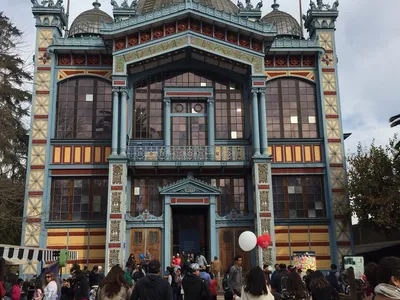
How Henri Picq's 1889 Paris Pavilion Traveled 11,000 Kilometers to Become Santiago's Artequín Museum
A prefabricated iron and glass pavilion built for the Paris Universal Exposition found a second life as a children's art museum in Chile.
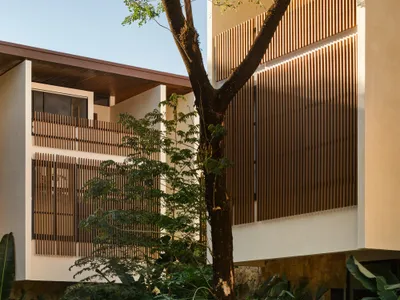
FAMM Arquitectura Organizes Ten Villas Around Courtyards and Jungle in Nosara, Costa Rica
El Molino pairs two elongated volumes with deep overhangs and timber louvers to build a compact coastal community five minutes from the beach.
Garden of Hope: Sustainable Architecture for a Resilient Community in Qandahar
Garden of Hope reimagines sustainable architecture as secure, organic community where women rebuild lives through housing, work, and nature.


Similar Reads
You might also enjoy these articles

Bao Huynh Watercolor Atelier: A Serene Art Retreat in Hội An
Bao Huynh Watercolor Atelier in Hội An blends multifunctional art spaces, sustainable design, local materials, and family-friendly living in a serene environment.

Atelier Macri Concept Store Interior Design by CASE-REAL
Atelier Macri store features a "ko" counter, walnut wood details, cork displays, blending retail, gallery, and seamless customer experiences.

Manuel Vargas Izquierdo Stadium and High-Performance Sports Center: Architectural Excellence in Jalpa de Méndez
The Manuel Vargas Izquierdo Stadium blends sustainable design, inclusive sports facilities, and cultural-inspired architecture, revitalizing Jalpa de Méndez’s public spaces.

KAKR Buluh Awar Hall: Revitalizing Community and Ecology Through Bamboo Architecture
Community built bamboo hall revitalizes Buluh Awar village, empowering youth, restoring ecology, celebrating vernacular craftsmanship through sustainable architecture and culture.


Explore Ai Generated Competitions
Discover active competitions in this discipline



The International Standard for Design Portfolios


The Global Benchmark for Architecture Dissertation Awards

The Global Benchmark for Graduation Excellence


Challenge to design mud housing for contemporary communities
Comments (0)
Please login or sign up to add comments
No comments yet. Be the first to comment!