

Un Nouveau Soleil: Adaptive Urban Design Reviving Paris’ Abandoned Railways
Adaptive urban design transforms abandoned Paris railways into inclusive, flexible public spaces that evolve with community needs


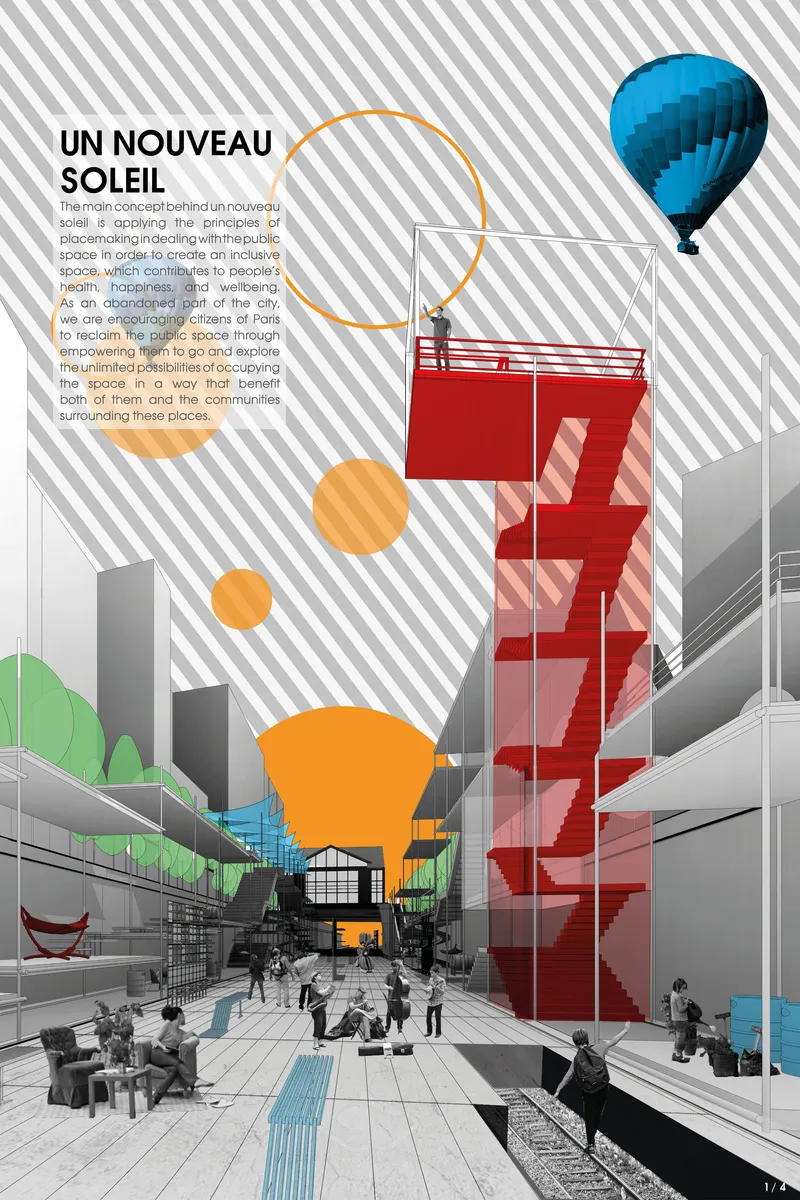
In the evolving discourse of adaptive urban design, cities are increasingly looking inward, re-evaluating underutilized infrastructures as opportunities for regeneration. Un Nouveau Soleil, a shortlisted entry in the Salut Paris competition by Ahmad Kadry, Israa El-Maghraby, Muhammad Bargal, and Hazem Youssef, positions itself within this paradigm by reimagining the abandoned railway corridors of Paris as dynamic, inclusive public spaces.
Rather than treating the disused Petite Ceinture as a relic of the past, the project leverages its latent spatial and cultural potential, transforming it into a participatory urban platform rooted in placemaking principles.
Adaptive Urban Design as a Framework
At its core, Un Nouveau Soleil operates through the lens of adaptive urban design, where flexibility, user participation, and temporal evolution define the spatial strategy. The proposal reframes public space not as a fixed entity, but as a continuously negotiable system shaped by its users.
The intervention encourages citizens to reclaim the site through active occupation. By enabling multiple forms of engagement, from leisure to commerce to shelter, the project aligns public space with broader goals of health, wellbeing, and social cohesion.
This approach reflects a shift from top-down urban planning toward bottom-up activation, where communities become co-creators of the built environment.
Embracing Linearity as Opportunity
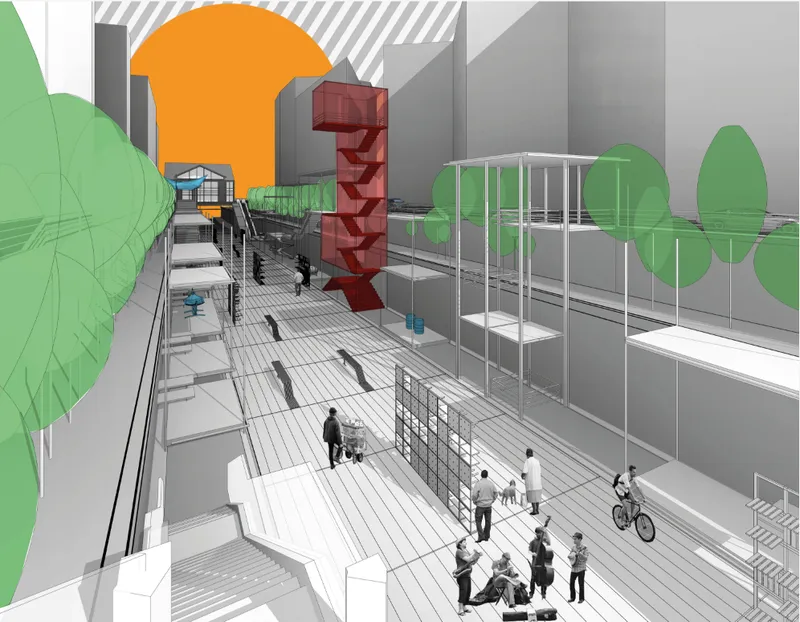
One of the most critical challenges of the site is its inherent linearity. Instead of resisting this condition, the design embraces it as an organizing principle. The railway corridor becomes a continuous spine that connects diverse activities and spatial moments.
This linear framework allows the project to function as a replicable model, extending beyond a single intervention into a scalable system that could be deployed across other segments of the Petite Ceinture. The continuity of movement and experience ensures that the space remains legible, navigable, and interconnected.
Modular Systems and Spatial Flexibility
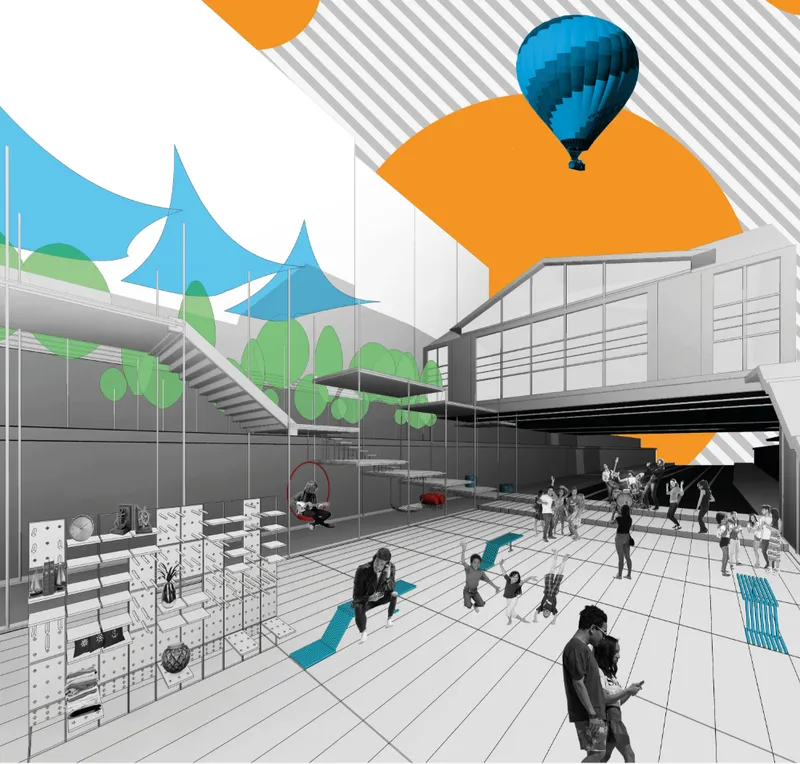
A defining feature of the project is its modular platform composed of foldable units. These units introduce a high degree of adaptability, allowing the space to transform according to user needs and temporal demands.
The same element can function as:
- Seating infrastructure
- Display units for marketplaces
- Shelter for vulnerable populations
- Aggregated enclosures for events
This multi-functionality positions the design within a systems-thinking approach, where architecture is not static form but a toolkit for evolving use.
The integration of a Voronoi-based logic further enhances spatial adaptability, enabling dynamic distribution of activities based on demand, density, and temporal conditions.
Programmatic Strategy and Public Life
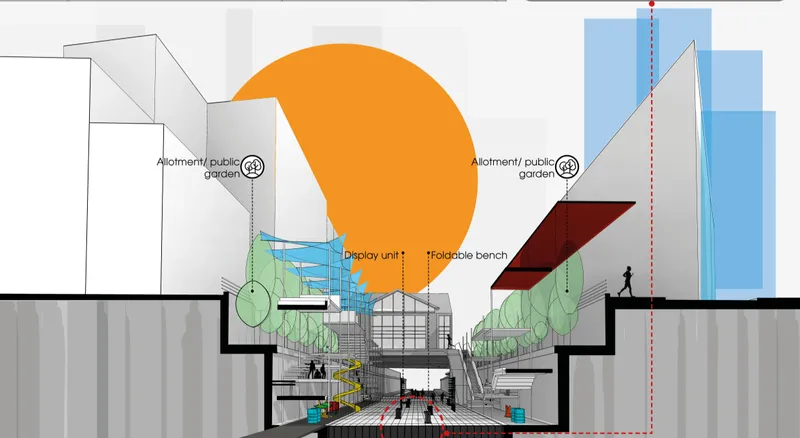
The project is structured into two primary layers:
- The Public Platform – A flexible ground plane that accommodates marketplaces, performances, leisure activities, and informal gatherings.
- Support Infrastructure – Scaffolding systems along the edges that house essential services such as circulation, storage, and public amenities.
This dual system ensures that the central space remains open and adaptable, while the periphery provides the necessary functional backbone. The result is a balanced ecosystem where freedom and structure coexist.
Sustainability and Cost Efficiency
Sustainability is embedded in both material and construction strategies. The use of recycled polycarbonate panels and prefabricated components reduces environmental impact while improving efficiency.
Off-site fabrication minimizes construction time and labor costs, while the modular nature of the system allows for easy maintenance, replacement, and scalability. The lightweight steel scaffolding further contributes to a reduced structural footprint.
This pragmatic approach ensures that the project remains economically viable while aligning with contemporary sustainable design practices.
Social Inclusivity and Urban Impact
A key strength of Un Nouveau Soleil lies in its inclusive design philosophy. The space is conceived to accommodate a diverse user base, including residents, tourists, informal vendors, and marginalized communities.
By allowing units to transform into shelters at night, the project addresses urgent urban issues such as homelessness, extending the role of public space beyond recreation into social support.
The intervention acts as a catalyst for community engagement, fostering interaction, collaboration, and shared ownership of the urban environment.
Digital Integration and Marketplace Logic
An additional layer of innovation is introduced through a digital application that governs marketplace operations. Users can register, select display units, and participate in the spatial economy of the site.
The system dynamically allocates space based on activity levels, events, and community needs, ensuring optimal distribution and utilization. This integration of digital infrastructure with physical space reflects emerging trends in smart urbanism.
Critical Reflection: Jury Perspective
While the project presents a compelling vision, it also raises important questions regarding execution and clarity.
Rachel Luchetti, juror, noted that the scaffolding structure lacks imagination and that the concept could be better articulated. This critique highlights the need for stronger formal expression and clearer communication of the design intent.
Such feedback underscores a broader challenge in adaptive urban design: balancing conceptual ambition with spatial clarity and architectural identity.
Un Nouveau Soleil exemplifies the potential of adaptive urban design to transform neglected infrastructures into vibrant public assets. By combining modular systems, participatory strategies, and sustainable construction, the project redefines how cities can engage with their past while designing for the future.
As urban environments continue to evolve, interventions like this offer valuable insights into creating resilient, inclusive, and dynamic public spaces that respond to the complexities of contemporary urban life.




Popular Articles
Popular articles from the community


Co-Life: Senior Housing Design That Reconnects Older Adults With the City
Co-Life reimagines senior housing design through healing gardens, shared streets, workshops, and a sustainable community across generations.

AL-JANNAH: Sustainable Architecture and Permaculture for Afghan Widows
AL-JANNAH uses sustainable architecture and permaculture to create resilient oasis of housing, learning, work and renewal for Afghan widows.

The Earth Pod: 3D Printed Homes for Resilient Refugee Communities
The Earth Pod reimagines refugee housing through 3D printed homes made from clay, combining resilience, self-sufficiency, and rapid shelter.

EW PARK: Sustainable Architecture Reimagines the Future of Urban Parking
EW PARK reimagines city parking as a modular wooden tower combining automation, solar energy, electric mobility, and adaptable urban design.


Similar Reads
You might also enjoy these articles

Eco Chapel: A Green Architecture Pavilion Designed in Symbiosis with the Forest
Eco Chapel uses green architecture to weave prayer, learning and reuse into a forest pavilion shaped by modular hexagonal canopies for life.
Kaffeebühnen: Coffee Shop Architecture Designed as a Civic Stage Between Vienna’s City and Park
Kaffeebühnen turns coffee shop architecture into a civic stage, linking Vienna’s park edge, urban life, warm timber yards, and coffee craft.
Healing Façade: Sustainable Architecture for Reforestation, Community, and Sacred Ecology in Ethiopia
Healing Façade reimagines sustainable architecture as a living wall that restores soil, catches water and renews Ethiopia's forest churches.


Urban Forest: A Vertical Ecosystem for 5,000 Workers in Singapore's Changi Business Park
Radially stacked pods and layered green decks turn a 7-acre plot into 47 acres of ecological workspace projected for 2040.

Comments (0)
Please login or sign up to add comments
No comments yet. Be the first to comment!