
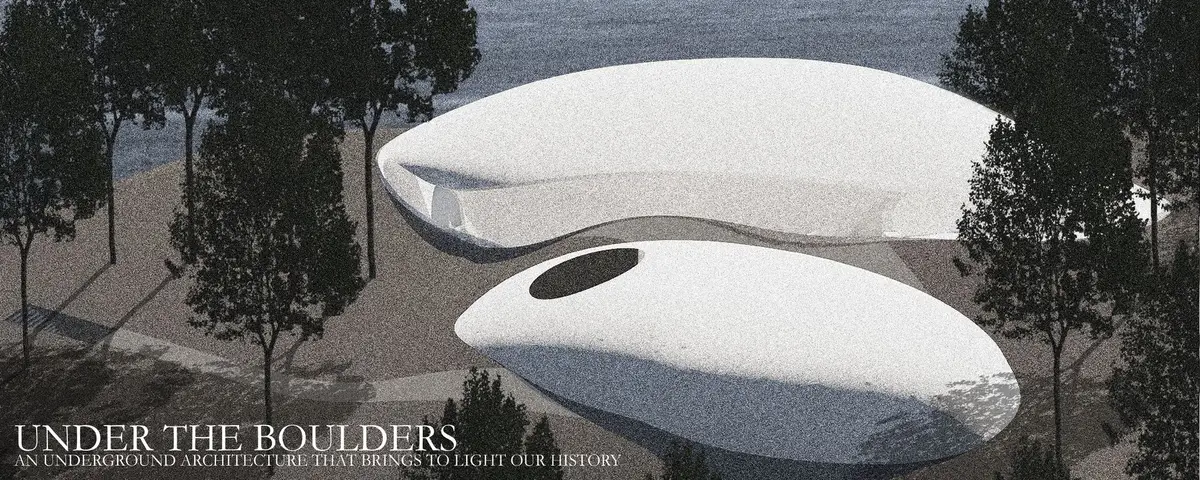
Under the Boulders: An Underground Observatory Carved Into the Remains of a 400-Million-Year-Old Impact
A shortlisted UnIATA '19 entry burrows beneath Cap Martin's granite boulders, pairing geological time below ground with starlight above.


Most observatories climb toward the sky. Under the Boulders digs down. The project treats the ground beneath Cap Martin as an archive and the night sky as a second one, then argues that the two record the same thing: time, made visible. The result is a geological and astronomical observatory tucked beneath enormous boulders, where descending into rock and looking up at the stars become a single act of looking back.
Designed by Sébastien Labbé and shortlisted in UnIATA '19, the proposal sits on the Quebec coast near the St. Lawrence River, inside the footprint of the Charlevoix Crater. Some 400 million years ago a meteorite struck this territory, and the Mont des Éboulements that rose from the impact remains one of the best-preserved central uplifts in the world. Labbé takes that inaccessible heritage as his brief: to make it legible, occupiable, and shared by amateurs and professionals from different disciplines.
A Headland Annotated as a Diagram of Earth and Sky

The opening image does the conceptual work in a single frame. A black-and-white photograph of the granite headland is overlaid with hand-drawn arrows pointing to the observatory, the stars, the access train and the granite itself. The building barely registers as an object; it is a position within a system. Rock below, sky above, and a route that threads visitors between them.
That restraint matters. By letting the boulders remain the dominant figure on the landscape, Labbé makes the case that the architecture's job is to reveal rather than to announce. The reception at the surface is meant to blend into the terrain, so the first experience of the project is the site, not the building.
Reading the Crater From Orbit

A rendering of a meteor impact seen from orbit sits beside a satellite relief map of the coastal region, and the pairing frames the project's scale of thought. The crater is invisible from the ground, readable only from far above. Cap Martin, with its metamorphic rock shaped by the impact, is one of the few places where that planetary event surfaces at human scale.
Labbé anchors the idea with a line from astrophysicist Jean-Pierre Luminet: "A star that is 1,000 light-years away appears to us as it was a thousand years ago." Starlight and stratified rock both deliver the past into the present. The observatory simply puts visitors in a place where they can hold both at once, moving through layered rock where history is not only visible but physically close.
A Vault Cut Into Solid Ground
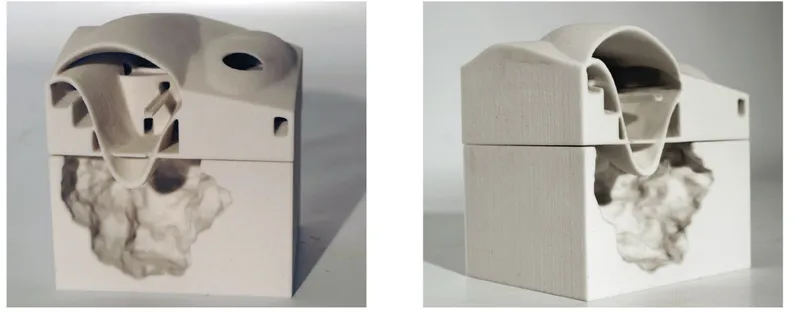
The 3D-printed section model shows the project's spatial core: a smooth, curved vault cut into the block above a rough, cave-like void. The contrast is deliberate. The upper chamber reads as carved and controlled, the lower as found and geological, and the section stacks them so the visitor experiences the shift from made space to raw earth as a descent.
This is where the three layers of the programme take shape. Reception sits at the surface; multimedia rooms and exhibition spaces occupy the deeper levels; an underground garden and coffee shop offer a quieter register at the end of the journey. Natural light filters through openings to guide movement, and the boulders overhead act as a protective shell, giving the interiors a meditative stillness that a conventional museum rarely achieves.
Plaster as a Stand-In for Geological Process
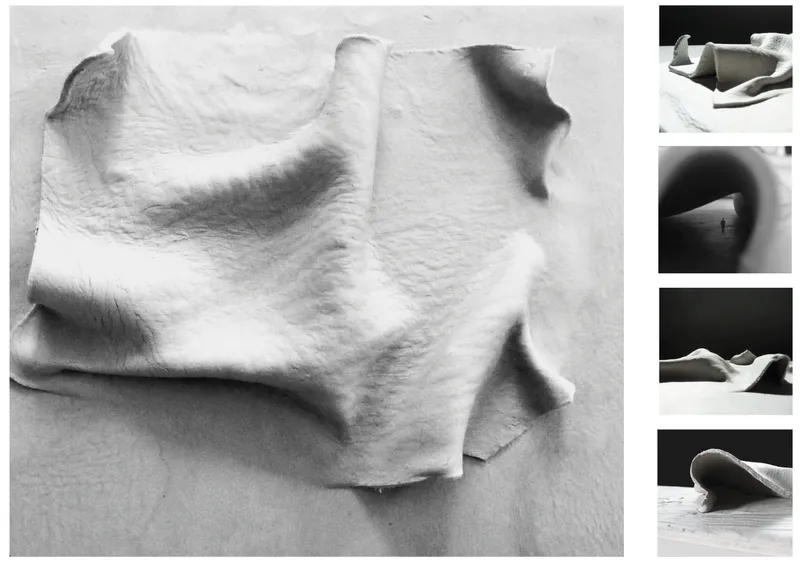
Rather than drawing a form and fitting it to the site, Labbé began by abstracting the geological processes themselves. The draped plaster sheet, folded and creased, captures something closer to how rock actually behaves under pressure: it buckles, compresses and sets. The four small edge views, with a tiny figure for scale, show how these accidents of the material become inhabitable ridges and hollows.
The method gives the project its credibility. Plaster records the tactile and visual quality of the ground directly, so the organic form that emerges feels less like a stylistic choice and more like a continuation of the terrain. Architecture and geology are not merely placed side by side here; the design process forces them to share a vocabulary.
Why This Project Matters
Underground architecture is often justified by efficiency or by keeping a low profile in sensitive landscapes. Under the Boulders offers a richer argument: going below ground can be the most direct way to understand a place. By building into the remains of a meteorite impact, the project turns an inaccessible geological heritage into a public experience while leaving the landscape's surface largely intact.
What stays with you is the coherence between method and meaning. The plaster studies, the carved section and the annotated headland all describe the same idea from different angles: that rock and starlight are both time capsules, and that architecture can place a person between them. For a shortlisted competition entry, that clarity of intent is exactly what makes it worth revisiting.
View the Full Project
About the Designers
Designer: Sébastien Labbé
Enter a Design Competition on uni.xyz
uni.xyz runs architecture and design competitions year-round that reward proposals with spatial conviction and real site intelligence.
Project credits: Under the Boulders by Sébastien Labbé UnIATA '19 (uni.xyz).


Popular Articles
Popular articles from the community


Singing Woman: An Opera House That Performs Before the Curtain Rises
Ovidiu Cristian Pavel's conceptual opera house translates Estonia's choral identity into a sculpted waterfront landmark facing the Baltic Sea.

The Amber Palace Opera: A Geological Fiction Surfaces on Tallinn's Baltic Waterfront
Pierre Brillard reimagines a Baltic legend as a public landscape, opera house, and waterfront promenade rooted in Tallinn's coastal identity.

Manzana Morphosis: Stretching Barcelona's Grid into a Living Landscape for 2050
A radical reworking of the Eixample manzana turns density into a tool for generous public space, vertical ecology, and environmental performance.


David Ortega Stacks a Two-Story Mexico City Penthouse Around a Steel Stair and a Pergola-Shaded Roof Terrace
In Colonia Roma, a 300 m² penthouse uses oak joinery, a planted steel stair and a slatted roof pergola to make a new-build apartment feel like a house.

Similar Reads
You might also enjoy these articles
Healing Façade: A Modular Chapel System That Restores Ethiopia's Sacred Forests
Winner of the Eco-Chapel competition, this circular timber façade collects water from air to rebuild soil and reforest degraded Ethiopian landscapes.
Kaffeebühnen: Where Coffee Shop Architecture Becomes a Civic Stage in Vienna
A linear sequence of timber boxes, transparent shells, and open yards turns the Viennese café tradition into a public performance space.
Eco Chapel: A Modular Forest Pavilion That Grows Like the Landscape It Protects
Hexagonal timber modules weave through existing trees, turning a chapel into a living system for prayer, education, and reforestation.


Urban Forest: A Vertical Ecosystem for 5,000 Workers in Singapore's Changi Business Park
Radially stacked pods and layered green decks turn a 7-acre plot into 47 acres of ecological workspace projected for 2040.

Explore Architecture Of Time Competitions
Discover active competitions in this discipline

Challenge to design locus for the upliftment of human rights

Design challenge to reuse E-waste
Comments (0)
Please login or sign up to add comments
No comments yet. Be the first to comment!