

University Catholic Stadium Modernization by IDOM – A Sustainable Transformation of Chile’s Iconic San Carlos de Apoquindo
A sustainable stadium transformation preserving original structure while adding lightweight timber expansions, improved sightlines, and circular construction strategies for a modern multipurpose arena


The University Catholic Stadium Modernization Project, designed by IDOM, redefines the historic San Carlos de Apoquindo Stadium in Las Condes, Santiago de Chile. Originally inaugurated in 1988, the stadium occupies a dramatic site between the Andes foothills and Manquehue Hill, partially embedded into the sloping terrain. The modernization responds to the club’s ambition to elevate the venue from a traditional football ground to a contemporary, multifunctional, and sustainably engineered arena capable of year-round activity.
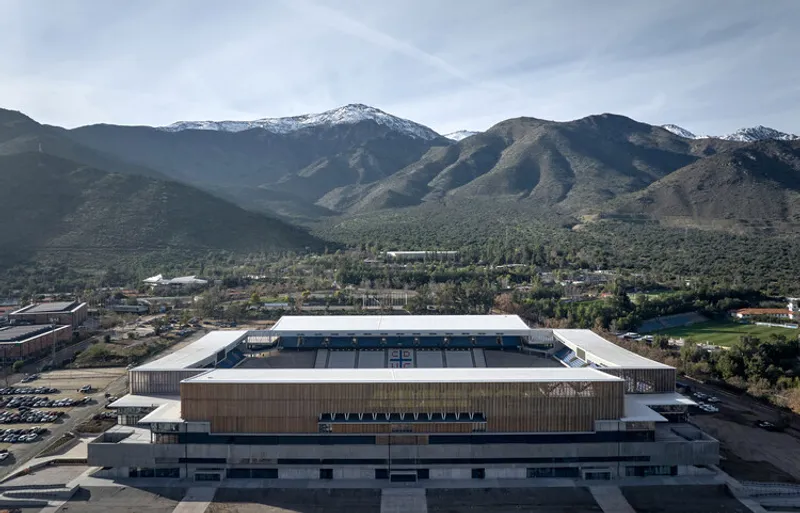

A Competition-Winning Design for a New Era of Sporting Architecture
To increase capacity from 12,000 to 20,000 spectators and enhance global-quality infrastructure, the club commissioned a design competition. IDOM’s winning proposal reimagines the stadium as a flexible, climate-responsive, and technologically advanced venue, integrating modern hospitality, media facilities, and community-oriented spaces.
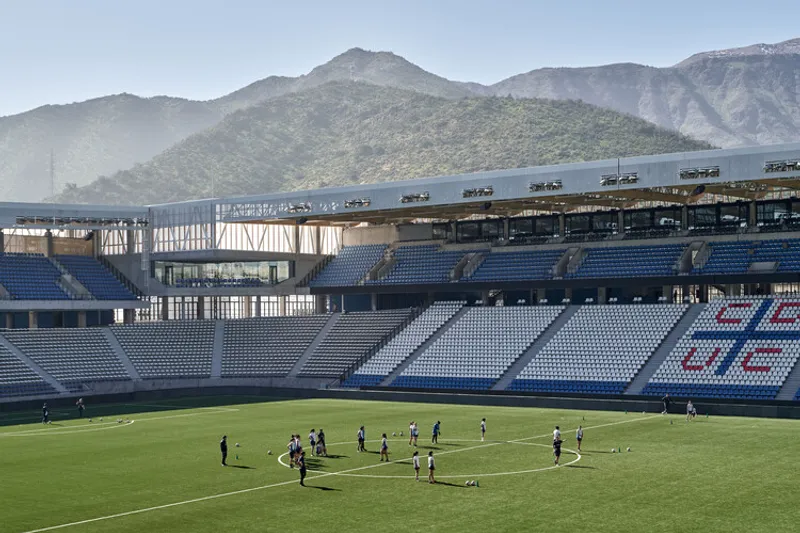
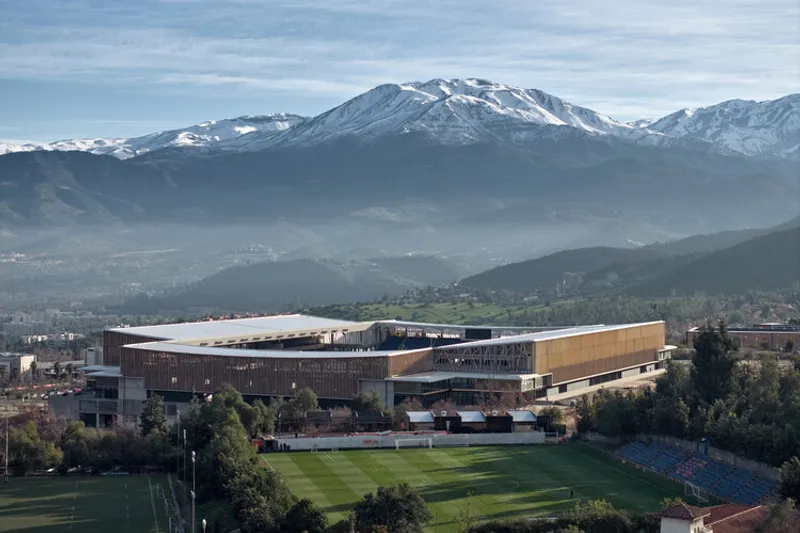
The design had to respect the footprint of the original building while introducing new circulation, accessibility, upgraded viewing conditions, and spaces that allow the stadium to function as a multipurpose civic hub beyond match days.
Strategy: Preserve the Past, Build Lightly Above
IDOM chose a rational and sustainable strategy, preserving the vast majority of the existing concrete structure—still healthy and structurally sound—while constructing a new perimeter boulevard at the Fouilloux level.
- Below the boulevard: the original stands and circulation systems remain.
- Above it: a new lightweight, permeable superstructure houses expanded seating, boxes, hospitality zones, and technical spaces.
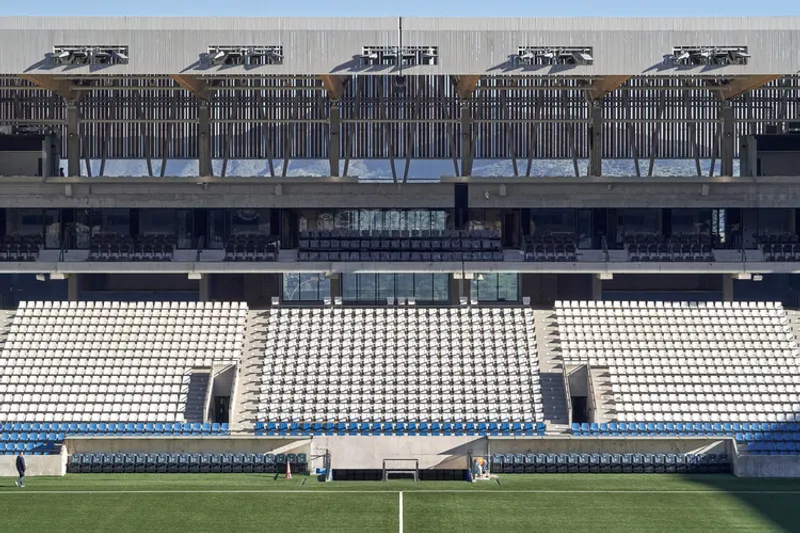
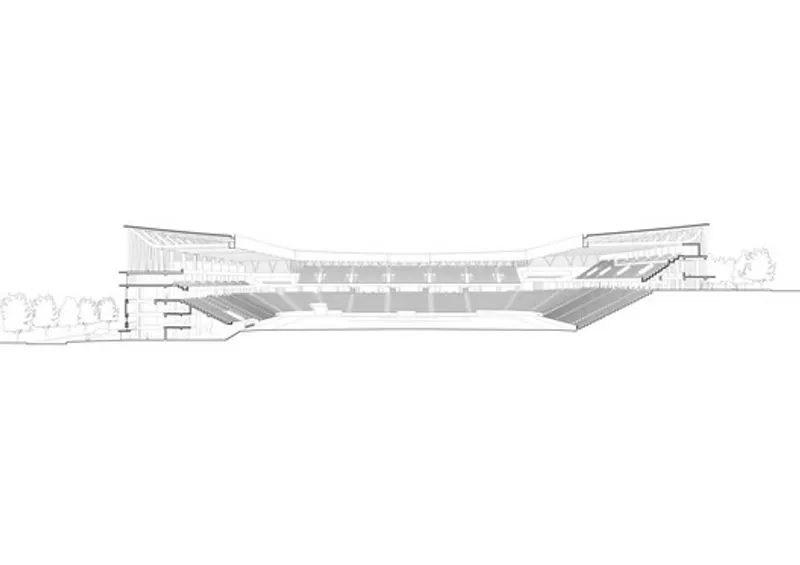
This approach minimizes demolition, reduces environmental impact, and honors the character of the historic bowl while opening new space for vertical expansion.
Geometry, Sightlines, and Enhanced User Experience
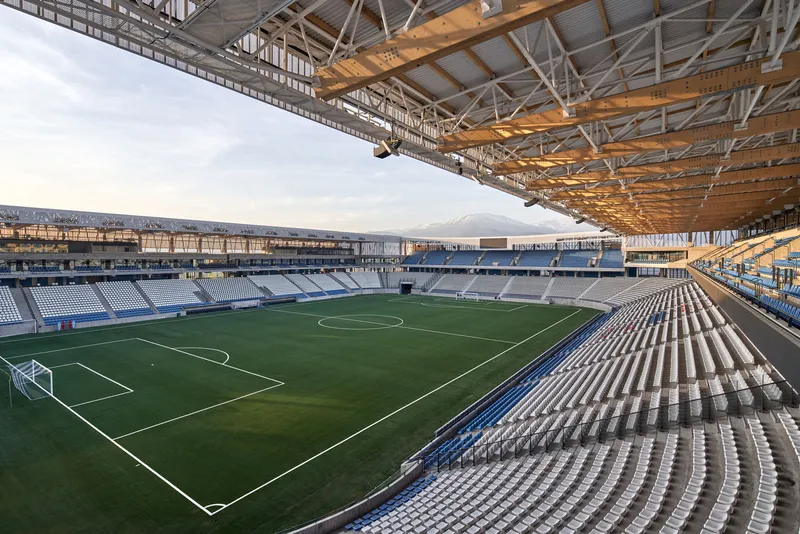
The renovated stadium adopts a rectangular configuration, ideal for football, optimizing sightlines and spatial efficiency. Remarkably, 95% of the original sightlines are preserved.
The corners become signature multifunctional spaces, serving as access nodes and vantage points with panoramic views toward both the field and the surrounding Andean landscape. These rooms are designed to function independently on match days, supporting conferences, events, and community programs.
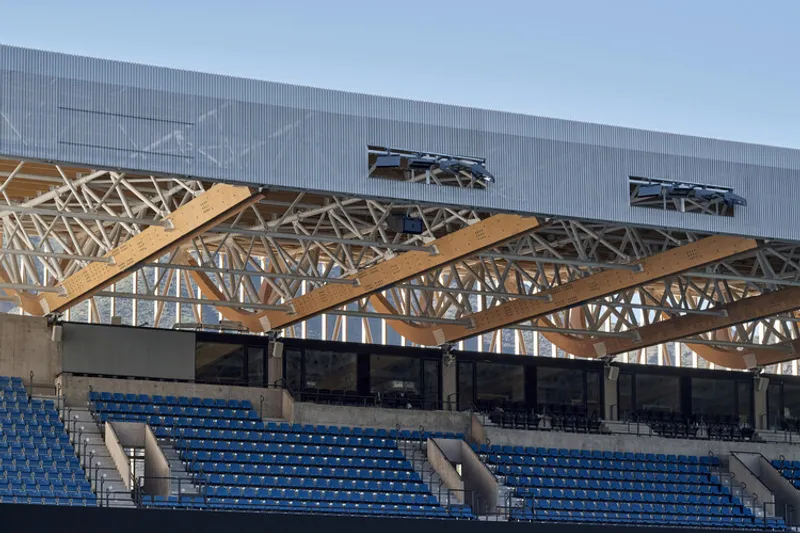
In the Livingstone sector, the expansion grows both above and below the boulevard, integrating:
- Locker rooms
- Press and media facilities
- Premium hospitality
- Technical and operations areas
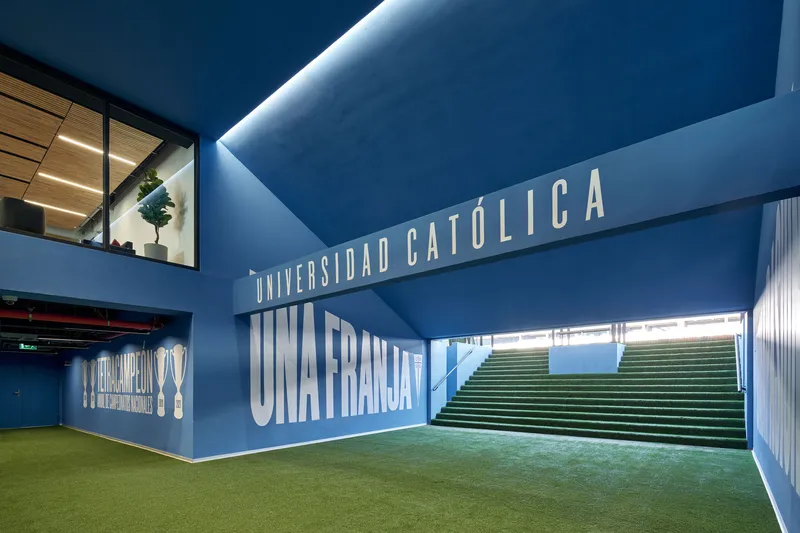
Material Logic: Concrete, Steel, and Laminated Wood in Harmony
The structural and material palette emphasizes minimal intervention and maximum efficiency:
Structural Framework
- Existing concrete retained as primary structural support
- New concrete beams and columns articulate the expansion around the bowl
- Corners use hybrid inverted concrete + steel systems, optimizing force distribution and respecting height restrictions


Envelope Design
The stadium’s façade balances aesthetics, performance, and environmental comfort:
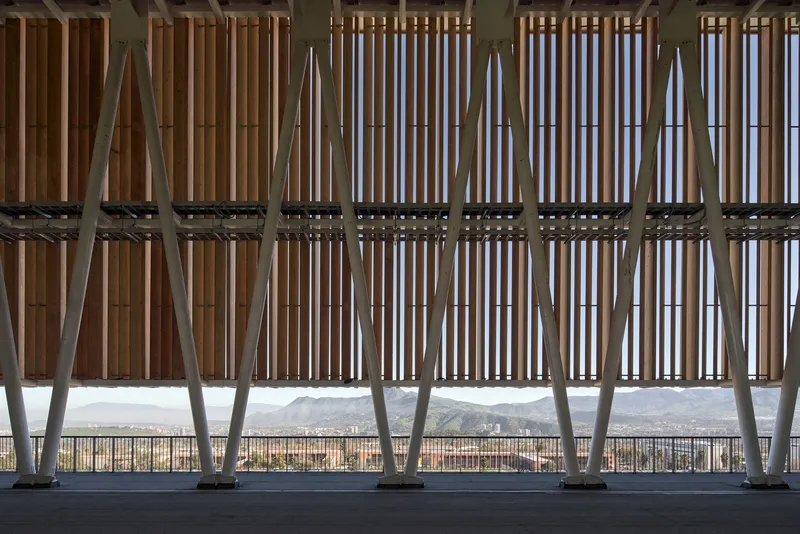
- Laminated radiata pine vertical slats spaced at one-meter intervals
- Integrated LED lighting for night-time identity
- Orientation-specific design incorporating solar frames, acoustic treatments, and ventilation openings
- A continuous concrete base strip grounding the façade composition
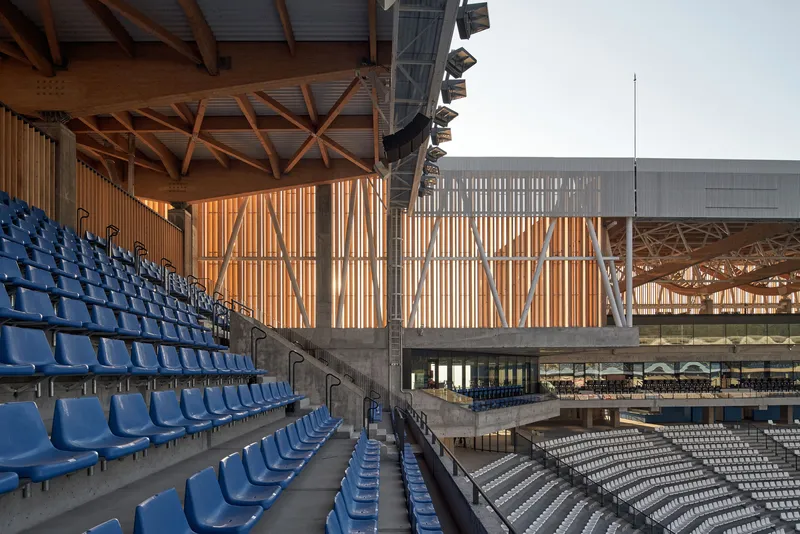
Roof Structure
Designed for seismic resilience, the roof uses:
- Laminated wood beams spanning 17 m at the rear
- Three-dimensional steel + wood structures spanning up to 31 m at the sides
- Lightweight metal sheeting and TPO waterproofing
The hybrid roof system takes advantage of the flexural performance of wood, reducing the need for steel connections and decreasing embodied carbon.

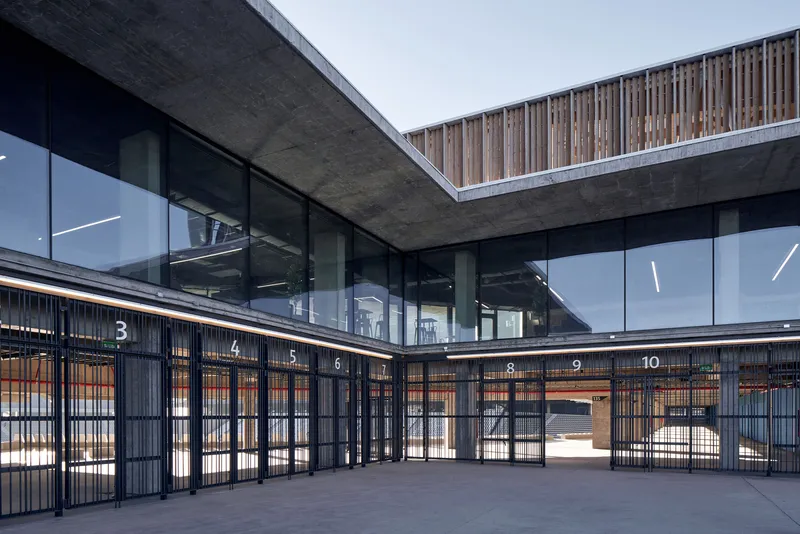
Sustainability & Circularity – A New Benchmark for Stadium Design
The modernization embeds deep sustainability principles across the project:
- Reuse of the existing concrete structure
- Recycling of steel from the old roof
- Recycling of plastic from outdated seats
- Minimized excavation and footprint
- Optimized energy and water systems
- Use of 1,600 m³ of Chilean laminated wood that stores over 1,500 tons of CO₂

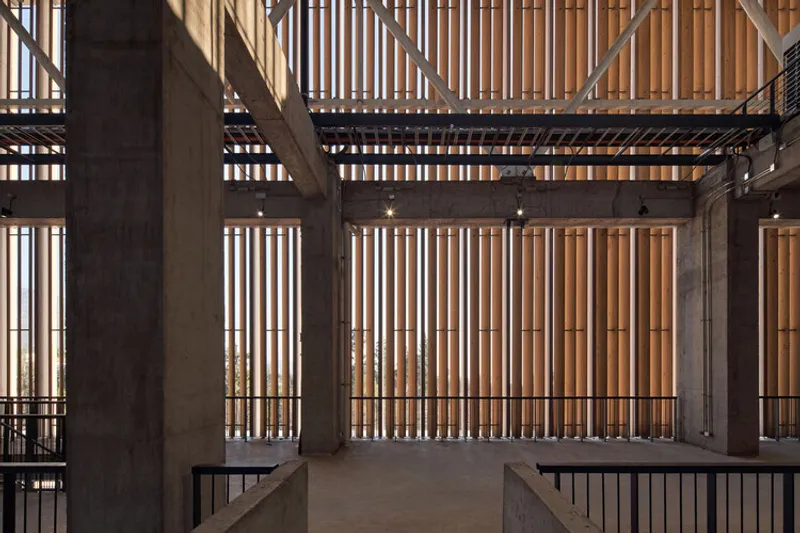
Beyond environmental metrics, the project stimulates local industry, strengthens circular economies, and positions wood as a viable structural material for large-scale public buildings in Chile.


All the Photographs are works of Cristóbal Palma


Popular Articles
Popular articles from the community


Tsunami Convergenics: Turning Catastrophic Ocean Forces into Underwater Housing Infrastructure
A speculative underwater settlement off the coast of Onagawa, Japan, treats tsunamis and typhoons as energy sources rather than threats.

Manzana Morphosis: Stretching Barcelona's Grid into a Living Landscape for 2050
A radical reworking of the Eixample manzana turns density into a tool for generous public space, vertical ecology, and environmental performance.

Opera by the Sea Estonia: Three Shells Dissolving Architecture into Tallinn's Coastline
A winning opera house proposal replaces monumental form with interconnected shells that blur the boundary between building, park and Baltic Sea.

Extended Shell: Retrofitting Kolkata's Balconies as Living Urban Thresholds
A modular retrofit system recovers the social and environmental intelligence of Kolkata's historic verandas for contemporary Park Street residents.

Similar Reads
You might also enjoy these articles


Hodi-Mandai Geram
Project Function: Preservation and revitalization of the Intangible heritage and socio-spatial identity of the Hodi by Housing, Cultural Memory Center, Sacred Grove, landscape, local tourism economy


Olio Towers: A Mid-Rise for Performers That Fuses Housing, Rehearsal, and Stage
Located blocks from Houston's Theater District, this modular tower stacks living units around a central performance atrium.

Oasis: Modular Green Housing Carved into Dhaka's Urban Fabric
A shortlisted Plugin Housing entry reclaims unauthorized settlements in Dhaka with stepped concrete volumes, green roofs, and ventilation-driven design.

Black Hole: A Floating Megastructure for the Post-Physical Era
Emiliano Mazzarotto envisions a spherical, self-scaling arena where e-sports, digital hotels, and holographic stadiums replace traditional public space.

Explore Stadium Competitions
Discover active competitions in this discipline

Challenge to design a barrier free sports center

Challenge to design an outdoor ice-rink and park

Challenge to reimagine the Iron Throne

Photograph architecture without architects
Comments (0)
Please login or sign up to add comments
No comments yet. Be the first to comment!