
Urban Circus: A Nomadic E-Sports Arena That Turns Cities Into Playgrounds
A lightweight, itinerant structure brings holographic gaming environments to public squares, merging spectacle with urban adaptability.


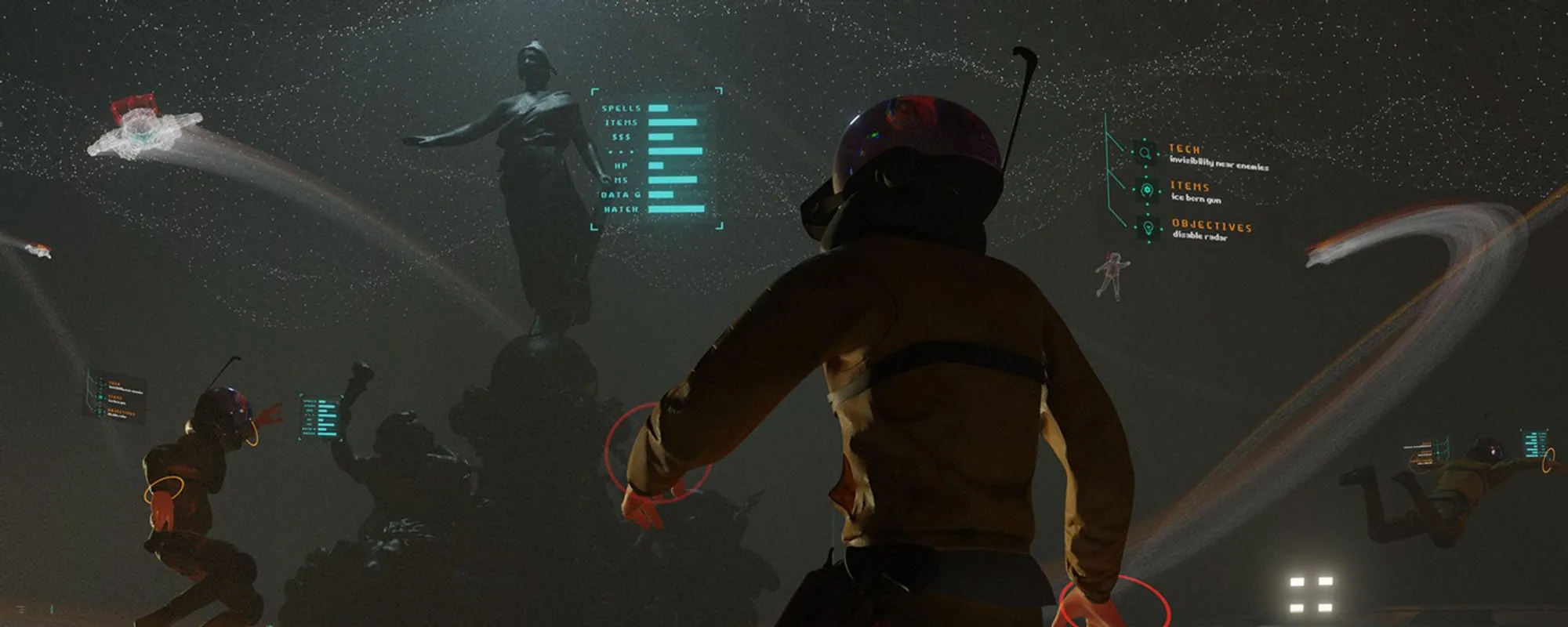
What if the stadium came to you? Urban Circus abandons the fixed-seat, big-screen model of e-sports venues and replaces it with something far stranger and more compelling: a travelling, tent-like structure that drops into city squares, projects holographic game environments onto its interior surfaces, and lets spectators wander freely through the action. There are no rows of chairs, no distant screens. The audience is inside the game, moving through a mixed-reality space where digital projections wrap around real bodies in real time.
Designed by Antoine Wojtowski and Bruno Timoteo, the project was shortlisted in The Digital Colosseum 2020, a competition that challenged entrants to reimagine the arena for a digital age. Set against a projected 2050 scenario of extreme urbanization and diminishing public space, Urban Circus proposes a venue that is deliberately impermanent, occupying civic spaces temporarily before moving on, leaving the city exactly as it found it.
Inside the Vault: Spectators as Participants
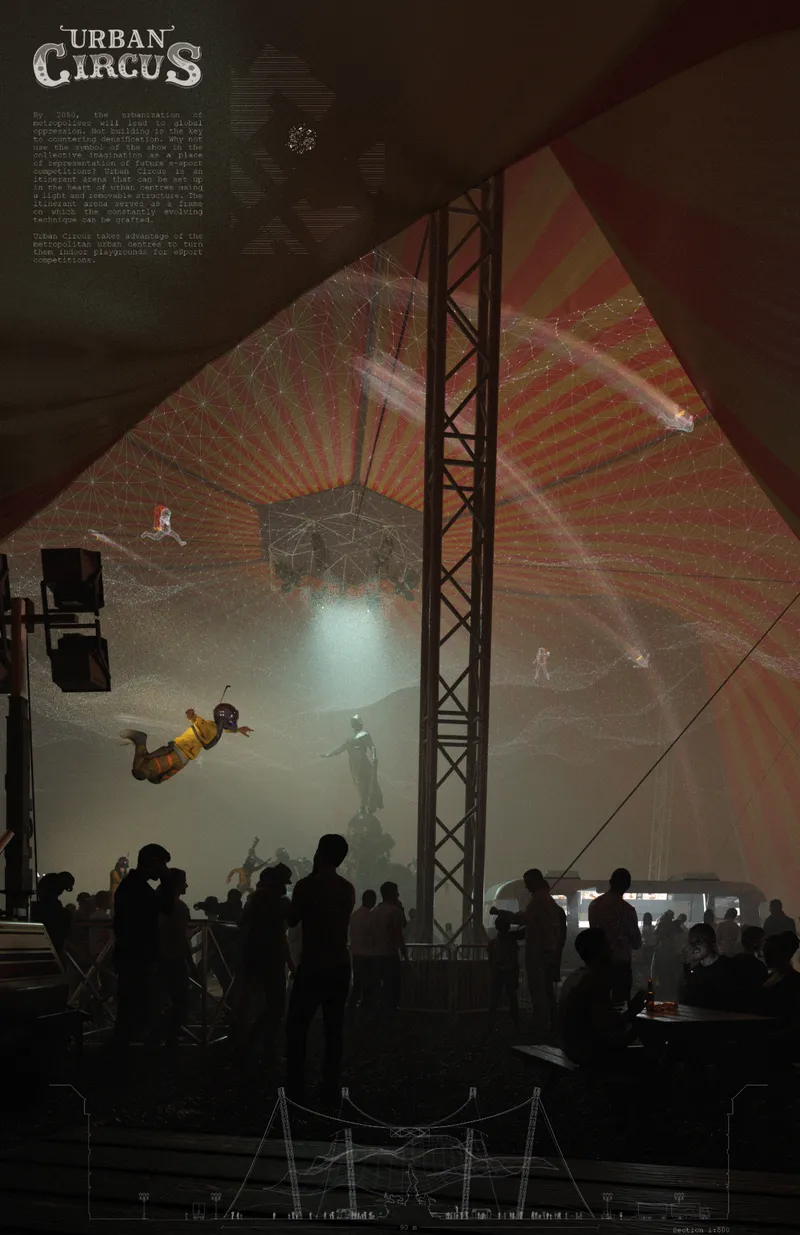
The interior view reveals the core spatial proposition. A vaulted ceiling, painted with bold circus-stripe projections in red and yellow, arches over a standing crowd. An acrobatic figure flies overhead, blurring the line between live performance and digital overlay. The space has no fixed seating, no stage, no obvious front or back. Spectators are distributed throughout the volume, each experiencing the event from a different vantage point. The holographic projections do not sit on a screen at the far end of a hall; they occupy the architecture itself, turning walls and ceiling into a continuous game surface.
This inversion of the traditional arena layout is the project's strongest move. By removing the hierarchy between performer and audience, Urban Circus makes the social dimension of e-sports palpable. You are not watching a stream. You are standing in the middle of it, surrounded by other people doing the same thing, negotiating a shared physical space while a virtual one unfolds around you.
A Facade That Advertises Itself
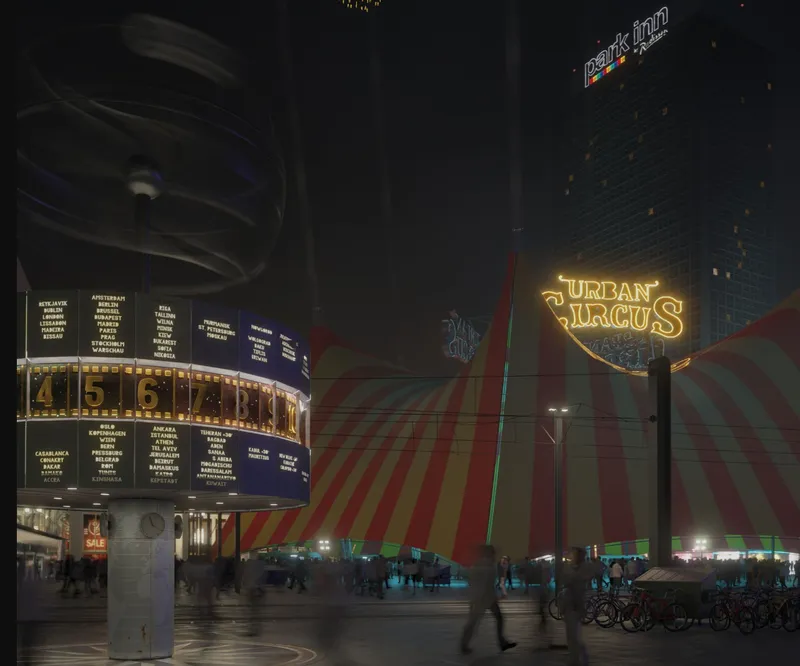
The night view of the facade shows how Urban Circus communicates with the city around it. Against a dark brick backdrop, illuminated signage and projected red-and-yellow stripes signal the event to passersby. The structure does not try to blend in. It borrows the visual language of the circus tent and the fairground marquee, codes that are universally legible as temporary, festive, and open to the public. The lighting treatment turns the facade into a beacon, readable from a distance, pulling foot traffic inward.
The choice of a circus aesthetic is deliberate and smart. Circuses have always been nomadic, always provisional, always spectacle-driven. By aligning e-sports with that lineage, the designers frame competitive gaming not as a niche subculture but as a popular entertainment tradition with deep roots in itinerant performance.
Lightweight Canopy, Heavy Ambition
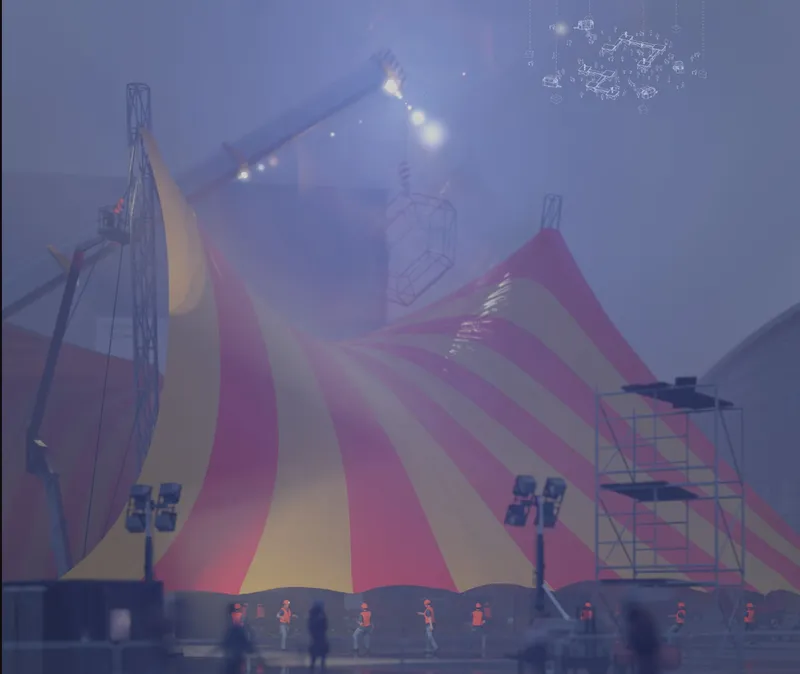
The exterior view in evening fog makes the structural logic legible. A striped canopy stretches over the site like a contemporary big top, its tent-like profile immediately recognizable. Pedestrians move casually beneath and around it, reinforcing the idea that this is not a fortress or a private club but an open insertion into the public realm. The structure reads as lightweight and removable, consistent with the project's core promise: it can be erected in a city square, outside a landmark, or along a waterfront, then dismantled and shipped elsewhere without permanent alteration to the site.
This portability addresses a real tension in urban development. As cities grow denser, dedicating large plots to single-use stadiums becomes harder to justify. Urban Circus sidesteps the problem entirely. It does not need its own land. It borrows civic space for a limited duration, generates cultural activity, and then disappears, leaving the sidewalk or plaza available for its next use.
Mixed Reality as Spatial Strategy
The technological premise of the project rests on a specific bet: that by 2050, holographic projection will be mature enough to replace screens entirely. If that bet pays off, the spatial consequences are significant. Screens enforce a single focal direction. Holography is omnidirectional. It fills volume rather than occupying a plane. Urban Circus is designed around that volumetric logic, giving spectators freedom of movement because the visual information surrounds them rather than sitting at one end of a hall.
Whether or not the timeline is accurate, the architectural argument holds. The project identifies a genuine mismatch between the spatial conventions of current e-sports venues and the immersive potential of the medium they host. Even today, the best e-sports experiences involve rich, three-dimensional digital worlds. Watching them on a flat screen from a fixed seat is an oddly regressive way to engage with that content. Urban Circus proposes the spatial format the medium deserves.
Why This Project Matters
Urban Circus matters because it refuses to treat the arena as a building problem. It treats it as an urban problem, a social problem, and a media problem simultaneously. The nomadic format protects public space from permanent privatization. The removal of fixed seating transforms spectators into active participants. The holographic projection strategy aligns the physical venue with the spatial logic of the games it hosts. Each decision reinforces the others.
Wojtowski and Timoteo have produced a provocation that is specific enough to be critiqued and imaginative enough to open new lines of thinking about what entertainment venues can be. In a discipline that too often treats e-sports architecture as a branding exercise, wrapping conventional halls in futuristic skins, Urban Circus asks a more fundamental question: what kind of space does a born-digital spectacle actually need? The answer, it turns out, might look a lot like a circus.
View the Full Project
About the Designers
Designers: Antoine Wojtowski, Bruno Timoteo
Enter a Design Competition on uni.xyz
uni.xyz runs architecture and design competitions year-round that reward proposals with spatial conviction and real site intelligence.
Project credits: Urban Circus by Antoine Wojtowski, Bruno Timoteo The Digital Colosseum 2020 (uni.xyz).




Popular Articles
Popular articles from the community


The Earth Pod: 3D Printed Homes for Resilient Refugee Communities
The Earth Pod reimagines refugee housing through 3D printed homes made from clay, combining resilience, self-sufficiency, and rapid shelter.

Co-Life: Senior Housing Design That Reconnects Older Adults With the City
Co-Life reimagines senior housing design through healing gardens, shared streets, workshops, and a sustainable community across generations.

Conexión: Biophilic Design Reimagines High-Rise Living in Hong Kong
Conexión reimagines high-rise living in Hong Kong through biophilic design, green facades, shared spaces, daylight, water and nature within.

The Musturak Paradise: Senior Living Architecture for a Connected Future in Temara, Morocco
The Musturak Paradise reimagines senior living architecture in Temara via private homes, social spaces, culture, community, and shared care.


Similar Reads
You might also enjoy these articles

Day and Night Park: A Time-Based Urban Newsstand in Beijing
A temporary urban newsstand in Beijing blending travel, light, and reading through poetic colors, compact form, and community-focused design.

Modernist Patio Renovation in El Masnou, Barcelona by Oliver Segura Arquitectura + Cebrià Arquitectura
Modernist patio renovation blending tradition and innovation with a movable pool, leveled floors, and Catalan materials in El Masnou.

Alto Residencial Coop: Cooperative Housing Development in Santiago de Compostela by Carbajo Barrios Arquitectos
A linear cooperative housing complex blending white volumes and perforated metal façades, enhancing community living, natural light, privacy, and urban integration.
Vil Genis School by BPA ARCHITECTURE – Massy, France
Vil Genis School in Massy, France, features sustainable design, south-facing classrooms, community integration, accessible spaces, and modern educational architecture.

Explore Urban Circus Competitions
Discover active competitions in this discipline



Challenge to reimagine the Iron Throne


Photograph architecture without architects


Illustrate the lost glory of Angkor Wat - Render Challenge


Design challenge to reuse E-waste
Comments (0)
Please login or sign up to add comments
No comments yet. Be the first to comment!