

Urban Farming Architecture: The Future of Sustainable Housing
Where sustainability, affordable housing, and urban farming unite to redefine modern living for eco-conscious young professionals.


Rent a room. Farm the floor above. If you cannot pay this month, trade hours on the grow-beds instead. Farm/House, A Hustle Hub for Young Hustlers, designed by Amelia Aussie and Daniel, turns urban farming from a hobby into a housing strategy. The project proposes a pair of towers where rooms and grow-beds are stacked together, and the unrented spaces are not empty: they are cultivated.
Shortlisted in the Hustle Hub '19 competition on uni.xyz, Farm/House sits in Moscow's ZIL District and argues that the most flexible thing a co-living building can offer its young residents is not a gym or a coworking lounge. It is soil. A residential floor you can rent, and a farming floor you can work, and a system that lets you move between the two depending on what you have this month: cash, time, or hunger.
The Site: Two Towers on the Moskva
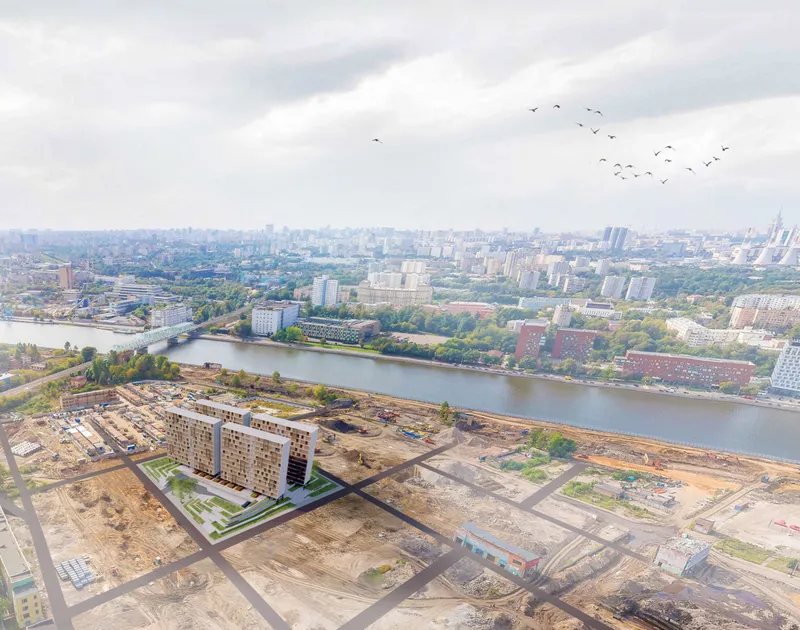
The aerial site collage shows the two Farm/House towers rising from the ZIL District along the Moskva River, with Moscow's skyline behind. The towers are slender rather than bulky, because the building type is not a block of flats. It is a vertical farm with housing threaded through it. The narrower the plate, the more sunlight reaches the grow-beds and the more daylight reaches the bedrooms. The form follows the plants.
The choice to place the project in ZIL is strategic. The district is Moscow's most visible post-industrial redevelopment, a former car factory being converted into mixed-use neighbourhoods. It is also the site of the 2019 Hustle Hub brief. Farm/House uses the ZIL context to make a broader point: when a city rebuilds a district from scratch, it should not only ask what kind of housing belongs there. It should ask what kind of labour belongs there, and who does it.
The Stack: Housing, Farming, Landscape
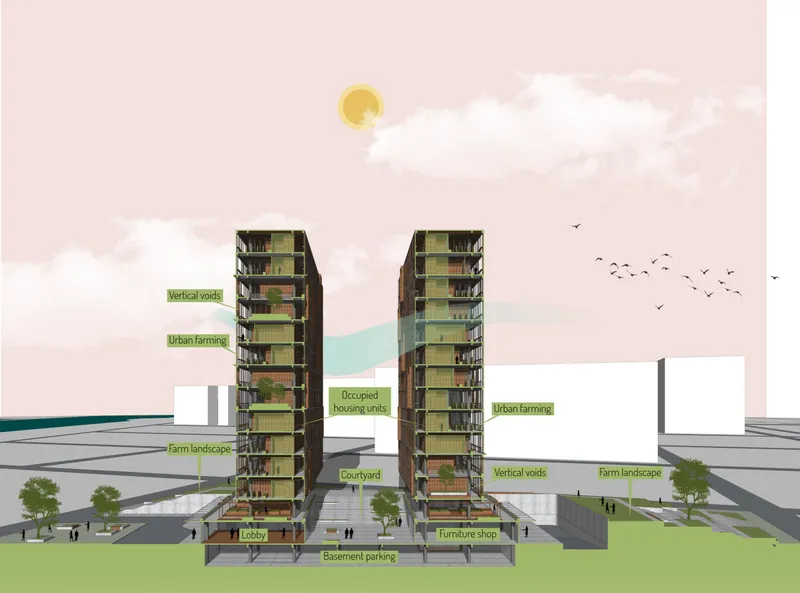
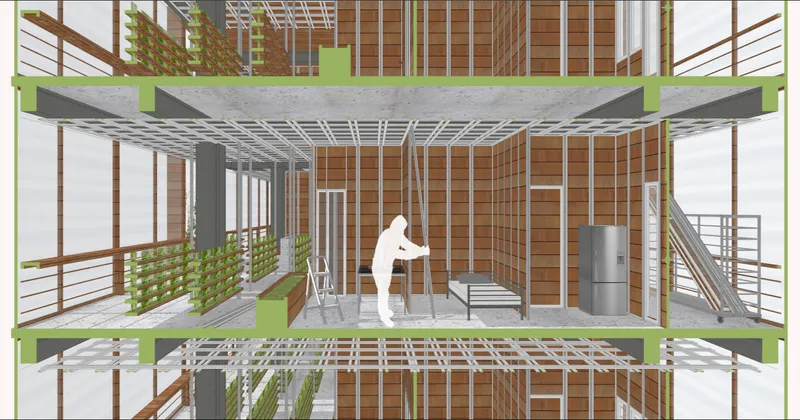
The labelled diagram is the project's clearest explanation of what is inside the towers. Stacked zones identify occupied housing units, urban farming floors, vertical growing walls, and landscaped ground spaces. The section cutaway shows how the two programmes interlock at every level. Housing rooms and farming rooms share the same staircases. Residents move between the two without needing to leave the building.
This is the part of the project that makes the economic model credible. Farm/House is not a tower with a rooftop garden. It is a tower where every floor is partly a garden. The urban farming is not an add-on. It is the plan. And because the farming is integrated, the owners can rent or unrent any floor as demand fluctuates, and the unrented floors go back to growing food instead of sitting empty. The occupancy rate no longer determines the building's productivity.
The Farming Floor: A Corridor of Greens
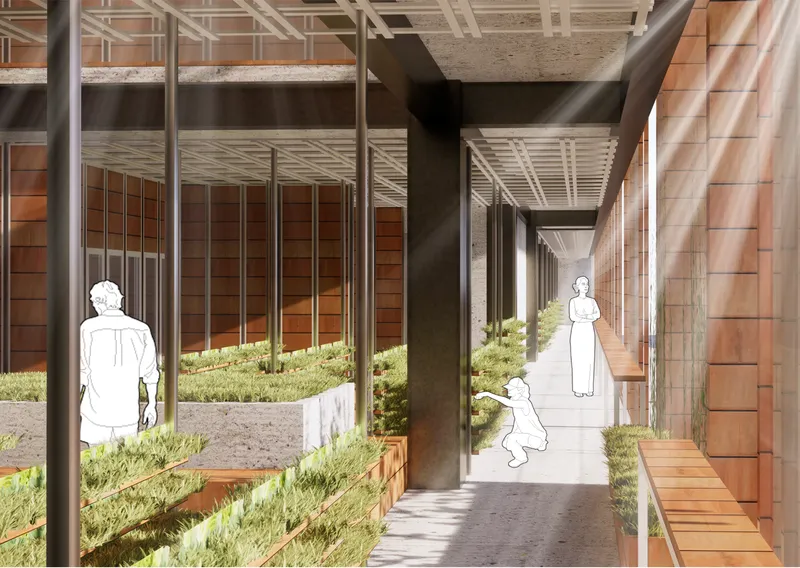
The interior farming corridor is the project's most intimate drawing. A long passage runs between timber frames and grow-light panels. Raised planters line both sides. Residents tend rows of leafy greens beside a wooden bench. The corridor is lit from above, and the timber keeps the atmosphere closer to a greenhouse than a factory. This is what daily work inside the building looks like.
The corridor format matters. A farming floor organised as a corridor, rather than as an open hall, is much easier to integrate with housing because the circulation path is already there. Residents pass the plants on their way home. They water a few planters, pick some herbs for dinner, and continue to their room. The friction between farming and living is minimised. The garden is on the commute.
The Ground Level: A Shared Courtyard
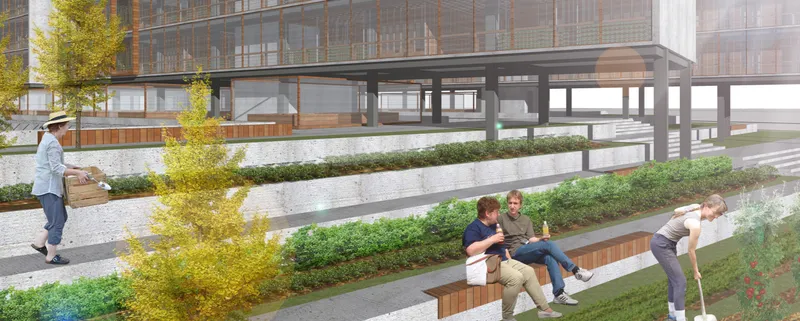
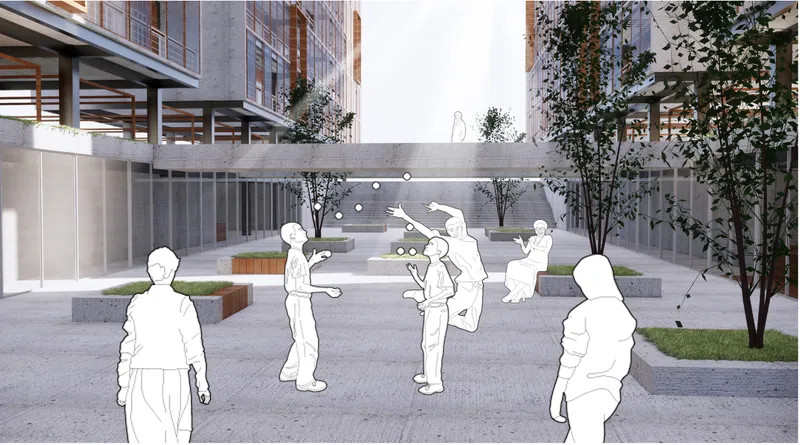
The ground-floor landscape render shows the outdoor public realm. Stepped planters line a garden path beneath the raised housing block. Residents read on benches and tend herbs in the foreground. The courtyard between the two towers, shown in the second render, is full: people playing, talking, and relaxing among trees and raised planters. The ground level is not just a lobby. It is a small agricultural plaza open to the neighbourhood.
This is where Farm/House extends beyond its own residents. The ground-level farming and plaza are public. Neighbours can walk through, buy fresh produce at the fresh market, and use the courtyard as a green public space in a district that does not have many. The towers are not a fortress. They are a source of food and shade for the blocks around them, and that porosity is what makes the co-living model socially legitimate.
Why This Project Matters
Most co-living proposals in the Hustle Hub competition focused on how to lower rent or how to build community. Farm/House focused on what you are supposed to do in a building if you cannot pay rent and you do not know anyone. The answer it gives is: you work the farm. That answer reframes the entire typology. Co-living becomes not just a place to live cheaply, but a place to produce something of value while you live there.
For anyone studying urban farming architecture, circular economy housing models, or adaptive co-living typologies, Farm/House is a useful reference. It does not sprinkle planters onto a generic apartment block. It interleaves the farm and the home so closely that the two programmes share corridors, stairs, and residents. The result is a building where an empty floor is not a loss but a harvest.
View the Full Project
About the Designers
Designers: Amelia Aussie, Daniel
Enter a Design Competition on uni.xyz
If urban farming architecture, circular-economy housing, or co-living as social infrastructure is the kind of work you want to explore, uni.xyz runs competitions year-round that reward proposals grounded in real economic logic and real community need.
Project credits: Farm/House, A Hustle Hub for Young Hustlers by Amelia Aussie and Daniel. Shortlisted, Hustle Hub '19 (uni.xyz).



Popular Articles
Popular articles from the community


Lunar Spiral: Space Architecture Shaped by the Mathematics of the Universe
Lunar Spiral reimagines space architecture through Fibonacci geometry, lunar regolith, levitating habitats, and self-sustaining Moon living.

Co-life: Sustainable Architecture for Age-Friendly Community Living
Co-life reimagines sustainable architecture for seniors through courtyards, rammed earth, shared gardens, and spaces designed for belonging.

Co-Life: Senior Housing Design That Reconnects Older Adults With the City
Co-Life reimagines senior housing design through healing gardens, shared streets, workshops, and a sustainable community across generations.

Conexión: Biophilic Design Reimagines High-Rise Living in Hong Kong
Conexión reimagines high-rise living in Hong Kong through biophilic design, green facades, shared spaces, daylight, water and nature within.


Similar Reads
You might also enjoy these articles

Day and Night Park: A Time-Based Urban Newsstand in Beijing
A temporary urban newsstand in Beijing blending travel, light, and reading through poetic colors, compact form, and community-focused design.

Modernist Patio Renovation in El Masnou, Barcelona by Oliver Segura Arquitectura + Cebrià Arquitectura
Modernist patio renovation blending tradition and innovation with a movable pool, leveled floors, and Catalan materials in El Masnou.

Alto Residencial Coop: Cooperative Housing Development in Santiago de Compostela by Carbajo Barrios Arquitectos
A linear cooperative housing complex blending white volumes and perforated metal façades, enhancing community living, natural light, privacy, and urban integration.
Vil Genis School by BPA ARCHITECTURE – Massy, France
Vil Genis School in Massy, France, features sustainable design, south-facing classrooms, community integration, accessible spaces, and modern educational architecture.


Comments (0)
Please login or sign up to add comments
No comments yet. Be the first to comment!