
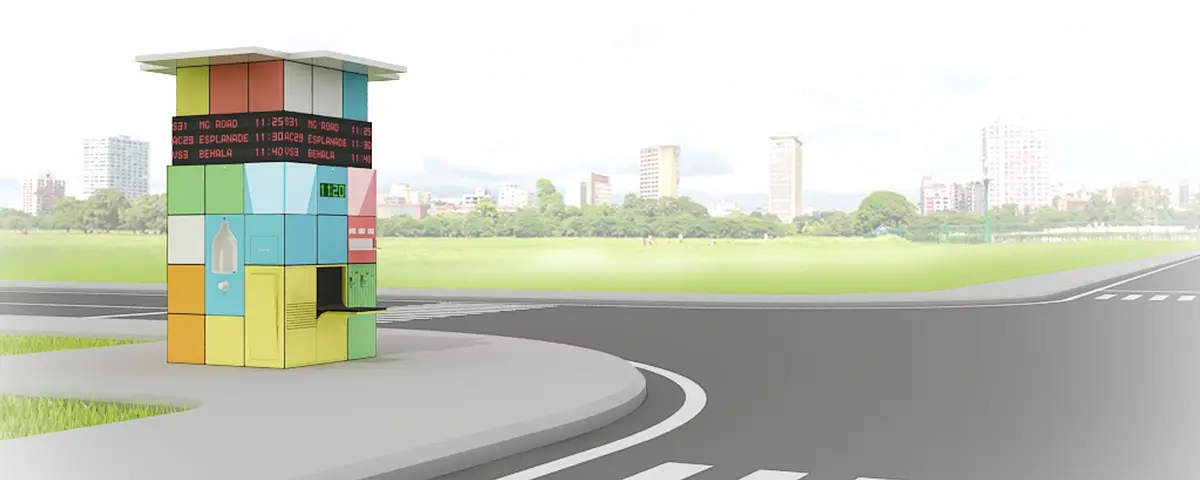
Urban Oasis: A Solar-Powered Rubik's Cube That Wants to Fix City Streets
A self-charging modular kiosk draws from the Rubik's Cube to pack seating, water purification, and digital services into one compact urban unit.


What if a single piece of street furniture could purify water, charge your phone, display transit information, and run entirely on solar power? Urban Oasis takes the logic of the Rubik's Cube and applies it to the public realm: a cuboidal module where every face is programmed for a distinct civic function. The result is a compact, repeatable unit that slots into the leftover spaces between buildings, sidewalks, and transit stops, converting dead zones into self-sufficient public nodes.
The project is the work of designers Arnab Bhattacharjee, Namrata Goswami, Sudipa Roy, and Debdut Pradhan. Their premise is direct: conventional street furniture solves one problem at a time, while cities demand convergence. By stacking utilities, seating, digital services, and water access into a single modular frame, they argue that interstitial urban furniture can become genuine infrastructure rather than decoration.
Every Face of the Cube Has a Job
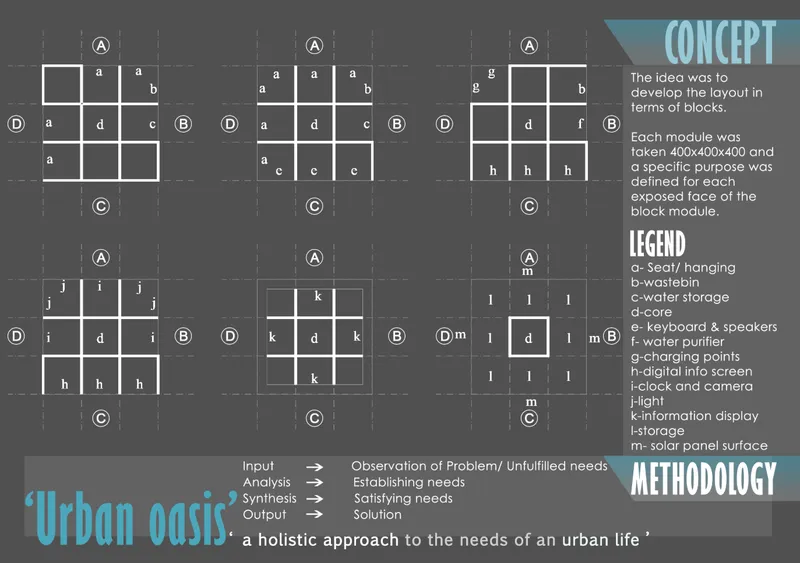
The floor plan diagram reveals how seriously the designers took their Rubik's Cube analogy. Each block within the modular layout is labeled with a specific function: seating zones, water storage compartments, charging points, waste bins, and cup dispensers. Nothing is accidental. The plan reads less like furniture and more like a small building, with clear spatial divisions that allow each utility to operate without interfering with its neighbor. Folding seats tuck away when not in use, freeing floor area for pedestrian flow during peak hours.
What stands out is the density of programme packed into such a tight footprint. Water purifiers sit alongside information screens; a printer occupies the same module as surveillance cameras and lighting. The designers treat every square centimeter as real estate, which is exactly the mindset cities need when the available public space is measured in slivers between existing structures.
A Colorful Kiosk Running on Sunlight
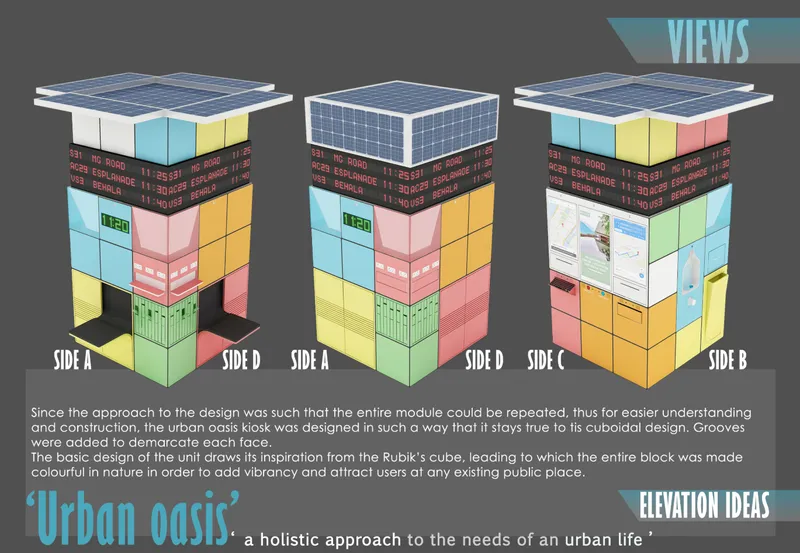
The axonometric views show the module as a freestanding kiosk crowned by a solar panel roof. A continuous digital information screen wraps around the upper band, while the lower faces break into colorful panels that give the unit its identity in the streetscape. The solar array feeds a UPS with battery backup, making the entire system self-charging. That means the screens, lighting, water purification, and charging points draw zero power from the municipal grid, a genuine advantage for cities where electrical infrastructure is already strained.
The vibrant facade is not merely cosmetic. In dense urban environments, visibility matters. A brightly colored object reads as a landmark, and landmarks become meeting points. By making the module visually assertive, the designers increase the likelihood that it will be found, used, and defended by the community around it.
Six Levels of Utility in One Vertical Stack
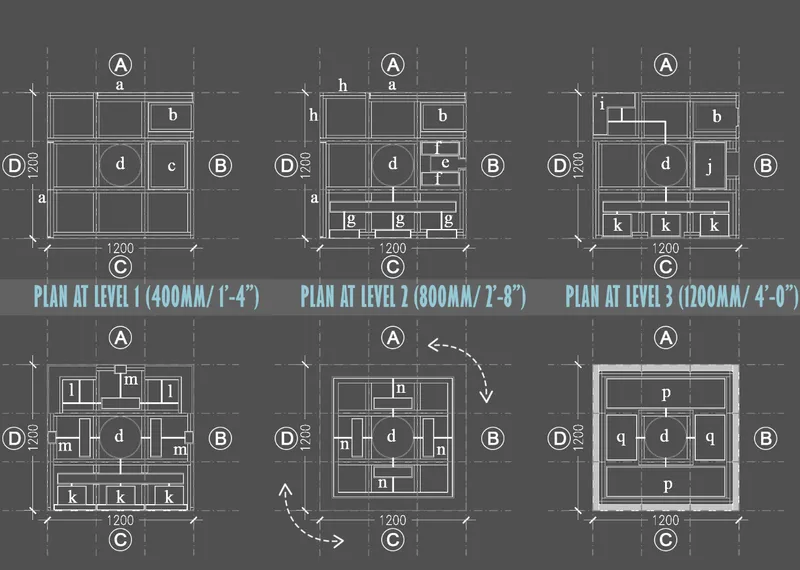
The section drawings slice the module vertically to expose six distinct levels, each annotated with dimensional data. Interior spatial divisions separate water storage from electrical systems, keeping wet and dry zones apart for safety and maintenance. The layered approach is what makes the compact footprint viable: by building upward through clearly partitioned horizontal bands, the designers avoid the sprawl that would make this module impractical for tight urban sites.
Dimensional annotations confirm that the module is sized for easy transport and on-site assembly. Because the cuboidal form repeats identically, multiple units can be clustered to create larger public amenity hubs or deployed individually at bus stops, market edges, and park thresholds. Scalability is baked into the geometry itself.
Why This Project Matters
Urban Oasis is not trying to reinvent the bench or the bollard. It is proposing that street furniture should behave like a micro-building: self-powered, multi-programme, and capable of genuine civic service. Water purification alone sets it apart from the vast majority of urban furniture concepts, which rarely venture beyond seating and shade. By adding surveillance, lighting, digital information, and device charging to the same unit, the design collapses an entire streetscape's worth of infrastructure into one repeatable object.
The real test for a modular concept is whether it can survive contact with different cities, climates, and cultures. The designers have positioned their module for exactly that challenge: energy-independent, dimensionally compact, and programmatically flexible. If the detailing holds up under real-world conditions, a unit like this could turn neglected interstitial spaces across the globe into something closer to what its name promises: an oasis.
View the Full Project
About the Designers
Designers: Arnab Bhattacharjee, Namrata Goswami, Sudipa Roy, Debdut Pradhan
Enter a Design Competition on uni.xyz
uni.xyz runs architecture and design competitions year-round that reward proposals with spatial conviction and real site intelligence.
Project credits: Urban Oasis by Arnab Bhattacharjee, Namrata Goswami, Sudipa Roy, Debdut Pradhan.


Popular Articles
Popular articles from the community

Temporary Home for Dogs: A Reversed Zoo Rethinks Animal Shelter Architecture
In Bucharest, a sinuous corridor and freed landscape flip the logic of containment, designing a shelter that works to make itself unnecessary.
Faces of the Soviet Avant-Garde: Turning Moscow's Street Names into an Open-Air Museum
A network of sculptural installations across a Moscow residential district transforms forgotten architect names into spatial encounters with cultural memor

The Amber Palace Opera: A Geological Fiction Surfaces on Tallinn's Baltic Waterfront
Pierre Brillard reimagines a Baltic legend as a public landscape, opera house, and waterfront promenade rooted in Tallinn's coastal identity.

Singing Woman: An Opera House That Performs Before the Curtain Rises
Ovidiu Cristian Pavel's conceptual opera house translates Estonia's choral identity into a sculpted waterfront landmark facing the Baltic Sea.

Similar Reads
You might also enjoy these articles

Play: Fragments of Their World: Remembered Architecture Rebuilt as a Modular Playground for Refugee Camps
Tom Gardner abstracts domes, arches and towers from the homelands of displaced families into a kit of child-scaled play parts for camp settlements.
REBIRTH: A Circular Settlement Where Afghan Widows and Their Children Rebuild Life Together
A shortlisted Resile entry turns the circle into a protective ring of timber and brick, gathering homes, classrooms and gardens around a shared landscape.
The Main Dream: A Recycled Plastic Kit That Lets Refugee Children Build Their Own Playground
Thirty-centimetre interlocking cubes that connect on three axes turn play into construction, letting children author the spaces they occupy.

Lunar Spiral: A Fibonacci-Driven Moon Settlement Rising from Shackleton Crater
Golden-spiral geometry organises buried infrastructure and orbiting habitable spheres into a lunar base designed to grow as life on the Moon expands.


Comments (0)
Please login or sign up to add comments
No comments yet. Be the first to comment!