
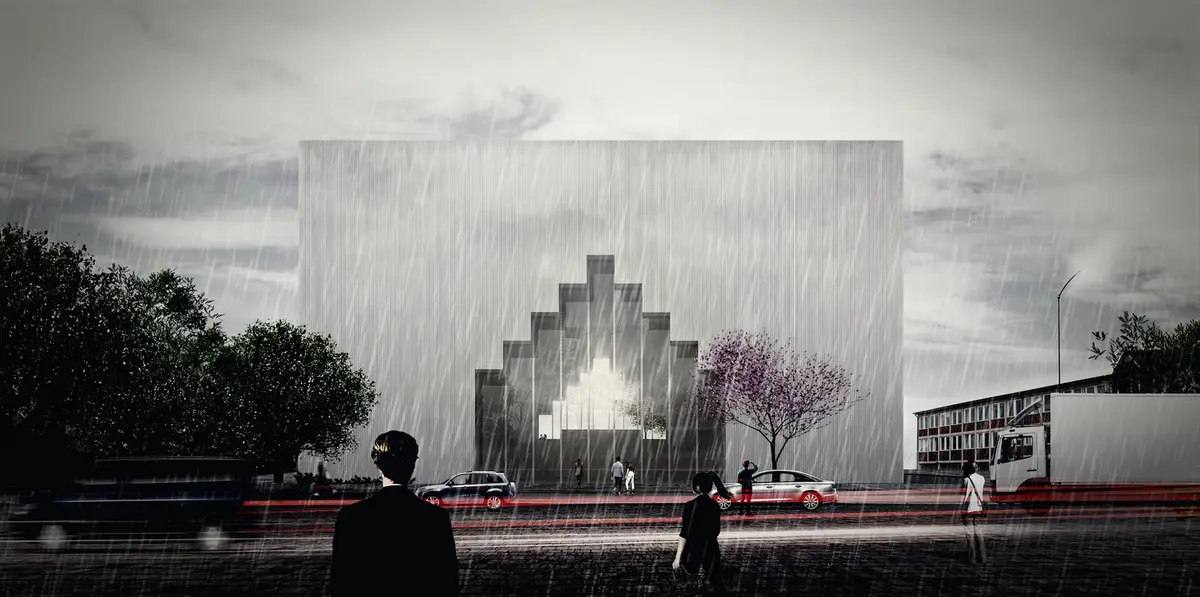
Urban Storage: A Hybrid Museum That Turns Its Archive into the Main Public Space
A museum where the archive becomes the architecture: high-density storage, a Welcome Street and a non-linear Random Path open the collection.


Most museums show only a fraction of what they own. The rest sits in climate-controlled basements, catalogued and largely unseen. Urban Storage, Hybrid Museum starts from that imbalance and reverses it. Instead of hiding the depot behind the gallery, it makes the depot the building. Storage stops being a back-of-house problem and becomes the spatial framework visitors move through, the thing they come to see.
Designed by Benno Schmitz, the project responds to a moment when collections are growing quickly and digitalisation is changing how people expect to reach knowledge. Visitors want personalised, participatory encounters. Researchers want direct and flexible access to artefacts. Institutions face the logistics of ever-expanding holdings. Schmitz's answer is a hybrid typology that merges archive, exhibition, research and public life into a single organism set within a dense urban site close to public transport.
Shelving Walls as Gallery Walls

The opening rendering puts the thesis plainly. Visitors gather on a gridded floor in front of white shelving walls lined with sculptures and vessels, and the glazed end of the hall opens onto trees beyond. Nothing here is mounted on a plinth or isolated under a spotlight. The objects sit where they are stored, and the storage system itself does the curatorial work of order and display.
This is where the project's guiding equation, Storage + Temple = Experience, becomes spatial. The shelving supplies the efficiency of a depot. The scale of the hall and its calm repetition supply something closer to a civic interior. The experience comes from standing between the two: an archive that has been given the dignity of a public room.
A Programme Weighted Toward the Collection

The drawing sheet pairs two floor plans, an exploded axonometric of stacked levels and a longitudinal section with a bar chart that states the building's priorities in numbers. Storage takes 68% of the programme in high-density, modular units. Experience spaces, meaning exhibition zones, forums, libraries and interactive environments, take 24%. The public circulation spine, the Welcome Street, takes the remaining 8%.
The ratio is the argument. A conventional museum would invert those proportions or hide the largest share entirely. Here the experience spaces are embedded directly inside the storage matrix rather than set apart from it, so the collection stays visually available wherever a visitor lands. The exploded axonometric shows how the levels stack into a single system instead of a gallery building with an archive bolted underneath.
Rooms That Look Back at the City

Not every space is about objects. One rendering shows a dark slatted room with a rope swing, a seated figure and a wall-wide window framing a rail yard and a brick tower. It is a pause in the sequence, a social zone where the view returns attention to the surrounding infrastructure and to the transport links the site depends on.
That outward glance supports the project's urban ambition. Schmitz positions the museum as an infrastructural connector rather than an isolated landmark, part of daily movement through the city. Externally the building reads as monolithic, robust and calm; internally, moments like this one reveal how much it engages with what lies around it.
A Stepped Void and the Freedom to Wander
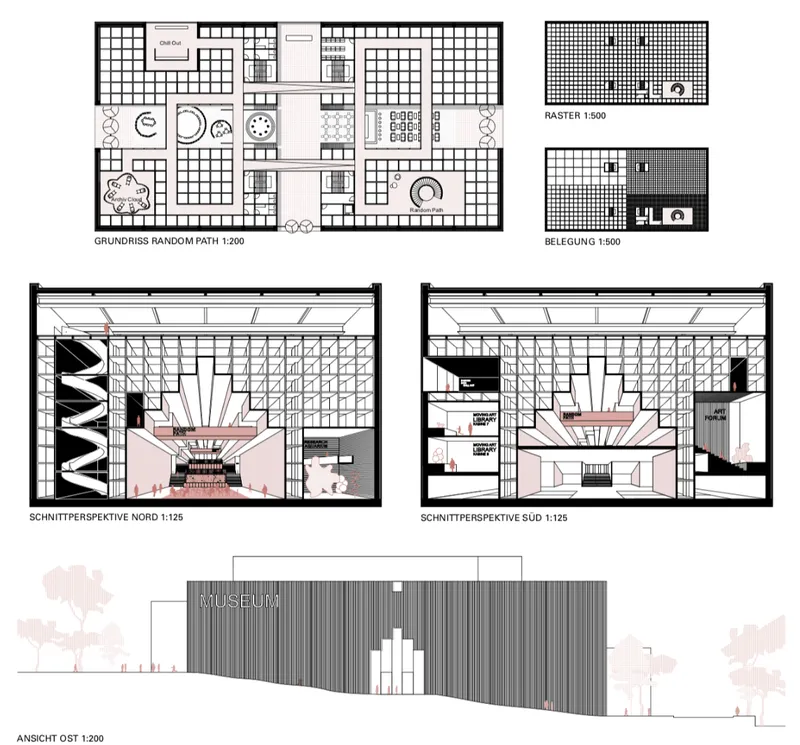

The second drawing sheet and the section perspective expose the building's core: a stepped central void cut through the gridded shelving structure, with a spiral stair rising at one side and small figures in pink scattered across the terraces. The east elevation shows the vertically ribbed facade that gives the exterior its infrastructural composure, a quiet skin around a highly active interior.
The void is where the Welcome Street and the Random Path do their work. At ground level the Welcome Street cuts through the building as a permeable interface between city and institution, connecting the programmatic layers visually as visitors pass. Above it, the Random Path abandons the fixed sequence of the traditional museum and lets people build their own routes through the collection. Circulation becomes a process of discovery, and interpretation shifts from the curator to the visitor.
Why This Project Matters
Urban Storage takes on a problem most institutions handle quietly and makes it the generator of form. By weighting the programme toward storage and making that storage navigable, Schmitz proposes a museum that is more honest about what it holds and more generous with access. The proportions in the bar chart are not a technical footnote; they are the design.
The project also offers a credible counter to the idea that digitalisation will empty the museum of purpose. If information can be accessed anywhere, the physical building has to offer what screens cannot: proximity to the real object, the freedom to wander and the presence of other people. A gridded archive, a stepped void and a street running through the middle make a convincing case that the depot could become the most public room in the city.
View the Full Project
About the Designers
Designer: Benno Schmitz
Enter a Design Competition on uni.xyz
uni.xyz runs architecture and design competitions year-round that reward proposals with spatial conviction and real site intelligence.
Project credits: Urban Storage, Hybrid Museum by Benno Schmitz.


Popular Articles
Popular articles from the community


David Macias Steps a Doorless Stone and Plaster House Down a Tropical Colombian Hillside
In the humid hills of Colombia, Threshold House replaces the front door with an open void and terraces its 850 m² down the slope instead of fighting it.

longwave studio Reorganizes a 112 m² Tainan Apartment Around the Daily Routines of a Family and Two Cats
In Tainan, Taiwan, birch plywood, rust-red furniture and a freestanding plaster wall link arrival, storage, work and family life in one apartment.

David Ortega Stacks a Two-Story Mexico City Penthouse Around a Steel Stair and a Pergola-Shaded Roof Terrace
In Colonia Roma, a 300 m² penthouse uses oak joinery, a planted steel stair and a slatted roof pergola to make a new-build apartment feel like a house.

Juan García Correa, John González and Claudia Rueda Sink a Circular Amphitheater into a Manizales Engineering Building
On the La Nubia campus in Manizales, Colombia, the S1 Building folds labs and offices into a hillside of ramped lawns that double as a campus route.

Similar Reads
You might also enjoy these articles
Healing Façade: A Modular Chapel System That Restores Ethiopia's Sacred Forests
Winner of the Eco-Chapel competition, this circular timber façade collects water from air to rebuild soil and reforest degraded Ethiopian landscapes.
Kaffeebühnen: Where Coffee Shop Architecture Becomes a Civic Stage in Vienna
A linear sequence of timber boxes, transparent shells, and open yards turns the Viennese café tradition into a public performance space.
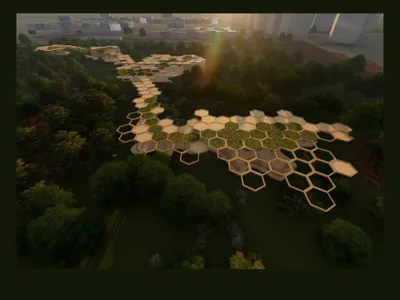
Eco Chapel: A Modular Forest Pavilion That Grows Like the Landscape It Protects
Hexagonal timber modules weave through existing trees, turning a chapel into a living system for prayer, education, and reforestation.


Urban Forest: A Vertical Ecosystem for 5,000 Workers in Singapore's Changi Business Park
Radially stacked pods and layered green decks turn a 7-acre plot into 47 acres of ecological workspace projected for 2040.

Explore Exhibition Space Competitions
Discover active competitions in this discipline

Challenge to reimagine the Iron Throne

Photograph architecture without architects

VR headsets Storefront design competition

Illustrate the lost glory of Angkor Wat - Render Challenge
Comments (0)
Please login or sign up to add comments
No comments yet. Be the first to comment!