

Ursa Major: Hempcrete Domes and Hydrogen Power for Arctic Settlement
A modular dome habitat built from carbon-storing hempcrete, powered by wind and solar hydrogen, designed for life at the edge of the ice.


What does it take to build a permanent settlement where temperatures plunge far below zero, winds rip across open tundra, and half the year passes in darkness? Ursa Major answers with a system of geodesic domes that function as bioclimatic shells, creating inhabitable microclimates inside structures built from hempcrete and cross-laminated timber. The project treats the Arctic not as a hostile frontier to be conquered but as a fragile environment demanding architectural precision: carbon-negative materials, modular housing that grows with its population, and a dual-source renewable energy system that stores surplus power as hydrogen.
Designed by Agata Misior, Ursa Major is a shortlisted entry in the EHC - Arctic competition. The project confronts a stark reality: the Arctic is warming at twice the global average, accelerating glacial melt, sea-level rise, and biodiversity loss. Rather than proposing a temporary research outpost, Misior envisions a full-scale settlement capable of long-term habitation, complete with modular residential units, recreational zones, and decentralized energy infrastructure suited to the Canadian Archipelago and Arctic Basin.
Geodesic Envelopes Half-Buried in Snow
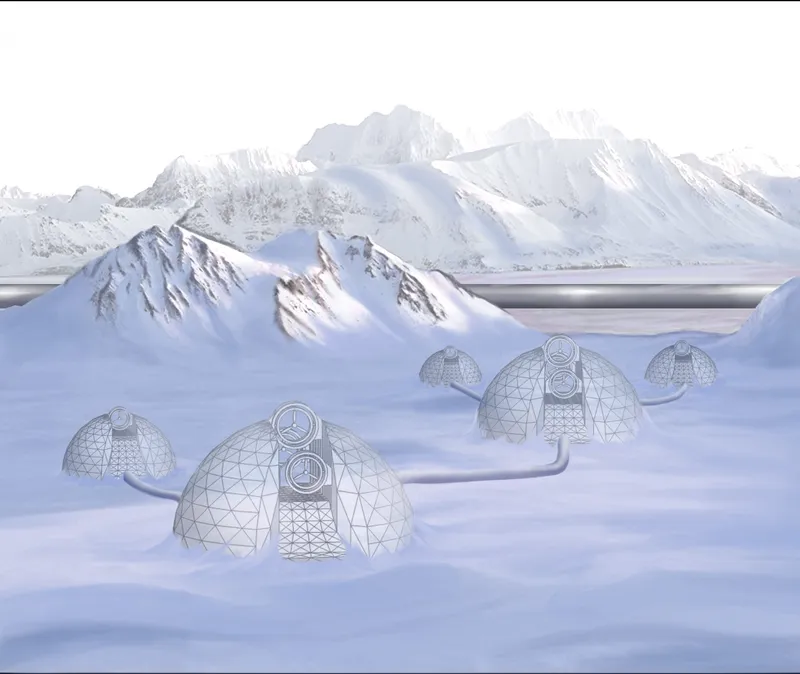
The settlement's defining gesture is a network of large geodesic domes partially embedded in the Arctic landscape, their triangulated skins catching low-angle light against a backdrop of fjords and snow-covered mountains. These domes are not simply shelters; they are energy-efficient buffers that convert extreme external conditions into manageable interior climates. The bio-climatic shell shields inhabitants from sub-zero temperatures and high winds while preserving access to daylight and open space. By acting as protective envelopes rather than sealed bunkers, the domes maintain a connection to the terrain that makes long-term habitation psychologically viable.
Timber Interiors Framed by Triangulated Glazing
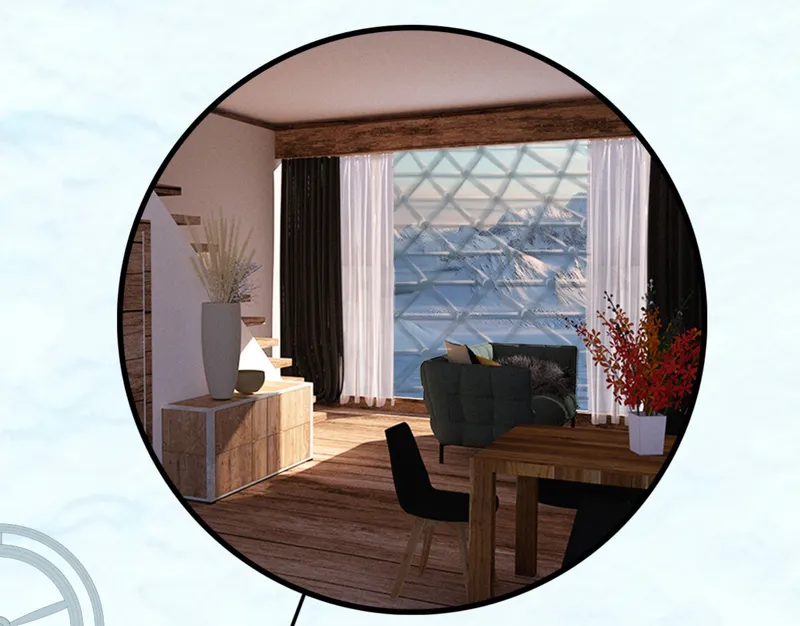
Step inside one of the domes through a circular aperture and you find a dining space with warm timber flooring, panoramic views of Arctic mountains filtering through the triangulated glazing overhead. The interiors are designed for thermal comfort without visual isolation: cozy, well-insulated environments that still frame the vast landscape beyond. Recreational zones include what Misior calls "mushroom" platforms and a circular footpath called "The Ring" intended for walking and cycling, introducing the kind of everyday activity loops that sustain community life in remote conditions.
The modular housing strategy is central to the project's long-term viability. A primary load-bearing wall supports residential units that can be added, removed, or rearranged as the settlement's population shifts. Residents personalize their layouts, choosing between single and multi-module configurations. Modules slide into position along horizontal rails and connect vertically through a centralized spine that distributes services and enables growth without compromising structural integrity. The entire system is built from hempcrete, whose carbon-storing capacity enables negative CO2 emissions, and cross-laminated timber, keeping module weight low enough for transport via hyperloop networks.
Wind, Solar, and Hydrogen: A Year-Round Energy Profile

The energy diagram lays out a clear logic: wind turbines and solar panels generate electricity, and surplus is stored as hydrogen through a reversible fuel cell system. This is not speculative technology but a pragmatic response to the Arctic's seasonal extremes. Wind conditions in the Canadian Archipelago and Arctic Basin favor turbine performance, particularly during the darker winter months when solar input drops to near zero. In summer, the midnight sun phenomenon reverses the equation, driving solar panel output upward. The dual-source, hydrogen-storage approach creates a decentralized, fail-safe energy supply, the kind of redundancy that remote settlements cannot afford to lack.
Dome Typologies and Circulation Systems at Settlement Scale
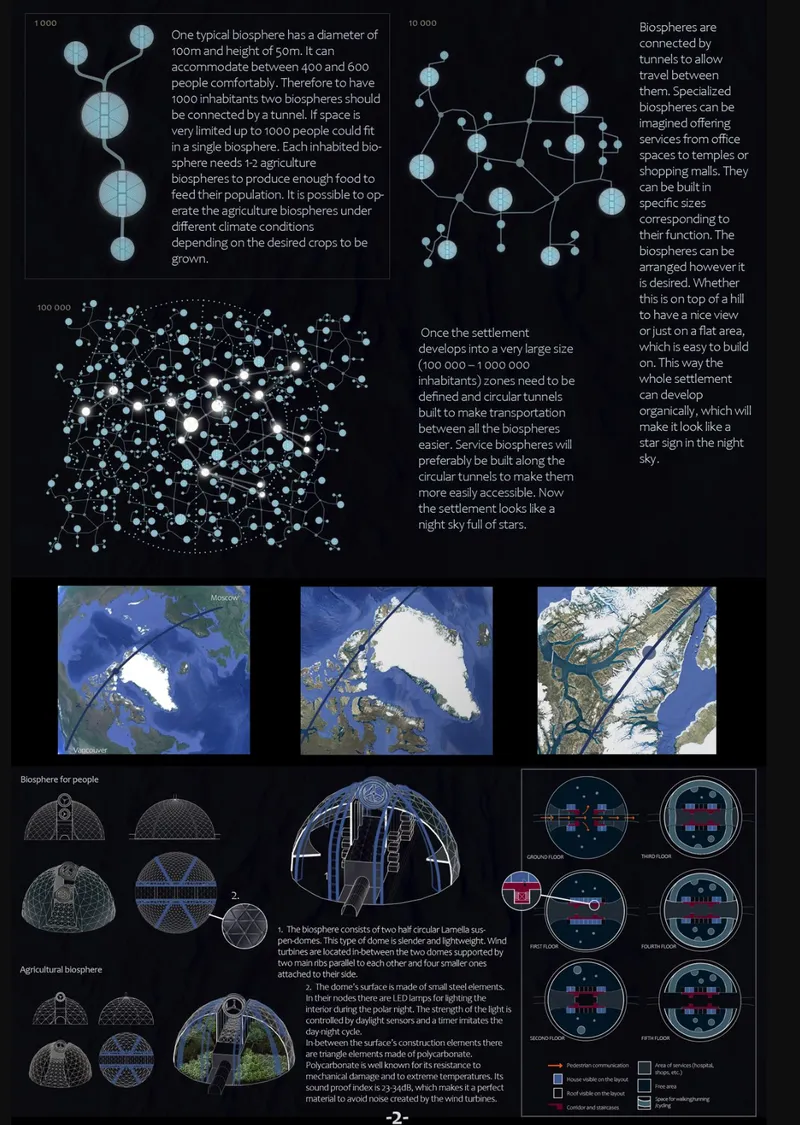
The presentation board reveals the project's full scope: dome typologies at various scales, circulation diagrams showing how movement flows between domes and along The Ring, satellite maps situating the settlement within the Arctic landscape, and sectional plans that expose the vertical layering of residential modules, service spines, and recreational platforms. What becomes clear is that Ursa Major is not a single building but an urban system, one that applies flexible planning principles typically reserved for temperate cities to an environment where those principles have rarely been tested.
Why This Project Matters
Ursa Major's strength lies in the specificity of its material and energy choices. Hempcrete's carbon-negative properties are not merely a talking point here; they directly address the paradox of building in a region already suffering from accelerated warming. Cross-laminated timber keeps structural weight low enough for realistic logistics. Hydrogen storage solves the intermittency problem that plagues renewable installations in high-latitude locations. Each decision serves the project's central argument: that architecture in extreme environments must be measured not by what it endures but by what it does not consume.
Misior positions the dome settlement as a testbed applicable beyond the Arctic, to deserts or even extraterrestrial contexts. That ambition is warranted. The modular rail system, the bioclimatic shell strategy, and the decentralized energy loop are all transferable principles. What makes the project compelling as an architectural proposition rather than a thought experiment is its refusal to treat sustainability as an add-on. Every system, from the hempcrete walls to the hydrogen fuel cells, is load-bearing in both the structural and the ethical sense.
View the Full Project
About the Designers
Designer: Agata Misior
Enter a Design Competition on uni.xyz
uni.xyz runs architecture and design competitions year-round that reward proposals with spatial conviction and real site intelligence.
Project credits: Ursa Major by Agata Misior EHC - Arctic (uni.xyz).


Popular Articles
Popular articles from the community


GROUP A Strips a 1969 Rotterdam Harbor Headquarters to Its Frame and Wraps It in Timber Louvers
In Rotterdam's M4H harbor district, Ferro Offices reuses a 1969 frame, adds one timber storey and reaches BREEAM-NL Outstanding.

David Ortega Stacks a Two-Story Mexico City Penthouse Around a Steel Stair and a Pergola-Shaded Roof Terrace
In Colonia Roma, a 300 m² penthouse uses oak joinery, a planted steel stair and a slatted roof pergola to make a new-build apartment feel like a house.

Architekt Andreas Gruber Scatters 23 Dark Timber Chalets Across a South Tyrolean Forest Edge
In Molini di Tures, Amonti Chalets breaks a resort into a hamlet of gabled timber houses, with parking, storage and services pushed into the slope.

Jaramillo Van Sluys Arquitectura and Urbanismo Turn a Demolished Registry Lot in Quito into an Orchard Plaza
In Quito's Centro Histórico, a 2,800 m² plaza exposes the San Agustín convent wall and redraws its lost Augustinian orchard in volcanic stone.

Similar Reads
You might also enjoy these articles


Vereda Arquitetos Renovates a 40-Square-Meter Apartment Inside Niemeyer's Copan Building
A compact unit in São Paulo's most iconic residential tower gets a material overhaul that pairs exposed concrete with bold blue Formica.

Shakur's House: Exposed Brick as an Interior Organiser in a 168 m² Mashhad Residence
Brick moves indoors in this Mashhad residence, where masonry walls, glass partitions and teal planes sequence a compact home without closing it off.

Day and Night Park: A Time-Based Urban Newsstand in Beijing
A temporary urban newsstand in Beijing blending travel, light, and reading through poetic colors, compact form, and community-focused design.

Modernist Patio Renovation in El Masnou, Barcelona by Oliver Segura Arquitectura + Cebrià Arquitectura
Modernist patio renovation blending tradition and innovation with a movable pool, leveled floors, and Catalan materials in El Masnou.

Explore Extreme Architecture Competitions
Discover active competitions in this discipline

Challenge to design a shop stop sunk in the city

Design challenge to reuse E-waste
Comments (0)
Please login or sign up to add comments
No comments yet. Be the first to comment!