

V2GETHER Design Threads a Spiraling Restaurant Through a 1990s Shanghai Tower
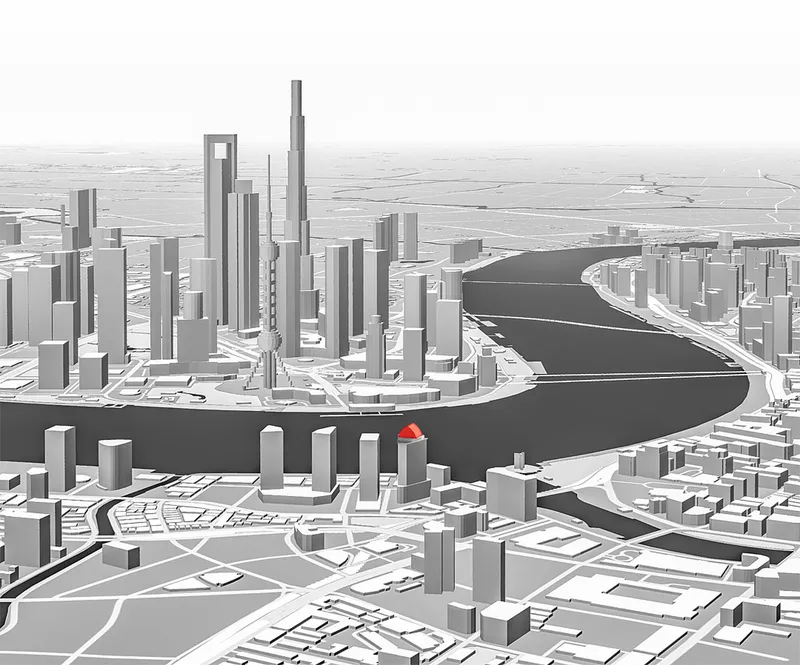
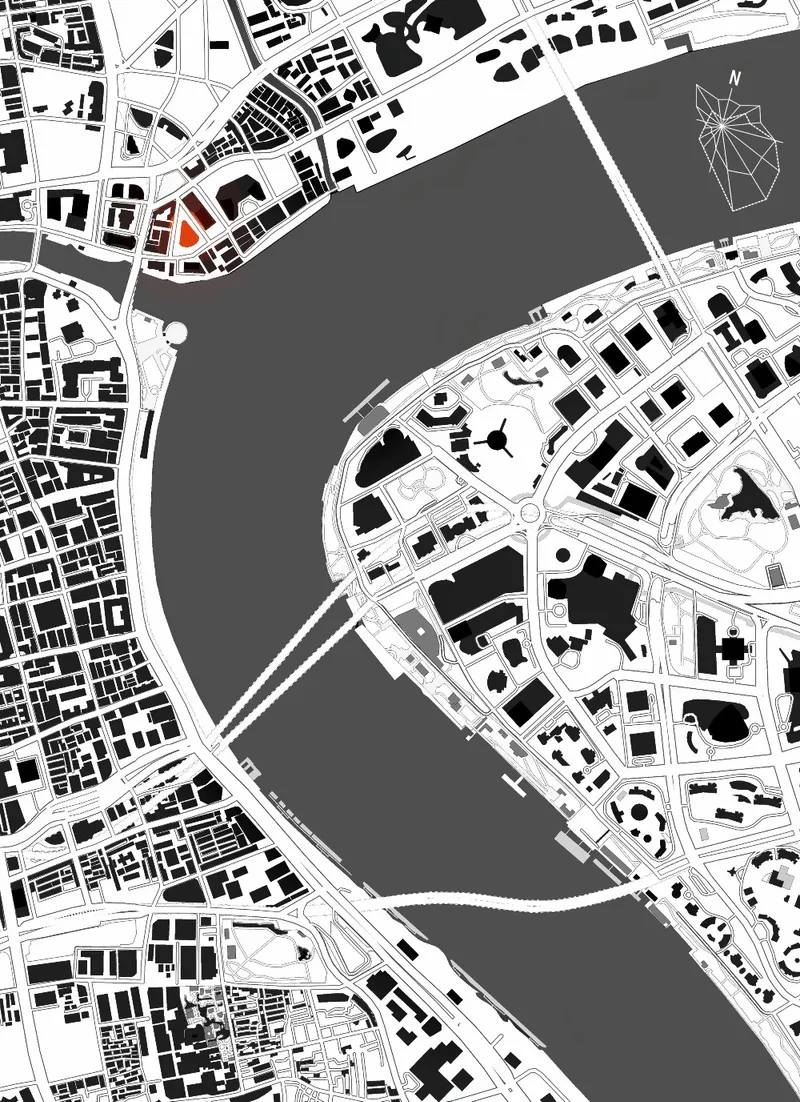
Perched atop the Haiwan Building on Shanghai's North Bund, Dijing occupies four floors of panoramic dining carved from an aging high-rise.


Getting to a restaurant on the 30th floor of a 1990s tower should feel like an event, not a chore. V2GETHER design, led by architect Rui Zhao, understood that when they took on Dijing·Exquisite Restaurant, a 2,260 square meter dining venue stacked across the upper floors of the Haiwan Building in Shanghai's Huangpu District. The building's original curtain wall was aging and the steel frame needed reinforcement, but the panoramic views of the Bund, Lujiazui, and the Huangpu River were irreplaceable. So the architects did what any sensible designer would do with a diamond in the rough: they polished the setting and let the view do the heavy lifting.
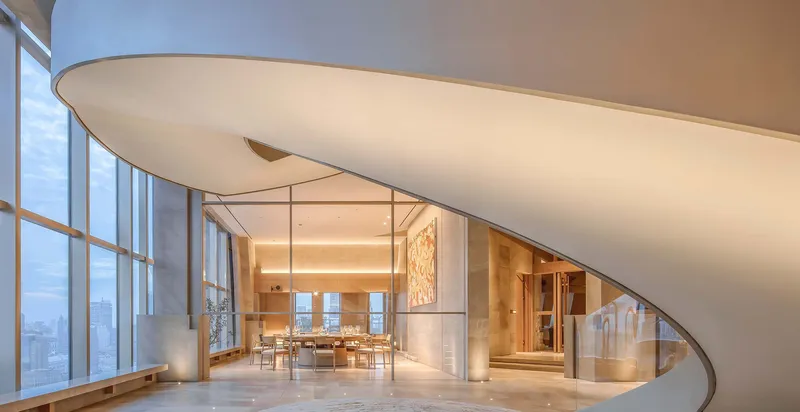
The result is a project defined by a single sculptural move: a suspended spiral staircase that stitches together four formerly flat, disconnected floors (29th through 32nd) into one continuous shared space. Three sets of viewing rooms were demolished and recombined to create this vertical atrium, and the staircase, with its glass railings and impossibly thin soffit, acts as both circulation spine and spatial anchor. The design philosophy borrows from Tao Yuanming's Peach Blossom Spring, the classical Chinese allegory of a hidden paradise discovered through a narrow passage. Guests enter on the 27th floor, ride an elevator to the 30th, and traverse an elongated wine cellar corridor before the space opens up. It is architecture as theater, and the pacing is deliberate.
The Staircase as Protagonist
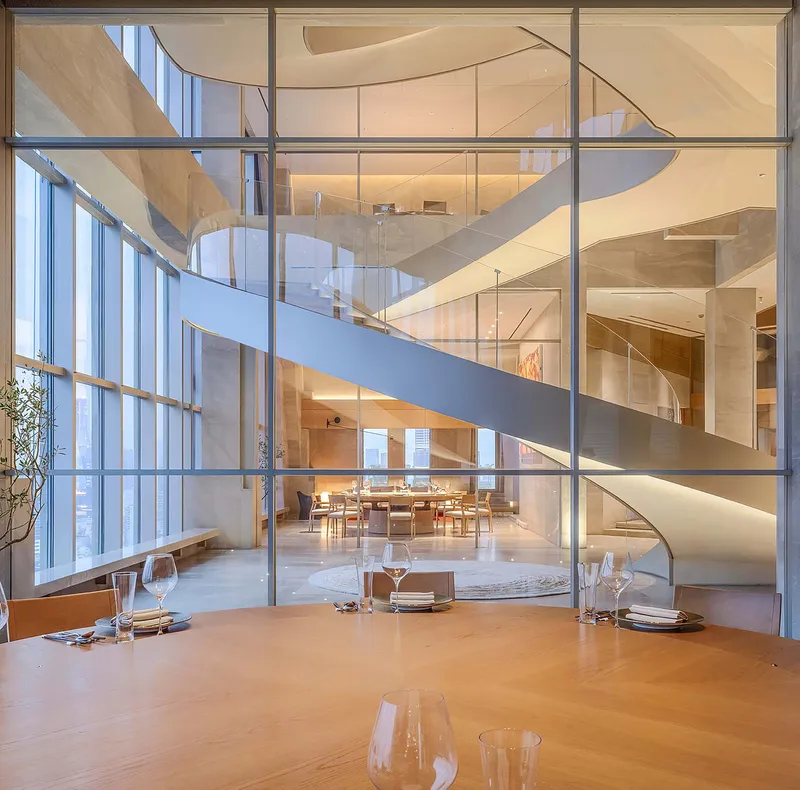
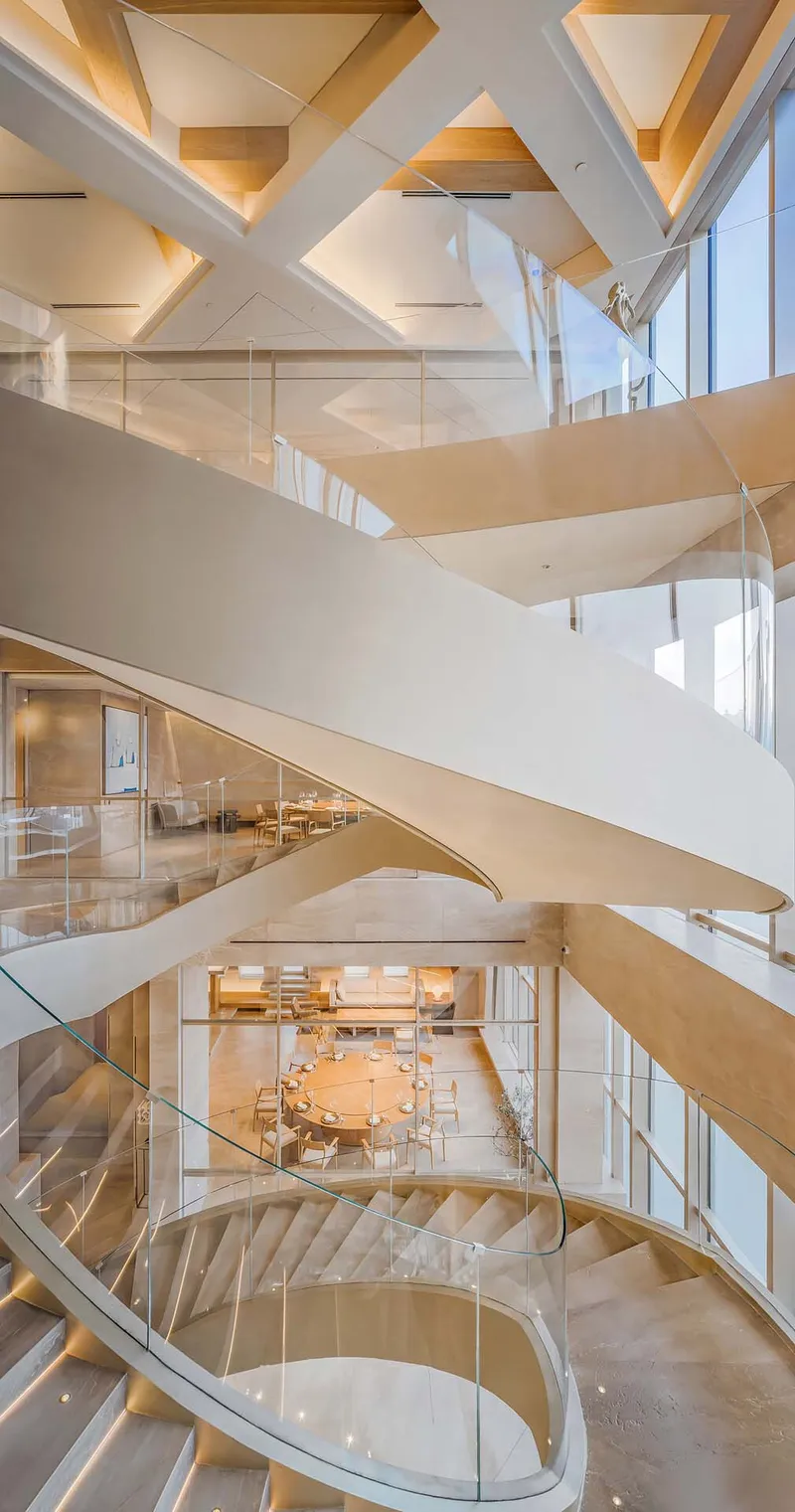
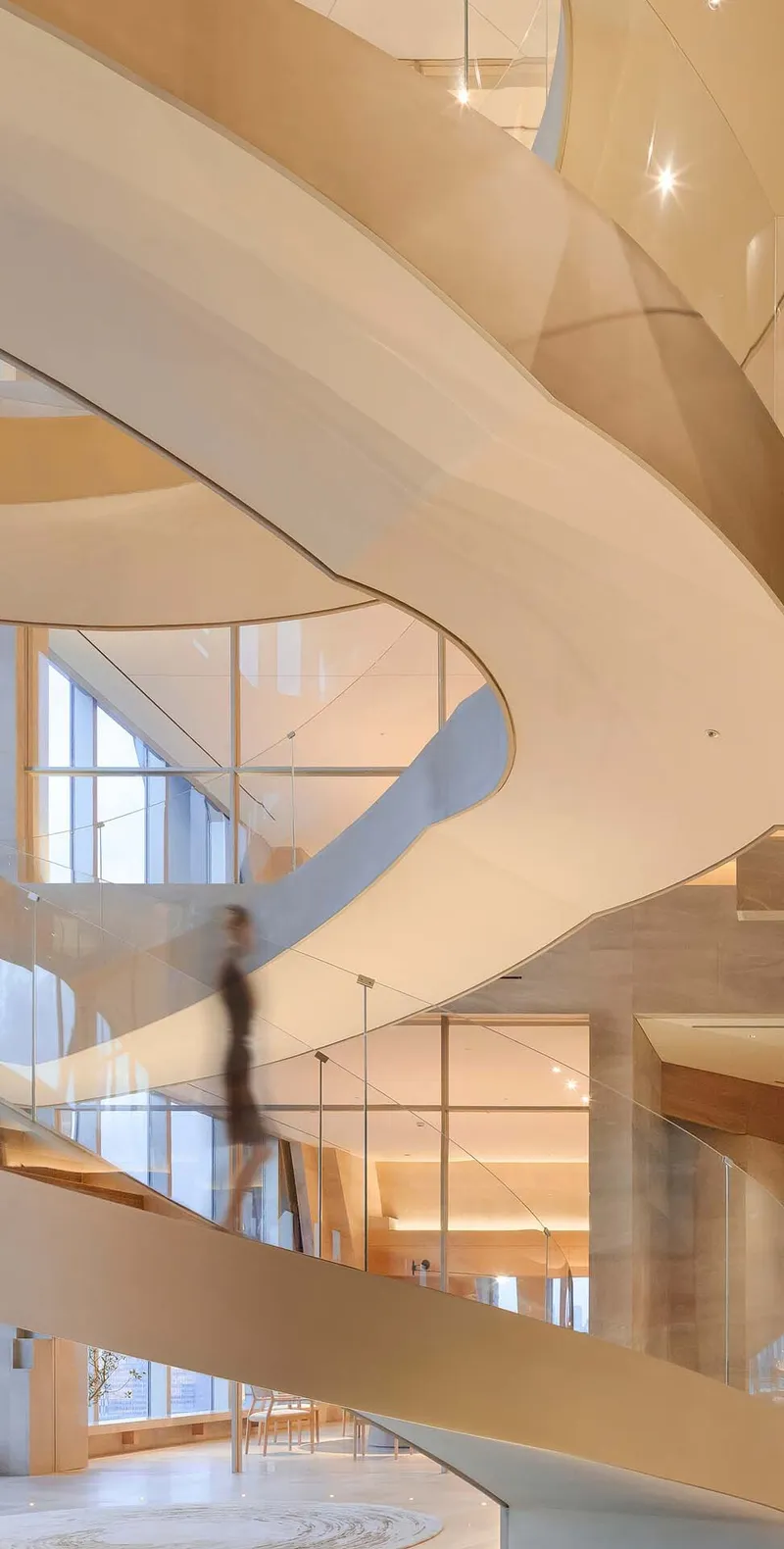
There is no subtlety about the hierarchy here. The helical staircase occupies the center of the shared atrium and commands every sightline. Viewed through the steel-framed glass partitions, its white ribbon form reads as a piece of sculpture rather than infrastructure. The soffit is smooth and seamless, the glass railings nearly invisible, and the overall effect is of a form suspended in air. A spherical device hovers between the 30th floor reception and the staircase landing, adding a surreal punctuation mark to an already dramatic composition.
From above, the coffered ceiling with its triangular panels creates a geometric counterpoint to the organic curves below. The staircase connects the 29th to the 31st floors, and its placement at the center of the plan means every dining zone, lounge, and private room orbits around it. This is not a staircase you happen to use. It is the reason the space works.
Framing the Skyline
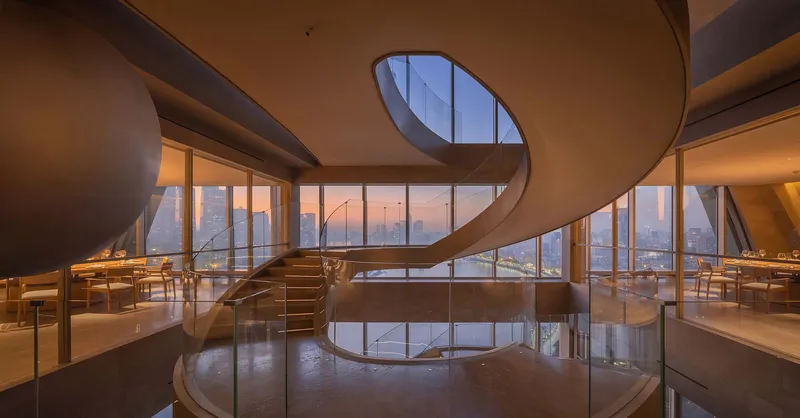

V2GETHER replaced the building's aging curtain wall with expansive insulating glass on both the north and south facades, maximizing the panoramic views that justify the restaurant's altitude. The design philosophy here is one of restraint: the interior deliberately refuses to compete with the skyline outside. Indoor lighting is soft and uniform, decorative fixtures are suppressed, and the material palette stays muted so that, at dusk, the Lujiazui towers and the curve of the Huangpu River become the décor.
The curved stair landings act as viewing platforms. Polished stone floors catch reflections of the sunset, doubling the spectacle. Two large private rooms on the 29th floor open onto a panoramic terrace, giving diners direct access to the open air, a rare luxury at this height in central Shanghai.
Material Restraint and Textural Contrast
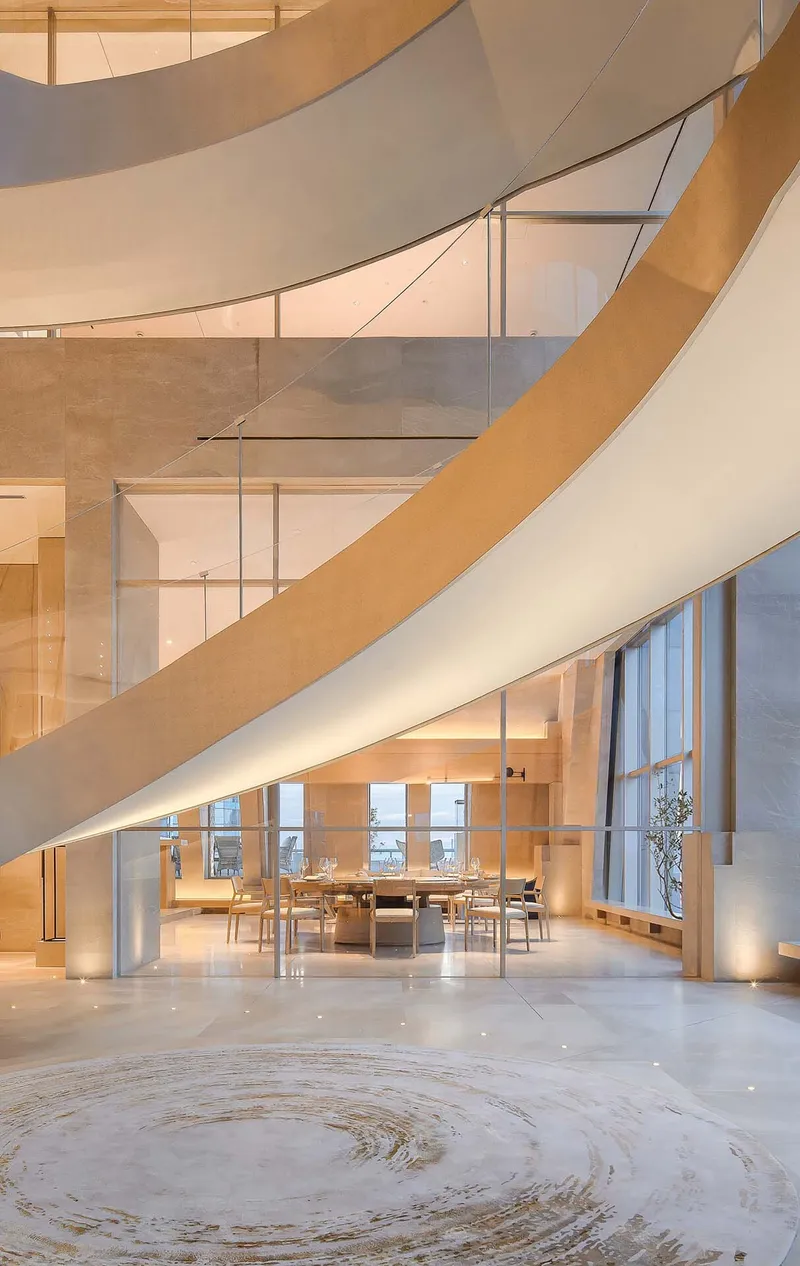
The material strategy is deliberately narrow. Beige natural marble with an antique surface finish lines most of the interior, providing a warm, neutral ground. Logs and timber appear sparingly as accents, most visibly in the cigar bar and beneath the sweeping stair soffits, where wood cladding introduces warmth without weight. Rough, naturally axed stone anchors the entrance and the pool areas, creating a textural shift that signals the transition from the urban exterior to the cultivated interior.
The entrance sequence deserves special mention. Guests encounter natural rough stones with holes, the sound of running water, and a shallow pool with live fish, its bed lined with beige quartz pebbles. The intent is to evoke a mountain stream, and it works because the materials are real rather than decorative. In a city where restaurant interiors frequently default to spectacle, Dijing's restraint is its distinguishing mark.
The Cigar Bar and Program Layering
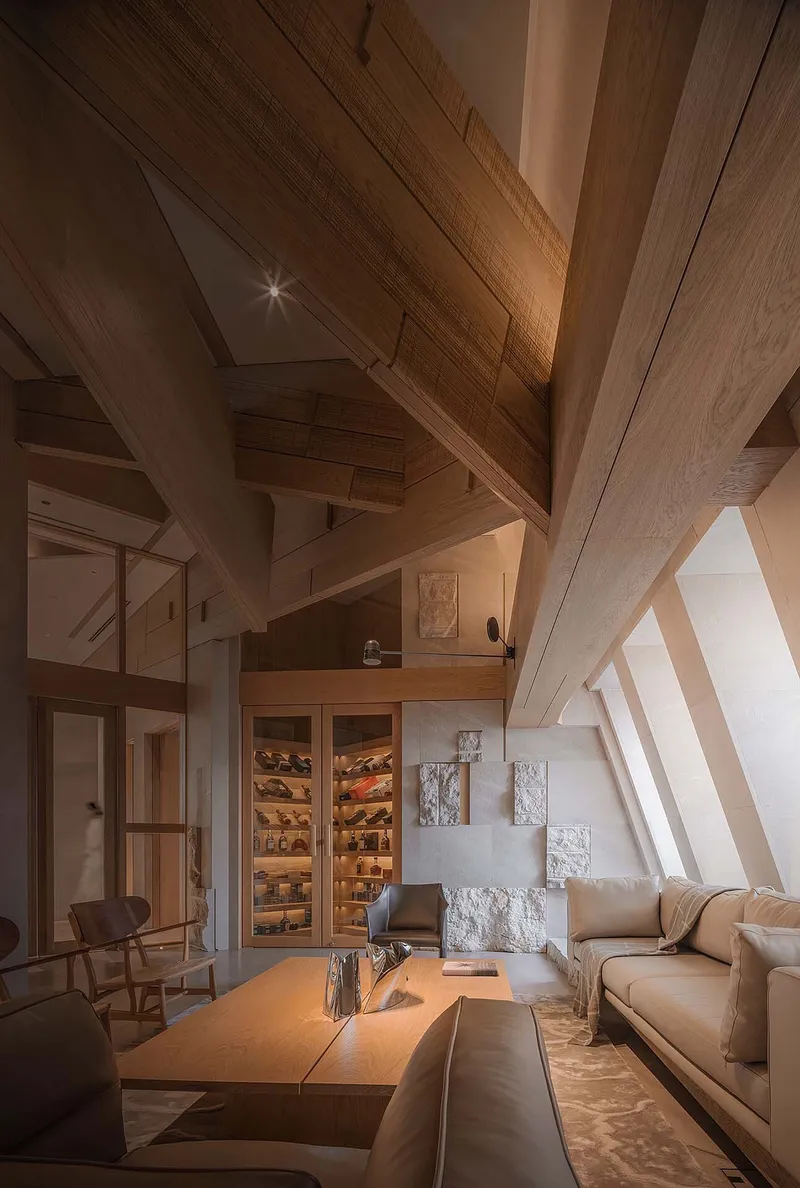
Beyond the main dining floors, the program layers in a cigar bar that doubles as a negotiation room, reading lounge, and wine tasting area. Diagonal timber ceiling beams define this space, and a built-in illuminated wine display transforms storage into a focal wall. The mood shifts from the open, light-flooded dining atrium to something more enclosed and intimate, an intentional contrast that gives the restaurant multiple registers.
Over twenty original contemporary artworks are scattered throughout the restaurant, displayed without fences or glass covers. This zero-distance approach to art is consistent with the design's broader ethos: nothing here is kept at arm's length. The space is meant to be touched, inhabited, and used, not merely admired.
Plans and Drawings
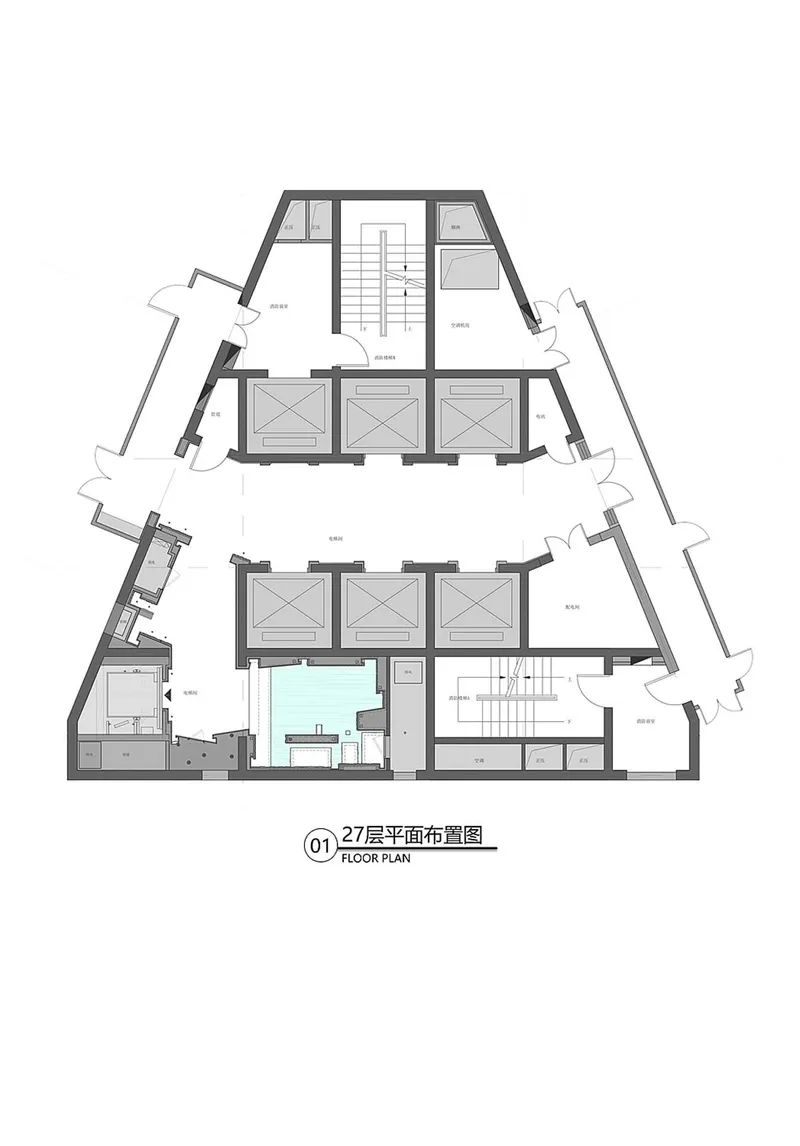

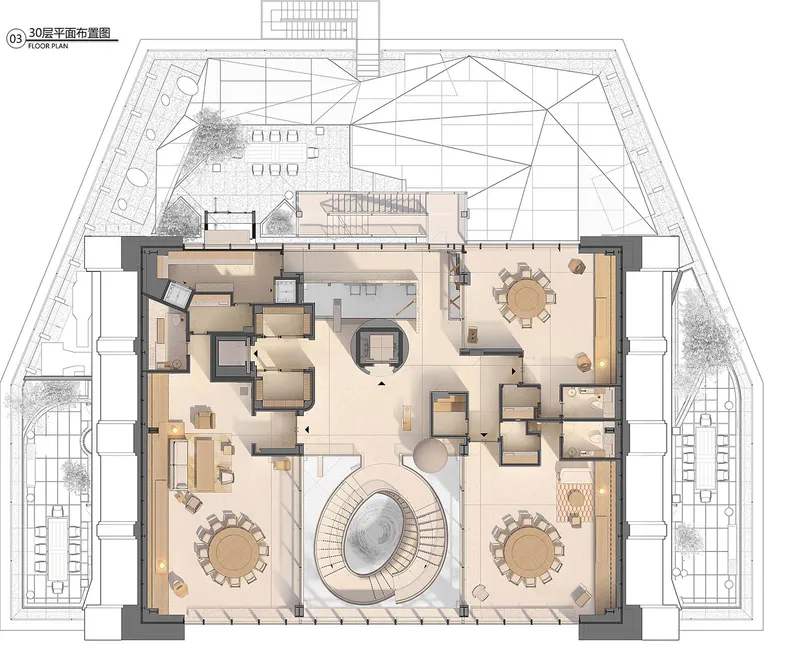
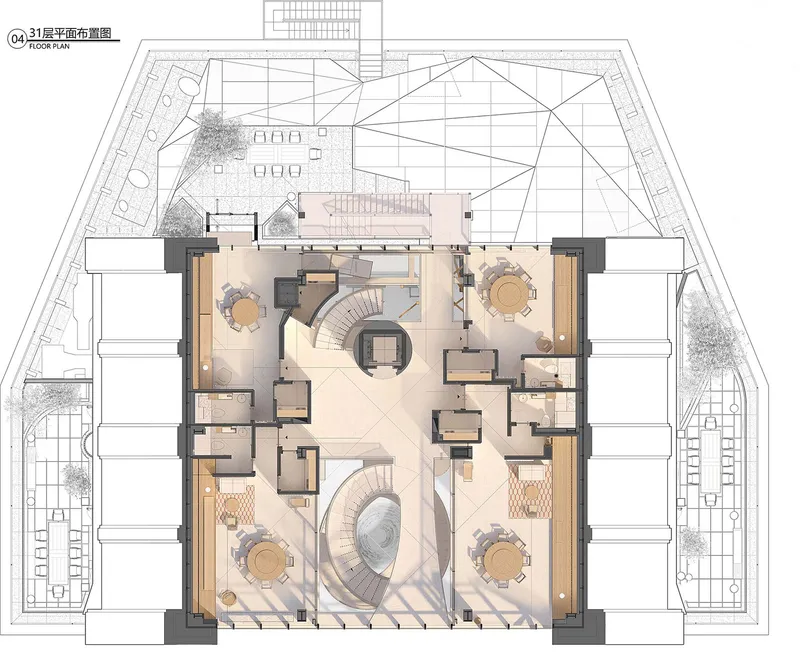

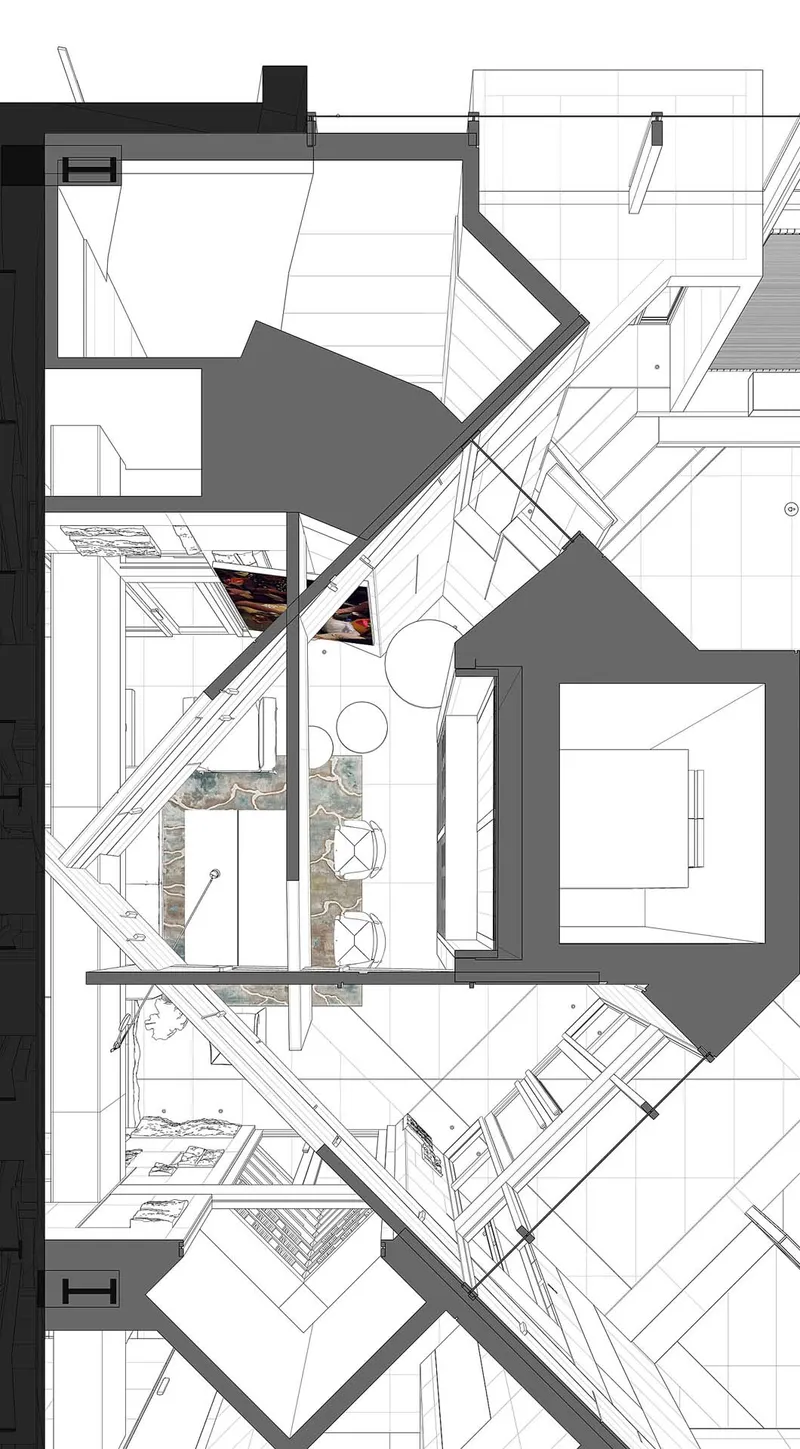
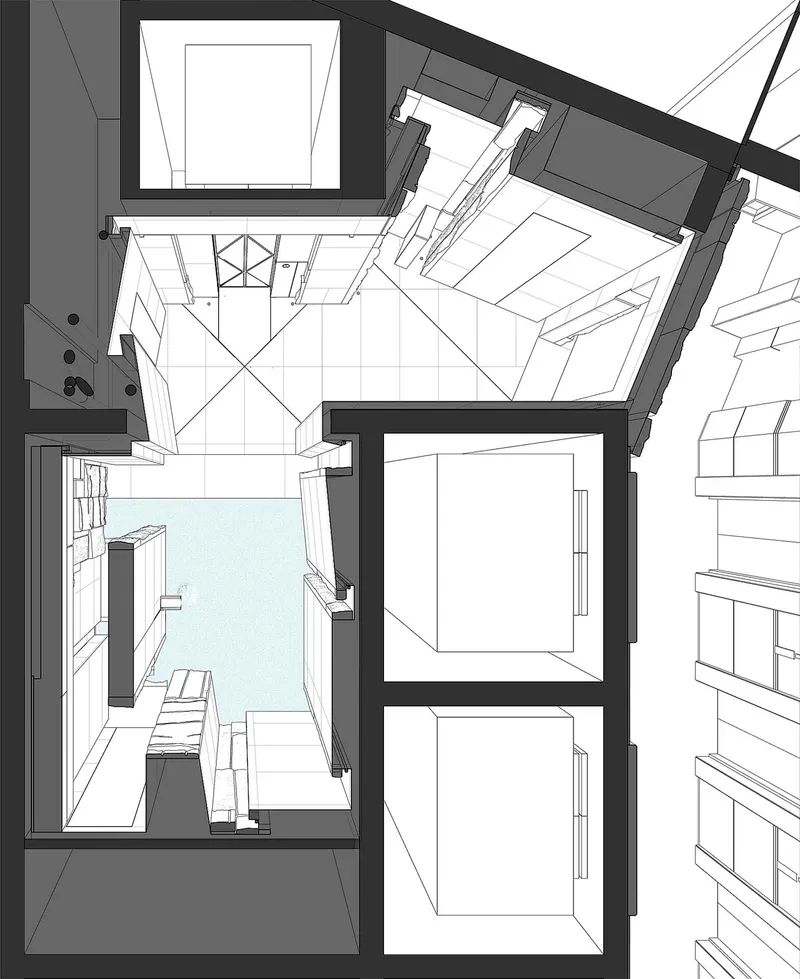

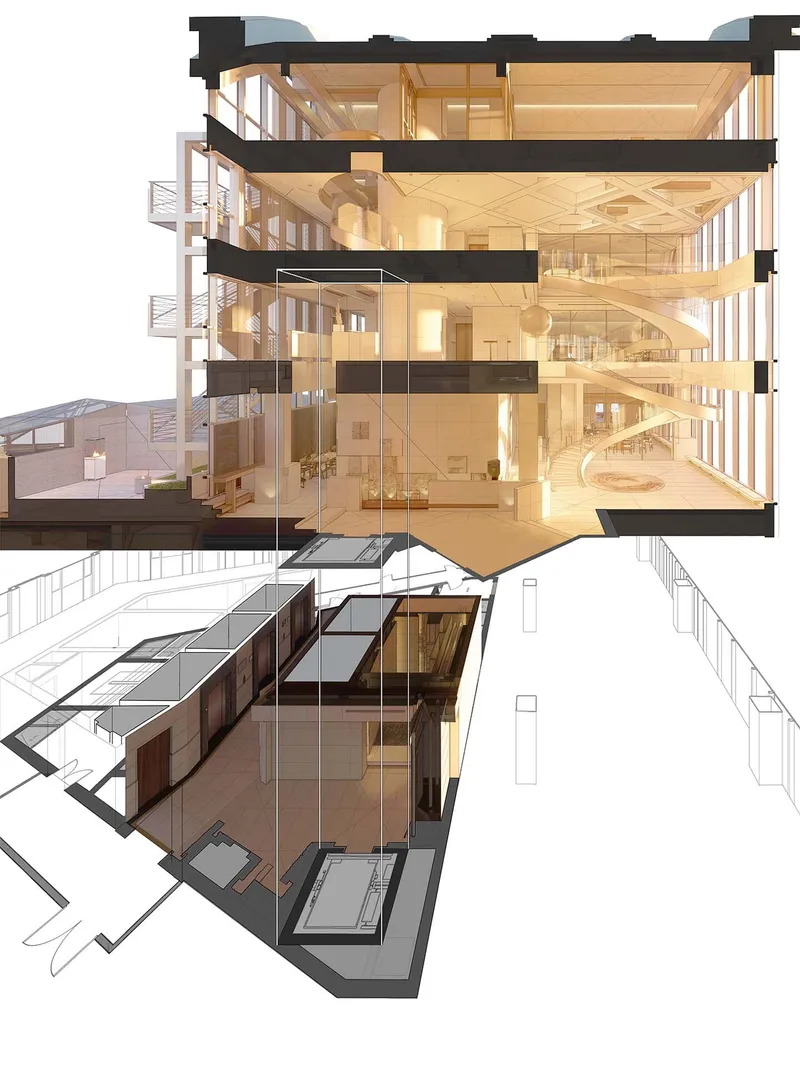
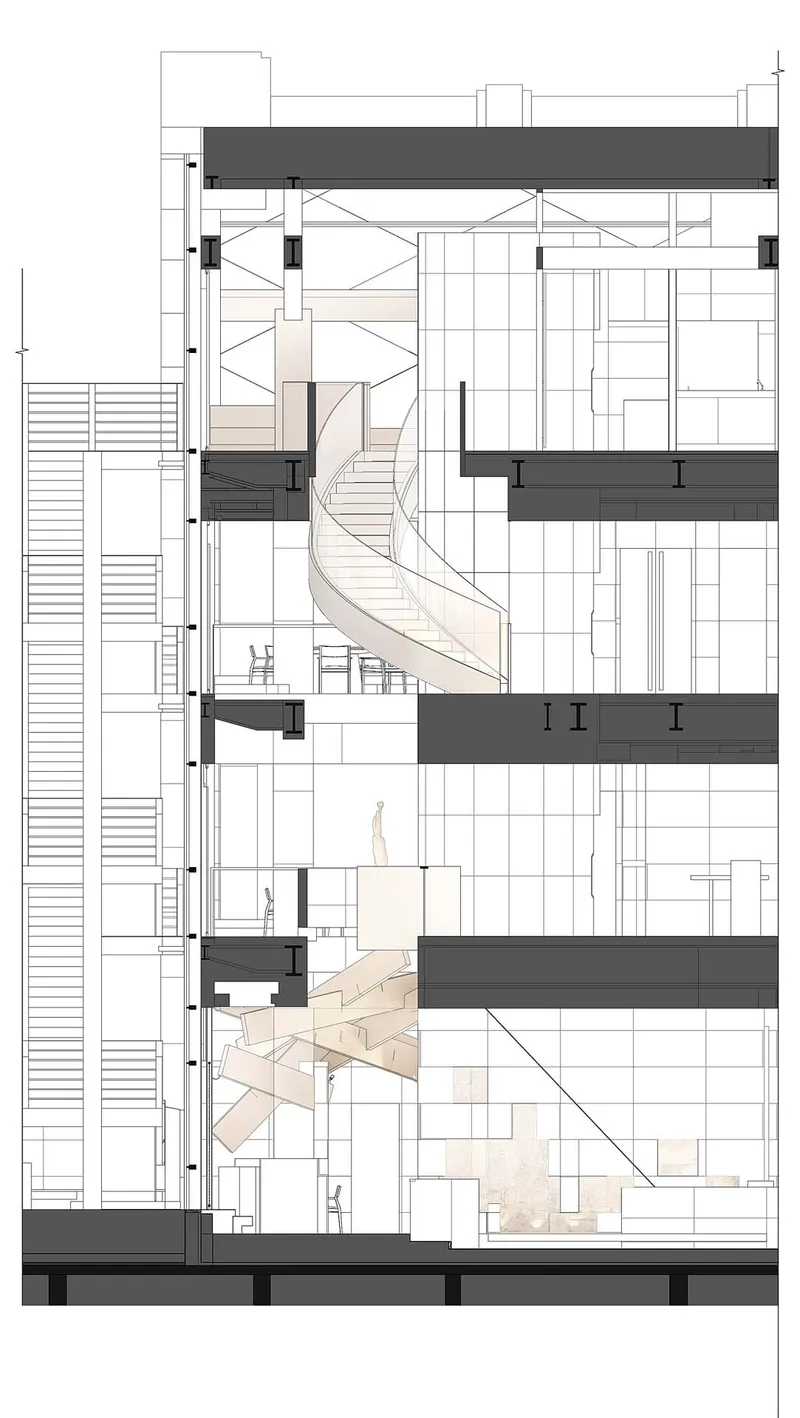
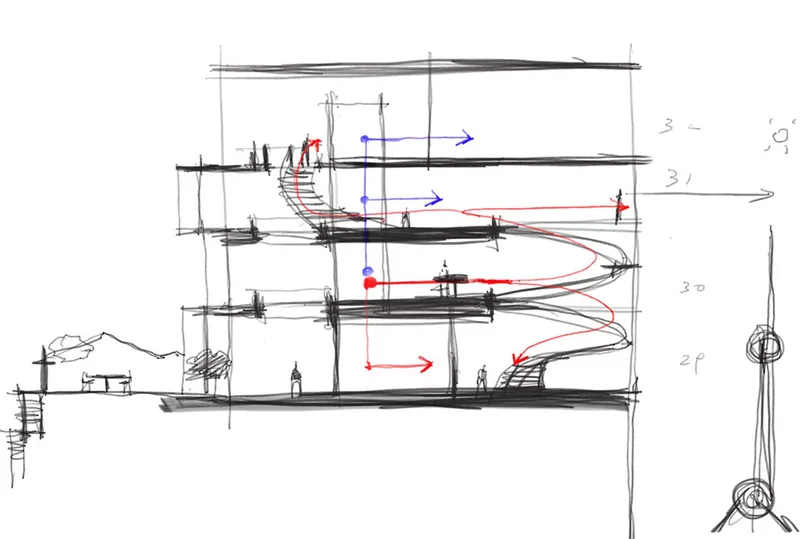
The plan drawings reveal how the architects navigated the building's irregular, roughly pentagonal footprint. The spiral staircase sits at the geometric center, with private rooms and dining zones radiating outward in a loose, staggered arrangement. The transparency of the layout is critical: glass walls between private rooms and the shared area maintain visual continuity, preventing the floor plates from feeling subdivided or cramped.
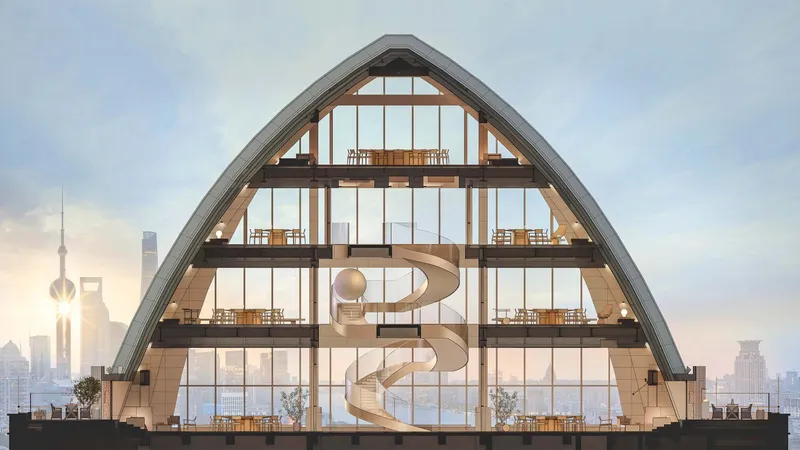
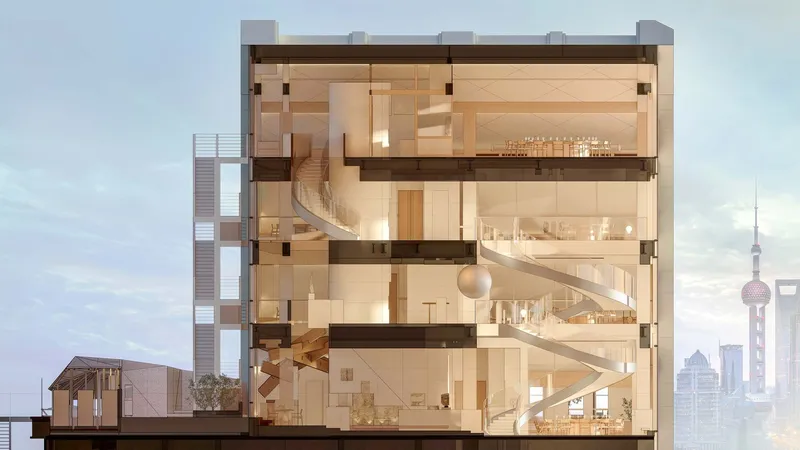
The section drawings are perhaps the most revealing. They show how three sets of original viewing rooms were gutted and reconnected to produce the four-story atrium, with the suspended staircase threading through the void. The sections also illustrate the relationship between the restaurant and the building's distinctive lotus-petal exterior contour, which closes upward toward the spire. The sketch section with its red and blue circulation arrows makes the Peach Blossom Spring narrative legible: a compressed entry sequence (elevator, wine cellar corridor) gives way to an expansive, spiraling reveal.
Why This Project Matters
Adaptive reuse of aging commercial towers is one of the most pressing design challenges in Chinese cities, and it rarely receives the attention given to ground-level heritage conversions. Dijing demonstrates that a 1990s high-rise with a tired curtain wall and weakening steel frame can be surgically transformed into a spatially ambitious interior without demolishing the host building. The decision to gut three floors and insert a vertical atrium is structurally bold and programmatically smart: it converts ordinary stacked floor plates into a single, memorable spatial experience.
More broadly, the project offers a credible alternative to the maximalist approach that dominates high-end dining design in Shanghai. By keeping the interior palette quiet, suppressing decorative lighting, and letting the panoramic views serve as the primary atmosphere, V2GETHER achieves an elegance that is architectural rather than decorative. The staircase is the one indulgence, and it earns its drama. For a restaurant perched above the North Bund, that is exactly the right calibration.
Dijing·Exquisite Restaurant, designed by V2GETHER design (lead architect Rui Zhao), Shanghai, China. 2,260 m², completed 2021. Photography by Qidiao Wu.
About the Studio
V2GETHER design
Share Your Own Work on uni.xyz
If projects like this are the kind of work you want to make, uni.xyz is a place to publish your own, find collaborators, and enter design competitions.


Popular Articles
Popular articles from the community


Faces of the Soviet Avant-Garde: Turning Moscow's Street Names into an Open-Air Museum
A network of sculptural installations across a Moscow residential district transforms forgotten architect names into spatial encounters with cultural memor

The Amber Palace Opera: A Geological Fiction Surfaces on Tallinn's Baltic Waterfront
Pierre Brillard reimagines a Baltic legend as a public landscape, opera house, and waterfront promenade rooted in Tallinn's coastal identity.

Tsunami Convergenics: Turning Catastrophic Ocean Forces into Underwater Housing Infrastructure
A speculative underwater settlement off the coast of Onagawa, Japan, treats tsunamis and typhoons as energy sources rather than threats.

Singing Woman: An Opera House That Performs Before the Curtain Rises
Ovidiu Cristian Pavel's conceptual opera house translates Estonia's choral identity into a sculpted waterfront landmark facing the Baltic Sea.

Similar Reads
You might also enjoy these articles

Pixel Gardens: One Repeated Module Stacked Into a Terraced Social Housing Tower for Famagusta
Salem Bader's shortlisted housing tower builds a vertical neighbourhood from one repeated module, offsetting units to carve terraces, light and air.

Bao Huynh Watercolor Atelier: A Serene Art Retreat in Hội An
Bao Huynh Watercolor Atelier in Hội An blends multifunctional art spaces, sustainable design, local materials, and family-friendly living in a serene environment.

Atelier Macri Concept Store Interior Design by CASE-REAL
Atelier Macri store features a "ko" counter, walnut wood details, cork displays, blending retail, gallery, and seamless customer experiences.

Manuel Vargas Izquierdo Stadium and High-Performance Sports Center: Architectural Excellence in Jalpa de Méndez
The Manuel Vargas Izquierdo Stadium blends sustainable design, inclusive sports facilities, and cultural-inspired architecture, revitalizing Jalpa de Méndez’s public spaces.

Explore Dining Competitions
Discover active competitions in this discipline

Challenge to design luxury tourism on rails

VR headsets Storefront design competition

Designing a staircase for a client
Comments (0)
Please login or sign up to add comments
No comments yet. Be the first to comment!