
V2in Architects Stack Cantilevered Cubes into a Home Office Hybrid in Nakhon Pathom
A Thai herbal company's headquarters and family residence fuse into a single stepped white volume on an awkward suburban site.


When a business outgrows its first shophouse, the typical move is to split: one building for the office, another for the family. V2in Architects rejected that split for Kongkaherb, a growing Thai herbal products company in Nakhon Pathom. Instead, they compressed office, warehouse, and multi-generational residence into a single 983 m² structure composed of staggered white boxes, each one cantilevered or rotated just enough to claim every usable centimeter of an irregular, angular lot.
What makes Residence Kongkaherb genuinely interesting is the conviction behind its geometry. The offset volumes are not decorative: they respond to setback lines, catch cross-breezes through their gaps, and carve out planted courtyards from leftover space between boxes. The result is a building that reads as a Jenga tower from the street but functions as a climate-responsive organism from the inside, with daylight, greenery, and air reaching deep into every floor.
A Street Presence Built from Overlapping Volumes
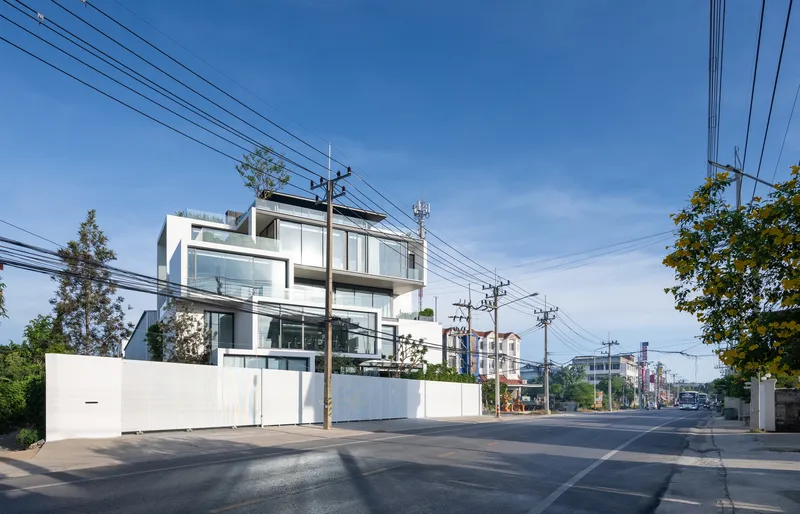


From the roadside, the building asserts itself through sheer compositional discipline. Each cube is finished in flat white stucco with full-height glazing recessed behind its frame, creating a rhythm of solid and void that shifts as you walk along the perimeter wall. The staggering is not random: the volumes rotate to align with the site's asymmetric boundary angles, which means the facade is technically different on every side.
Overhead power lines and the suburban context prevent Residence Kongkaherb from looking pristine in every photograph, and that honesty is refreshing. The building does not pretend to sit in a vacuum. It negotiates with its neighborhood, using the perimeter wall and planted buffers to mediate between the crisp geometry above and the busy street below.
Terraces and Rooftop Gardens Soften the Stack

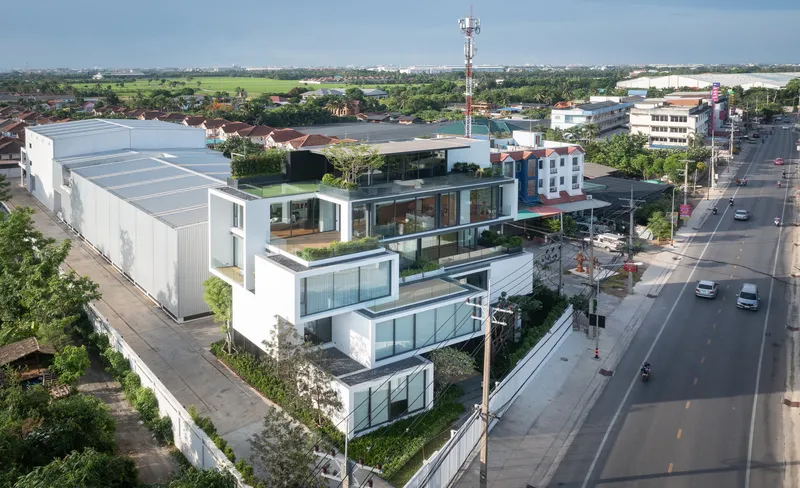

From above, the offsets between volumes become terraces. Each setback hosts a planted bed or timber deck, so the building reads as a cascade of gardens when seen from an aerial perspective. Trees emerge from planters at rooftop level, their canopies visible from the street and functioning as thermal buffers for the rooms directly beneath them.
These terraces do double duty. On the upper residential floors, they extend living spaces outdoors. On the lower office floors, they provide staff with breakout zones that feel domestic rather than corporate, a deliberate echo of the owner's original shophouse where work and home were indistinguishable.
The Floating Staircase as Spatial Anchor

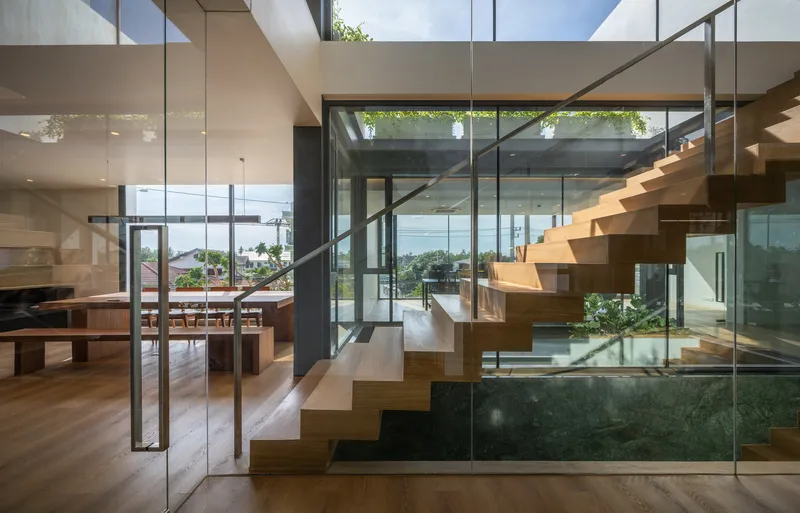
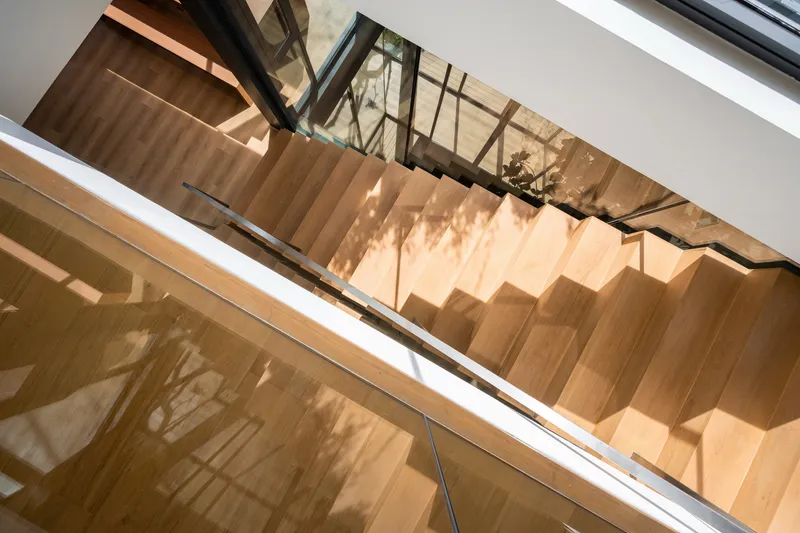
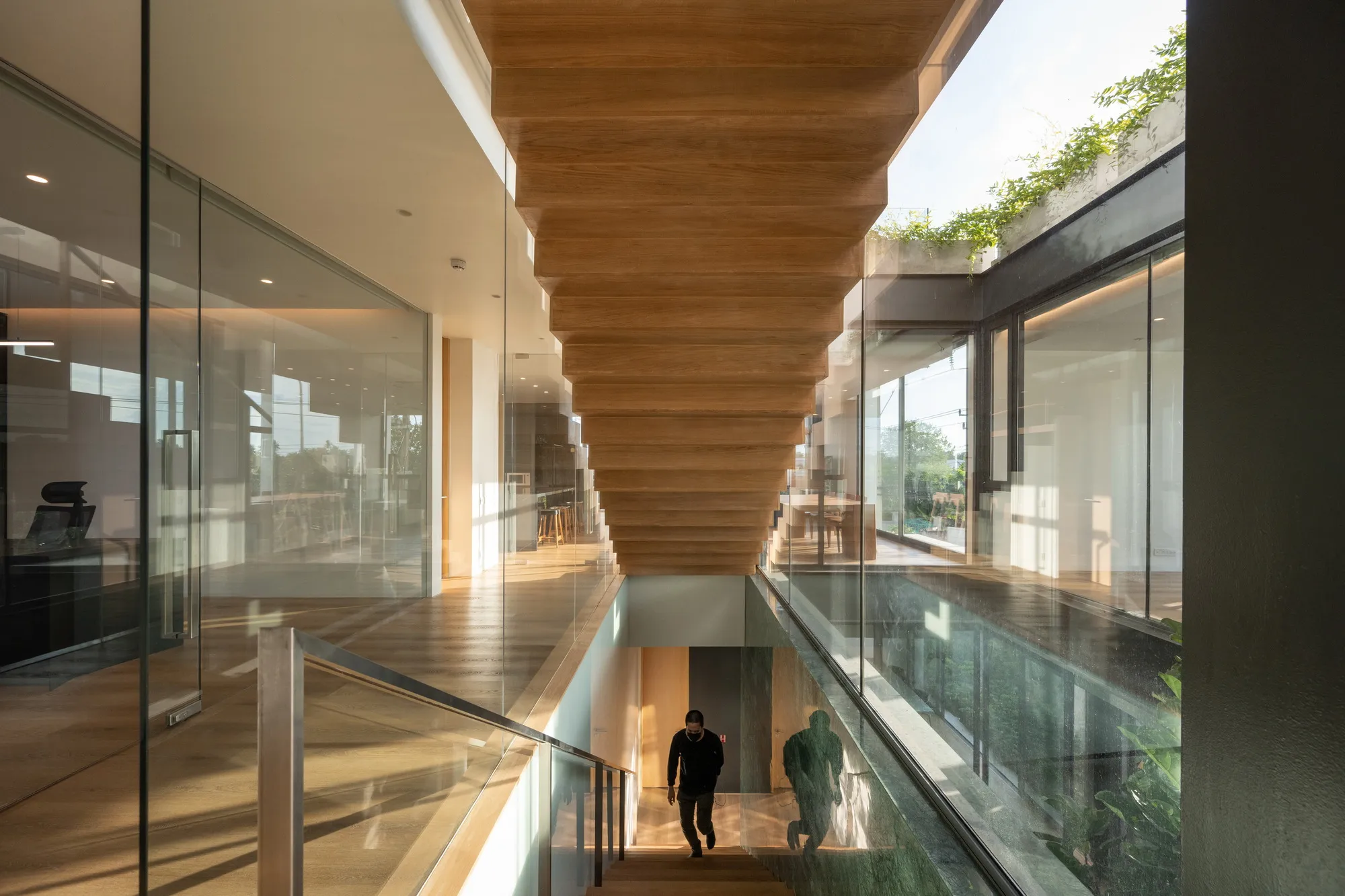
A cantilevered timber staircase threads through the building's central void, connecting the offset floor plates across four stories. Framed by glass walls and lit from above through skylights, it operates as the spine of the building, both structurally and socially. You see people on other levels as you climb, which collapses the psychological distance between the office below and the home above.
The stair detailing is restrained: warm timber treads, integrated handrail lighting, glass balustrades that disappear in daylight. It is the kind of element that could easily become the building's showpiece, but V2in keep it in check, letting the spatial drama of the double-height void do the work rather than any single material gesture.
Courtyards Carved from Leftover Space
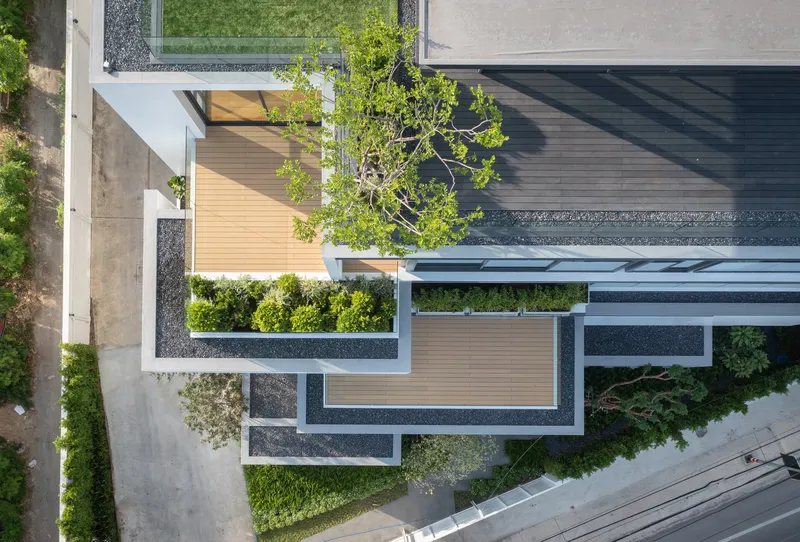

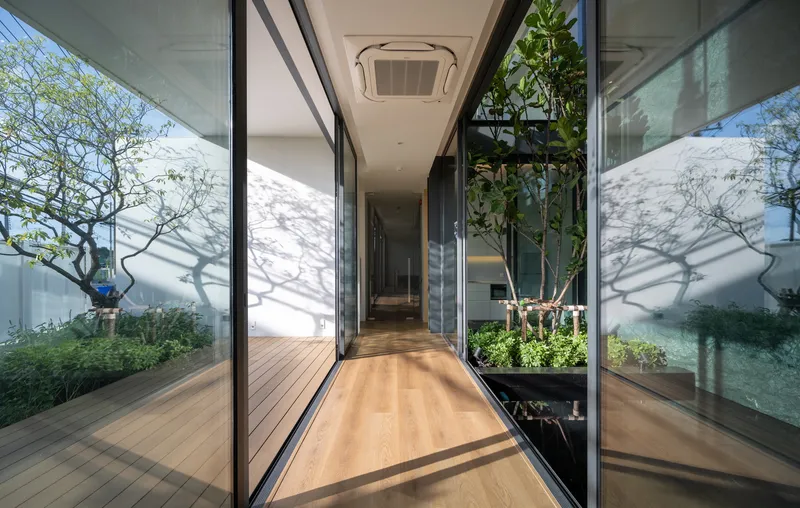
The asymmetric site left triangular and trapezoidal voids between the rotated boxes. Rather than filling these with structure, V2in turned them into interior courtyards, each one planted with mature trees and floored in timber decking or gravel. Sliding glass doors open offices and corridors directly onto these pockets of green, which pull daylight into the center of the plan and channel breezes through the section.
The courtyards also serve a less tangible purpose: they embed nature into the daily experience of workers and residents alike. Cascading greenery, dappled shadows, and the sound of wind through tree canopies are available from nearly every room. For a building born from the constraints of an awkward lot, these courtyards are arguably its most generous spaces.
Interior Material Palette: Timber, Glass, and Charred Wood
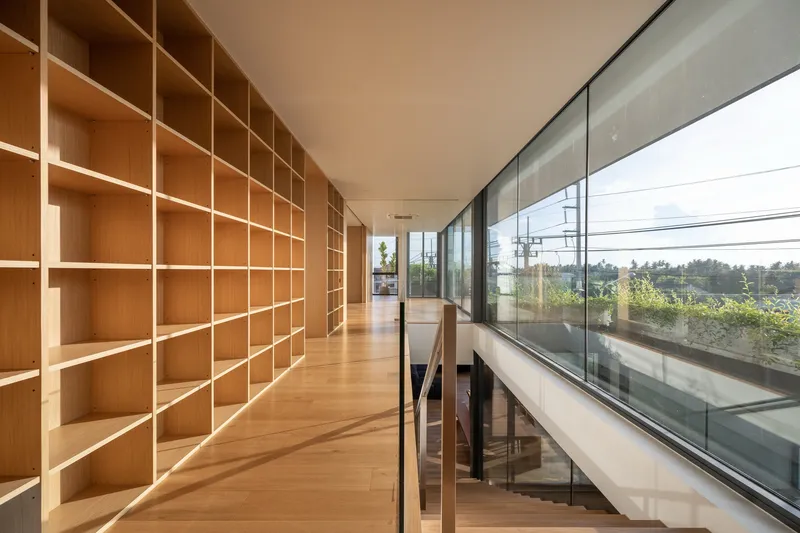
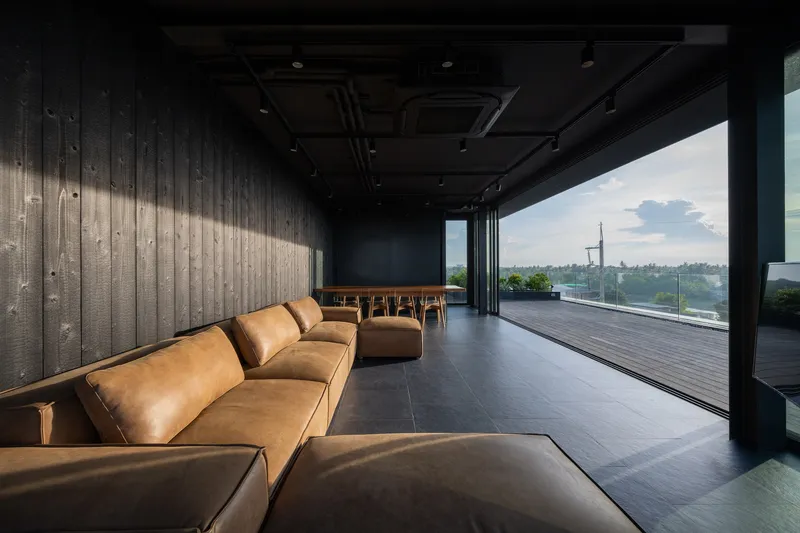

Inside, V2in limit themselves to a tight palette. Floors and stairs are warm timber. Walls are either white or clad in charred wood paneling, whose deep black tone grounds the residential lounge on the upper floors. Stone cladding appears sparingly in the stairwell, adding texture without competing with the greenery visible through every glass wall.
The insulated glass used throughout the exterior and interior does more than frame views. It generates visual connectivity between programs, so someone in the third-floor living room can see down into the office atrium or out across the rooftop garden. Privacy is managed through spatial separation and level changes rather than opaque walls, which keeps the building feeling open despite its density.
Evening Thresholds and the Rooftop Pavilion


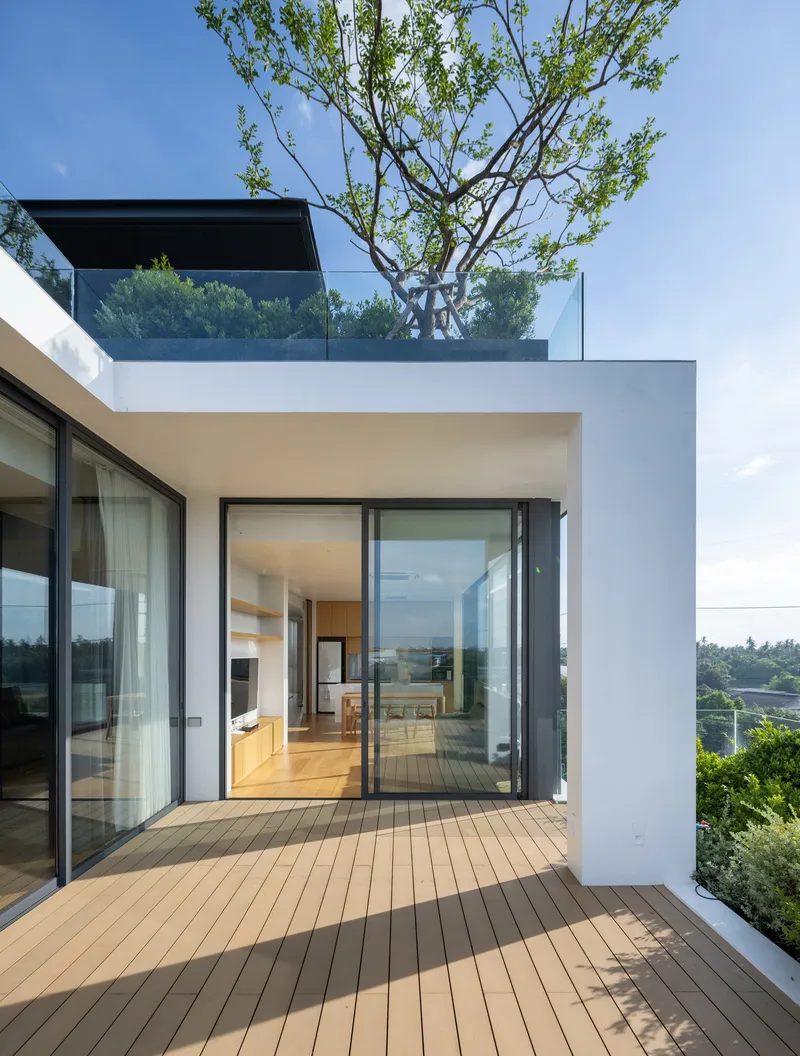
At dusk, the building transforms. The deep overhangs above the upper terraces frame views toward the surrounding Nakhon Pathom landscape, while warm light spills out from the glazed residential volumes. A rooftop pavilion, clad in timber and enclosed in glass, functions as a private retreat above the entire complex, with a small lawn and a single tree establishing it as a garden room rather than a leftover roof slab.
These evening images reveal the building's dual identity most clearly. The lower floors glow with the neutral light of a working office; the upper floors radiate the amber tones of a home. The two programs coexist under one skin but maintain their distinct atmospheres through material, light, and vertical distance.
Facade Detail and Layered Depth
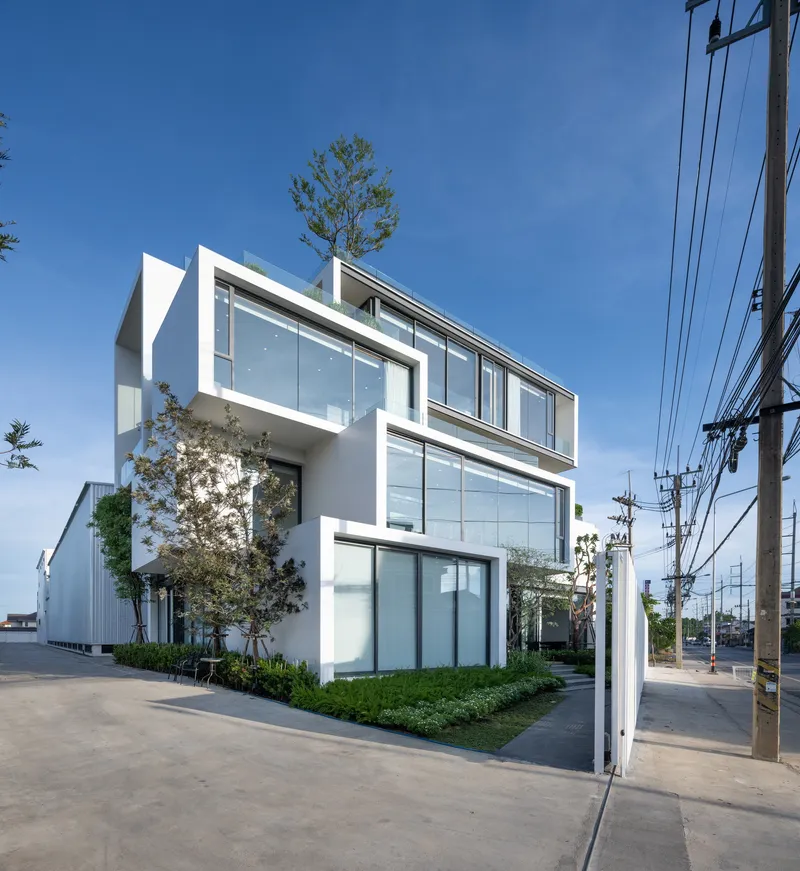

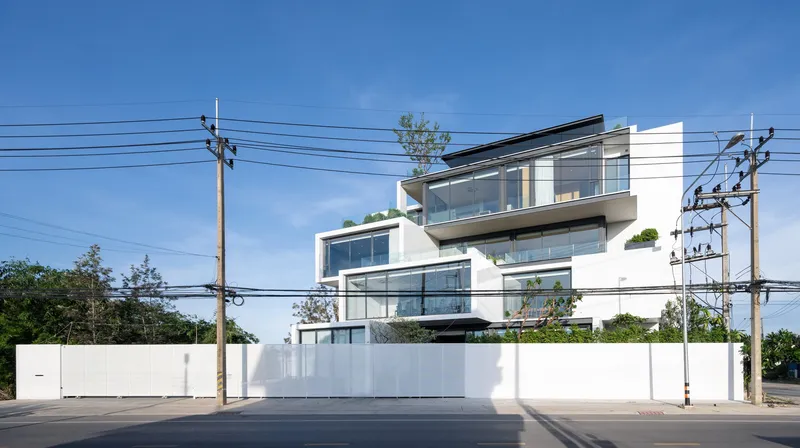
Up close, the facade reveals its depth. White frames project forward of the glass plane, creating shadow lines that change throughout the day. Dark horizontal banding at certain levels marks the transition between programs, while rooftop trees emerging from planted buffers soften the hard edge where building meets sky. The layered composition means the facade is never flat; it operates as a series of parallel planes that telescope as you move around the perimeter.
Plans and Drawings

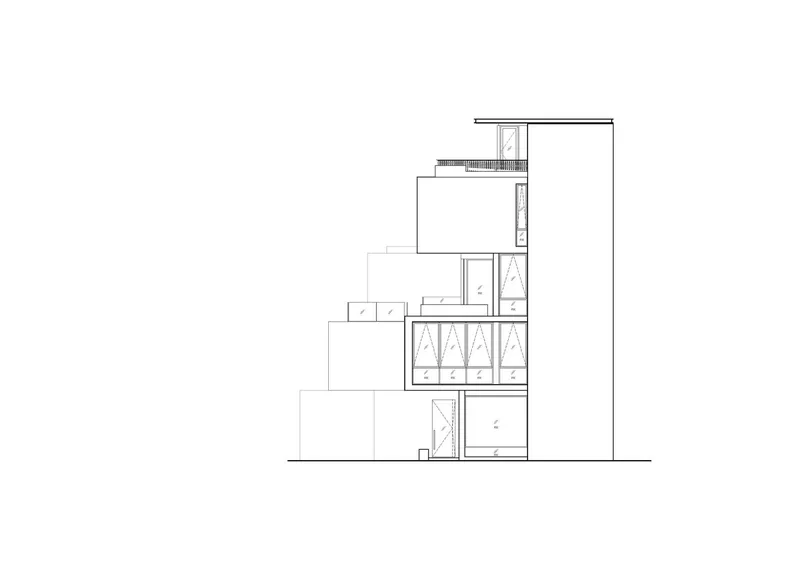
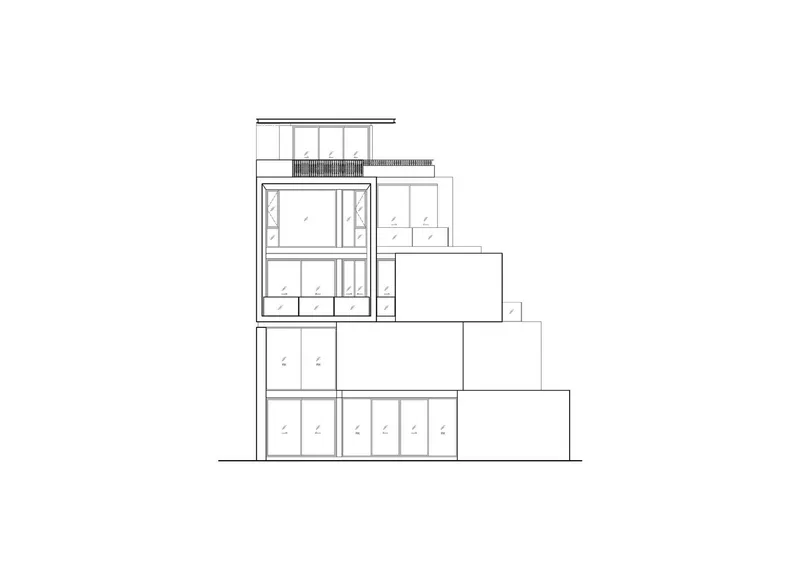
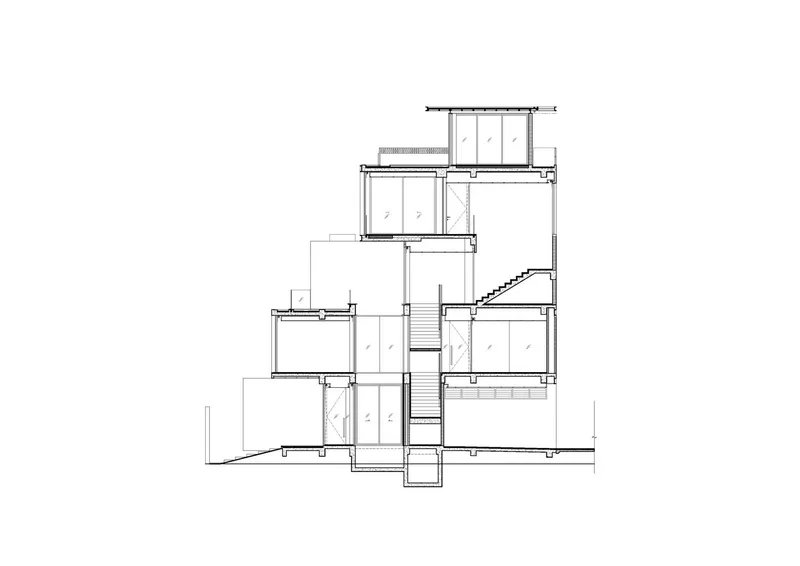

The axonometric diagrams make the design logic legible. Each program, office, residence, service, is color-coded and shown as a discrete box, with surrounding vegetation mapped as part of the architecture rather than an afterthought. The elevation drawings confirm the stepped profile and reveal how the full-height glazing is distributed: concentrated on the courtyard-facing sides where solar gain is manageable, and more restrained on the street elevations.
The section drawings are where the project's intelligence is most apparent. A long diagonal staircase traverses split levels, connecting offset floor plates that would be isolated in a conventional plan. The central void reads as a continuous vertical space, with planted courtyards appearing as carved-out pockets that bring light and air to the deepest parts of the section. The structural cantilevers, invisible in photographs, are clearly expressed as the mechanism that allows each box to project beyond the one below.
Why This Project Matters
Residence Kongkaherb matters because it takes a common Southeast Asian building type, the family business with living quarters above, and rethinks it from the ground up without abandoning the intimacy that makes the type work. The owner's nostalgia for the original shophouse where business and domestic life overlapped is not merely referenced; it is structurally embedded in a building where you can see from the office atrium into the family garden two floors above.
It also demonstrates that site constraints do not have to be liabilities. The awkward lot angles that defeated a conventional plan became the generator of the building's most compelling features: the rotated volumes, the interstitial courtyards, the cascade of terraces. V2in Architects turned limitation into logic, and the result is a building that feels both inevitable and surprising, which is the hardest thing in architecture to pull off.
Residence Kongkaherb by V2in Architects. Nakhon Pathom, Thailand. 983 m². Completed 2021. Engineering by CEofficers. Contractor: ARTCON. Interior contractor: WAWARA design. Landscape contractor: WA Planning. Photography by Rungkit Charoenwat.
About the Studio
Share Your Own Work on uni.xyz
If projects like this are the kind of work you want to make, uni.xyz is a place to publish your own, find collaborators, and enter design competitions.


Popular Articles
Popular articles from the community


Riyadh For All: Intergenerational Urban Design for Active Aging in Rabat
Riyadh For All reimagines urban design in Rabat with intergenerational co-living, adaptive courtyards, and Moroccan cultural exchange today.

Co-Life: Senior Housing Design That Reconnects Older Adults With the City
Co-Life reimagines senior housing design through healing gardens, shared streets, workshops, and a sustainable community across generations.

Conexión: Biophilic Design Reimagines High-Rise Living in Hong Kong
Conexión reimagines high-rise living in Hong Kong through biophilic design, green facades, shared spaces, daylight, water and nature within.

Co-life: Sustainable Architecture for Age-Friendly Community Living
Co-life reimagines sustainable architecture for seniors through courtyards, rammed earth, shared gardens, and spaces designed for belonging.
Similar Reads
You might also enjoy these articles

Bao Huynh Watercolor Atelier: A Serene Art Retreat in Hội An
Bao Huynh Watercolor Atelier in Hội An blends multifunctional art spaces, sustainable design, local materials, and family-friendly living in a serene environment.

Atelier Macri Concept Store Interior Design by CASE-REAL
Atelier Macri store features a "ko" counter, walnut wood details, cork displays, blending retail, gallery, and seamless customer experiences.

Manuel Vargas Izquierdo Stadium and High-Performance Sports Center: Architectural Excellence in Jalpa de Méndez
The Manuel Vargas Izquierdo Stadium blends sustainable design, inclusive sports facilities, and cultural-inspired architecture, revitalizing Jalpa de Méndez’s public spaces.
KAKR Buluh Awar Hall: Revitalizing Community and Ecology Through Bamboo Architecture
Community built bamboo hall revitalizes Buluh Awar village, empowering youth, restoring ecology, celebrating vernacular craftsmanship through sustainable architecture and culture.


Explore Residence Competitions
Discover active competitions in this discipline


Challenge to design mud housing for contemporary communities


Challenge to reimagine the Iron Throne


Photograph architecture without architects


Illustrate the lost glory of Angkor Wat - Render Challenge
Comments (0)
Please login or sign up to add comments
No comments yet. Be the first to comment!