
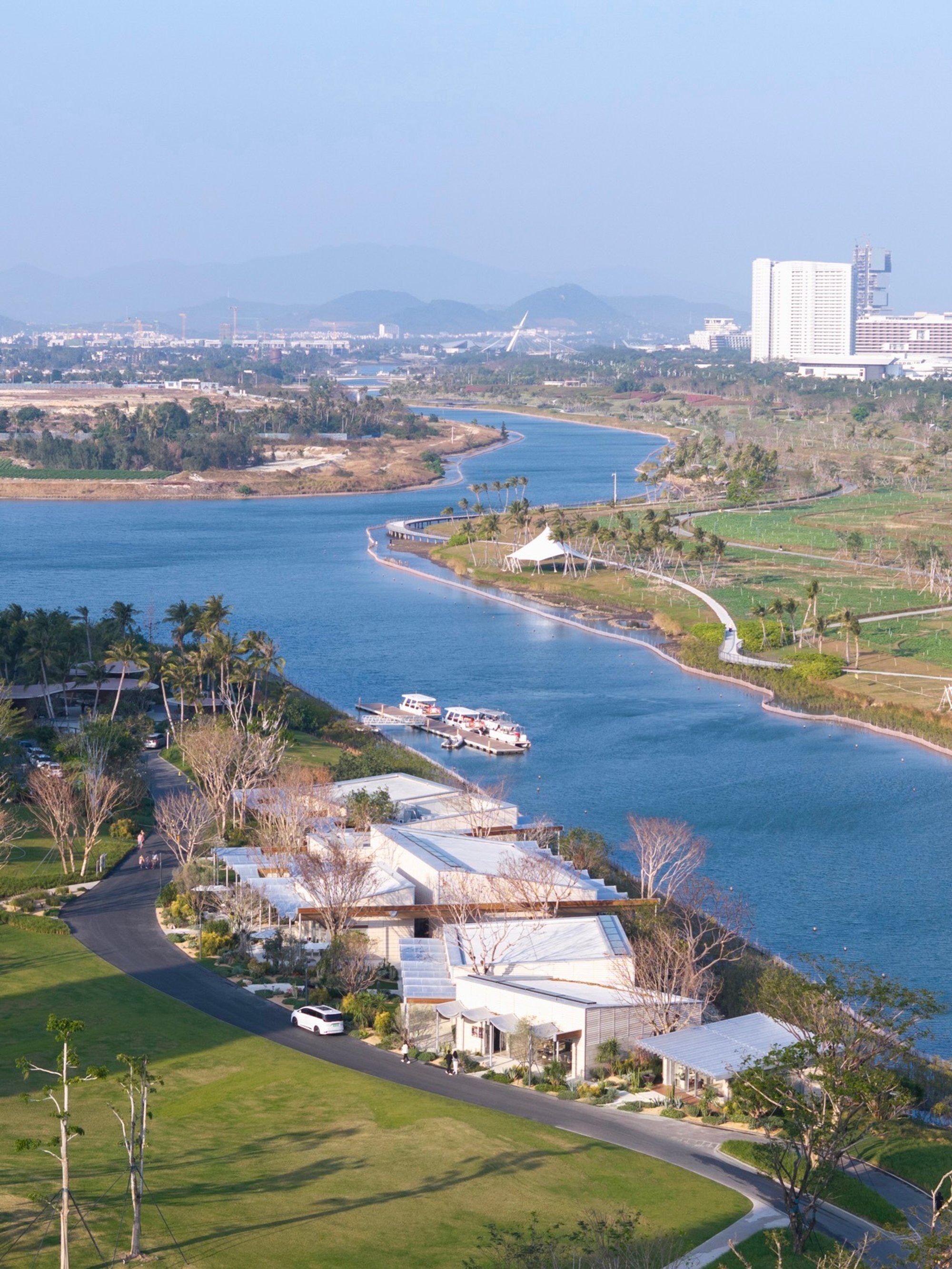
Vari Architects Scatters a Waterfront Village Across the Mangrove Edge of Sanya's Haitang Bay
A 2,000 square meter cluster of draped canopies and low pavilions settles into the wetlands of southern Hainan, blurring the line between building and shor

Most waterfront commercial developments treat shoreline as a backdrop, lining up retail boxes to face the view. Vari Architects, led by Feng Pan'ao, took a different approach on the banks of Sanya's Haitang River. Instead of a single building, they dispersed a 2,000 square meter program into a loose constellation of pavilions that follow the river's meander, each one capped with a billowing canopy that reads less like a roof and more like fabric caught mid-gust. The result is a place that feels grown from its site rather than imposed upon it.
What makes this project worth studying is the conviction behind its formal logic. The undulating roofs are not decoration; they are the primary environmental device, casting deep shadows across terraces and courtyards in a climate where shade is survival. The village layout, meanwhile, creates the kind of spatial variety that a single large building never could: tight alleys, open courts, waterfront decks, planted gaps. It is a small project with the ambition of an urban plan.
A Roofscape That Reads as Landscape
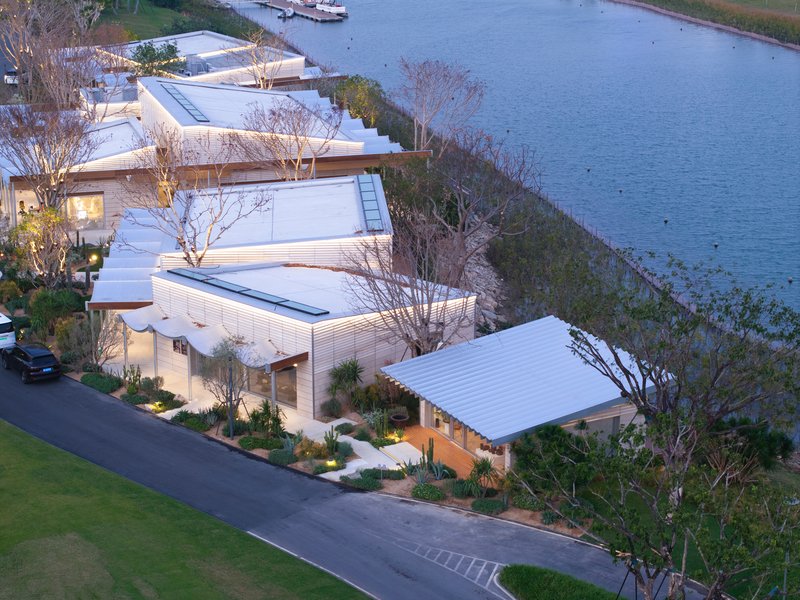
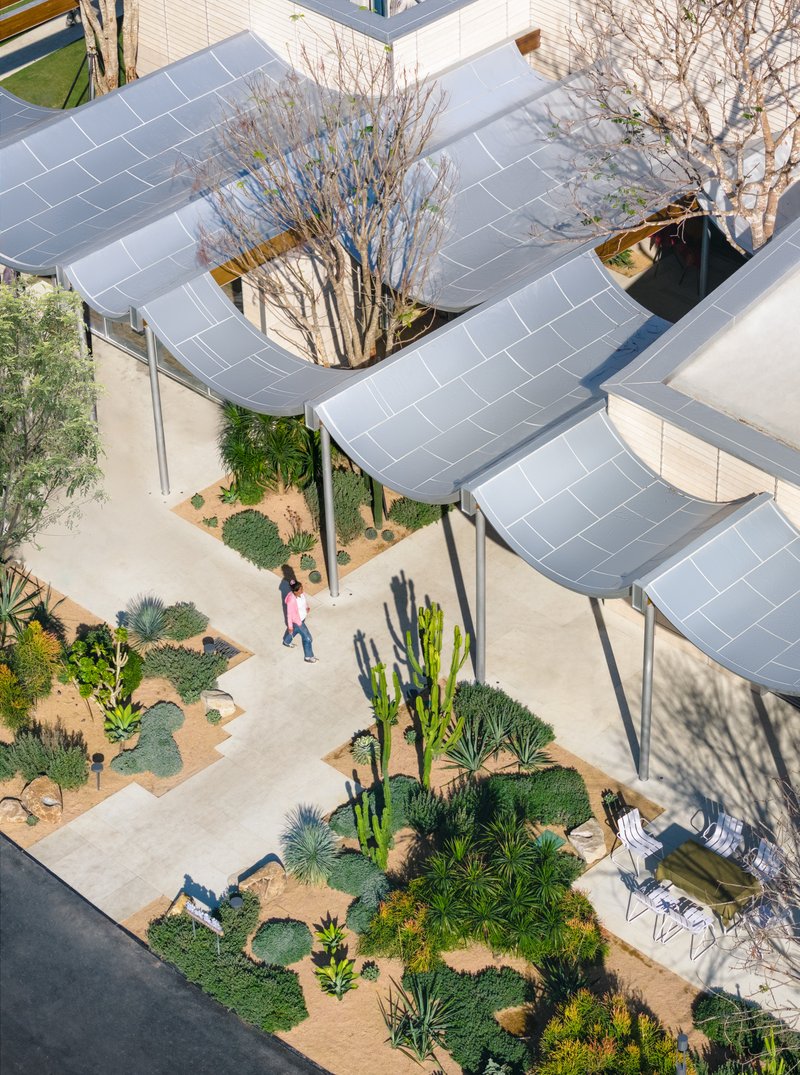
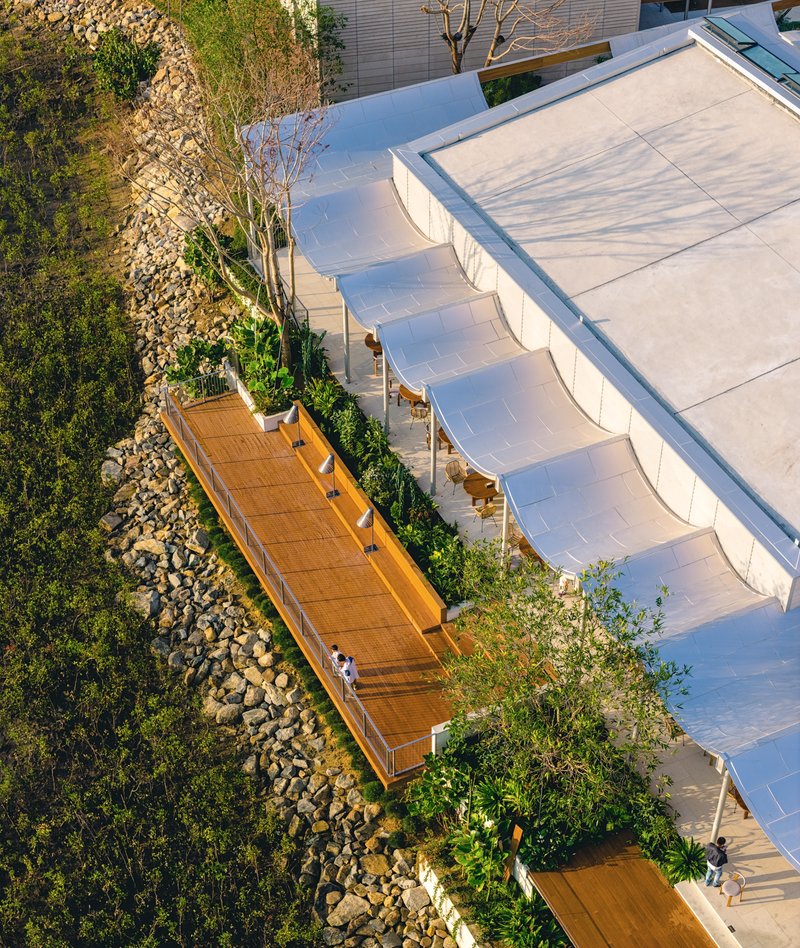
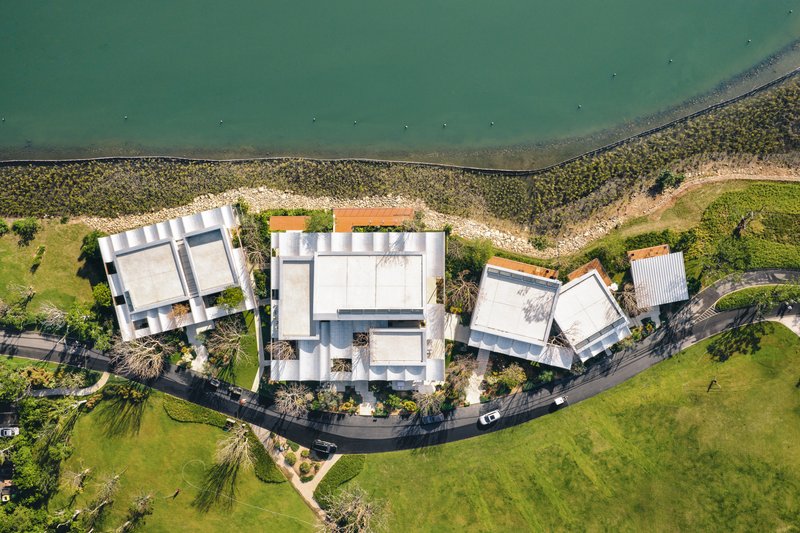
Seen from above, the project's metal roofs ripple and fold in a continuous topography that mirrors the soft contours of the riverbank below. The corrugated surfaces catch light at different angles throughout the day, shifting from bright silver to warm pewter as the sun tracks across Hainan's sky. These are not standard standing-seam panels laid flat; they drape over irregular geometries, creating valleys where rainwater channels and peaks that ventilate the spaces beneath.
The aerial views reveal something important about the design strategy: the roofs are the architecture. Walls are minimal, often just glass or timber slats tucked under generous overhangs. The canopy does all the heavy lifting, defining territory, directing movement, and establishing the project's identity against the horizontal expanse of river and mangrove.
Settling Into the Shoreline
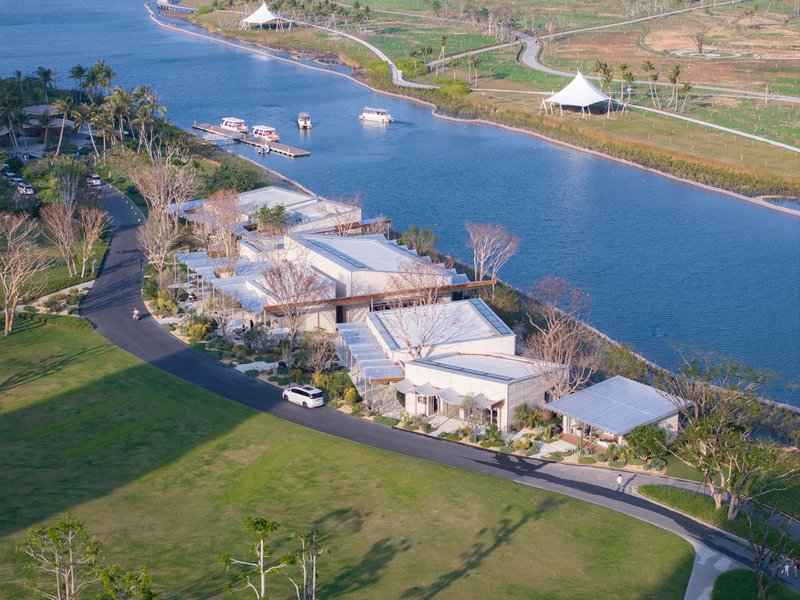
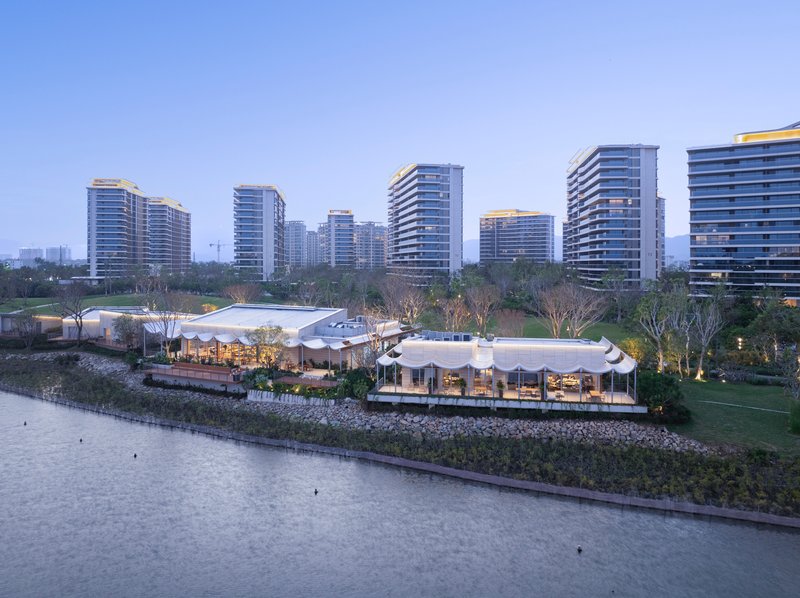
The site sits at the threshold between developed Sanya and its wetland fringe, a liminal strip where coconut palms, mangroves, and manicured lawn overlap. Vari Architects positioned the pavilions to straddle that threshold rather than resolve it. From the canal side, the cluster appears as a white village floating above the water's edge. From the inland approach, it reads as a series of modest structures nestled among planting, their low profiles deferring to the towers that rise in the distance.
The evening shot along the lake edge is telling: illuminated pavilions glow softly while high-rise towers loom behind, and the contrast between the two scales is the project's strongest argument. Against the relentless verticality of resort development in Sanya, this horizontal, fragmented approach feels almost subversive.
Shade as Architecture
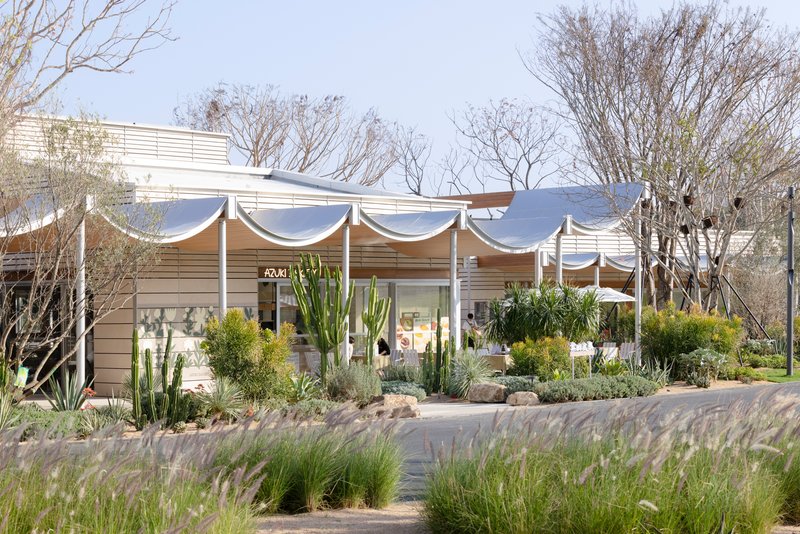
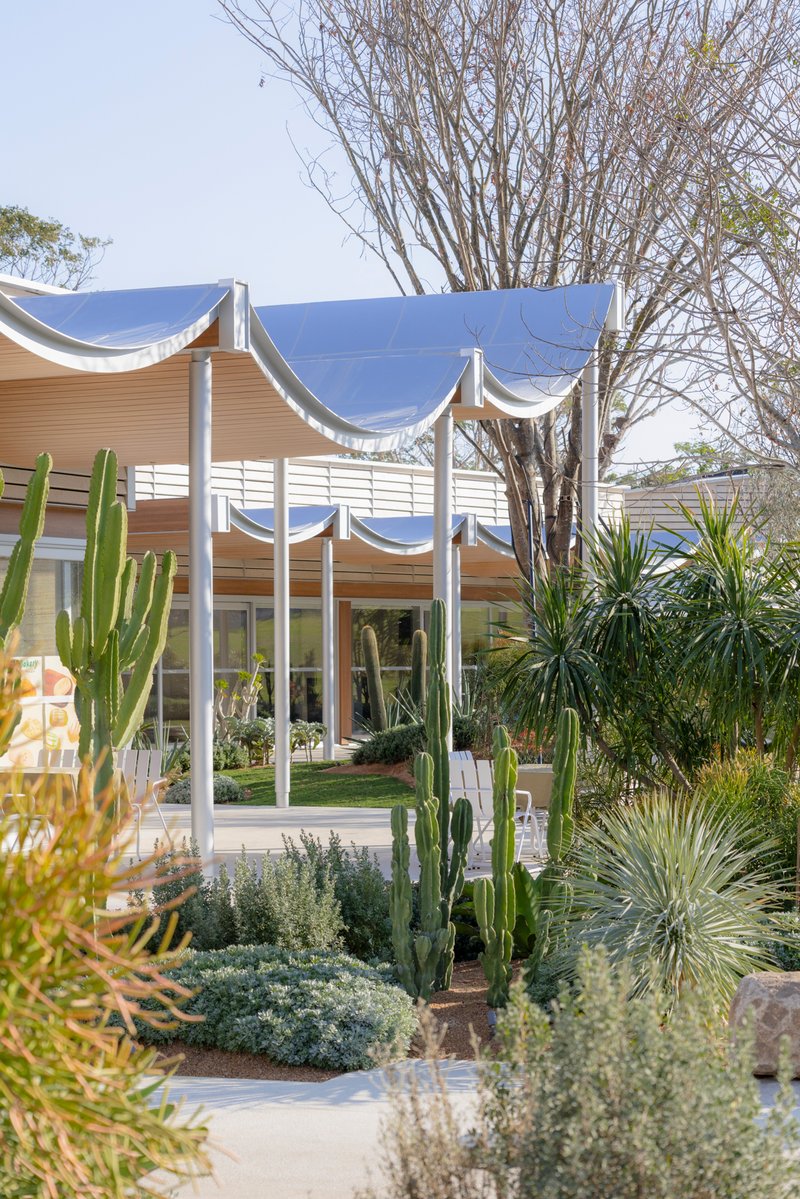
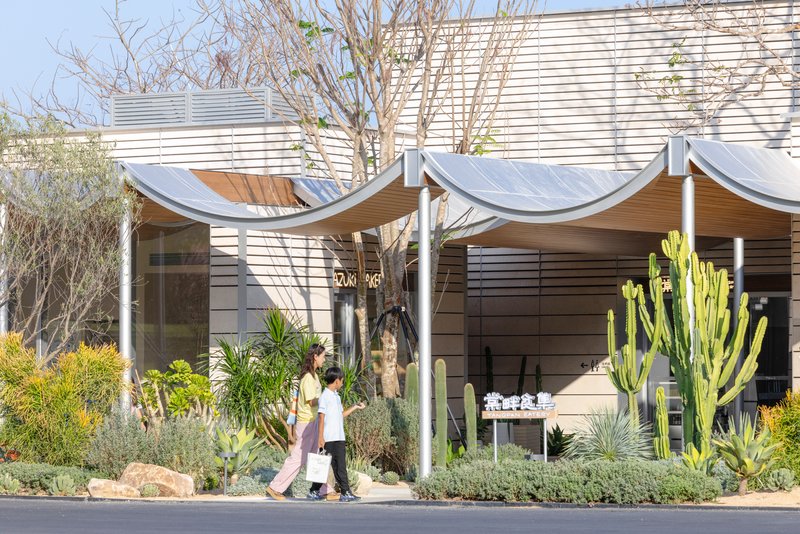
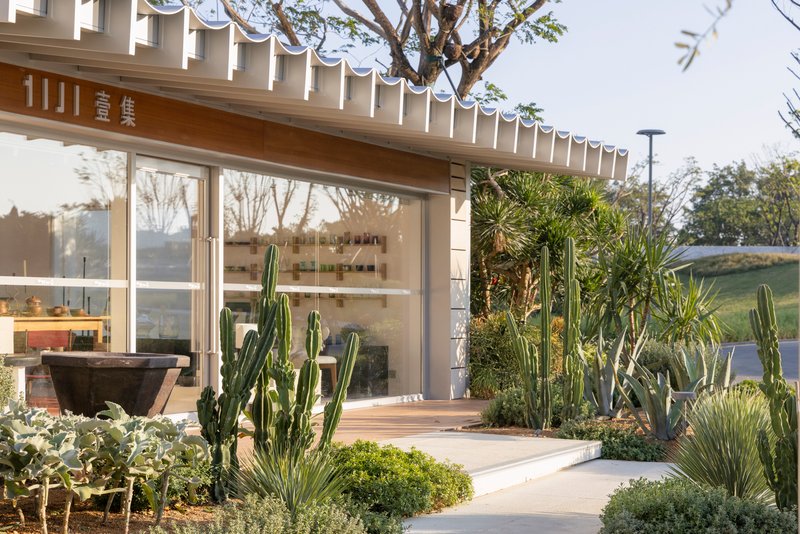
In a tropical climate where temperatures rarely dip below comfortable, the primary job of a building envelope is not to insulate but to shade. The fabric-like canopies that sweep over the pavilions produce deep, layered shadows across terraces, walkways, and glazed storefronts. Visitors move from one pool of shade to the next, with the scalloped edges of each canopy creating a rhythmic alternation of light and dark underfoot.
The planting strategy reinforces this logic. Cacti, succulents, and desert grasses cluster around the pavilion bases, chosen not for decorative whimsy but for their tolerance of the hot, exposed conditions at the canopy perimeter. Where the shade deepens, softer species take over. The landscape and the architecture are calibrated to the same gradient of sun and shadow.
Under the Canopy
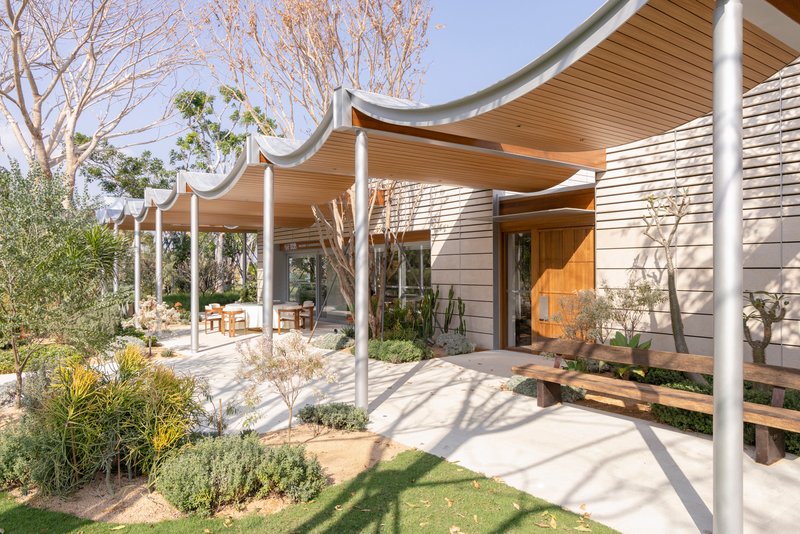
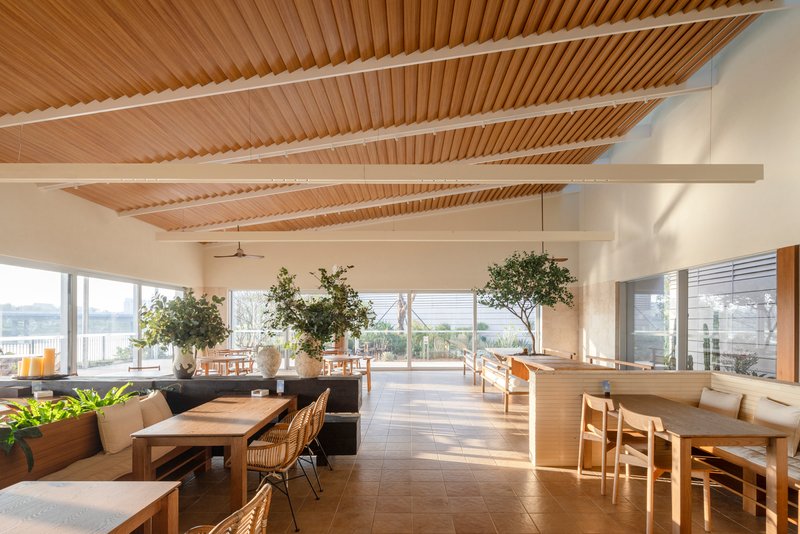
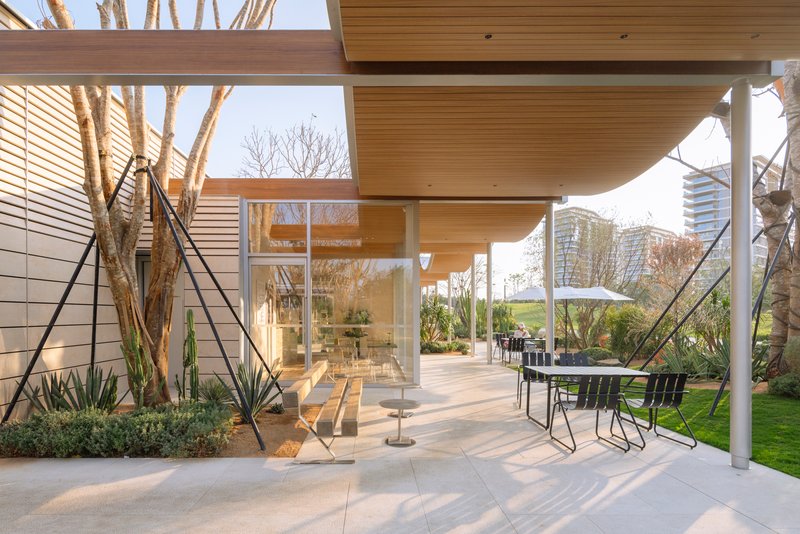
Beneath the roofs, the interiors lean hard into timber: slatted ceilings, wood soffits, and exposed beam structures that bring warmth and grain to spaces that could easily have defaulted to white minimalism. The undulating wood ceiling in the main terrace is the best example, its curves echoing the exterior roof form while creating an intimate, almost domestic scale overhead. White columns stand clean against the timber, simple enough to disappear.
The covered patio spaces work as transitional rooms, neither fully interior nor exterior. Glass doors slide open to erase the boundary between dining areas and planted courtyards, and the generous overhangs mean these thresholds stay dry and shaded even during Sanya's monsoon season. It is a fundamentally tropical architecture: the wall is optional, the roof is everything.
Interior Atmospheres
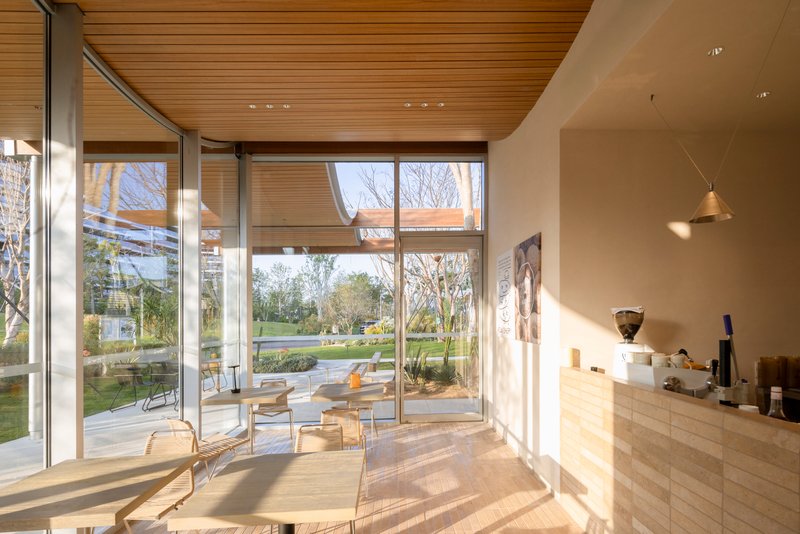
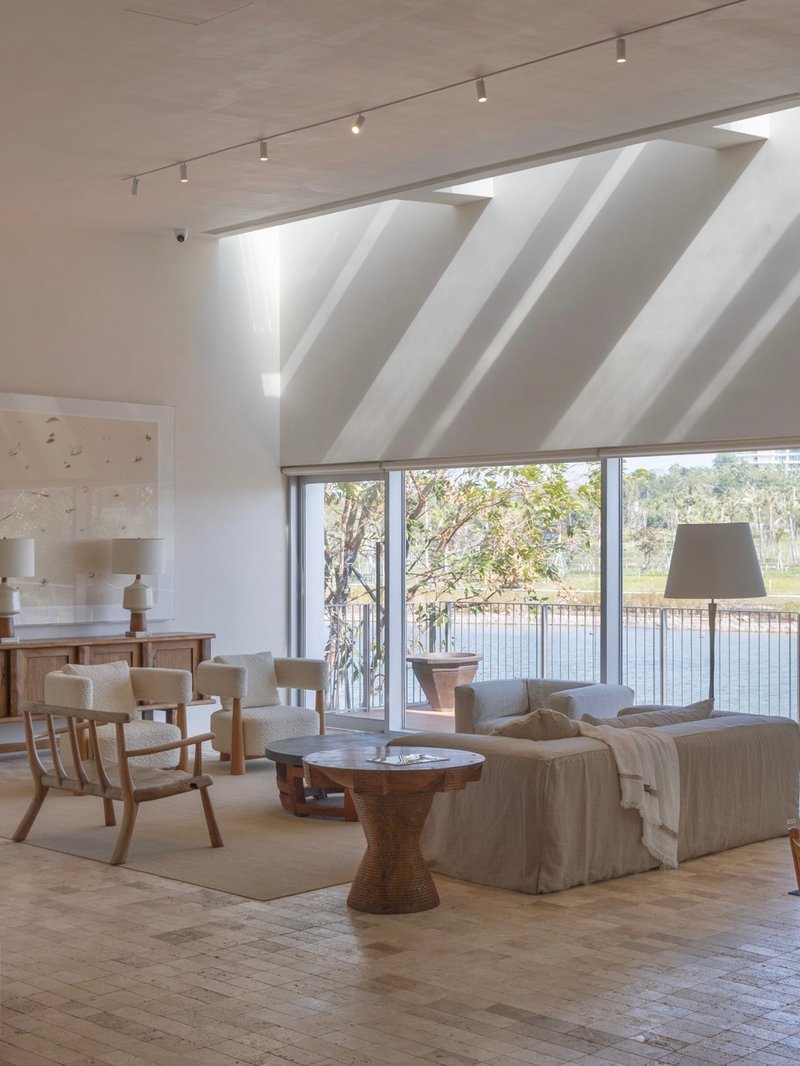
Where the program demands enclosure, the interiors maintain visual porosity through floor-to-ceiling glazing that frames the parkland and waterfront beyond. The dining space, with its slatted timber ceiling and afternoon sun streaming through the glass, manages to feel like a refined room and an open pavilion simultaneously. Angled white fabric ceiling baffles in the living areas diffuse light and soften acoustics, borrowing the language of the exterior canopy and translating it to an interior scale.
The material palette stays restrained: wood, white surfaces, glass, and strategic glimpses of vegetation. There is no moment where the interiors compete with the views. Instead, they act as carefully calibrated frames, each window positioned to capture a specific relationship with the trees, water, or sky beyond.
Twilight and the River
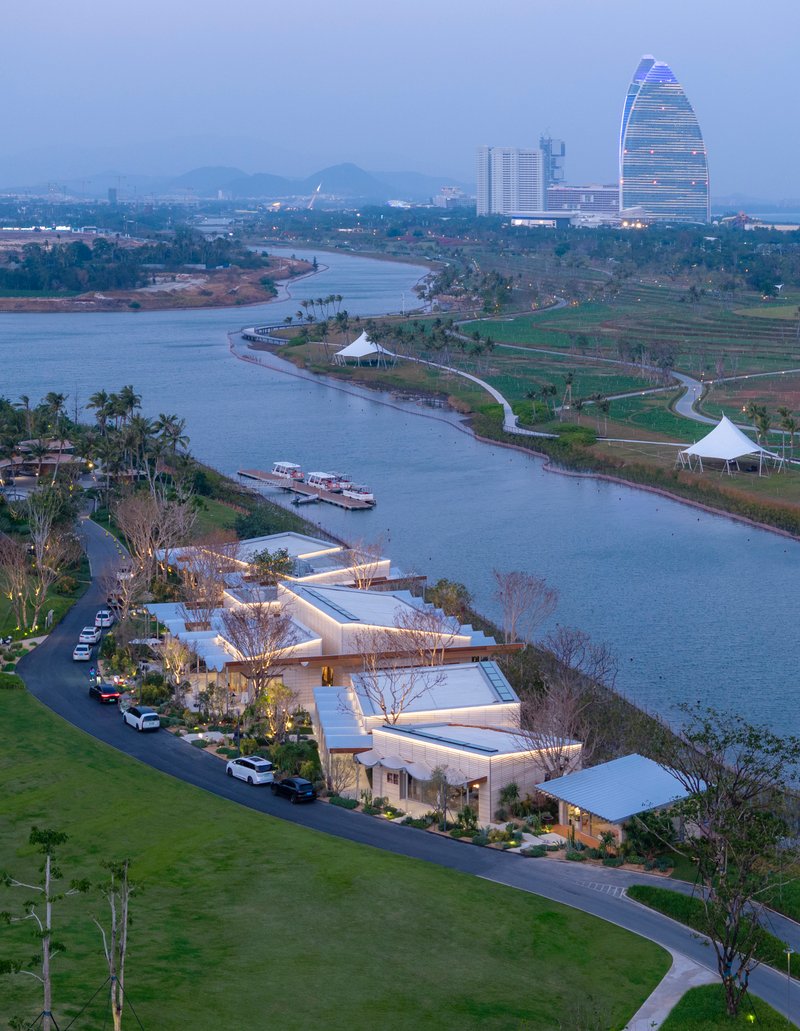
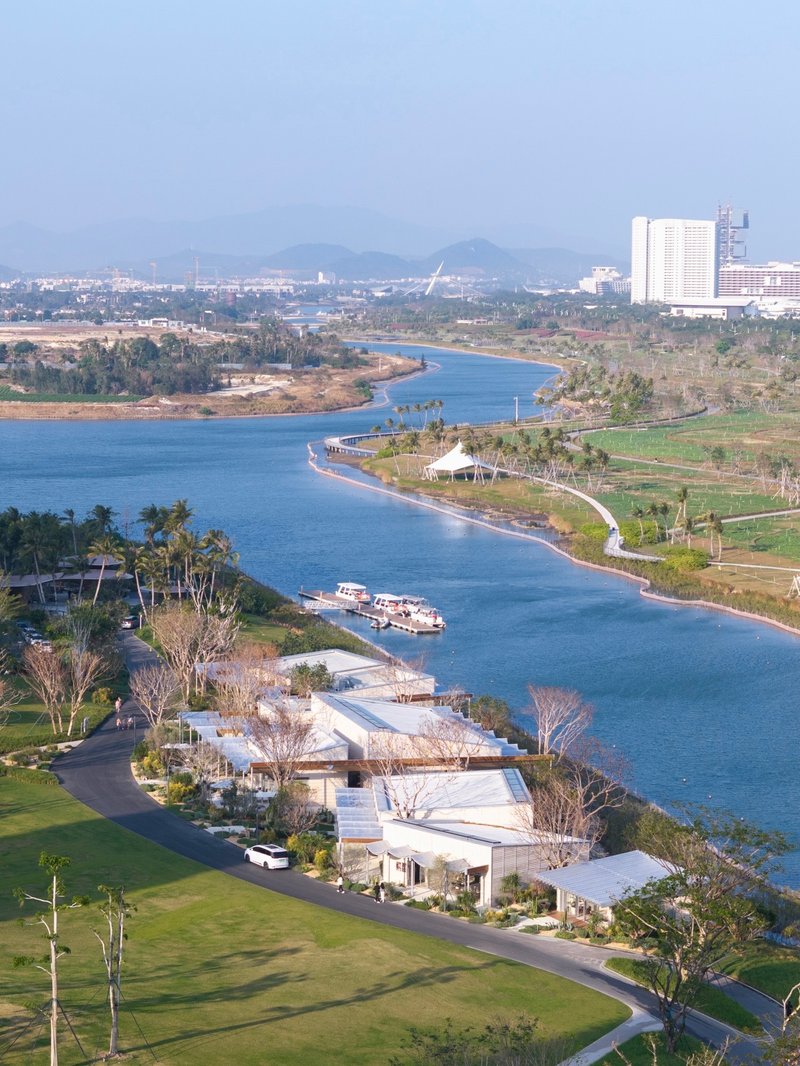
The elevated twilight view, with pavilions lining the canal and mountains visible in the distance, reveals the project's real scale. It is not a building but a piece of infrastructure for public life along the water. The boardwalk, the canal, the planted terraces, and the sheltered commercial spaces all work together as a continuous system. You move through it the way you would move through a coastal village: by wandering, with no single front door and no prescribed route.
Plans and Drawings
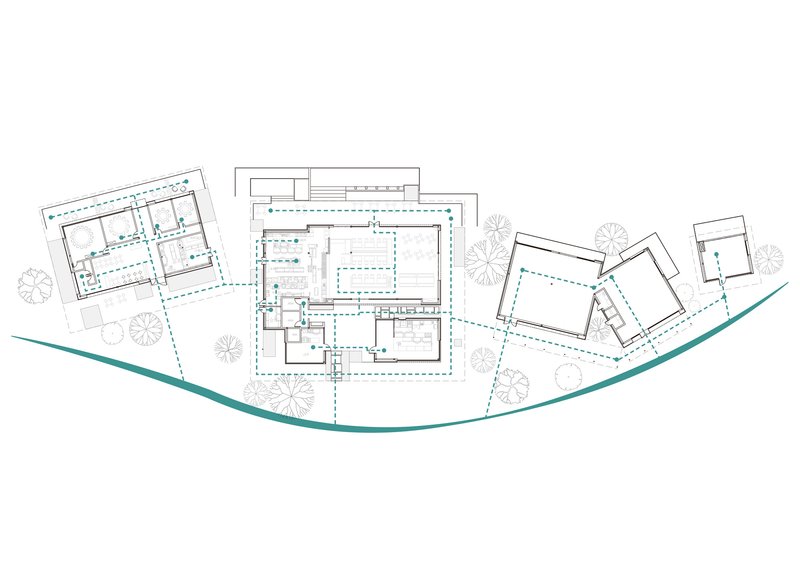
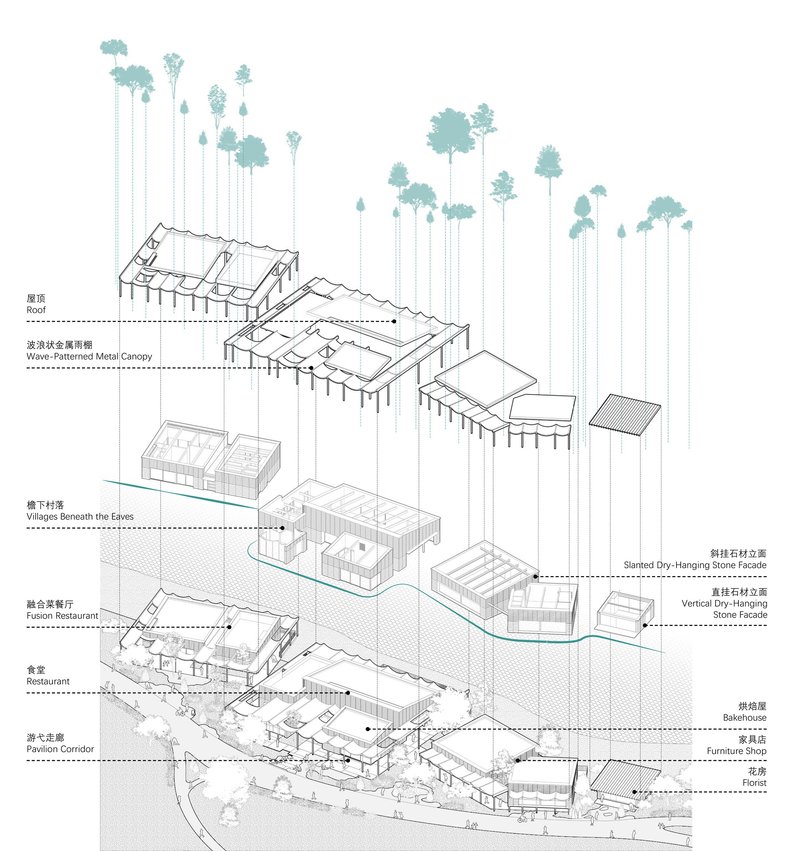
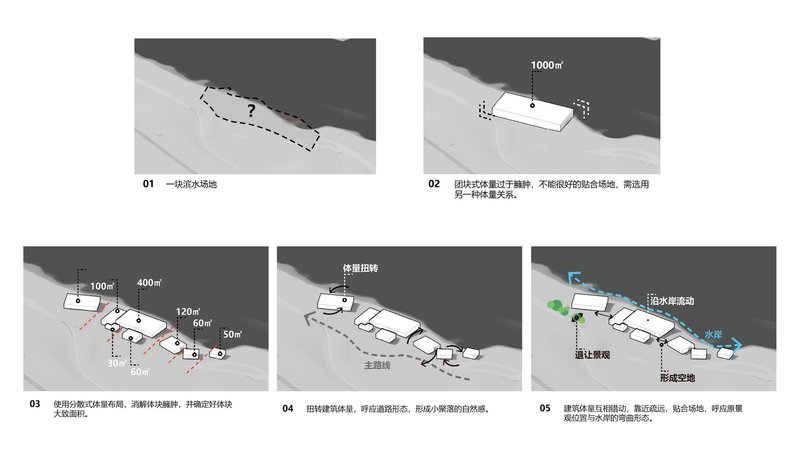
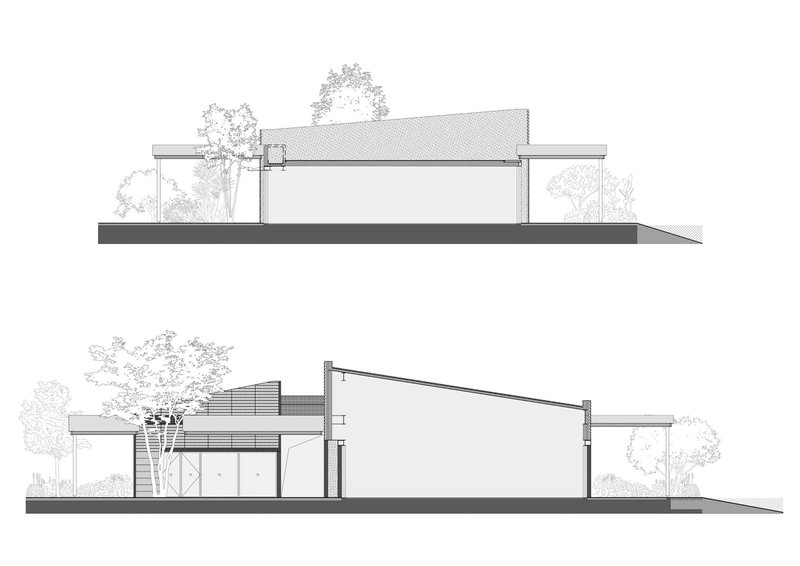
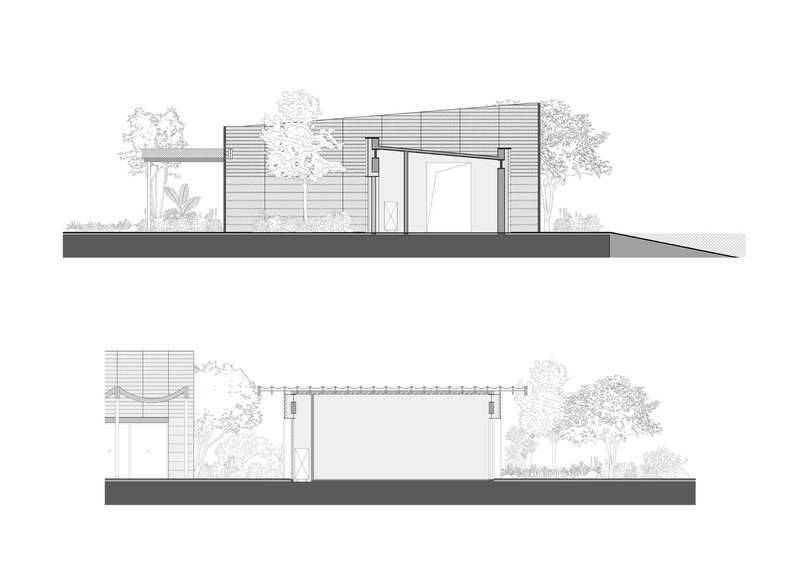
The site plan confirms what the aerial photographs suggest: the pavilions are arranged along a curving waterfront edge, spaced irregularly to create a sequence of courtyards, passages, and openings to the river. The exploded axonometric is particularly revealing, showing how the layered roof forms sit on relatively simple rectangular volumes, with tall trees threading through the gaps. The massing diagrams illustrate a stepped approach to the sloped topography, each pavilion adjusting its floor level to follow the grade rather than flattening it.
The elevations demonstrate the project's commitment to horizontality. Slatted timber facades and large portal openings break down the building mass, and no roofline rises above the surrounding tree canopy. Vegetation is drawn as a co-equal element of the architecture, not background scenery. The drawings make a case that the landscape is doing as much spatial work as the built form.
Why This Project Matters
Sanya's coastline has been developing at breakneck speed, and the default mode is towers, podiums, and manicured resort landscapes that seal themselves off from the ecology they claim to celebrate. Vari Architects' waterfront center proposes a quieter, more porous alternative. By fragmenting the program into a village of small pavilions and letting the roof do the work of climate control, the design creates public space that belongs to its site rather than sitting on top of it. The mangroves, the tides, the coconut palms are not decorative amenities here; they are the organizing logic.
At 2,000 square meters, the project is modest in floor area, but its influence on the shoreline is disproportionately large. It demonstrates that in tropical waterfront contexts, less building can mean more architecture. The undulating canopies, the open courtyards, the blurred thresholds between inside and outside all point toward a model of development that takes climate and landscape as its starting conditions rather than obstacles to overcome. That is an argument worth making, especially in a city where the pressure to build higher and denser shows no sign of easing.
Sanya CR Land Haitang Bay Waterfront Center by Vari Architects, lead architect Feng Pan'ao. Located in Sanya, China. 2,000 m². Completed 2026. Photography by Arch-Exist and Shan-jian images.
About the Studio
Share Your Own Work on uni.xyz
If projects like this are the kind of work you want to make, uni.xyz is a place to publish your own, find collaborators, and enter design competitions.




Popular Articles
Popular articles from the community

IKC de Geluksvogel: Sustainable School Architecture Designed for Free Movement and Digital Learning
IKC de Geluksvogel turns sustainable school architecture into a flexible Maastricht campus for digital learning, nature, and free movement.
Milan Crossover: Sustainable Architecture for a New Fashion Culture in Milan
Milan Crossover transforms fashion culture through sustainable architecture, linking material libraries, remake studios, and public runways.

Eco Chapel: A Green Architecture Pavilion Designed in Symbiosis with the Forest
Eco Chapel uses green architecture to weave prayer, learning and reuse into a forest pavilion shaped by modular hexagonal canopies for life.
Kaffeebühnen: Coffee Shop Architecture Designed as a Civic Stage Between Vienna’s City and Park
Kaffeebühnen turns coffee shop architecture into a civic stage, linking Vienna’s park edge, urban life, warm timber yards, and coffee craft.


Similar Reads
You might also enjoy these articles
Freebird Residence by Alexis Dornier: A Tropical Modernist Sanctuary in Bali
Floating living pavilion above pool anchors H-shaped tropical villa, blending Japanese minimalism, sustainable strategies, lush landscape, and sculptural interiors.
127af Flips a Tiny Bagnolet Rowhouse Upside Down with a Handcrafted Roof Extension
A 55-square-meter terraced house on the edge of Paris gains a luminous upper living floor through lightweight timber and steel.
1.61 Design Workshop Wraps a 600-Square-Meter Café in Vietnam in Sculptural Burgundy Drama
Reden Café & Bistro pairs a helical staircase, mosaic floors, and deep red interiors to rethink Vietnamese hospitality space.

The Unbound Brain: A School Shaped by Cognitive Architecture
Cylindrical learning pods radiate like neurons from a central cortex, turning the floor plan into a spatial model of human thought.






Comments (0)
Please login or sign up to add comments
No comments yet. Be the first to comment!